Convert Recurring Decimals to Fractions
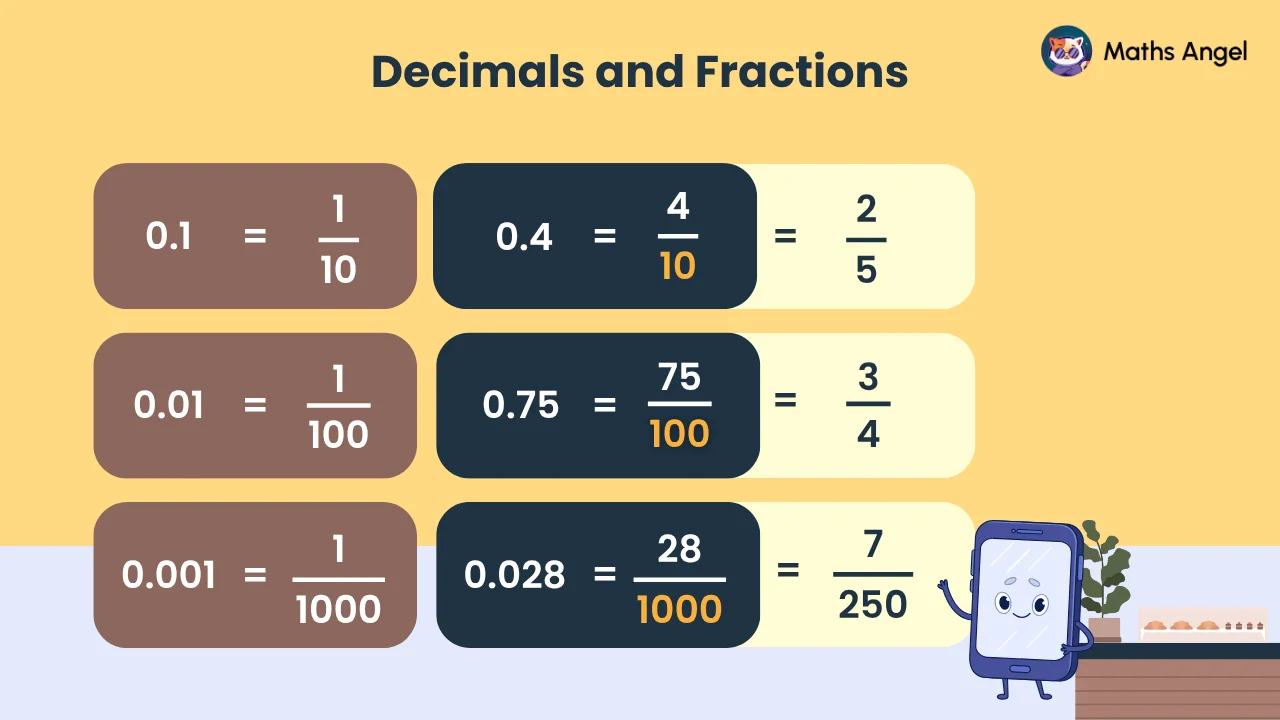
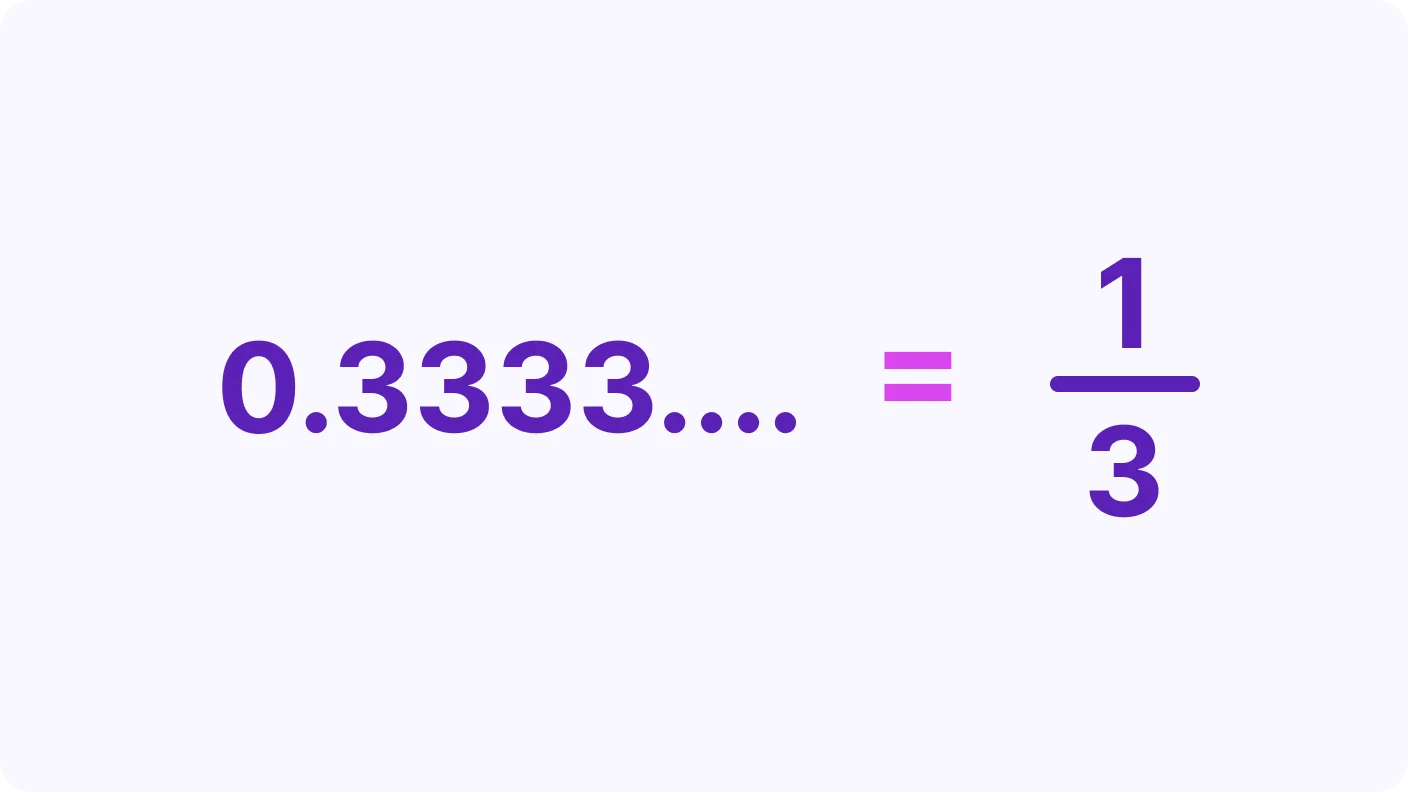
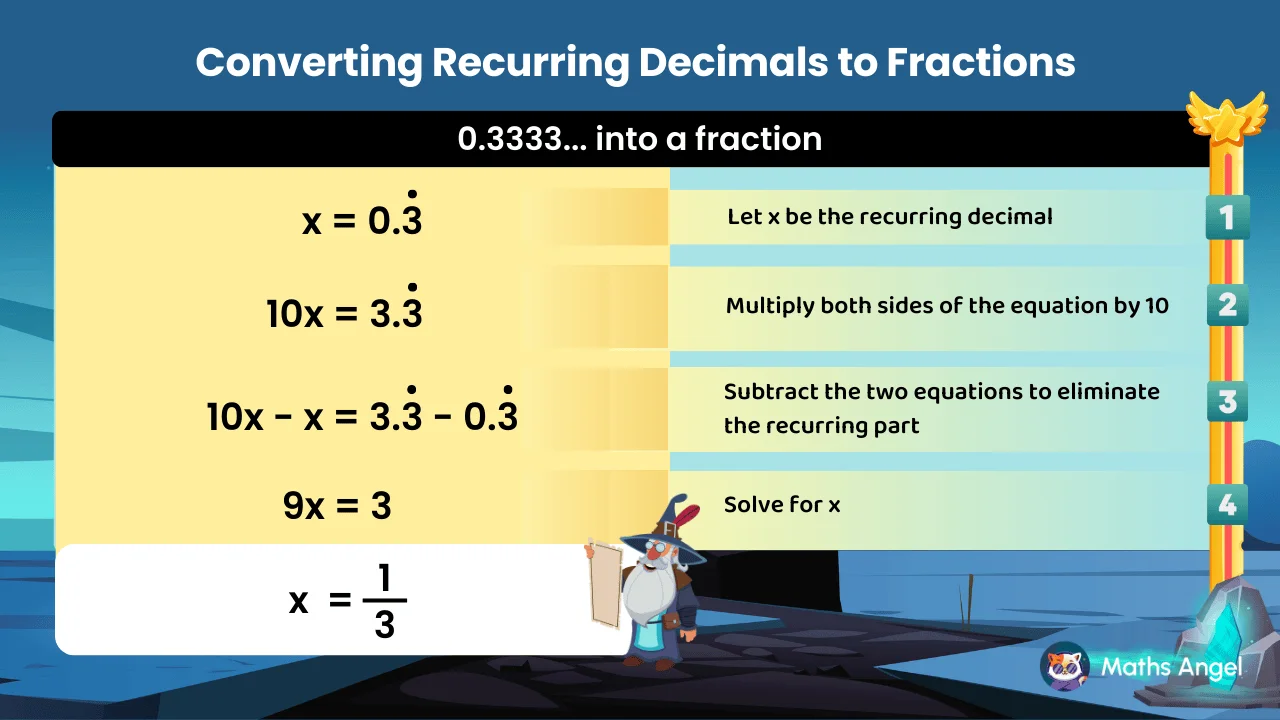
Convert recurring decimals to fractions by letting x equal the decimal, then multiplying by a power of 10 so the repeating digits line up. Subtracting cancels them: if x = 0.333…, then 10x = 3.333…, so 10x − x = 3 and x = 1/3, which is 0.3 recurring as a fraction.
Video Lesson
Watch and learn the basics
🎬 Did this video explain it clearly?
Flashcards
Review key concepts visually
%20Converting%20Recurring%20Decimals%20to%20Fractions%20(Method).webp)
%20Converting%20Recurring%20Decimals%20to%20Fractions%20(Example).webp)
%20Converting%20Recurring%20Decimals%20to%20Fractions%20(Practice).webp)
Converting Recurring Decimals to Fractions
- Let x equal the recurring decimal, for example ….
- Multiply by 10 so the repeating digits line up, then subtract 10x − x.
- Solve , so , meaning 0.333… .
Converting Two Recurring Digits
- Let …, where 45 repeats.
- Multiply by 100 so the repeating digits line up, then subtract 100x − x.
- Solve , so , meaning 0.4545… .
Converting Mixed Recurring Digits
- Let …, where only the 6 repeats.
- Multiply by 10 and 100 so the repeating digit lines up, then subtract 100x − 10x.
- Solve , so , meaning 0.1666… .
Practice Questions
Test your understanding
Convert to a fraction in its simplest form.
Correct! 🎉 +10 pointsCorrect! 🎉 Worth 10 XPNot quite right
Let . One digit repeats, so multiply by 10: .
Subtracting makes the recurring tails cancel exactly: .
So , which is already in its simplest form.
Convert to a fraction in its simplest form.
Correct! 🎉 +10 pointsCorrect! 🎉 Worth 10 XPNot quite right
Let . The repeating block has two digits, so multiply by 100: .
Subtracting gives , so .
Dividing the numerator and denominator by 3 gives .
Convert to a fraction in its simplest form.
Correct! 🎉 +20 pointsCorrect! 🎉 Worth 20 XPNot quite right
Let . The repeating block has two digits, so multiply by 100: .
Subtracting gives , so .
Dividing the numerator and denominator by 9 gives .
Convert to a fraction in its simplest form.
Correct! 🎉 +20 pointsCorrect! 🎉 Worth 20 XPNot quite right
Let . Only the 6 repeats, and there is one digit before it, so use two multiples ten times apart.
and .
Subtracting the first from the second makes the recurring tails cancel: , so .
Convert to a fraction in its simplest form.
Correct! 🎉 +20 pointsCorrect! 🎉 Worth 20 XPNot quite right
Let . The repeating block has three digits, so multiply by 1000: .
Subtracting gives , so .
Dividing the numerator and denominator by 3 gives .
Convert to a fraction in its simplest form.
Correct! 🎉 +30 pointsCorrect! 🎉 Worth 30 XPNot quite right
Let . Only the 7 repeats, with one digit before it, so use two multiples ten times apart.
and .
Subtracting the first from the second makes the recurring tails cancel: , so .
Want to see the full working?
Interactive Activity
Learn how to convert recurring decimals into fractions
Loading interactive widget...
Frequently asked questions
The questions students bump into most on this topic
Let x equal the decimal, multiply so the repeating digits line up, subtract, then solve. For 0.333…: let x = 0.333…, so 10x = 3.333…. Subtracting, 10x − x = 3.333… − 0.333…, so 9x = 3 and x = 3/9 = 1/3. The subtraction removes the never-ending tail, leaving whole numbers.
To shift the digits so the repeating parts line up: 10 when one digit repeats, 100 when two do. For 0.4545…, the repeating part is 45, two digits, so let x = 0.4545… and 100x = 45.4545…. The two tails are identical, so subtracting cancels them exactly: 99x = 45, and x = 45/99 = 5/11.
Make more equations and subtract the pair whose tails match. For 0.1666…: let x = 0.1666…, so 10x = 1.666… and 100x = 16.666…. Then 100x − 10x = 15, so 90x = 15 and x = 1/6. For 0.4777…, 100x − 10x = 47.777… − 4.777… = 43, so 90x = 43 and x = 43/90.
7/9. Let x = 0.777…, so 10x = 7.777…; subtracting gives 9x = 7, so x = 7/9. Any single repeating digit works the same way and ends up over 9: 0.555… = 5/9, and 0.333… = 3/9 = 1/3. Americans say “repeating decimal”; it means the same as recurring.
Yes, every one. Whatever digits repeat, set the decimal equal to x, multiply by 10, 100 or 1,000 to line up the repeating part, subtract to remove it, and solve. That working is also the proof an exam asks for when it says “prove that 0.4545… = 5/11”. A decimal that never repeats, like pi, cannot be written as a fraction.
What's next?
Found this one hard? Go one step back first. Feeling confident? Carry on to the next lesson.