Powers and Indices
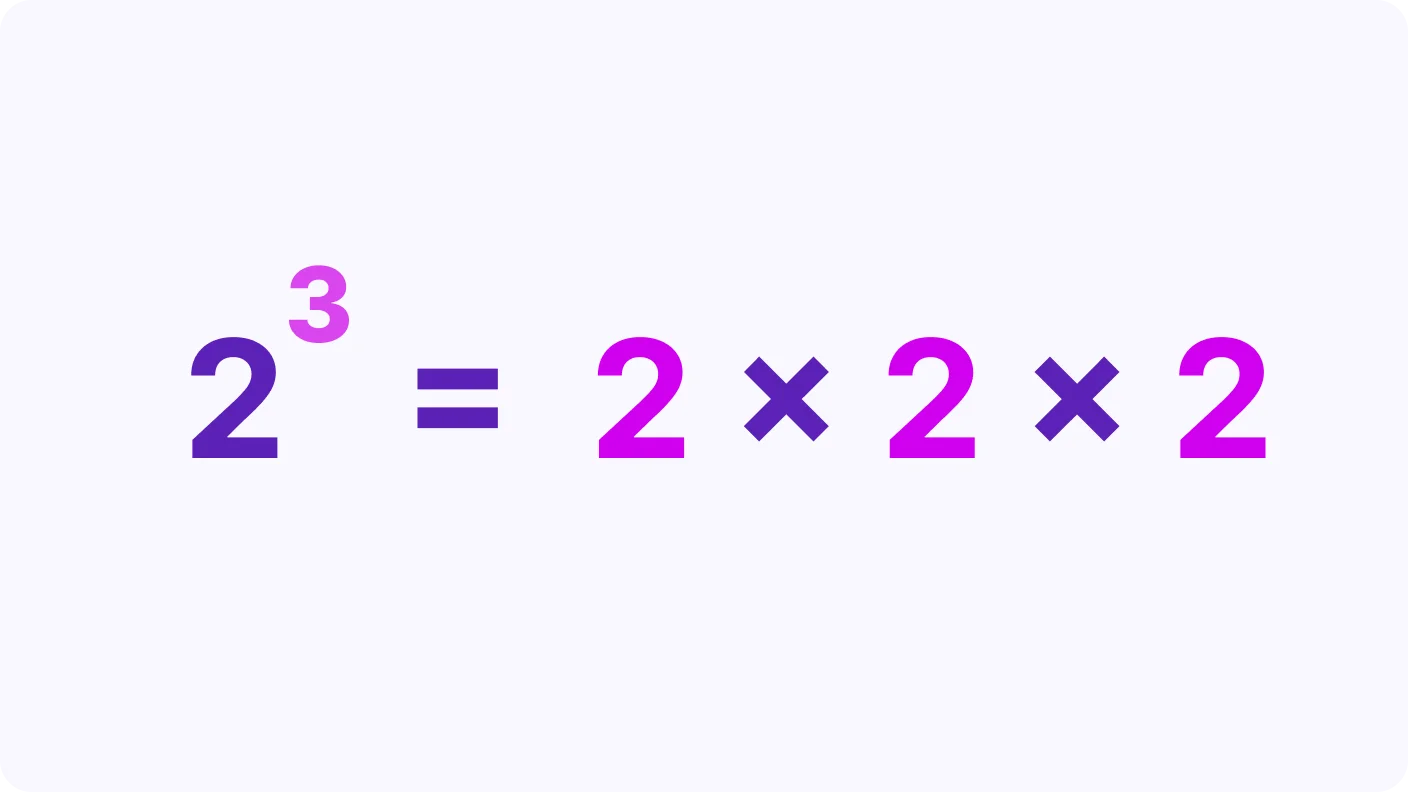
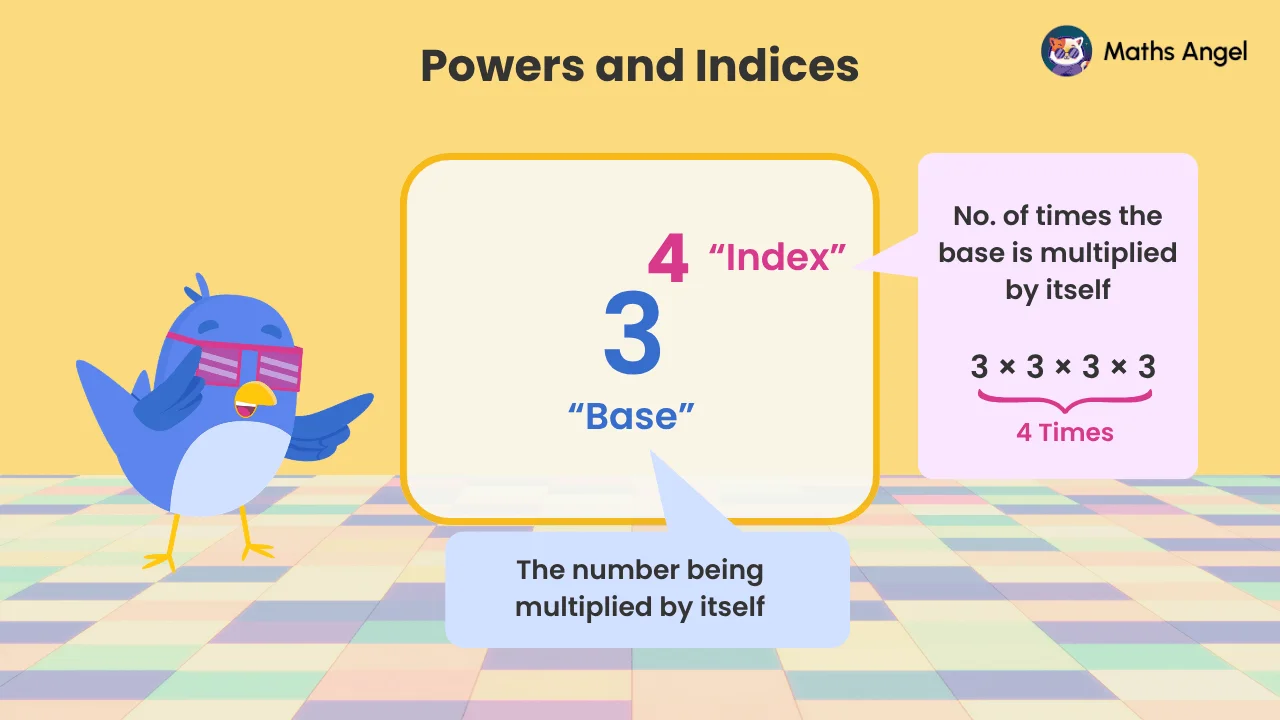
Powers and indices are a short way to write repeated multiplication, so 2³ = 2 × 2 × 2 = 8 makes 8 a cube number. Each power has a base and an exponent showing how many times it is multiplied.
Video Lesson
Watch and learn the basics
🎬 Did this video explain it clearly?
Flashcards
Review key concepts visually
%20Introduction%20to%20Powers%20(indices).webp)
%20Notation%20of%20Powers.webp)
%20Properties%20of%20Powers.webp)
%20Common%20Powers%20(Indices).webp)
%20Simplifying%20Expressions%20with%20Powers.webp)
%20Calculating%20Expressions%20with%20Indices.webp)
What are Powers?
- Powers show repeated multiplication of the same number.
- For example, 3⁴ means 3 × 3 × 3 × 3.
How to Read Powers
- The base is the number being multiplied.
- The power (small number at the top right) shows how many times it is multiplied.
Important Properties of Powers
- Any number to the power of 1 equals itself (e.g. 5¹ ).
- Any number (except 0) to the power of 0 equals 1 (e.g. 5⁰ ).
Common Powers: Squares and Cubes
- Square numbers have power 2 (e.g. .
- Cube numbers have power 3 (e.g. .
Simplifying Expressions with Powers
- First, group the same numbers together in multiplication.
- Then, write repeated multiplication using powers.
Calculating with Powers
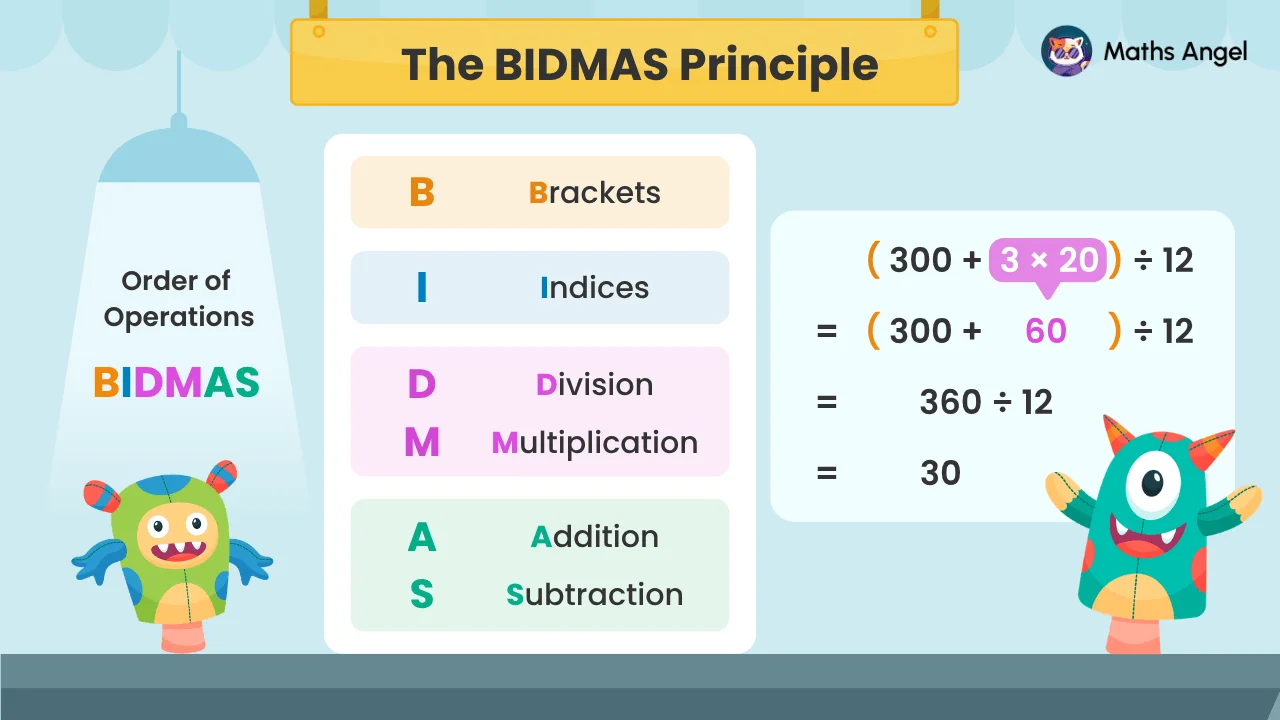
- Following BIDMAS, work out powers before multiplication.
- But if there are brackets, calculate inside the brackets first.
Practice Questions
Test your understanding
What is the value of ?
Correct! 🎉 +10 pointsCorrect! 🎉 Worth 10 XPNot quite right
Any non-zero number raised to the power 0 equals 1, so .
You can see why from the pattern , , : each step down divides by 10, so the next step gives .
What is the value of ?
Correct! 🎉 +10 pointsCorrect! 🎉 Worth 10 XPNot quite right
The index 1 tells you there is just one factor of the base, so .
Any number raised to the power 1 is simply itself.
Evaluate 3 × 4².
Correct! 🎉 +20 pointsCorrect! 🎉 Worth 20 XPNot quite right
Work out the power before the multiplication: . Then multiply: .
Remember that 4² is not 4 × 2, and that the index applies only to the 4, so this is not (3 × 4)².
Calculate 5 × 10².
Correct! 🎉 +20 pointsCorrect! 🎉 Worth 20 XPNot quite right
Work out the power first: . Then multiply: .
Only the 10 is squared, so this is not (5 × 10)², and 10² is not 10 × 2.
Evaluate (6²) + (2⁴).
Correct! 🎉 +20 pointsCorrect! 🎉 Worth 20 XPNot quite right
Work out each power first. , and 2⁴ .
Then add the two results: .
Simplify (10³) − (6 × 5²).
Correct! 🎉 +30 pointsCorrect! 🎉 Worth 30 XPNot quite right
Work out the powers first: and .
Next do the multiplication inside the second bracket: . Finally subtract: .
Want to see the full working?
Interactive Activity
Practice grouping factors to create exponent expressions
Frequently asked questions
The questions students bump into most on this topic
Indices are a short way to write repeated multiplication. A power has two parts: the base, the number being multiplied, and the index, the small raised number that says how many times to use it. So 3⁴ means 3 × 3 × 3 × 3, read “3 to the power of 4”. The base and the index cannot be swapped: 4³ is a different number.
Nearly. A power is the whole expression, such as 3⁴, made of a base and an index. The index is just the small raised number, so it is one part of a power rather than another word for it. In American English the index is called the exponent; indices, exponents and powers all describe the same idea.
A square number is a whole number multiplied by itself, a number to the power of 2: 1, 4, 9, 16, 25, 36, 49, 64, 81 and 100 are the square numbers up to 100. So 7 and 20 are not square numbers, because no whole number squared gives them. Cube numbers use the power of 3: 1, 8, 27, 64 and so on.
A cube number is a whole number multiplied by itself twice, a number to the power of 3: 2³ = 2 × 2 × 2 = 8, so 1, 8, 27, 64 and 125 are the first five cube numbers. Square numbers use the power of 2 instead: 1, 4, 9, 16, 25.
Any number except 0 raised to the power of 0 equals 1, so 10⁰ = 1 and 5⁰ = 1. It is worth remembering alongside the other special rule: any number to the power of 1 equals itself, so 9¹ = 9. The one exception is 0⁰, which is undefined.
Follow BIDMAS: work out brackets first, then indices, then multiplication. In (2 × 5)², the brackets give 10, and 10² = 100. In 2 × 5², there are no brackets, so square first: 5² = 25, then 2 × 25 = 50. The two answers are completely different, so the order matters.
Build squares with counters: 2 rows of 2 make 4, 3 rows of 3 make 9, 4 rows of 4 make 16. Each is a square shape, which is why they are called square numbers, and the maths is 2 × 2, 3 × 3, 4 × 4. Then show the short way to write it: 4².
What's next?
Found this one hard? Go one step back first. Feeling confident? Carry on to the next lesson.