Standard Form
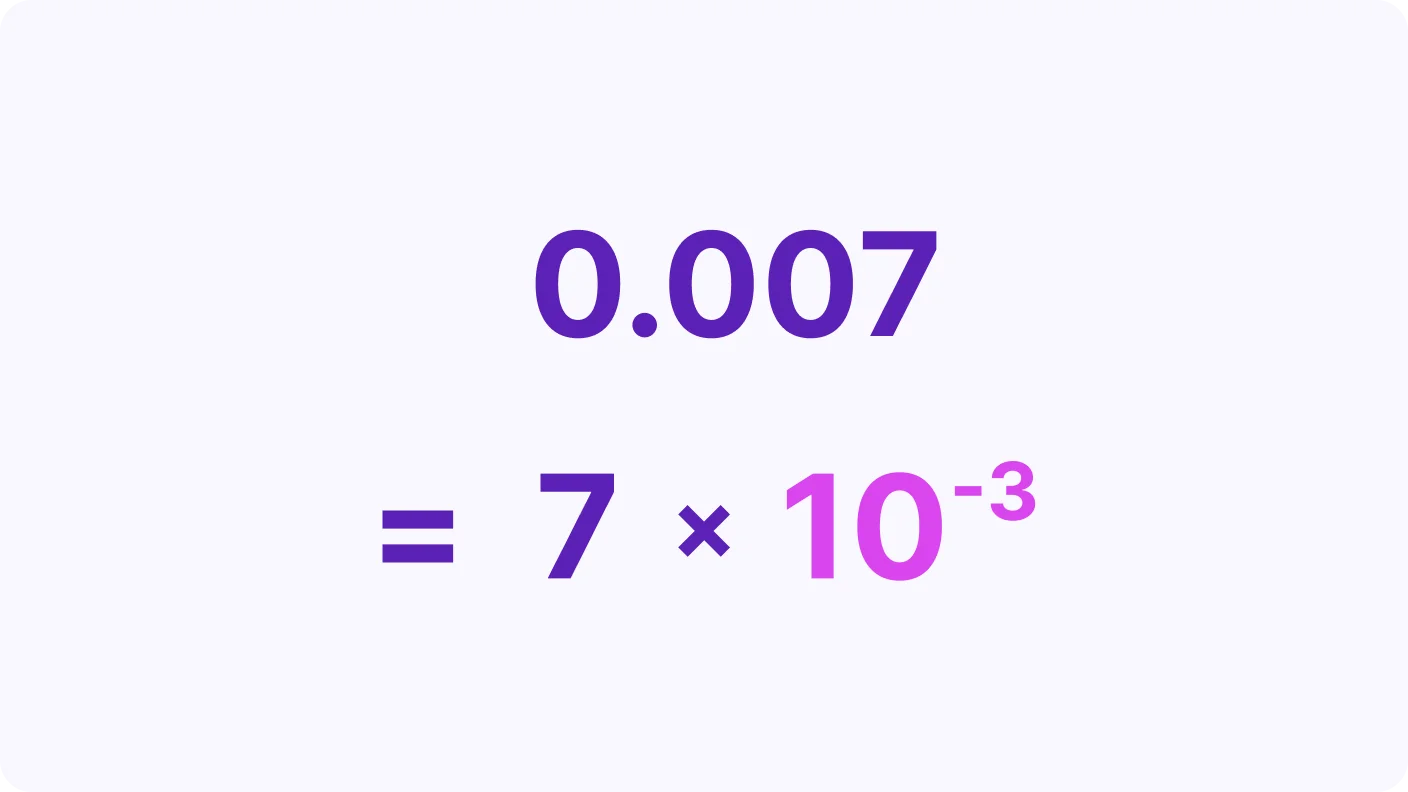
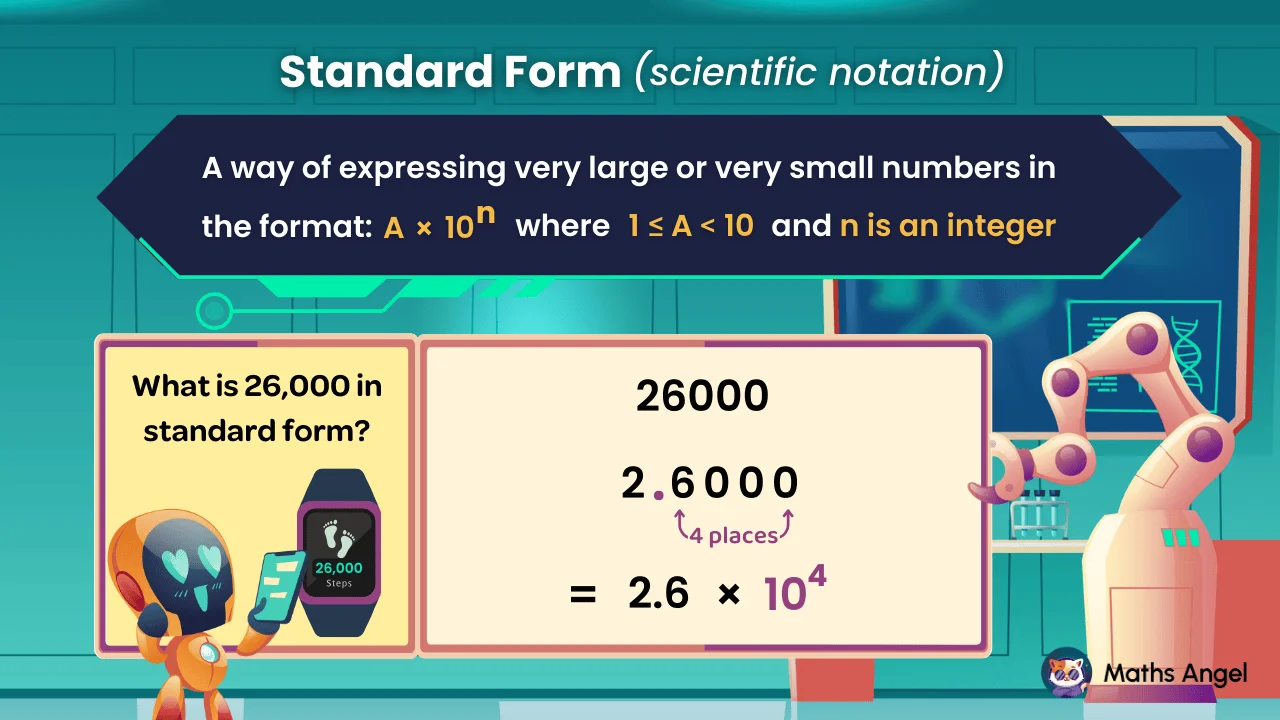
Standard form (or scientific notation) writes very large or very small numbers as A × 10ⁿ, where A is between 1 and 10. The power n counts how many places the decimal point moves. So 0.007 becomes 7 × 10⁻³, a negative power.
Video Lesson
Watch and learn the basics
🎬 Did this video explain it clearly?
Flashcards
Review key concepts visually
%20Standard%20Form.webp)
%200.007%20to%20standard%20form.webp)
%20384000%20to%20standard%20form.webp)
%20Calculating%20with%20Standard%20Form%20Example%201.webp)
%20Calculating%20with%20Standard%20Form%20Example%202.webp)
What Is Standard Form (Scientific Notation)?
- A way to write very large or very small numbers so they are easier to work with.
- It always looks like A × 10ⁿ, where A is between 1 and 10
How to Rewrite a Number into Standard Form?
- Move the decimal point so the number at the front is between 1 and 10.
- The number of places you move tells you the power of 10.
How the Power of 10 Works?
- Decimal moved left → positive power (e.g. 384000 → 3.84 × 10⁵)
- Decimal moved right → negative power (e.g. 0.007 → 7 × 10⁻³)
How to Multiply in Standard Form?
- Multiply the front numbers as normal.
- Add the powers of 10: 10⁷ × 10⁻¹⁻⁵
How Do We Check a Standard Form Answer?
- The front number must be between 1 and 10.
- If not, move the decimal and adjust the power (e.g. 12 × 10³ → 1.2 × 10⁴)
Practice Questions
Test your understanding
What is 25000 in standard form?
Correct! 🎉 +10 pointsCorrect! 🎉 Worth 10 XPNot quite right
Standard form is a number between 1 and 10 multiplied by a power of 10.
Move the decimal point in 25000 four places to the left to get 2.5, which is between 1 and 10. The point moved 4 places to the left, so multiply by 10⁴, giving 2.5 × 10⁴.
Count the places the decimal point moves, not the number of zeros, and always check the first number is between 1 and 10.
Simplify (2 × 10⁶) × (3 × 10⁻⁴). Give your answer in standard form.
Correct! 🎉 +10 pointsCorrect! 🎉 Worth 10 XPNot quite right
Multiply the front numbers: .
Add the indices of the powers of 10: 10⁶ × 10⁻⁴ ⁶⁺⁽⁻⁴⁾ .
So the answer is 6 × 10², which is already in standard form because 6 is between 1 and 10. .)
What is 0.0045 in standard form?
Correct! 🎉 +20 pointsCorrect! 🎉 Worth 20 XPNot quite right
Standard form is a number between 1 and 10 multiplied by a power of 10.
Move the decimal point in 0.0045 three places to the right to get 4.5, which is between 1 and 10. Moving the point to the right means the power is negative, so ⁻³.
The index is negative because the number is smaller than 1, not because the number itself is negative.
Write (5 × 10³) × (4 × 10⁻⁷) in standard form.
Correct! 🎉 +20 pointsCorrect! 🎉 Worth 20 XPNot quite right
Multiply the front numbers: .
Add the indices: 10³ × 10⁻⁷ ⁺⁽⁻⁷⁾ ⁻⁴. That gives 20 × 10⁻⁴.
20 is not between 1 and 10, so rewrite it as 2 × 10¹: 20 × 10⁻⁴ ¹ × 10⁻⁴ ⁻³ (which is 0.002). When you make the front number 10 times smaller, the power must go up by 1.
What is 670000 in standard form?
Correct! 🎉 +20 pointsCorrect! 🎉 Worth 20 XPNot quite right
Standard form is a number between 1 and 10 multiplied by a power of 10.
Move the decimal point in 670000 five places to the left to get 6.7, which is between 1 and 10. The point moved 5 places, so multiply by 10⁵, giving 6.7 × 10⁵.
Count the places the decimal point moves, not the zeros and not the digits.
Write (8.2 × 10⁶) × (2.5 × 10⁻⁴) in standard form.
Correct! 🎉 +30 pointsCorrect! 🎉 Worth 30 XPNot quite right
Multiply the front numbers: .
Add the indices: 10⁶ × 10⁻⁴ ⁶⁺⁽⁻⁴⁾ . That gives 20.5 × 10².
20.5 is not between 1 and 10, so rewrite it as 2.05 × 10¹: ¹ which is 2050). Making the front number 10 times smaller means the power goes up by 1.
Want to see the full working?
Interactive Activity
Standard form (scientific notation)
Loading interactive widget...
Frequently asked questions
The questions students bump into most on this topic
Standard form writes a very large or very small number as A × 10ⁿ, where A is at least 1 and less than 10 and n is a whole number. So 384,000 is 3.84 × 10⁵ and 0.007 is 7 × 10⁻³. It keeps long strings of zeros out of calculations. In the US and on calculators it is called scientific notation.
Move the decimal point until you have a number between 1 and 10, then count the places you moved: that count is the power of 10. For 26,000, the point moves 4 places to the left to give 2.6, so 26,000 = 2.6 × 10⁴. In the same way 4,200 = 4.2 × 10³ and 543,000 = 5.43 × 10⁵.
Move the decimal point to the right until the number is between 1 and 10, and make the power negative. For 0.007 the point moves 3 places right to give 7, and each move made the number ten times bigger, so you balance it with 10⁻³: 0.007 = 7 × 10⁻³. In the same way, 0.000263 = 2.63 × 10⁻⁴. A negative power always means a number below 1.
Multiply the front numbers, then add the powers of 10. For 2 × 10⁷ times 8 × 10⁻¹²: 2 × 8 = 16 and 10⁷ × 10⁻¹² = 10⁻⁵, giving 16 × 10⁻⁵. But 16 is not between 1 and 10, so write it as 1.6 × 10¹ and add the powers again: 1.6 × 10⁻⁴. Forgetting that last step is the common mistake.
Divide the front numbers, then subtract the powers of 10. For 8 × 10⁷ divided by 2 × 10³: 8 ÷ 2 = 4 and 10⁷ ÷ 10³ = 10⁴, so the answer is 4 × 10⁴. If the front number ends up outside 1 to 10, adjust it as you would after multiplying: 2 × 10⁵ divided by 8 × 10² gives 0.25 × 10³, which is 2.5 × 10².
Write both numbers out in full, add or subtract as normal, then put the answer back into standard form. For 3 × 10⁴ + 5 × 10³: 30,000 + 5,000 = 35,000, which is 3.5 × 10⁴. You cannot add the powers, because adding is not multiplying; the powers only combine when they are the same.
What's next?
Found this one hard? Go one step back first. Feeling confident? Carry on to the next lesson.