Basics of Square Roots
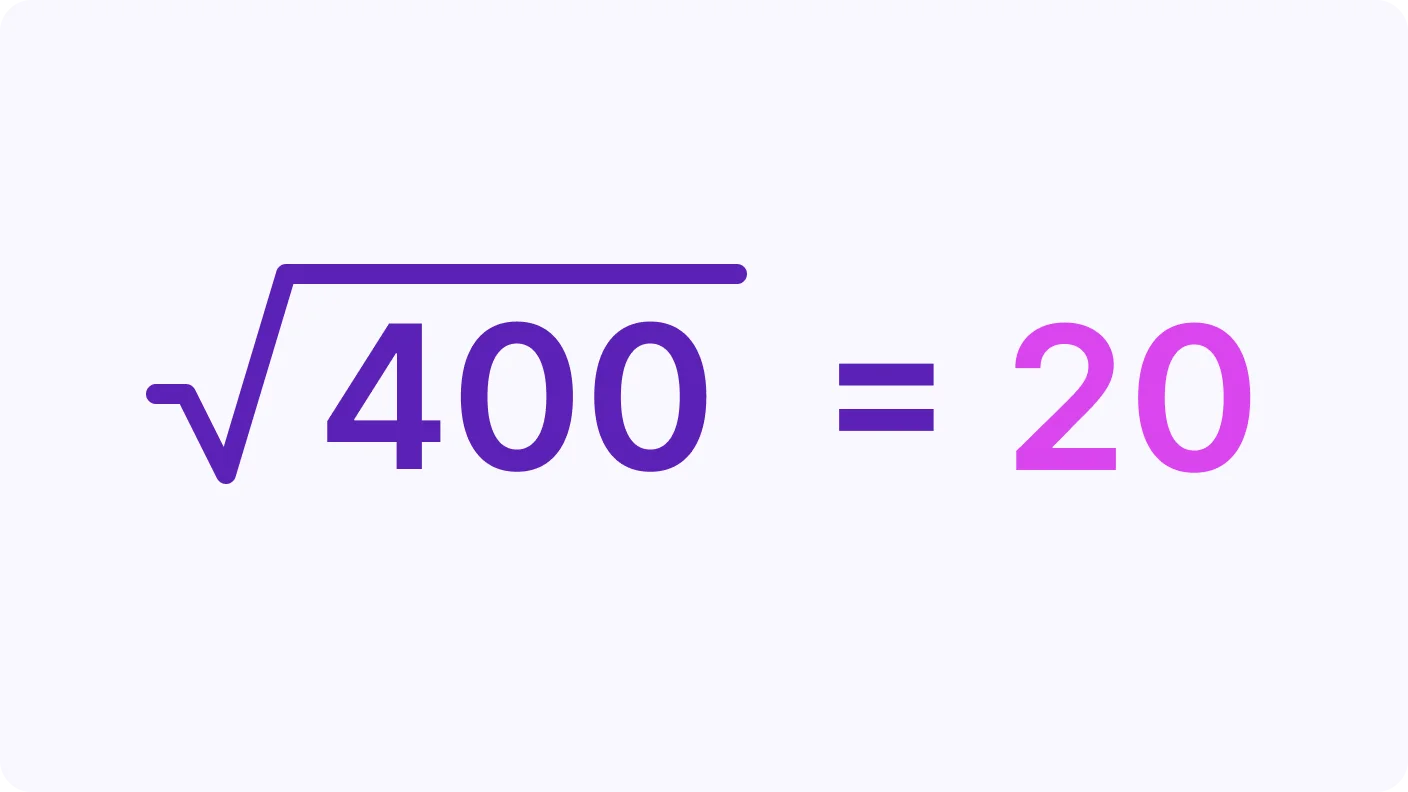
A square root of a number is the non-negative value you multiply by itself to get that number. For example, √400 = 20 because 20 × 20 = 400. Whole numbers like 1, 4, 9 and 16 are perfect squares.
Video Lesson
Watch and learn the basics
🎬 Did this video explain it clearly?
Flashcards
Review key concepts visually
%20What%20is%20a%20Square%20Roots.webp)
%20Square%20Roots%20Definition%20%26%20Properties.webp)
%20Practicing%20Square%20Roots.webp)
%20List%20of%20Common%20Square%20Roots.webp)
What Is a Square Root?
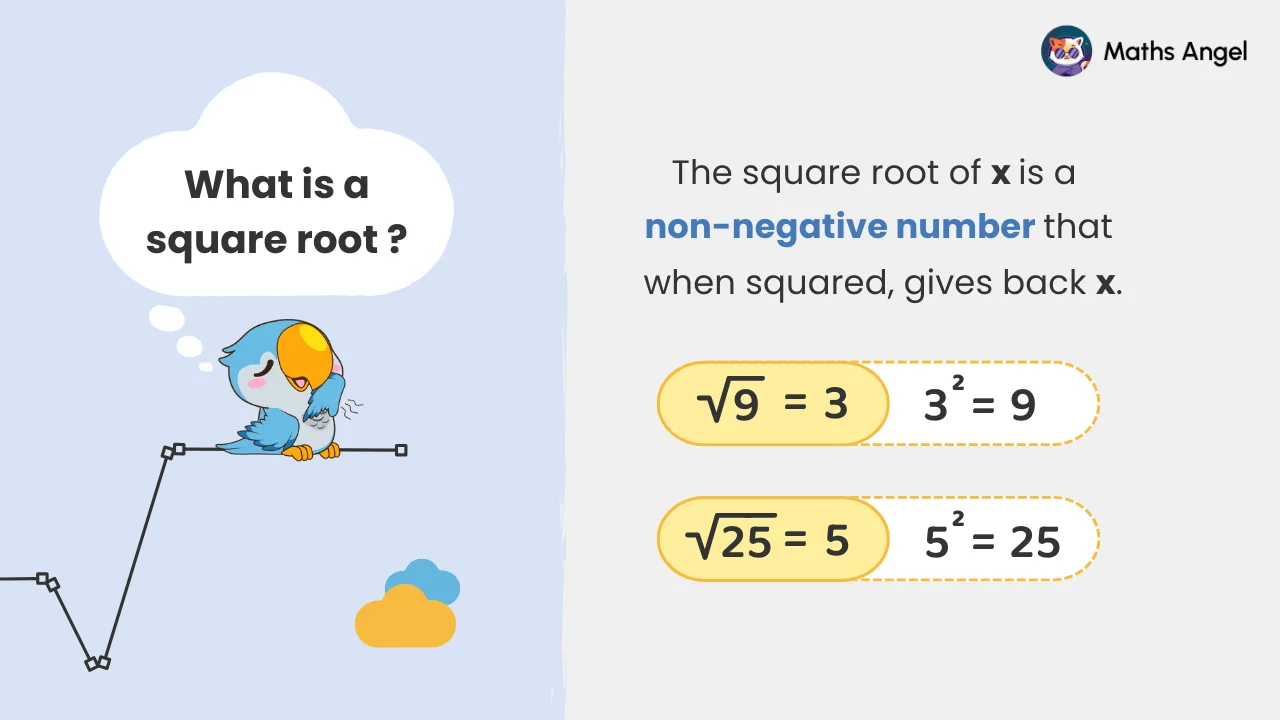
- A square root of a number is a non-negative number that multiplies by itself to give the original number.
- For example, √ because .
Important Rules About Square Roots
- Square roots are non-negative, so .
- Negative numbers do not have square roots because no number squared is negative.
Practising Square Roots
- √, √, and √.
- Always check by squaring your answer to see if you get the original number.
Perfect Squares to Remember
- Perfect squares are numbers made by squaring whole numbers like 1, 4, 9, 16, 25.
- Knowing these helps you find square roots quickly in exams.
Practice Questions
Test your understanding
What is √9?
Correct! 🎉 +10 pointsCorrect! 🎉 Worth 10 XPNot quite right
√ because .
The √ sign means the positive (principal) root only. It is true that as well, but √9 on its own always means the non-negative value, so the answer is 3 and not −3 or 'both'.
What is √25?
Correct! 🎉 +10 pointsCorrect! 🎉 Worth 10 XPNot quite right
√ because .
The √ sign means the positive (principal) root only. Although as well, √25 on its own is always the non-negative value, so the answer is 5.
What is √0?
Correct! 🎉 +20 pointsCorrect! 🎉 Worth 20 XPNot quite right
√ because .
Zero is not a negative number, so the rule that stops us square-rooting negatives does not apply. √0 is perfectly well defined. It is not 1 either: , not 0.
What is √−25?
Correct! 🎉 +20 pointsCorrect! 🎉 Worth 20 XPNot quite right
√−25 has no value in the real number system.
Multiplying any real number by itself gives a positive answer or zero: and as well, never −25. So no real number squares to give −25 and the square root is undefined.
What is √81?
Correct! 🎉 +20 pointsCorrect! 🎉 Worth 20 XPNot quite right
√ because .
The √ sign means the positive (principal) root, so even though as well, the answer is 9. It helps to know the square numbers: and .
What is √144?
Correct! 🎉 +30 pointsCorrect! 🎉 Worth 30 XPNot quite right
√ because .
The √ sign means the positive (principal) root, so even though as well, the answer is 12. Knowing the square numbers helps here: , and .
Want to see the full working?
Interactive Activity
Explore square roots visually
Loading interactive widget...
Frequently asked questions
The questions students bump into most on this topic
Squaring a number means multiplying it by itself; finding the square root is the reverse. The square root of a number is the non-negative number that, when squared, gives it back: the square root of 9 is 3 because 3 × 3 = 9, and the square root of 25 is 5. It is written with the tick-like sign, √, called the radical sign.
Ask which non-negative number, multiplied by itself, gives the number. For √400, 20 × 20 = 400, so the answer is 20; for √144 it is 12. Knowing the perfect squares makes this instant. If the number is not a perfect square, such as 2 or 8, the square root is not a whole number and you use a calculator or leave it as √2.
8, because 8 × 8 = 64. The other square roots people look up are all perfect squares too: √4 = 2, √16 = 4, √25 = 5, √36 = 6, √49 = 7, √81 = 9 and √100 = 10. Check any of them by squaring the answer: 7 × 7 = 49.
Because a square root is defined as the non-negative answer. It is true that (−3) × (−3) also equals 9, but the radical sign always means the non-negative root, so √9 = 3. Whenever you see the tick-like sign, think of a number that is zero or positive, never a negative one.
No. Every squared number is zero or positive, because a positive times a positive and a negative times a negative are both positive, so no number squared gives −25. The square root of a negative number does not exist among the real numbers. Zero is fine: √0 = 0, because 0 × 0 = 0.
The perfect squares are the numbers you get by squaring whole numbers: 1, 4, 9, 16, 25, 36, 49, 64, 81, 100, 121, 144, 169, 196 and 225 are 1² to 15². Knowing them turns most square root questions into instant recall: when you see 144 you know it is 12², which matters in non-calculator exams.
What's next?
Found this one hard? Go one step back first. Feeling confident? Carry on to the next lesson.