Multiplying and Dividing Square Roots
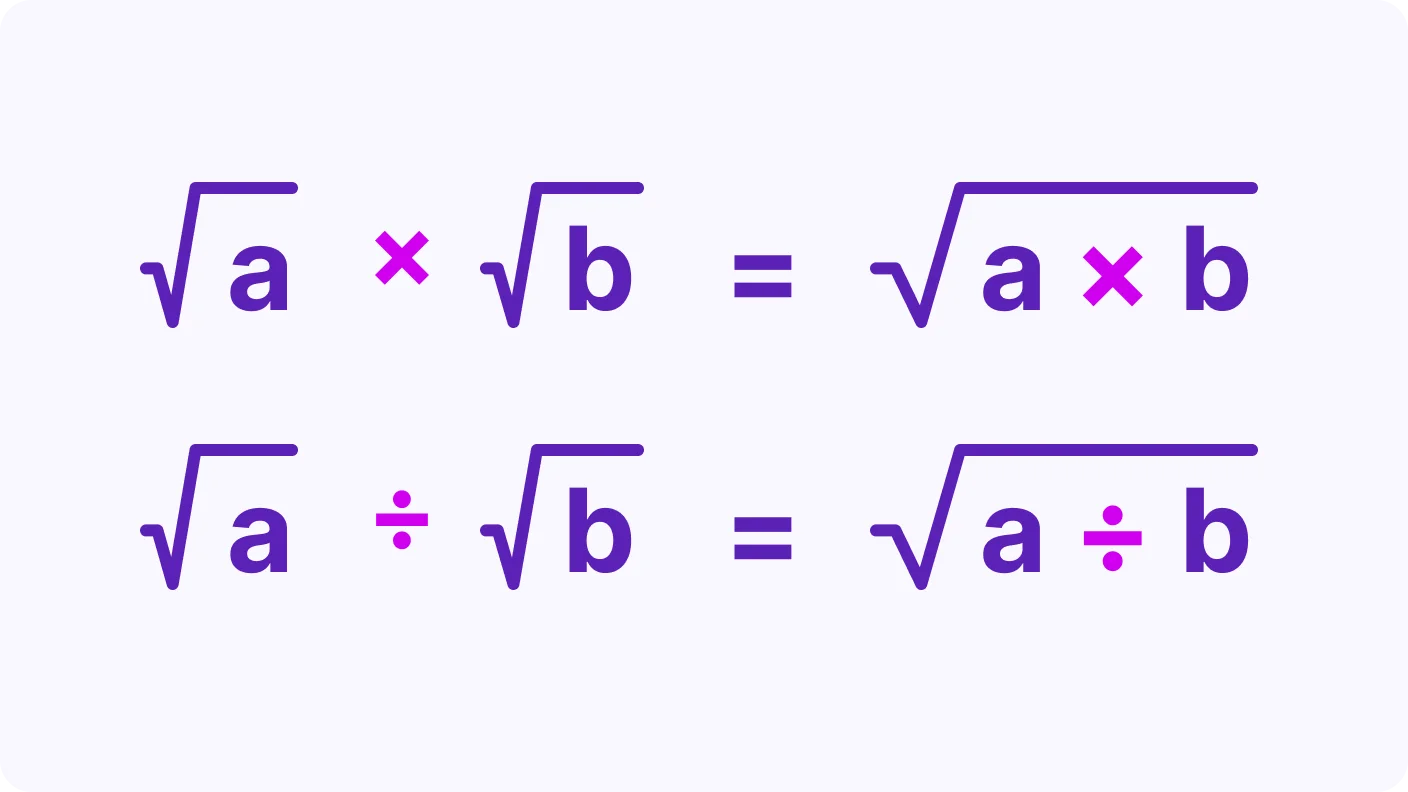
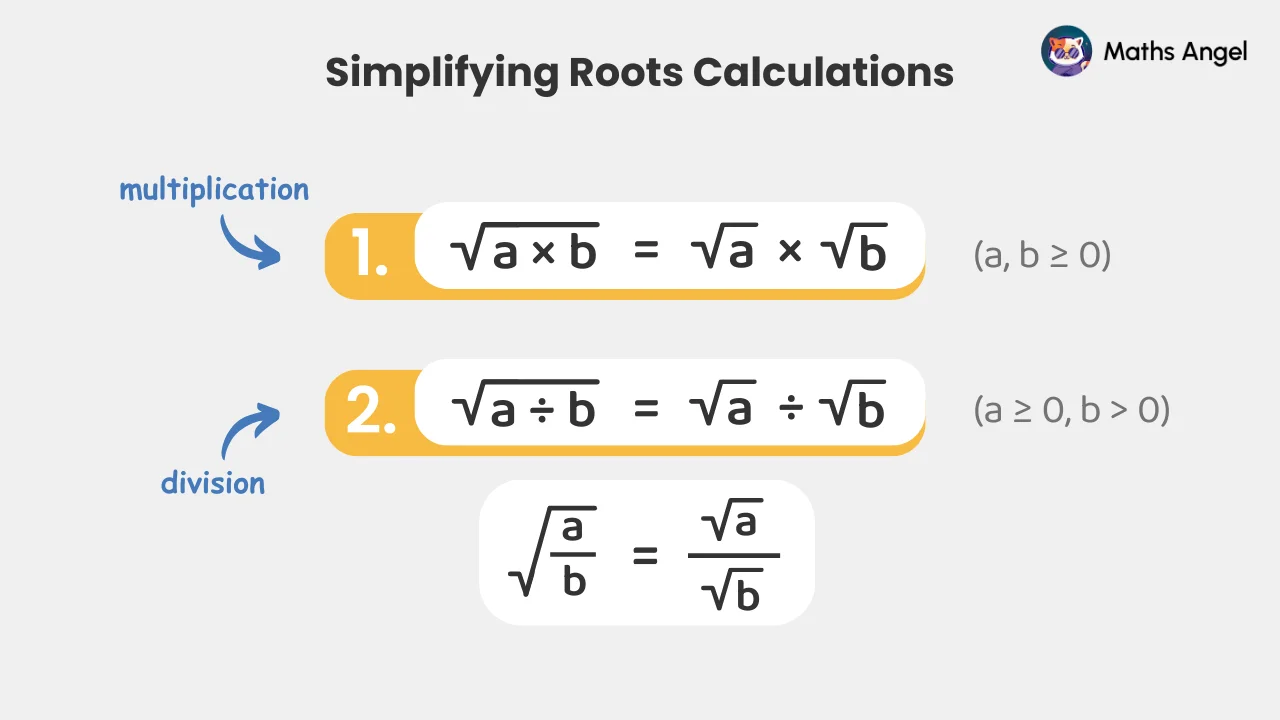
Multiplying square roots, or surds, uses √a × √b = √(ab), so you multiply the numbers under one root sign. Dividing square roots works the same way using √a ÷ √b = √(a/b). Both rules let you simplify square roots in a calculation.
Video Lesson
Watch and learn the basics
🎬 Did this video explain it clearly?
Flashcards
Review key concepts visually
%20Multiplying%20and%20Dividing%20Roots.webp)
%20Example%20Multiplication.webp)
%20Example%20Division.webp)
Square Root Rules: Multiply and Divide
- To multiply square roots, .
- To divide square roots, .
Multiplying Square Roots
- Example 1: .
- Example 2: .
Dividing Square Roots
- Example 1: .
- Example 2: .
Practice Questions
Test your understanding
Simplify .
Correct! 🎉 +10 pointsCorrect! 🎉 Worth 10 XPNot quite right
Look for the largest square number that divides 50. That is 25, because .
Using the multiplication rule :
.
The 25 must itself be square-rooted to give 5, and that 5 stays outside the root while the 2 stays inside, so the answer is . Both parts must be kept: the cannot be dropped, and the 5 cannot be pushed back inside the root.
Simplify .
Correct! 🎉 +10 pointsCorrect! 🎉 Worth 10 XPNot quite right
Look for the largest square number that divides 72. That is 36, because .
Using :
.
So the answer is . Check it: squared is . Note that a square root is not half the number, the 6 must stay outside the root, and the must not be dropped.
Simplify .
Correct! 🎉 +20 pointsCorrect! 🎉 Worth 20 XPNot quite right
Use the division rule for square roots: .
So .
Two things matter here: divide the right way round (50 by 2, not 2 by 50), and remember to take the square root at the end rather than stopping at 25.
You can check it the other way: , and .
Simplify .
Correct! 🎉 +20 pointsCorrect! 🎉 Worth 20 XPNot quite right
Use the division rule for square roots: .
So .
You can also work each root out separately: and , and , the same answer.
Take care to divide 36 by 9 (not 9 by 36) and to take the square root of 4 at the end.
Simplify , giving your answer as a fraction in its simplest form.
Correct! 🎉 +20 pointsCorrect! 🎉 Worth 20 XPNot quite right
The root of a fraction applies to the top and the bottom: .
So .
Both numbers must be rooted. Rooting only one of them leaves the fraction wrong. As a check, , and is already in its simplest form.
What is ? Give your answer in its simplest surd form.
Correct! 🎉 +30 pointsCorrect! 🎉 Worth 30 XPNot quite right
Use the multiplication rule :
.
Take care with the decimal: multiplying by 100 moves the digits two places, so , not 630.
Now simplify . The largest square factor of 63 is 9, since , so . The must be worked out as 3, and that 3 stays outside the root.
Want to see the full working?
Interactive Activity
Practice multiplying and dividing square roots
Loading interactive widget...
Frequently asked questions
The questions students bump into most on this topic
A surd is a square root that is not a whole number, left in root form because that is exact: √2, √3 and √5 are surds, but √9 is not, because it is 3. 5√2 means 5 × √2. GCSE papers say “leave your answer as a surd” when they want the exact value rather than a rounded decimal.
Multiply the numbers under one root sign: √a × √b = √(ab). So √2 × √3 = √6, and √4.8 × √10 = √48. Then simplify if a perfect square hides inside: 48 = 16 × 3, so √48 = √16 × √3 = 4√3. The rule works both ways, so you can also split one root into two.
Find the biggest perfect square that divides the number, split the root, and take the square root of the perfect square. √18 = √(9 × 2) = √9 × √2 = 3√2. In the same way √8 = √4 × √2 = 2√2, so yes, 2√2 and √8 are the same number, and √50 = √25 × √2 = 5√2.
Divide the numbers under one root sign: √a ÷ √b = √(a ÷ b), as long as b is not zero. Used left to right, √(36 ÷ 25) = √36 ÷ √25 = 6 ÷ 5 = 1.2. Used right to left, √50 ÷ √2 = √(50 ÷ 2) = √25 = 5. It works the same way for fractions as for divisions.
Yes. Left to right splits one root into two, which is how you simplify: √18 becomes √9 × √2. Right to left combines two roots into one, which is how you tidy a division: √50 ÷ √2 becomes √25. Both rules work for fractions as well as divisions, with one limit: the number you divide by can never be zero.
What's next?
Found this one hard? Go one step back first. Feeling confident? Carry on to the next lesson.