Laws of Indices (Same Base, Same Indices)
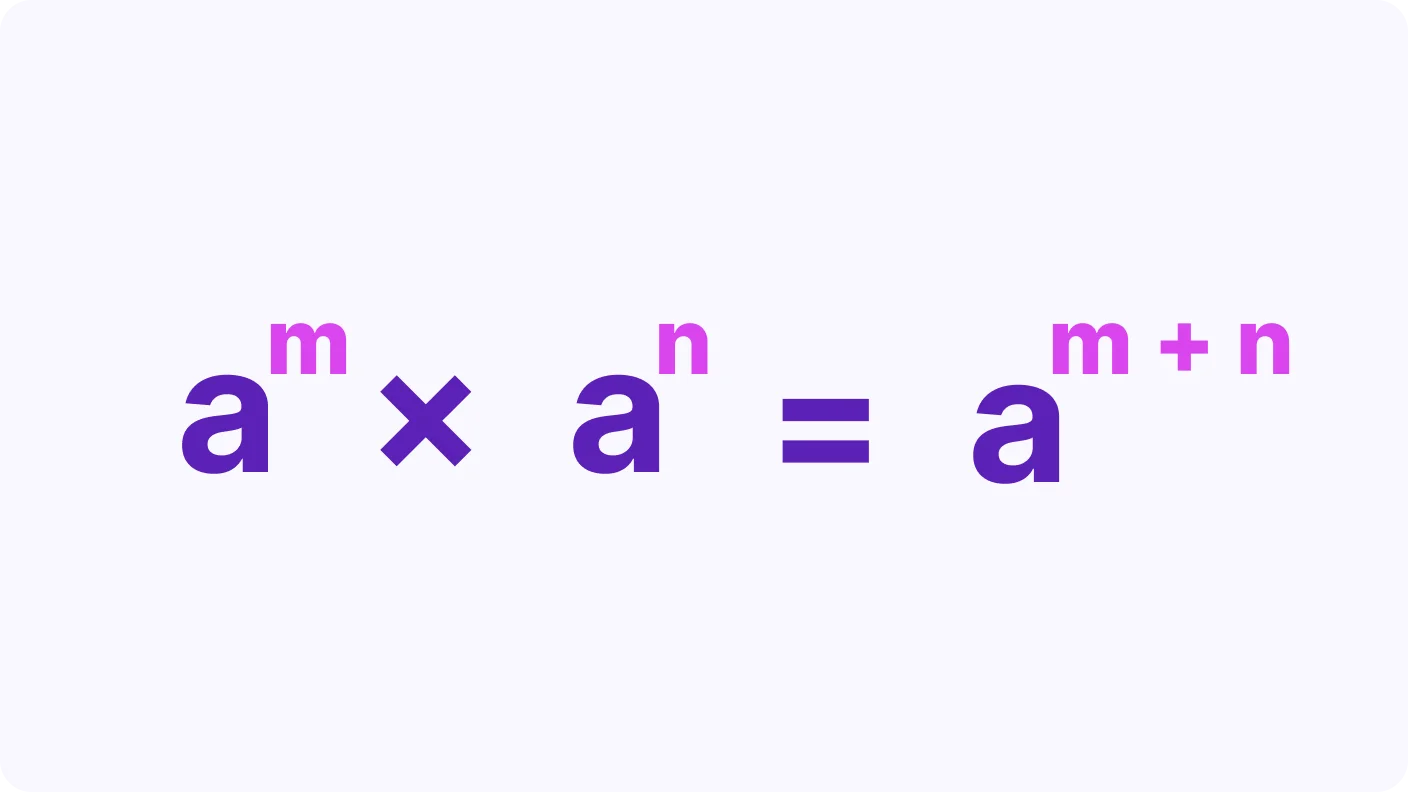
The laws of indices are shortcut rules for simplifying powers. With the same base, you add the indices, e.g. 2³ × 2⁴ = 2³⁺⁴ = 2⁷. With the same index, you multiply the bases, e.g. 2³ × 5³ = (2 × 5)³ = 10³.
Video Lesson
Watch and learn the basics
-math-angel.webp)
🎬 Did this video explain it clearly?
Flashcards
Review key concepts visually
%20What%20are%20Indices.webp)
%20Laws%20of%20Indices%20(Same%20Base).webp)
%20Laws%20of%20Indices%20(Same%20Index).webp)
Indices: Base and Exponent
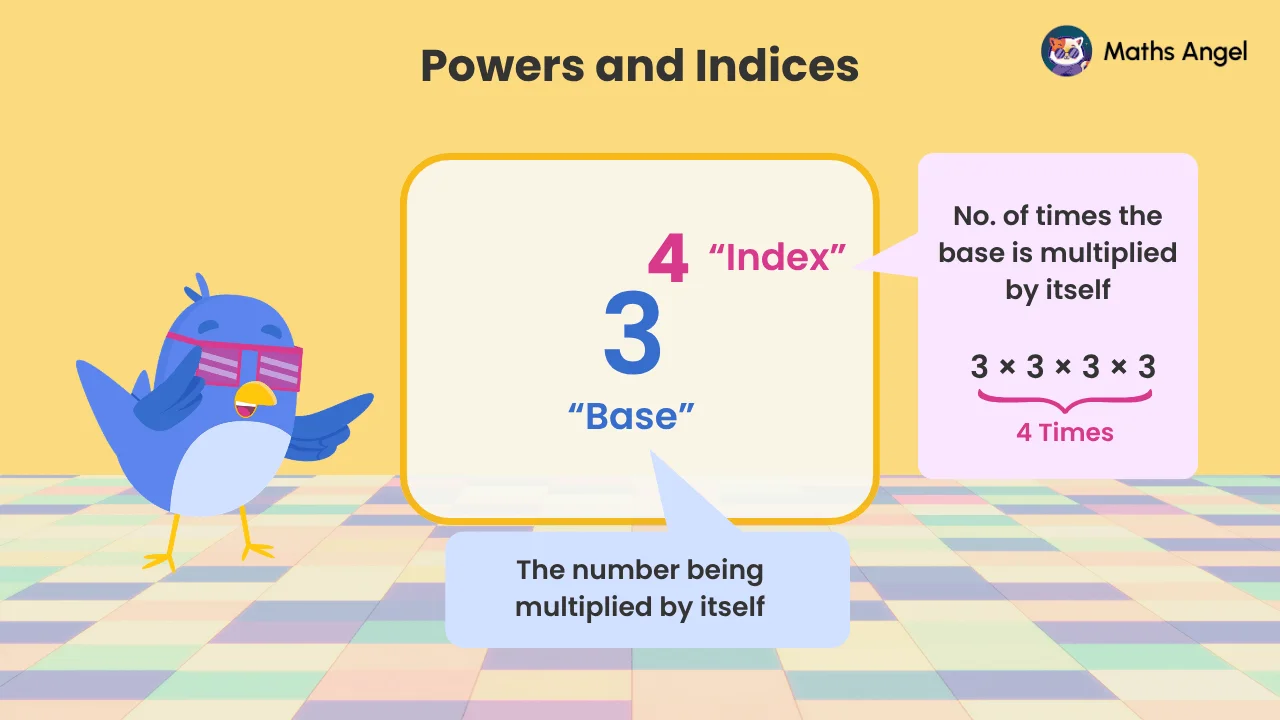
- The base is the repeated number and the index (exponent) tells how many times it is multiplied.
- Example: .
Laws of Indices: Same Base Rules
- When you multiply the same base, you add the indices, e.g. .
- When you divide the same base, you subtract the indices, e.g. .
Laws of Indices: Same Index Rules
- When the index is the same, you multiply the bases, e.g. .
- When the index is the same, you divide the bases, e.g. .
Practice Questions
Test your understanding
What is ?
Correct! 🎉 +10 pointsCorrect! 🎉 Worth 10 XPNot quite right
When multiplying powers with the same base, keep the base and add the indices: .
So . Checking, and . The base stays 2. Only the indices are added.
What is ?
Correct! 🎉 +10 pointsCorrect! 🎉 Worth 10 XPNot quite right
When dividing powers with the same base, keep the base and subtract the indices: .
So . Checking, and . The base stays 4. Only the indices are subtracted.
What is ?
Correct! 🎉 +20 pointsCorrect! 🎉 Worth 20 XPNot quite right
When dividing powers with the same base, subtract the indices: .
So (which is ).
Check it by writing the powers out: . Subtract in the order given (, not ), and never add or multiply the indices.
Simplify .
Correct! 🎉 +20 pointsCorrect! 🎉 Worth 20 XPNot quite right
When two powers share the same index, you can multiply the bases: .
Here , so .
And , so the answer is . (Check the long way: and , and .)
Simplify .
Correct! 🎉 +20 pointsCorrect! 🎉 Worth 20 XPNot quite right
When dividing powers with the same base, subtract the indices: .
So .
Subtract in the order written (, not ). A negative index does not make the answer negative: , which is a small positive number.
What is ?
Correct! 🎉 +30 pointsCorrect! 🎉 Worth 30 XPNot quite right
When multiplying powers with the same base, add the indices, and make sure every power is included: .
So (which is ).
Add the indices, do not multiply them, and remember means , not .
Want to see the full working?
Interactive Activity
Solve the problems below to master the Laws of Indices
Loading interactive widget...
Frequently asked questions
The questions students bump into most on this topic
An index shows how many times a base number is multiplied by itself. In 2³ the base is 2 and the index is 3, so 2³ means 2 × 2 × 2 = 8. Indices are also called powers or, in American books, exponents. The laws of indices are shortcuts for multiplying and dividing numbers written this way.
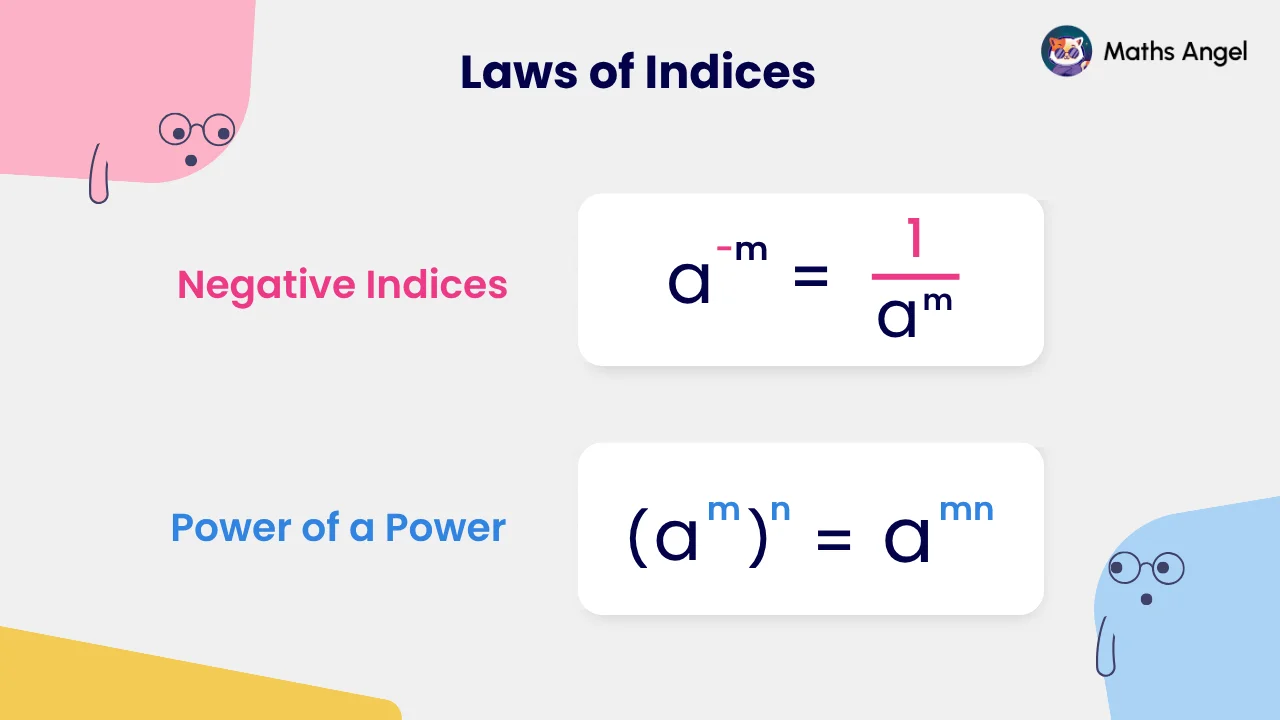
Rules for simplifying powers without writing them out. With the same base: multiply by adding the indices, 2³ × 2⁴ = 2⁷, and divide by subtracting them, 4⁵ ÷ 4³ = 4². With the same index: multiply or divide the bases and keep the index, 2³ × 5³ = 10³ and 6⁵ ÷ 3⁵ = 2⁵. These four are the GCSE core; the next lessons add negative, fractional and power-of-a-power rules.
It depends how you count them, which is why websites list anything from five to nine. This lesson covers four: add indices to multiply with the same base, subtract to divide, and multiply or divide the bases when the index is the same. Negative indices, a power of a power, fractional indices and the zero index come in the next lessons.
Add the indices and keep the base: 2³ × 2⁴ = 2⁷, because three 2s multiplied by four 2s is seven 2s. It works with negative indices too: 3⁻⁵ × 3⁷ = 3², since −5 + 7 = 2. And with three terms: 2⁴ × 2² × 2³ = 2⁹. Never multiply the indices here; that is the power-of-a-power rule.
Subtract the indices and keep the base: 4⁵ ÷ 4³ = 4² = 16, because five 4s divided by three 4s leaves two. The answer can have a negative index: 5⁴ ÷ 5⁶ = 5⁻², and 10⁵ ÷ 10² = 10³. Subtract the bottom index from the top one, in that order.
Combine the bases and keep the index. To multiply, multiply the bases: 2³ × 5³ = (2 × 5)³ = 10³, and 0.1⁸ × 10⁸ = 1⁸ = 1. To divide, divide the bases: 6⁵ ÷ 3⁵ = (6 ÷ 3)⁵ = 2⁵. The index never changes in either case.
What's next?
Found this one hard? Go one step back first. Feeling confident? Carry on to the next lesson.