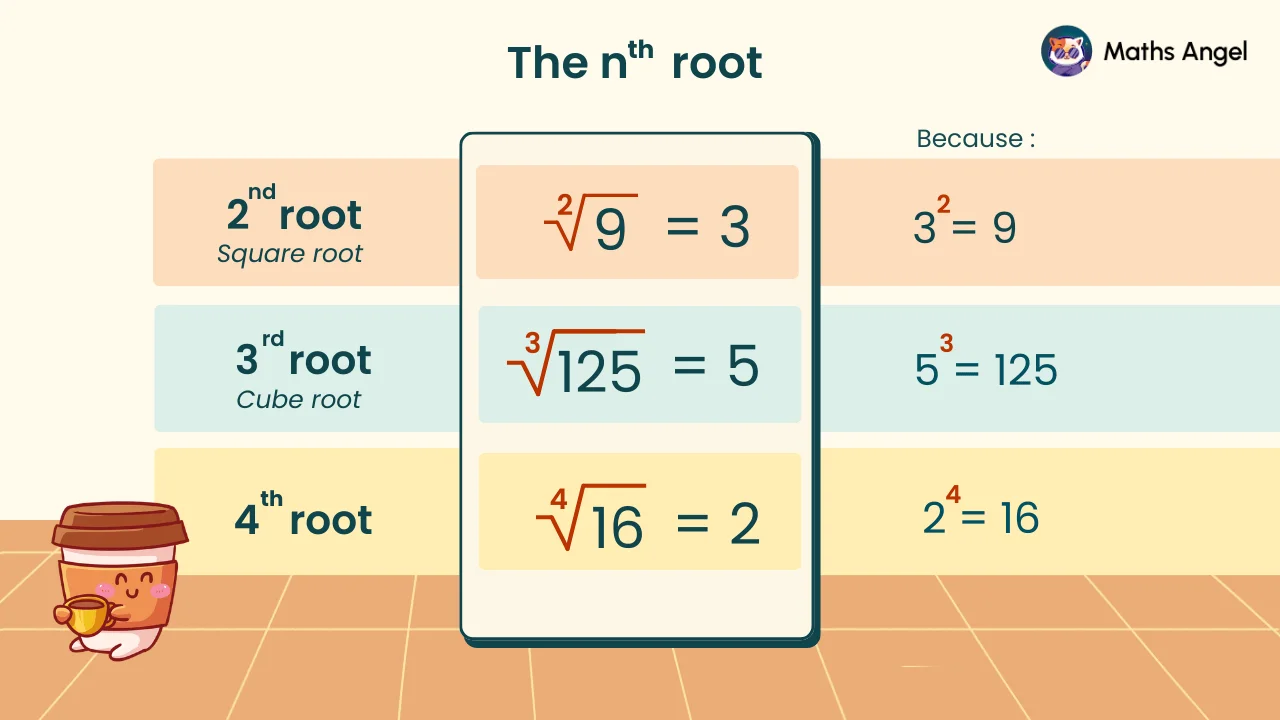
Negative Indices and Power of a Power
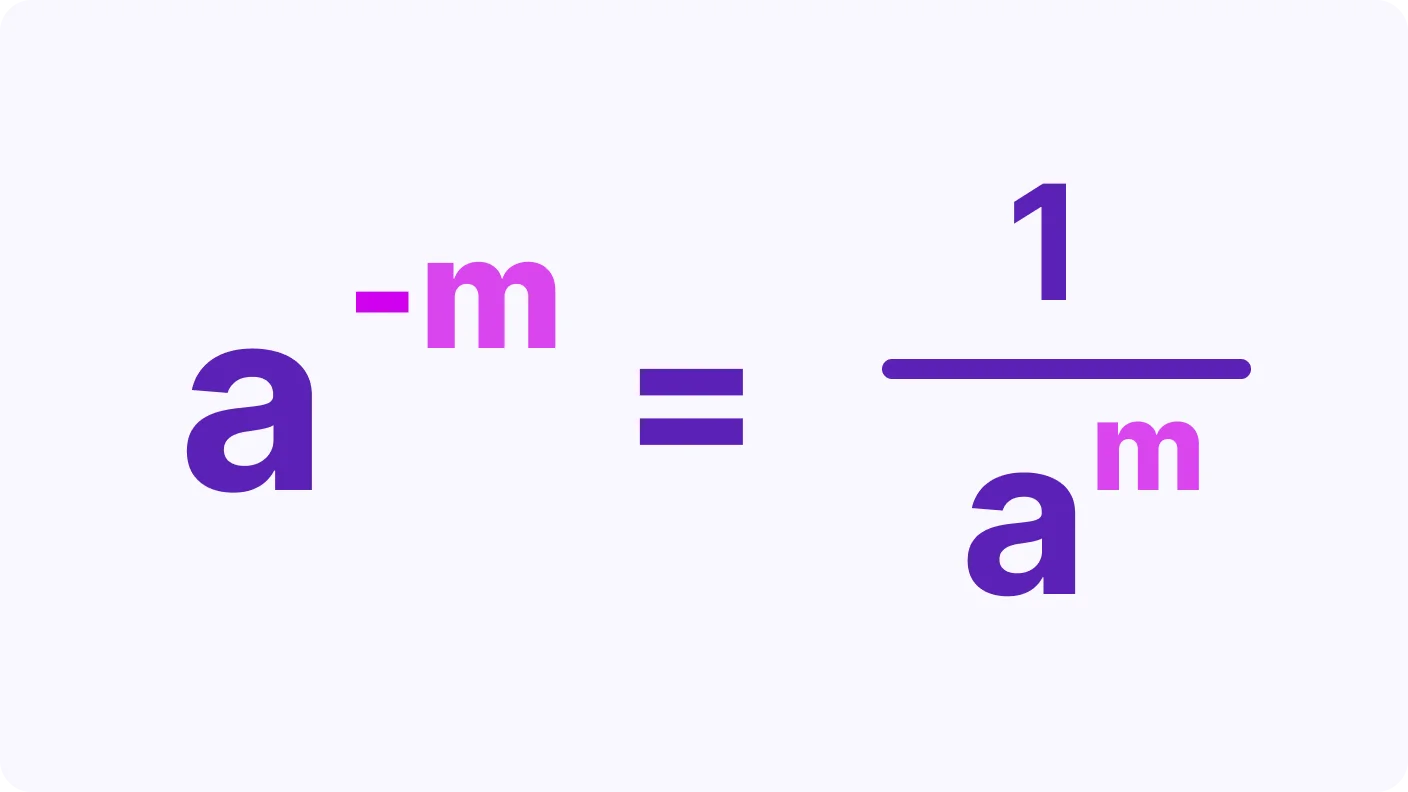
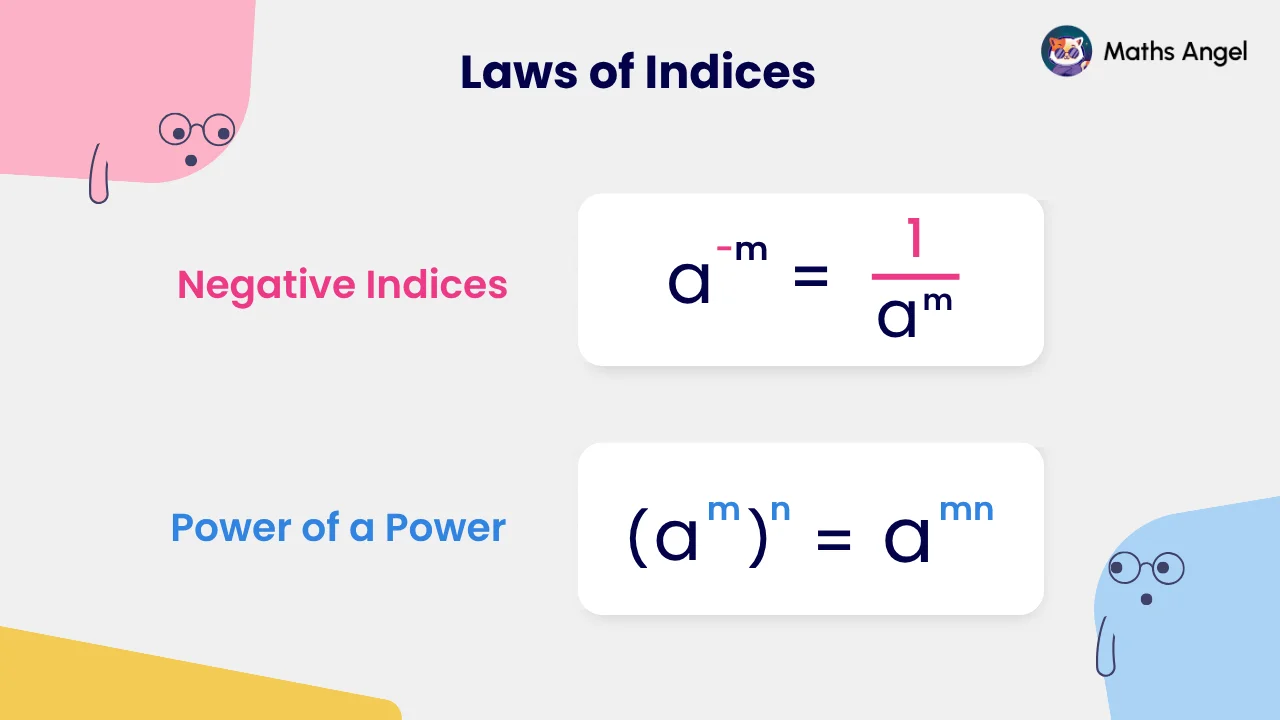
Negative indices tell you to take the reciprocal, so the base flips into a fraction with a positive power. For example, 2⁻³ = 1/2³ = 1/8. A power of a power means you multiply the indices, giving (2³)⁵ = 2¹⁵.
Video Lesson
Watch and learn the basics
🎬 Did this video explain it clearly?
Flashcards
Review key concepts visually
%20Law%20of%20Indices.webp)
%20Applying%20Negative%20Indices%20Rule%20on%20Fractions.webp)
%20Power%20of%20a%20Power%20Rules.webp)
%20Power%20of%20a%20Power%20Examples.webp)
%20Law%20of%20Indices%20and%20Power%20Rules.webp)
Negative Indices: Make a Reciprocal
- A negative index means take the reciprocal: .
- Example: .
Negative Indices with Fractions
- A negative index on a fraction flips it: .
- Example: .
Power of a Power: Multiply the Indices
- A power of a power means you multiply the indices: .
- Example: .
Power of a Power with Negative Indices
- You still multiply the indices, so two negatives make a positive index.
- Example: .
Laws of Indices Summary
- If the base is a fraction and the index is negative, you flip the fraction to make the index positive.
- A power of a power means multiply the indices, even if an index is negative.
Practice Questions
What is ?
Correct!Not quite!
+10pointsXPWhen a power is raised to another power, multiply the indices: .
So .
The indices are multiplied, not added, so is wrong. Both indices must be used, so ignores the power inside the bracket. Also, means , not , so the base stays as 2.
What is ?
Correct!Not quite!
+10pointsXPA negative index means take the reciprocal of the base: .
So .
The minus sign in the index does not make the answer negative, and it does not tell you to multiply the base by the index. It tells you to write 'one over' the base.
What is ?
Correct!Not quite!
+20pointsXPA negative index means take the reciprocal and make the index positive: .
So , because .
The negative index means 'one over', so the answer is not , and it is not either. The minus sign cannot simply be ignored. Note also that is 8, not .
What is ?
Correct!Not quite!
+20pointsXPA negative index means take the reciprocal and make the index positive: .
So . Since , the answer is .
The answer is negative because the base is negative and the index 3 is odd, not because the index is negative. Dropping the minus on the base would wrongly give , and forgetting the reciprocal would wrongly give .
What is ?
Correct!Not quite!
+20pointsXPWhen a power is raised to another power, multiply the indices: .
So , which equals .
The indices are multiplied, not added. Adding would give . Both indices must be used, so writing ignores the outer power of 2. A negative index makes a reciprocal, not a negative answer, so is wrong.
What is ?
Correct!Not quite!
+30pointsXPA negative index on a fraction means flip the fraction and make the index positive: .
So .
Flipping the fraction first is what makes the answer bigger than 1. The negative index does not make the answer negative, and means , not .
Interactive Activity
Master the rules of exponents through experimentation
Loading interactive widget...
Frequently asked questions
The questions students bump into most on this topic
A negative index means take the reciprocal, one over the number, with the index made positive: 2⁻³ = 1 ÷ 2³ = 1/8. The minus sign flips the number into a fraction; it does not make the answer negative. “Exponent” is the American word for index; the rule is the same.
Write 1 over the number with a positive index, then work it out: 4⁻¹ = 1/4 and 2⁻³ = 1/2³ = 1/8. If the base is negative, keep its sign and do the same: (−5)⁻³ = 1 ÷ (−5)³ = 1 ÷ (−125) = −1/125. Flip first, then calculate.
Flip the fraction over, then use the positive index. (2/3)⁻² becomes (3/2)², which is 9/4. (1/2)⁻³ becomes 2³ = 8. Turning the fraction upside down is the reciprocal step; the negative sign disappears with it, and then you square or cube as normal.
When a power is raised to another power, multiply the indices: (2³)⁵ = 2¹⁵. It works because (2³)⁵ means five lots of 2³ multiplied together, and each 2³ is three 2s, so there are 3 × 5 = 15 twos in all. The base stays the same throughout.
Still multiply the indices, so two negatives make a positive: (3⁻²)⁻² = 3⁴ = 81, and (5⁻²)² = 5⁻⁴. Because multiplication can be done in any order, you can also swap the two indices when that is easier: (1/4)⁻¹ raised to the power 3 is the same as 4³, since (1/4)⁻¹ is just 4.
What's next?
Found this one hard? Go one step back first. Feeling confident? Carry on to the next lesson.
-math-angel.webp)