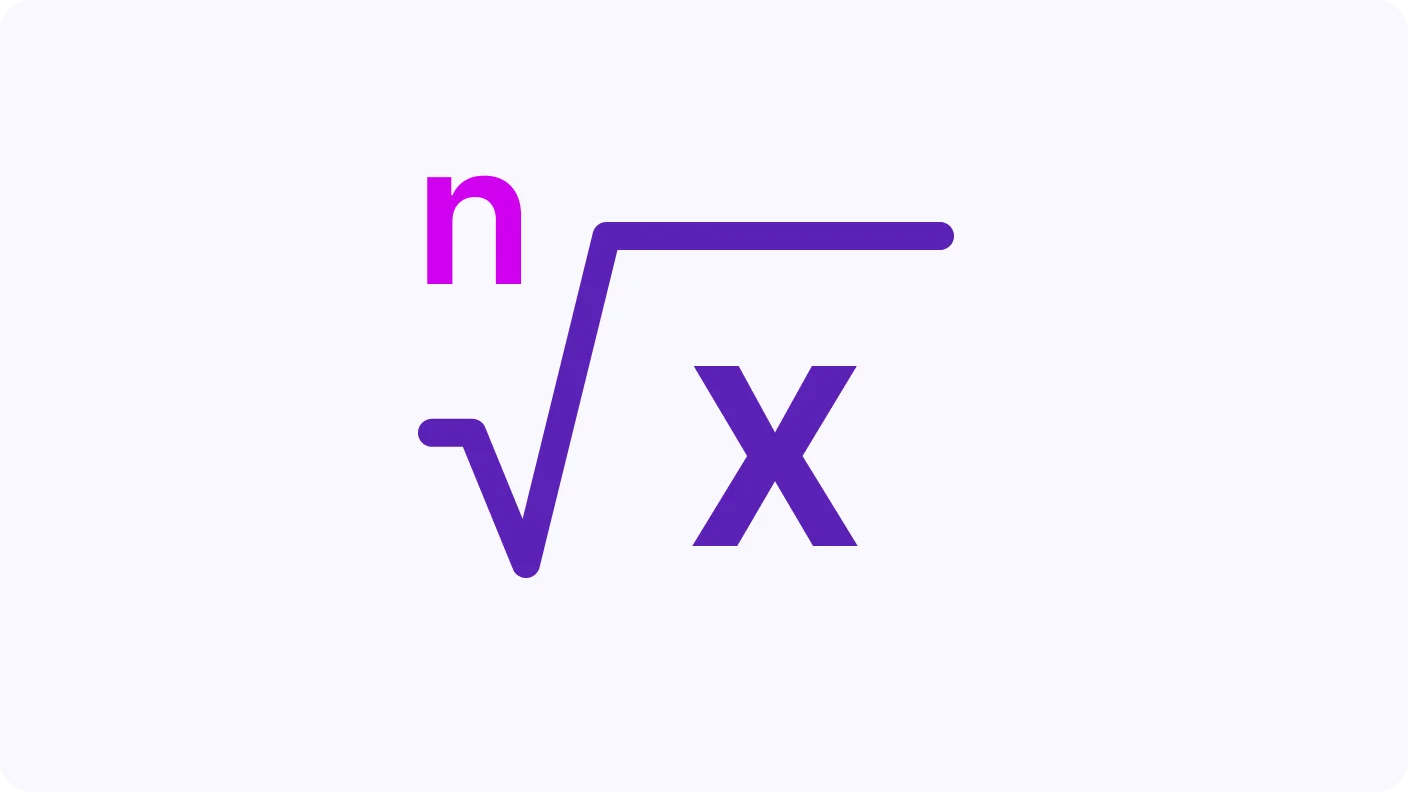
The nth Root and Fractional Indices
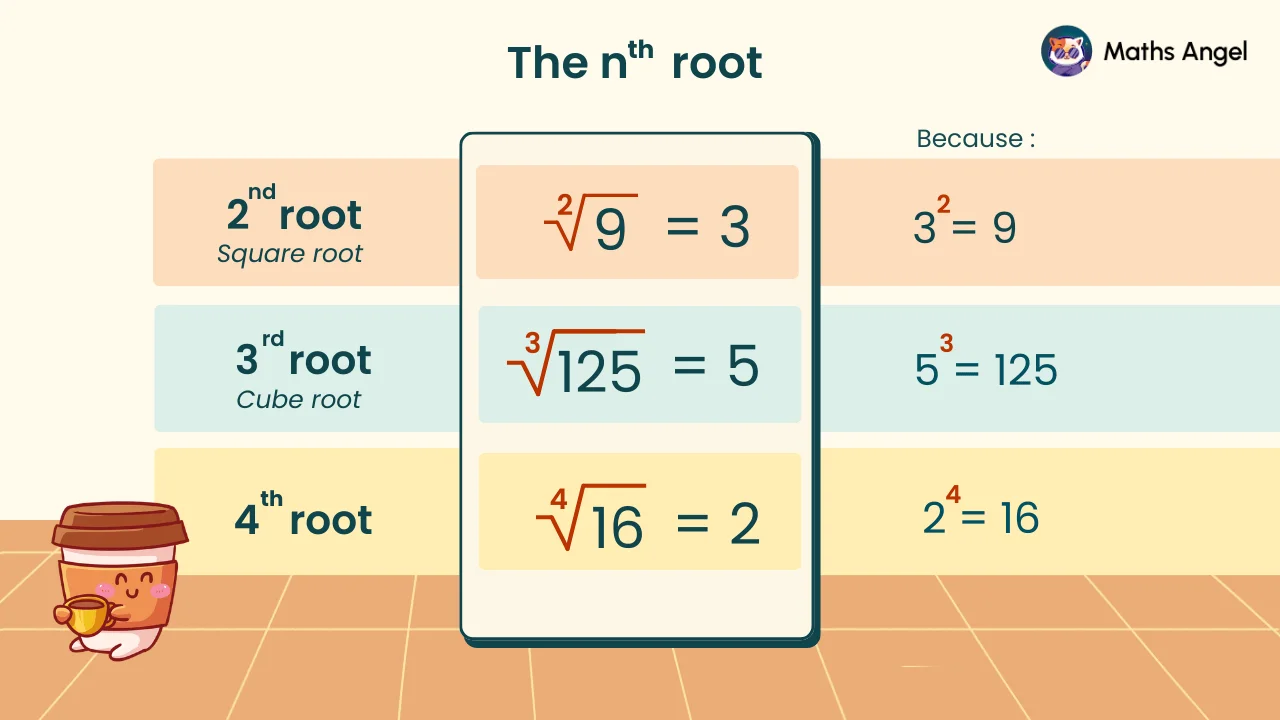
Fractional indices write a root as a power. Raising 125 to the power 1/3 gives the cube root of 125, which is 5. The bottom of the fraction says which root to take, and the top says what power to raise it to.
Video Lesson
Watch and learn the basics
🎬 Did this video explain it clearly?
Flashcards
Review key concepts visually
%20The%20nth%20Root.webp)
%20Characteristics%20of%20the%20nth%20Root.webp)
%20Basic%20Fractional%20Indices.webp)
%20Basic%20Fractional%20Indices%20Example.webp)
%20Fractional%20Indices.webp)
%20Fractional%20Indices%20Example.webp)
nᵗʰ Root
- The nᵗʰ root means a number that is multiplied by itself times.
- For example, the cube root of 27 is 3 because .
Rules of the nᵗʰ Root
- The algebraic rule is when multiplied times.
- For example, .
Roots as Fractional Indices
- A fractional index is another way to write a root.
- The rule is
Example:
- The fractional index means take the cube root.
- because .
Fractional Indices Rule
- In , the denominator tells you the root.
- The numerator tells you the power.
Example:
- Find the 4th root of 16 to get 2.
- Then raise it to the power 3 to get 8.
Practice Questions
Test your understanding
What is ?
Correct! 🎉 +10 pointsCorrect! 🎉 Worth 10 XPNot quite right
A power of means the cube root: .
The cube root of 125 is the number that multiplies by itself three times to give 125. Since , the answer is 5.
What is ?
Correct! 🎉 +10 pointsCorrect! 🎉 Worth 10 XPNot quite right
The cube root of 64 is the number that multiplies by itself three times to give 64.
, so .
Take care not to use the square root by mistake: , because .
What is ?
Correct! 🎉 +20 pointsCorrect! 🎉 Worth 20 XPNot quite right
The index means the cube root, so because .
The outer power of 2 then squares that result: .
You can also combine the indices first: . So .
What is ?
Correct! 🎉 +20 pointsCorrect! 🎉 Worth 20 XPNot quite right
In a fractional index, the denominator tells you which root to take and the numerator tells you which power to raise it to.
So . The fourth root of 16 is 2, because .
Then , so .
What is ?
Correct! 🎉 +20 pointsCorrect! 🎉 Worth 20 XPNot quite right
The denominator 3 tells you to take the cube root and the numerator 2 tells you to square the result: .
The cube root of 125 is 5, because .
Squaring gives , so .
What is ?
Correct! 🎉 +30 pointsCorrect! 🎉 Worth 30 XPNot quite right
The denominator 4 tells you to take the fourth root and the numerator 5 tells you to raise the result to the fifth power: .
The fourth root of 16 is 2, because .
Then , so . Notice the answer is larger than 16, because the index is greater than 1.
Want to see the full working?
Interactive Activity
Simplifying nth roots and fractional indices
Loading interactive widget...
Frequently asked questions
The questions students bump into most on this topic
The nth root of a number is the value that, multiplied by itself n times, gives that number. The cube root of 125 is 5, because 5 × 5 × 5 = 125; the fourth root of 16 is 2, because 2⁴ = 16. The small number on the root sign says which root. To find one, ask which number to that power gives the original.
A fractional index is another way of writing a root: a number to the power of 1/n is its nth root. So 8 to the power of 1/3 is the cube root of 8, which is 2, and 125 to the power of 1/3 is 5. A power of 1/2 is a square root. American sites call them fractional or rational exponents.
The bottom of the fraction tells you the root and the top tells you the power. For 125 to the power of 2/3, take the cube root first, 5, then square it: 25. For 16 to the power of 3/4, the fourth root of 16 is 2, and 2³ = 8. Root, then power, every time.
Deal with the minus sign first, then the fraction. A negative index means take the reciprocal, so 8 to the power of −1/3 is 1 over 8 to the power of 1/3, which is 1/2. For 16 to the power of −3/4: 16 to the 3/4 is 8, so the answer is 1/8. Flip, then root, then power.
Root first, then power; it keeps the numbers small. For 16 to the power of 5/4, the fourth root of 16 is 2, and 2⁵ = 32. Doing the power first would mean working out 16⁵, which is over a million, before taking a fourth root. Both orders give the same answer, so choose the easy one.
What's next?
Found this one hard? Go one step back first. Feeling confident? Carry on to the next lesson.
-math-angel.webp)