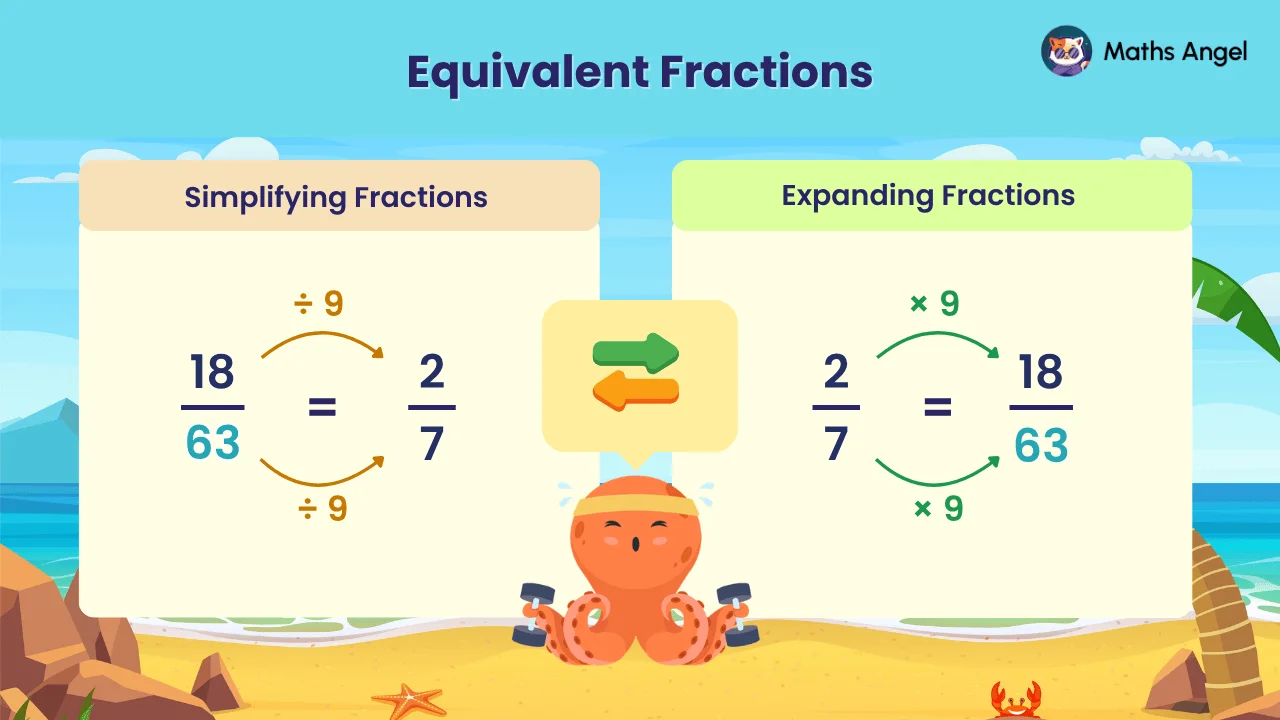
Comparing Fractions
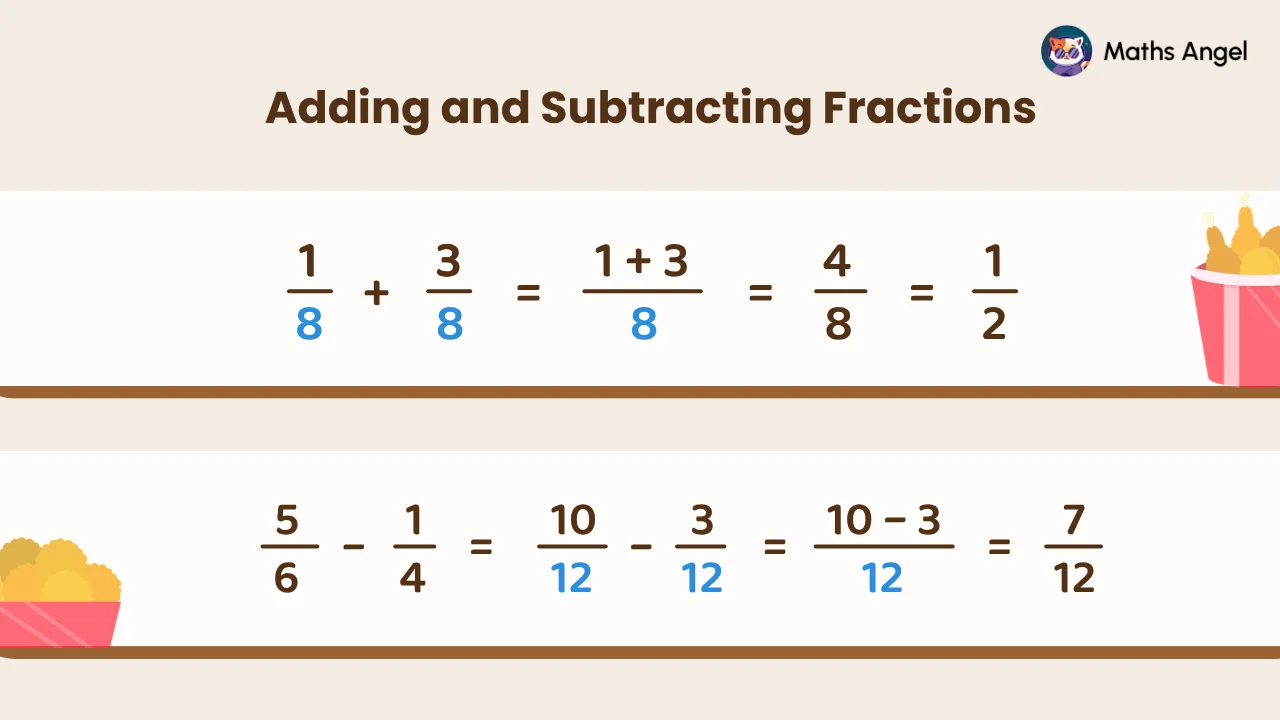
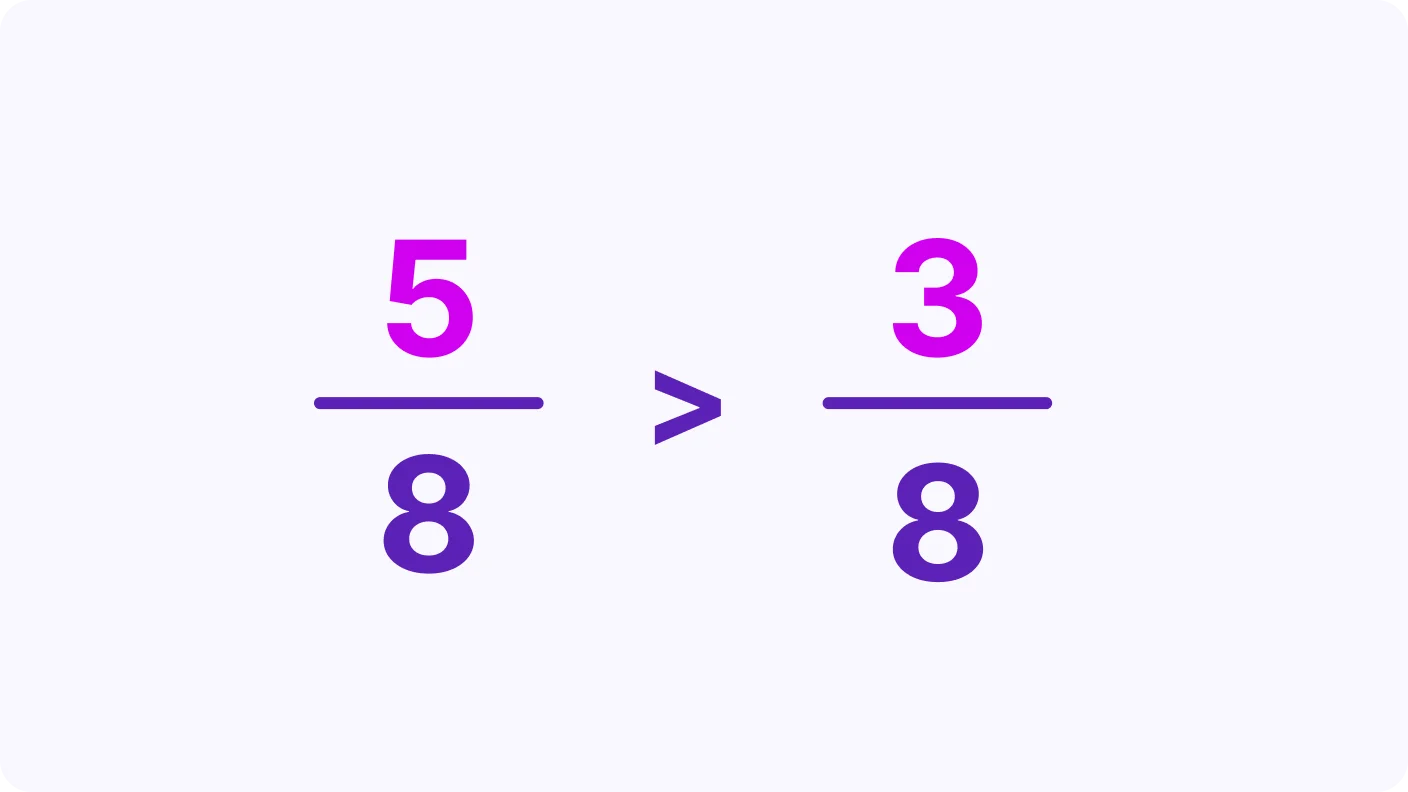
Comparing fractions means finding which one is larger or smaller. If the denominators match, the larger numerator wins, so 5/8 > 3/8. If they differ, convert both to a common denominator, then compare.
Video Lesson
Watch and learn the basics
🎬 Did this video explain it clearly?
Flashcards
Review key concepts visually
%20Rules%20for%20Comparing%20Fractions.webp)
%20Common%20Denominator%20Method.webp)
%20Practise%20Comparing%20Fractions%20part%201.webp)
%20Practise%20Comparing%20Fractions%20part%202.webp)
Quick Comparison Rules
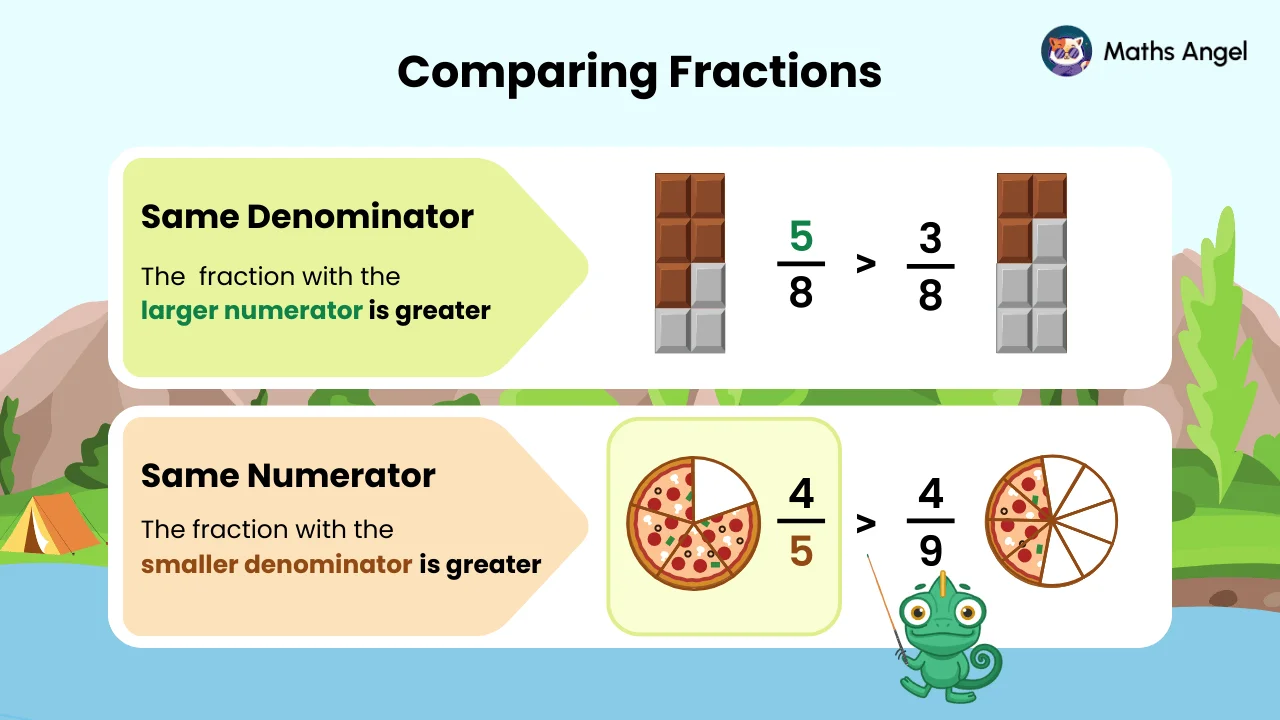
- If the denominators are the same, the fraction with the larger numerator is greater.
- If the numerators are the same, the fraction with the smaller denominator is greater.
Comparing Fractions Using a Common Denominator
- Find the lowest common multiple (LCM) of the denominators. For example, the LCM of 6 and 10 is 30.
- Convert both fractions to have this same denominator, then compare numerators.
When One Denominator Is Already the LCM
- Sometimes one fraction already has the LCM as its denominator.
- Only change the other fraction, then compare the numerators.
When Denominators Are Prime to Each Other
- If the denominators have no common factors, the LCM is their product.
- When the denominators are the same, you can ignore them and just compare the numerators.
Practice Questions
Test your understanding
Which is greater, or ?
Correct! 🎉 +10 pointsCorrect! 🎉 Worth 10 XPNot quite right
Both fractions are sevenths, so the pieces are exactly the same size and we only need to count them.
Five sevenths is more pieces than three sevenths, so is greater.
Which is greater, or ?
Correct! 🎉 +10 pointsCorrect! 🎉 Worth 10 XPNot quite right
Both fractions take 4 pieces, so the size of each piece decides it.
Splitting a whole into 9 parts gives bigger parts than splitting it into 11, so 4 of the ninths is more than 4 of the elevenths and is greater. Checking with decimals, and
Which fraction is greater: or ?
Correct! 🎉 +20 pointsCorrect! 🎉 Worth 20 XPNot quite right
Bring both fractions to a common denominator of 30: and . Since , is greater.
As decimals, and . Rounded to one decimal place both look like 0.7, so you must compare them exactly rather than by a rounded decimal.
Which fraction is greater: or ?
Correct! 🎉 +20 pointsCorrect! 🎉 Worth 20 XPNot quite right
Use a common denominator of 30: and . Since , is greater.
As decimals, and . They round to the same value at one decimal place, so compare the exact equivalent fractions instead.
Which is greater: or ?
Correct! 🎉 +20 pointsCorrect! 🎉 Worth 20 XPNot quite right
Use a common denominator of 24: and . Since , is greater.
A bigger denominator does not make a bigger fraction - the pieces are smaller. As decimals, and , and both round to 0.6 at one decimal place, so compare exactly.
Compare and . Which fraction is smaller?
Correct! 🎉 +30 pointsCorrect! 🎉 Worth 30 XPNot quite right
Bring both fractions to a common denominator of 52: and . Since , is smaller.
A larger denominator does not make a larger fraction. As decimals, and , which again shows is the smaller one.
Want to see the full working?
Interactive Activity
Adjust the denominators to compare the fractions
Loading interactive widget...
Frequently asked questions
The questions students bump into most on this topic
A common denominator is a number that both denominators divide into, so two fractions can be written with the same bottom number and compared. The lowest common denominator is the smallest one: for 5/6 and 7/10 it is 30, because 30 is the lowest common multiple of 6 and 10. Then 5/6 becomes 25/30 and 7/10 becomes 21/30.
Two quick rules. If the denominators are the same, the bigger numerator wins: 5/8 is bigger than 3/8, because whoever took more pieces ate more. If the numerators are the same, the smaller denominator wins: 4/5 is bigger than 4/9, because a pizza cut into 5 has bigger slices than one cut into 9. Otherwise, use a common denominator.
Find the lowest common multiple of the denominators, change each fraction to that denominator, then compare the numerators. For 5/6 and 7/10, the lowest common multiple of 6 and 10 is 30: 5/6 = 25/30 and 7/10 = 21/30. Since 25 is more than 21, 5/6 is the bigger fraction.
List the multiples of each denominator and take the smallest number in both lists: for 6 and 10 that is 30. Two shortcuts: if one denominator is a multiple of the other, use the bigger one, so for 4 and 16 it is 16 and only 1/4 needs changing; if the denominators share no factor, multiply them, so for 11 and 12 it is 132.
3/4 is bigger. The lowest common multiple of 3 and 4 is 12, so 2/3 = 8/12 and 3/4 = 9/12, and 9 is more than 8. Against 1/2, use quarters: 1/2 = 2/4, and 3/4 is bigger than 2/4. Whenever the numerators and denominators both differ, a common denominator settles it.
Start with food. A chocolate bar cut into 8 pieces makes 5/8 against 3/8 easy: more pieces is more chocolate. Then two pizzas, one cut into 5 and one into 9: four slices from the 5-piece pizza is more, because its slices are bigger. Only after that introduce the common denominator for the harder cases.
What's next?
Found this one hard? Go one step back first. Feeling confident? Carry on to the next lesson.