Adding and Subtracting Fractions
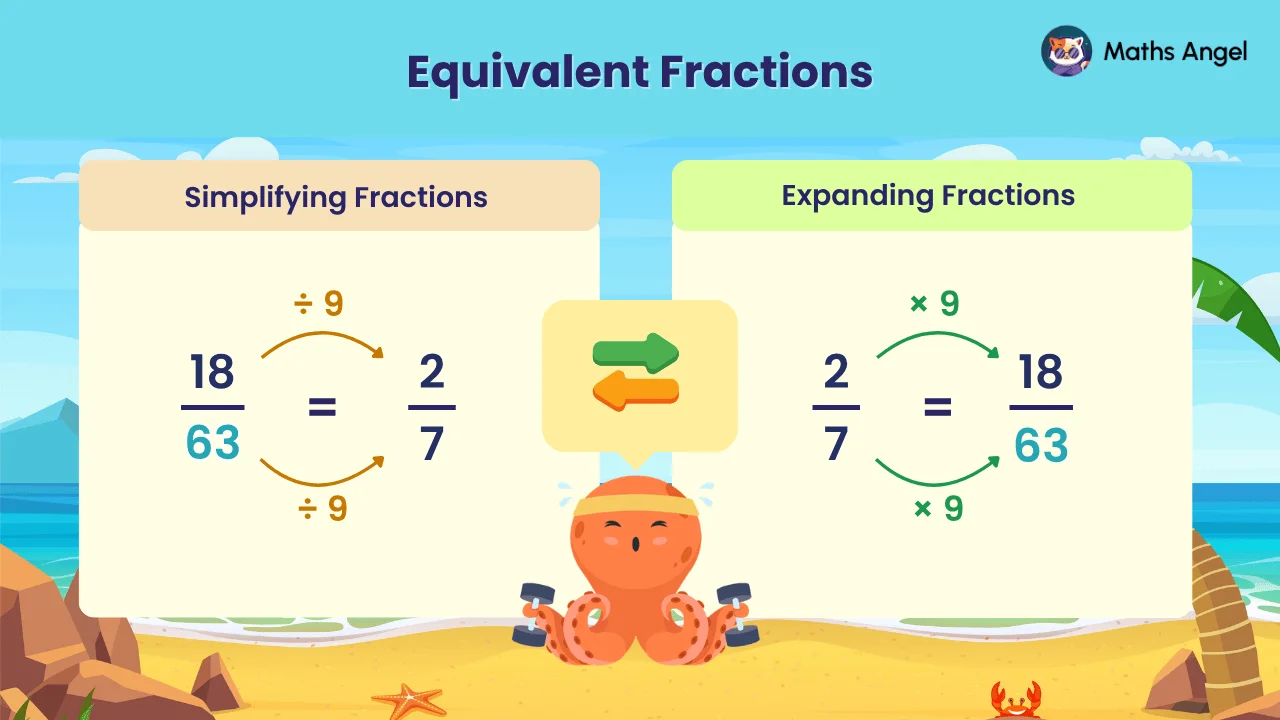
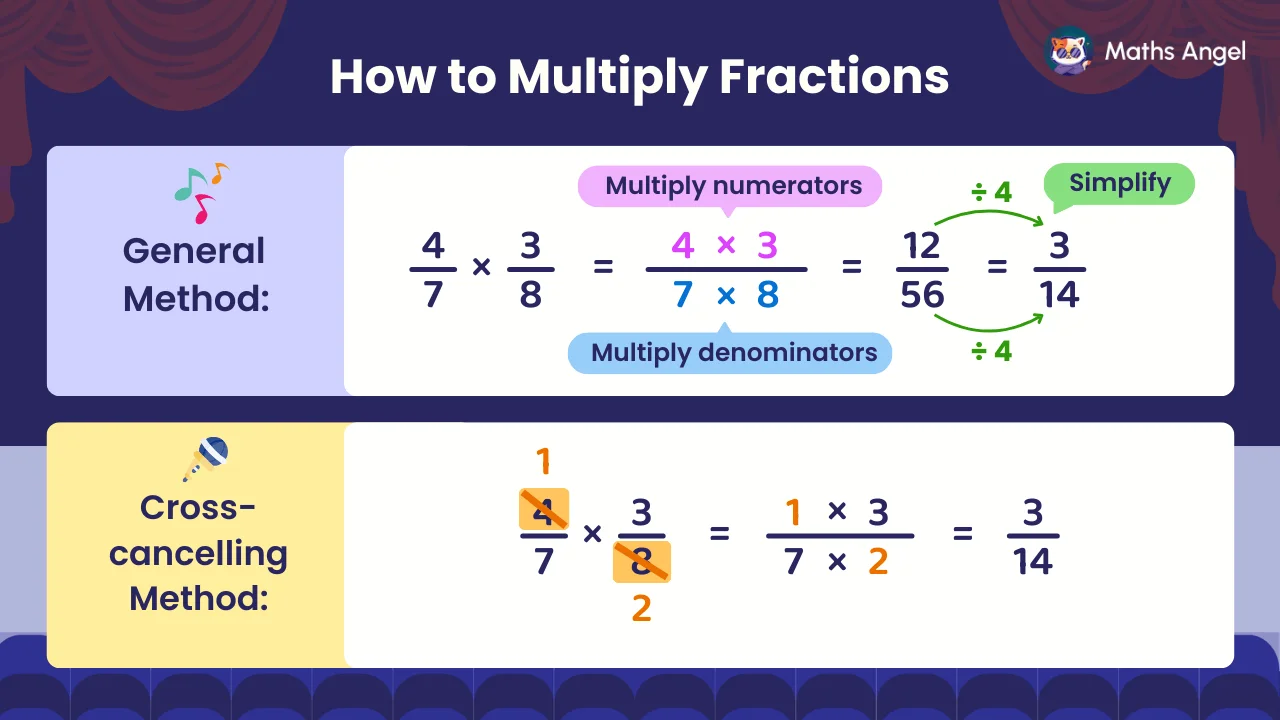
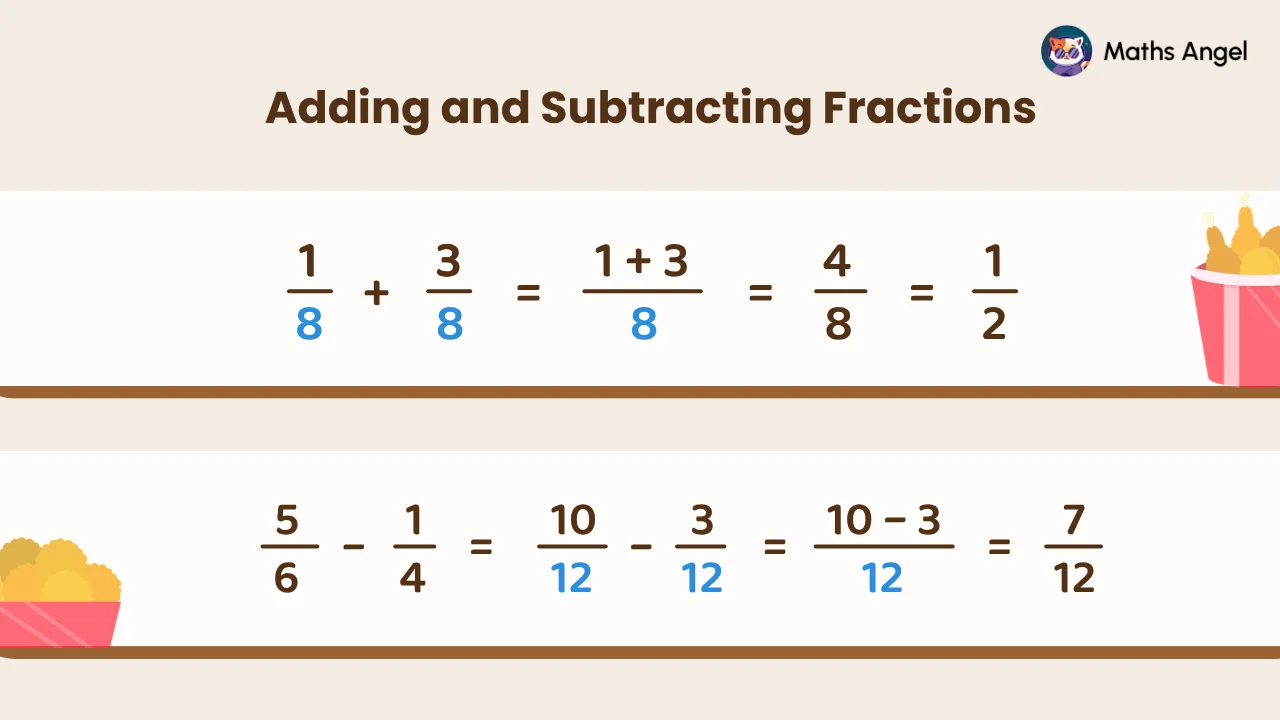
Adding and subtracting fractions is easy when the denominators are the same. Just add or subtract the numerators and keep the denominator. If the fractions are unlike, first find a common denominator.
Video Lesson
Watch and learn the basics
🎬 Did this video explain it clearly?
Flashcards
Review key concepts visually
%20Adding%20Subtracting%20Like%20Fractions.webp)
%20Adding%20Subtracting%20Unlike%20Fractions.webp)
%20Proper%2C%20Improper%2C%20Mixed%20Fractions.webp)
%20Improper%20Fractions%20to%20Mixed%20Fractions.webp)
Adding and Subtracting Like Fractions
- Like fractions have the same denominator.
- Add or subtract the numerators only, keep the denominator the same, then simplify if possible.
Adding and Subtracting Unlike Fractions
- Unlike fractions have different denominators.
- Make the denominators the same first, then add or subtract.
Types of Fractions
- Proper fractions: numerator is smaller than the denominator (e.g. )
- Improper fractions: numerator is greater than or equal to the denominator (e.g. )
- Mixed numbers: a whole number and a fraction together (e.g. )
Converting Between Improper and Mixed Fractions
- Improper → Mixed: divide the numerator by the denominator.
- Mixed → Improper: multiply the whole number by the denominator, then add the numerator.
Practice Questions
Test your understanding
Which of the following is a proper fraction?
Correct! 🎉 +10 pointsCorrect! 🎉 Worth 10 XPNot quite right
A proper fraction is worth less than one whole, so its numerator must be smaller than its denominator.
In , 3 is smaller than 4, so it is proper.
is top-heavy (improper), is exactly one whole, and is a mixed number worth more than 2.
Add and .
Correct! 🎉 +10 pointsCorrect! 🎉 Worth 10 XPNot quite right
9 is a multiple of 3, so use 9 as the common denominator.
Multiply the top and bottom of by 3: .
Now add the numerators only, keeping the denominator: (which is ).
Convert into an improper fraction.
Correct! 🎉 +20 pointsCorrect! 🎉 Worth 20 XPNot quite right
Three whole ones are worth fifths.
Add the 2 fifths that are already there: fifths.
So . The denominator stays as 5 because the pieces are still fifths.
Add and .
Correct! 🎉 +20 pointsCorrect! 🎉 Worth 20 XPNot quite right
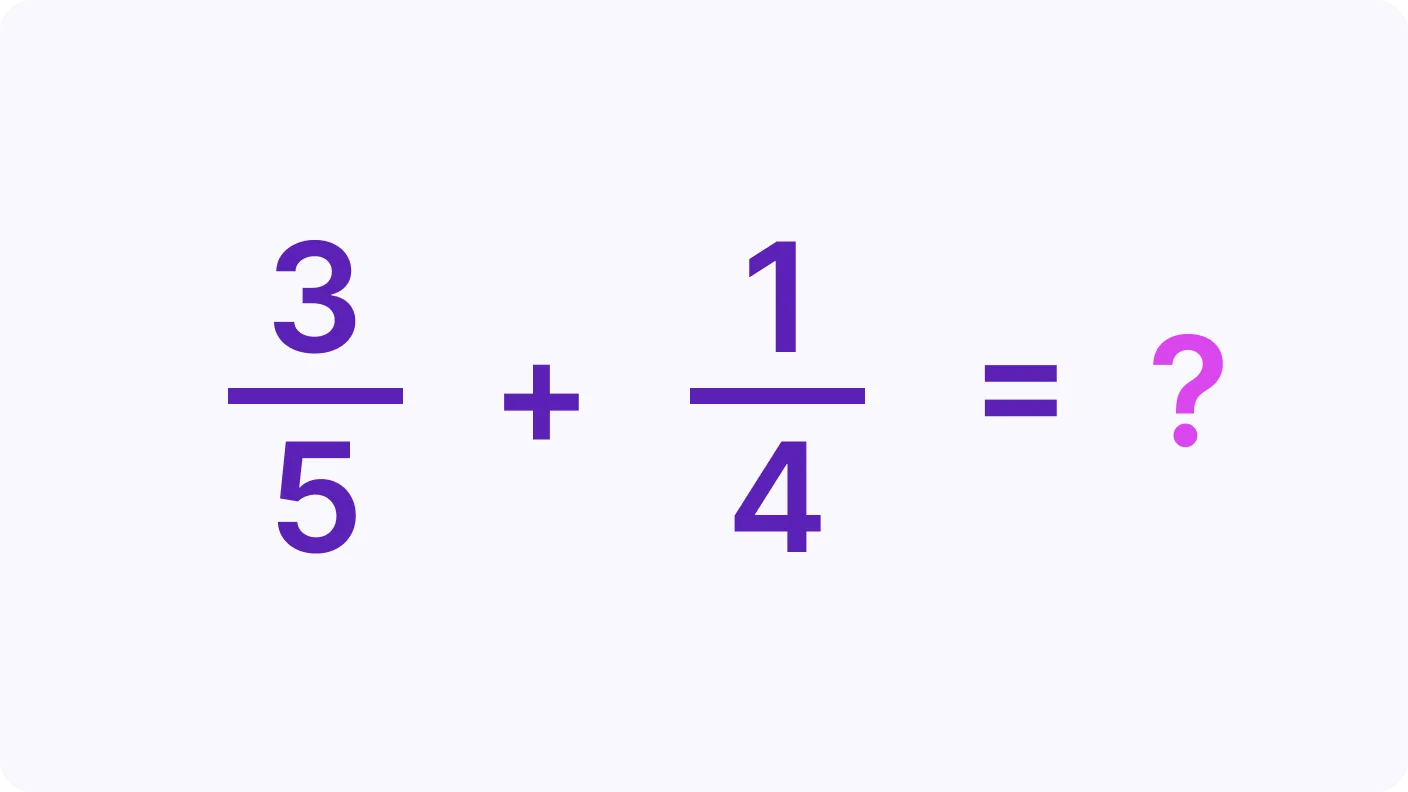
The lowest common denominator of 6 and 4 is 12.
Multiply top and bottom of by 2 to get , and top and bottom of by 3 to get .
Now add the numerators only: (which is ).
Subtract from .
Correct! 🎉 +20 pointsCorrect! 🎉 Worth 20 XPNot quite right
The lowest common denominator of 12 and 9 is 36.
Multiply top and bottom of by 3 to get , and top and bottom of by 4 to get .
Now subtract the numerators only: , which is already in its simplest form.
Subtract from .
Correct! 🎉 +30 pointsCorrect! 🎉 Worth 30 XPNot quite right
Change both mixed numbers into improper fractions with the same denominator.
and .
Subtract: , and remainder 3, so the answer is .
Want to see the full working?
Interactive Activity
Practice adding and subtracting fractions algebraically
Loading interactive widget...
Frequently asked questions
The questions students bump into most on this topic
If the denominators are the same, add the numerators and keep the denominator: 1/5 + 2/5 = 3/5. If the denominators are different, change the fractions so they match first, then add the numerators. Simplify the result if you can, and turn an improper fraction into a mixed number when the question asks for one.
Find the lowest common multiple of the denominators and expand both fractions to it, because you can only add parts of the same size. For 2/3 + 4/9, the multiples of 3 and 9 first meet at 9, so 2/3 becomes 6/9 and 6/9 + 4/9 = 10/9, which is 1 1/9. For 1/4 + 1/2, 1/2 is 2/4, so the answer is 3/4.
Subtracting works like adding. With the same denominator, subtract the numerators and keep the denominator. With different denominators, make them the same first. For 5/6 − 1/4, list the multiples of 6 and 4: the smallest shared one is 12. So 5/6 = 10/12 and 1/4 = 3/12, and 10/12 − 3/12 = 7/12.
A proper fraction has a numerator smaller than its denominator, so it is worth less than 1, like 1/3. An improper fraction has a numerator greater than or equal to its denominator, so it is worth 1 or more, like 8/5 or 7/7. A mixed number is a whole number with a proper fraction, like 2 3/5, which means 2 + 3/5.
Divide the numerator by the denominator: the whole-number answer is the whole part and the remainder is the new numerator, over the same denominator. 125 ÷ 6 is 20 remainder 5, so 125/6 = 20 5/6. To go back, multiply the whole number by the denominator and add the numerator: 20 × 6 + 5 = 125, so 20 5/6 = 125/6.
The same two rules, but GCSE questions often use mixed numbers, so convert them to improper fractions first. For 6 1/2 − 2 3/4: 6 1/2 = 13/2 = 26/4 and 2 3/4 = 11/4, so 26/4 − 11/4 = 15/4, which is 3 3/4. Give the answer as a mixed number in its simplest form unless the question says otherwise.
What's next?
Found this one hard? Go one step back first. Feeling confident? Carry on to the next lesson.