Natural Numbers, Whole Numbers, and Integers
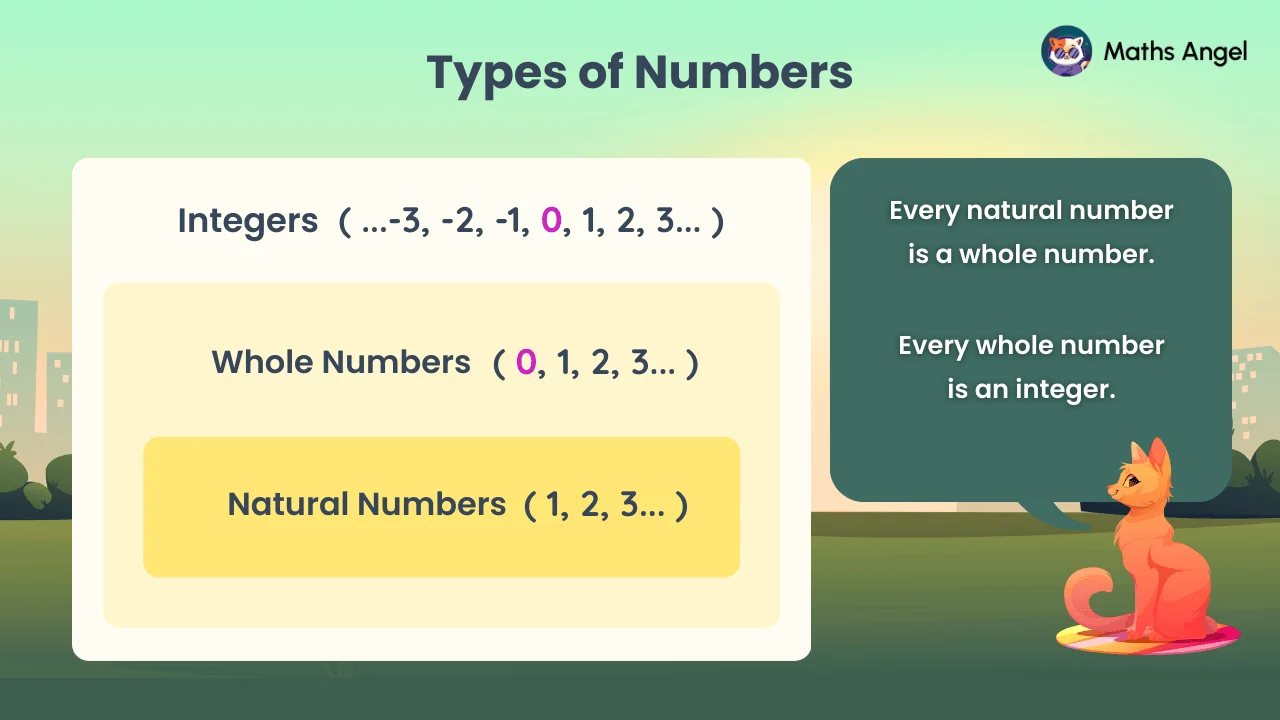
Natural numbers are the counting numbers that start at 1, like 1, 2, 3, 4, 5. Whole numbers add 0, while integers also include negatives like −1, −2, −3. Each set fits inside the next, so every whole number is an integer.
Video Lesson
Watch and learn the basics
🎬 Did this video explain it clearly?
Flashcards
Review key concepts visually
%20Types%20of%20Numbers.webp)
%20Definition%20of%20Natural%20Numbers.webp)
%20Natural%20Numbers%20Practice.webp)
%20Definition%20of%20Whole%20Numbers.webp)
%20Whole%20Numbers%20Practice.webp)
%20Definition%20of%20Integers.webp)
%20Integers%20Practice.webp)
Types of Numbers
- Numbers can be grouped into different sets.
- Common sets are natural numbers, whole numbers, and integers.
What are Natural Numbers?
- Natural numbers are used for counting and start at 1.
- They include 1, 2, 3, 4, 5 … only.
How to Identify Natural Numbers?
- Only positive counting numbers are natural numbers.
- 0, −5, 1/3, and 2.5 are not natural numbers.
What are Whole Numbers?
- Whole numbers are natural numbers plus zero.
- They do not include negative numbers, fractions, or decimals.
How to Identify Whole Numbers?
- Zero is a whole number, but not a natural number.
- Negative numbers are not whole numbers.
What are Integers?
- Integers are whole numbers, their negatives, and zero.
- They do not include fractions or decimals.
How Are Natural Numbers, Whole Numbers, and Integers Related?
- Every natural number is a whole number.
- Every whole number is an integer.
Practice Questions
Test your understanding
Which of the following is a natural number?
Correct! 🎉 +10 pointsCorrect! 🎉 Worth 10 XPNot quite right
Natural numbers are the counting numbers: 1, 2, 3, 4, … They start at 1 and go up in ones.
Natural numbers do not include negative numbers, zero, decimals or fractions. So −3 is out because it is negative, 0 is out because counting starts at 1 (0 is a whole number, but not a natural number), and 2.5 is out because it is a decimal.
That leaves 7, which is a natural number.
Which of the following is a whole number?
Correct! 🎉 +10 pointsCorrect! 🎉 Worth 10 XPNot quite right
Whole numbers are 0, 1, 2, 3, …: the counting numbers together with zero.
Whole numbers do not include negative numbers, decimals or fractions. So −2 is out because it is negative, 4.7 is out because it is a decimal, and is out because it is a fraction. It sits between 0 and 1, not on a whole-number step.
That leaves 15, which is a whole number.
Which set contains only natural numbers?
Correct! 🎉 +20 pointsCorrect! 🎉 Worth 20 XPNot quite right
Natural numbers are the counting numbers : positive, with no zero, no negatives and no decimals.
Every value in 1, 5, 20 is a counting number, so this is the correct set. The set 0, 4, 7 fails because 0 is a whole number but not a natural number. The set −3, 1, 10 fails because −3 is negative. The set 2.5, 3, 4 fails because 2.5 is a decimal, not a counting number.
Which of the following lists contains only integers?
Correct! 🎉 +20 pointsCorrect! 🎉 Worth 20 XPNot quite right
Integers are the whole numbers together with their negatives: . No fractions and no decimals.
Every value in −4, 0, 3 is an integer, so this list is correct. The list −2, 3/2, 6 fails because is a fraction, not a whole amount. The list 0.2, 1, 7 fails because 0.2 is a decimal. The list −3, −2.8, 5 fails because −2.8 is a decimal, even though it is negative. Being negative is allowed, but the value must still be whole.
Which statement is correct?
Correct! 🎉 +20 pointsCorrect! 🎉 Worth 20 XPNot quite right
Integers are , so they do include negative numbers. That statement is correct.
Whole numbers are and are never negative. Natural numbers are the counting numbers , so zero is not one of them. A fraction such as is not an integer, because an integer must be a whole amount.
Which statement is true?
Correct! 🎉 +30 pointsCorrect! 🎉 Worth 30 XPNot quite right
Natural numbers are and whole numbers are , so every natural number is also a whole number. That statement is true.
Not all integers are whole numbers, because integers include negatives such as . For the same reason not all integers are natural numbers. Zero is a whole number, but it is not a natural number, so the last statement is false.
Want to see the full working?
Interactive Activity
Practice identifying Natural, Whole, and Integer numbers
Loading interactive widget...
Frequently asked questions
The questions students bump into most on this topic
Natural numbers are the counting numbers: 1, 2, 3, 4, 5 and so on, without end. They are the numbers you count bees with. They do not include zero, negative numbers, fractions or decimals, so 0, −5, 1/3 and 2.5 are not natural numbers. The first twelve are 1 to 12, and every number from 1 to 100 is a natural number.
No. Natural numbers start at 1, because counting starts at one. Zero belongs to the next two sets: it is a whole number and an integer. Natural numbers cannot be negative either; −5 is an integer but not a natural number. Some textbooks abroad start the natural numbers at 0, but UK school maths starts at 1.
Zero. Whole numbers are the natural numbers plus 0: 0, 1, 2, 3 and so on. You use them when something can be zero, such as the score in a game. Like natural numbers, they have no negatives, fractions or decimals. Exam tip: if a question asks for a whole number, the answer is allowed to be 0.
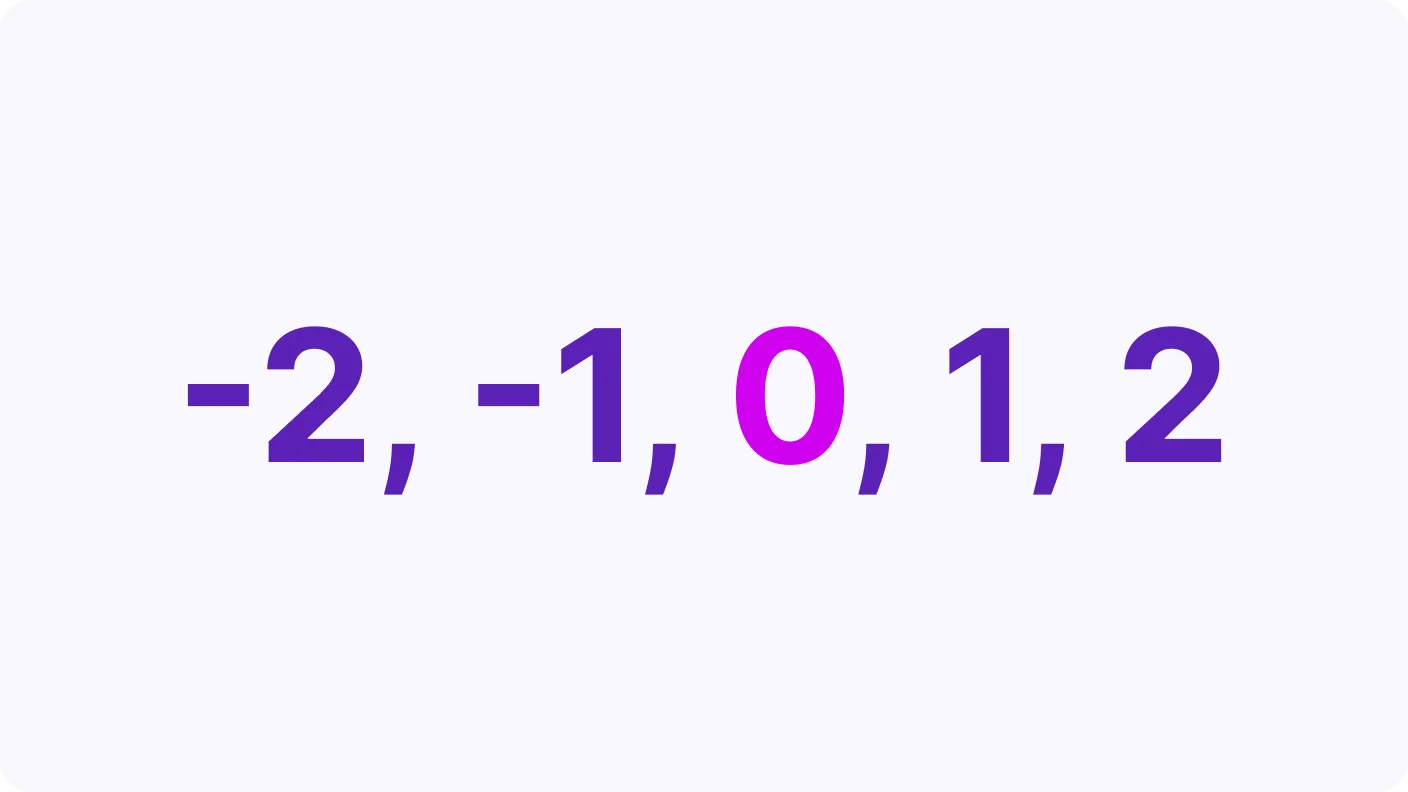
Integers are the whole numbers, their negatives and zero: …, −3, −2, −1, 0, 1, 2, 3, …. You use them when values can go below zero, such as the floors in a building or temperatures. Integers have no fractions or decimals, so 2.5 and 1/3 are not integers, but −7 and 0 are.
The negatives. Whole numbers are 0, 1, 2, 3 and upwards; integers include all of those plus −1, −2, −3 and so on. So every whole number is an integer, but a negative integer such as −7 is not a whole number. The sets are nested: natural numbers sit inside whole numbers, which sit inside integers, so 5 belongs to all three.
Yes, as long as they are whole: −1, −2, −3 and −7 are all integers. They are not natural numbers or whole numbers, because both of those sets exclude negatives. Fractions and decimals are never integers, whatever their sign: 2.5, −2.5 and 1/3 are not integers, because integers have nothing after the decimal point.
What's next?
Found this one hard? Go one step back first. Feeling confident? Carry on to the next lesson.