Rational Numbers and Their Location on a Number Line
Rational numbers can be written as a fraction of two integers. This covers all fractions, integers and decimals that end or repeat. Irrational numbers cannot: their decimals never end or repeat, like π.
Video Lesson
Watch and learn the basics
🎬 Did this video explain it clearly?
Flashcards
Review key concepts visually
%20What%20Are%20Rational%20Numbers.webp)
%20What%20Are%20Irrational%20Numbers.webp)
%20Locating%20Fractions%20on%20a%20Number%20Line.webp)
%20Rational%20Decimals%20on%20a%20Number%20Line.webp)
What are Rational Numbers?
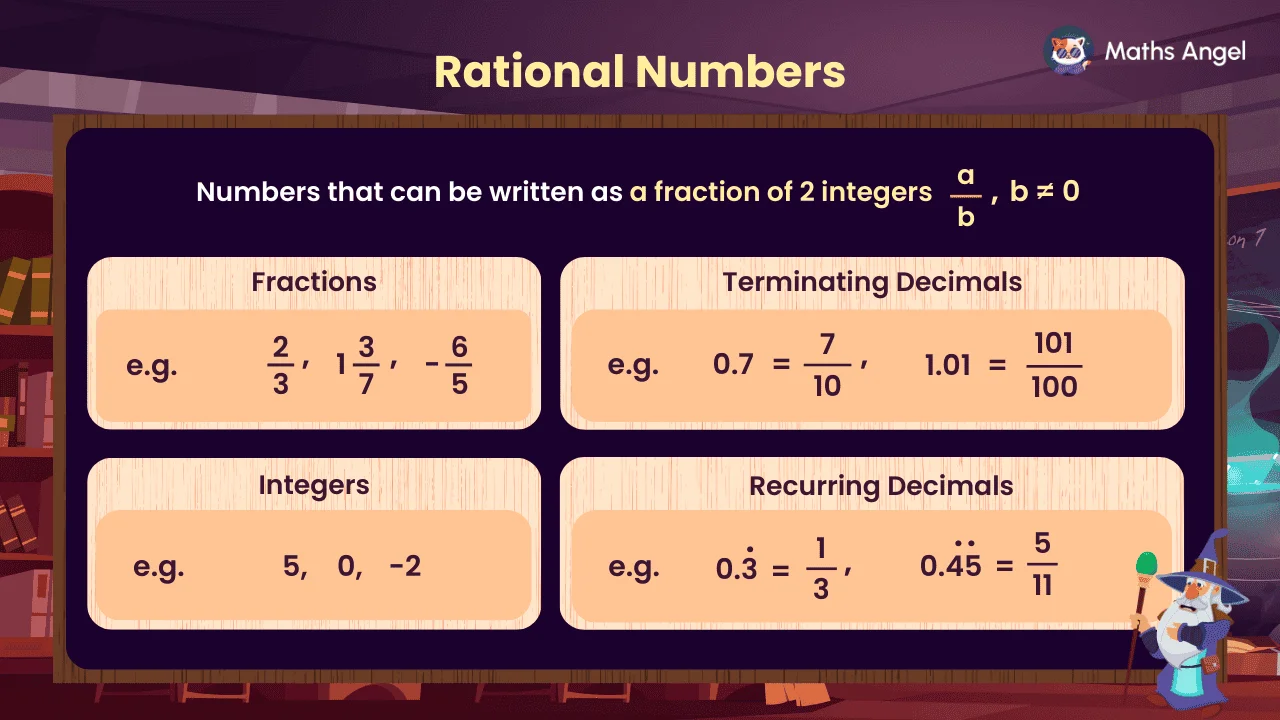
- Rational numbers can be written as a fraction of two integers.
- They include fractions, terminating decimals, integers, and recurring decimals.
What are Irrational Numbers?
- Irrational numbers are decimals that never end and do not repeat.
- They cannot be written as a fraction.
How to Locate Fractions on a Number Line?
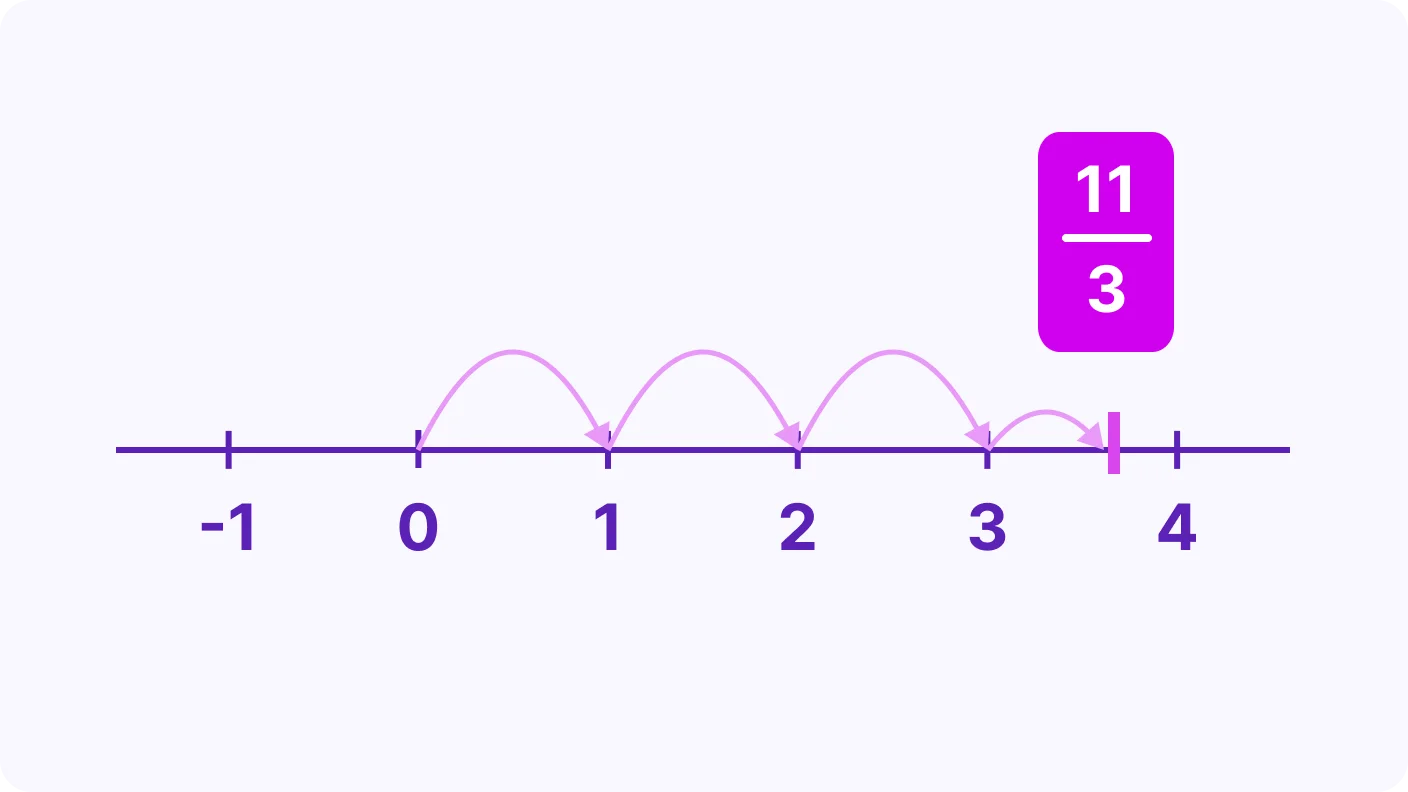
- Rewrite the fraction as a mixed number, for example .
- Go to 3 on the number line, split the gap from 3 to 4 into 3 equal parts, and move 2 parts to find 11/3.
How to Locate Decimals on a Number Line?
- Rewrite the decimal to separate the whole and decimal parts, for example .
- Go to −2, divide the gap from −2 to −3 into 10 equal parts, and move 7 parts to find −2.7.
Practice Questions
Test your understanding
Which of the following numbers is a rational number?
Correct! 🎉 +10 pointsCorrect! 🎉 Worth 10 XPNot quite right
A rational number can be written as one whole number divided by another.
0.25 terminates, so . It is rational. √… and π … never end and never settle into a repeating pattern, and neither does 0.1011011101111… (one 1, then two, then three, separated by zeros), so those three are irrational.
Which of the following is not a rational number?
Correct! 🎉 +10 pointsCorrect! 🎉 Worth 10 XPNot quite right
A rational number can be written as one whole number divided by another.
0.12524364… is irrational: its digits carry on for ever without ever terminating or repeating, so it cannot be written as a fraction. The other three all can be: − is already a fraction, , and the recurring decimal 0.333… .
Locate 7/2 on a number line. Which of the following steps is correct?
Correct! 🎉 +20 pointsCorrect! 🎉 Worth 20 XPNot quite right
7/2 means 7 ÷ 2, which is 3 remainder 1, so .
Start at 0 and move 3 whole units to the right to reach 3. Then split the unit from 3 to 4 into 2 equal parts (each worth ) and stop at the end of the 1st part. That point is 3.5, which is 7/2.
Locate -1.6 on a number line. Which of the following steps is correct?
Correct! 🎉 +20 pointsCorrect! 🎉 Worth 20 XPNot quite right
-1.6 lies between -1 and -2, because 1.6 is between 1 and 2.
Move 1 unit to the left to reach -1, then split the distance between -1 and -2 into 10 equal parts (each worth 0.1) and count 6 of those parts further to the left. You stop at -1.6.
Which of the following numbers is irrational?
Correct! 🎉 +20 pointsCorrect! 🎉 Worth 20 XPNot quite right
A rational number can be written as a fraction of two whole numbers; an irrational number cannot, and its decimal never ends and never repeats.
is irrational: 7 is not a square number, and goes on forever without repeating.
The others are all rational. . −8/3 is already a fraction of two whole numbers. 2.1212… is a recurring decimal, and every recurring decimal is rational. This one equals 70/33.
On a number line, where would −11/4 be located?
Correct! 🎉 +30 pointsCorrect! 🎉 Worth 30 XPNot quite right
−11/4 means −(11 ÷ 4). Since remainder 3, we have , so .
Move 2 units to the left to reach −2, then split the distance between −2 and −3 into 4 equal parts (each worth 0.25) and count 3 of them. You stop at −2.75, between −2 and −3 but closer to −3.
Want to see the full working?
Interactive Activity
Explore how rational numbers (decimals and fractions) are located on the line.
Loading interactive widget...
Frequently asked questions
The questions students bump into most on this topic
A rational number is any number that can be written as a fraction of two integers, a over b, where b is not 0. That includes every fraction, such as 2/3 and −6/5; every integer, such as 5, 0 and −2, because 5 is 5/1; every terminating decimal, such as 0.7 = 7/10; and every recurring decimal, such as 0.333… = 1/3.
An irrational number cannot be written as a fraction of two integers: its decimal goes on forever without repeating. Pi, 3.14159…, and the square root of 2, 1.41421…, are the common examples. The square root of 7 is irrational too, as is the square root of any whole number that is not a perfect square. Every number is either rational or irrational.
Yes: 3.14 is a terminating decimal, so it is 314/100, a fraction of two integers. Pi is not. 3.14 is only an approximation of pi; pi itself is 3.14159… and goes on forever without repeating, so it cannot be written as a fraction and is irrational. The same goes for 22/7: rational, but only an approximation.
Yes. Every integer is rational, because you can write it over 1: 0 is 0/1, 5 is 5/1 and −2 is −2/1. The numerator and denominator are integers and the denominator is not zero, which is all the definition asks. The only rule is that the bottom of the fraction cannot be 0.
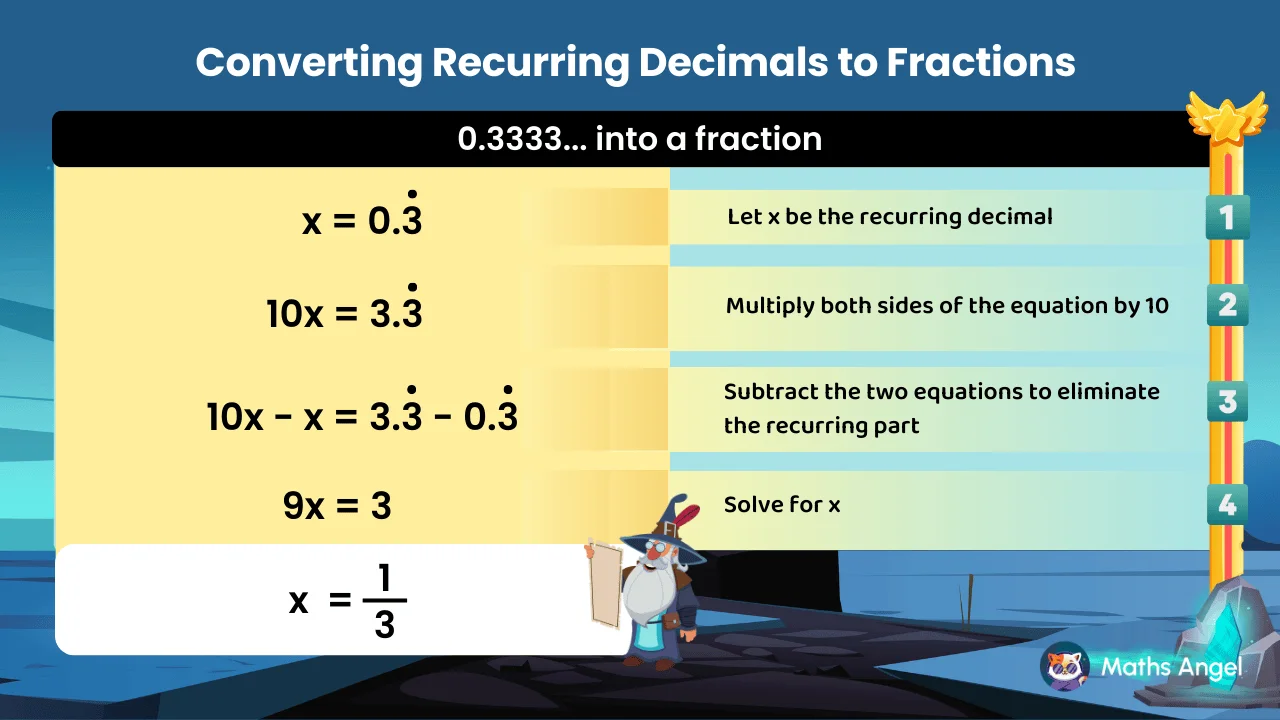
All fractions are rational by definition. Decimals are rational if they terminate, like 0.7 = 7/10 and 1.01 = 101/100, or recur, like 0.333… = 1/3 and 0.4545… = 5/11, because both kinds can be written as fractions. A decimal that never ends and never repeats, like pi, is the only kind that is not.
Write it as a mixed number, go to the whole number, then split the next unit. For 11/3 = 3 2/3, go to 3, divide the gap from 3 to 4 into 3 equal parts and move 2 parts right. For a decimal, split the unit into 10: for −2.7, go to −2, divide the gap to −3 into 10 parts and move 7 parts left.
What's next?
Found this one hard? Go one step back first. Feeling confident? Carry on to the next lesson.