Divisibility and Divisibility Rules
Divisibility rules are quick digit checks that tell you whether a number is divisible by another, meaning it divides exactly with no remainder: a number is divisible by 2 when its last digit is even.
Video Lesson
Watch and learn the basics
🎬 Did this video explain it clearly?
Flashcards
Review key concepts visually
%20Divisibility.webp)
%20Divisibility%20Rules%20for%202%2C4%2C8.webp)
%20Divisibility%20Rules%20for%203%2C6%2C9.webp)
%20Divisibility%20Rules%20for%205%2C%2010.webp)
What Does Divisible Mean?
- A number is divisible if it divides exactly with no remainder.
- For example, (divisible), but (not divisible).
Divisibility Rules for 2, 4, and 8
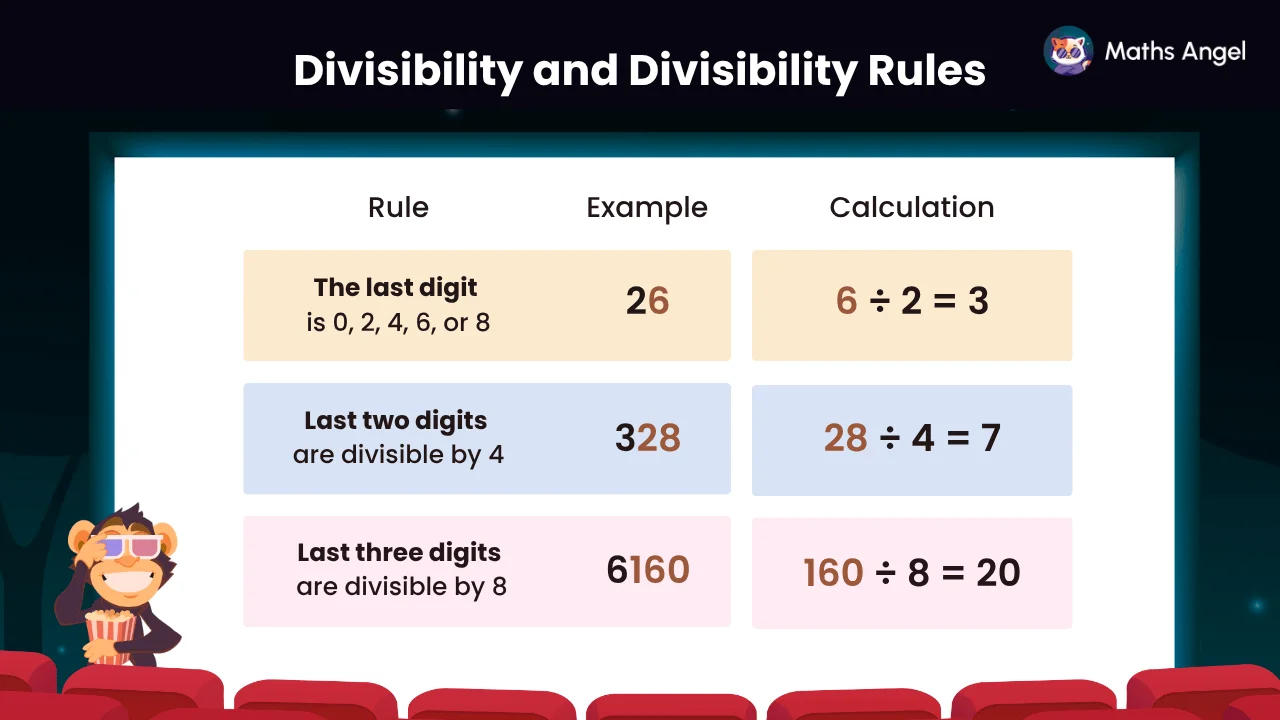
- A number is divisible by 2 if the last digit is even (0, 2, 4, 6, 8).
- A number is divisible by 4 if the last two digits are divisible by 4.
- A number is divisible by 8 if the last three digits are divisible by 8.
Divisibility Rules for 3, 6, and 9
- A number is divisible by 3 if the sum of its digits is divisible by 3.
- A number is divisible by 6 if it is divisible by both 2 and 3.
- A number is divisible by 9 if the sum of its digits is divisible by 9.
Divisibility Rules for 5 and 10
- A number is divisible by 5 if the last digit is 0 or 5.
- A number is divisible by 10 if the last digit is 0.
Practice Questions
Test your understanding
Is 124 divisible by 2?
Correct! 🎉 +10 pointsCorrect! 🎉 Worth 10 XPNot quite right
A whole number is divisible by 2 if its last digit is 0, 2, 4, 6 or 8.
124 ends in 4, so it is even. Checking: with no remainder, so 2 goes into 124 exactly.
So the answer is Yes.
Which of the following numbers is divisible by 5?
Correct! 🎉 +10 pointsCorrect! 🎉 Worth 10 XPNot quite right
A whole number is divisible by 5 only if its last digit is 0 or 5.
40 ends in 0, and exactly, so 40 is the number that is divisible by 5.
The others end in 3, 4 and 7: remainder 3, remainder 4 and remainder 2.
Is 542 divisible by 3?
Correct! 🎉 +20 pointsCorrect! 🎉 Worth 20 XPNot quite right
A number is divisible by 3 when the sum of all its digits is a multiple of 3.
For 542: . The multiples of 3 either side of 11 are 9 and 12, so 11 is not a multiple of 3 and neither is 542.
Check: , so there is a remainder of 2.
Looking at only part of the number (for example, spotting that ) is not enough. The test uses every digit.
Is 675 divisible by 9?
Correct! 🎉 +20 pointsCorrect! 🎉 Worth 20 XPNot quite right
A number is divisible by 9 when the sum of its digits is a multiple of 9.
For 675: , and , so 675 is divisible by 9.
Check: exactly.
The digit sum only has to be a multiple of 9. It does not have to be 9 itself. Being an odd number does not stop 675 from being divisible by 9 either.
Which of the following numbers is divisible by 8?
Correct! 🎉 +20 pointsCorrect! 🎉 Worth 20 XPNot quite right
A whole number is divisible by 8 if its last three digits form a number that is divisible by 8.
432 has only three digits, so check it directly: exactly, so 432 is divisible by 8.
Is 528 divisible by 6?
Correct! 🎉 +30 pointsCorrect! 🎉 Worth 30 XPNot quite right
A number is divisible by 6 when it is divisible by both 2 and 3.
528 is even, so it is divisible by 2. Its digits add to , and is a multiple of 3, so 528 is divisible by 3 as well.
Both tests pass, so 528 is divisible by 6. Check: exactly.
Note that the digit sum only has to be a multiple of 3. It does not need to be a multiple of 6.
Want to see the full working?
Interactive Activity
Click to test divisibility rules and see which digits matter.
Loading interactive widget...
Frequently asked questions
The questions students bump into most on this topic
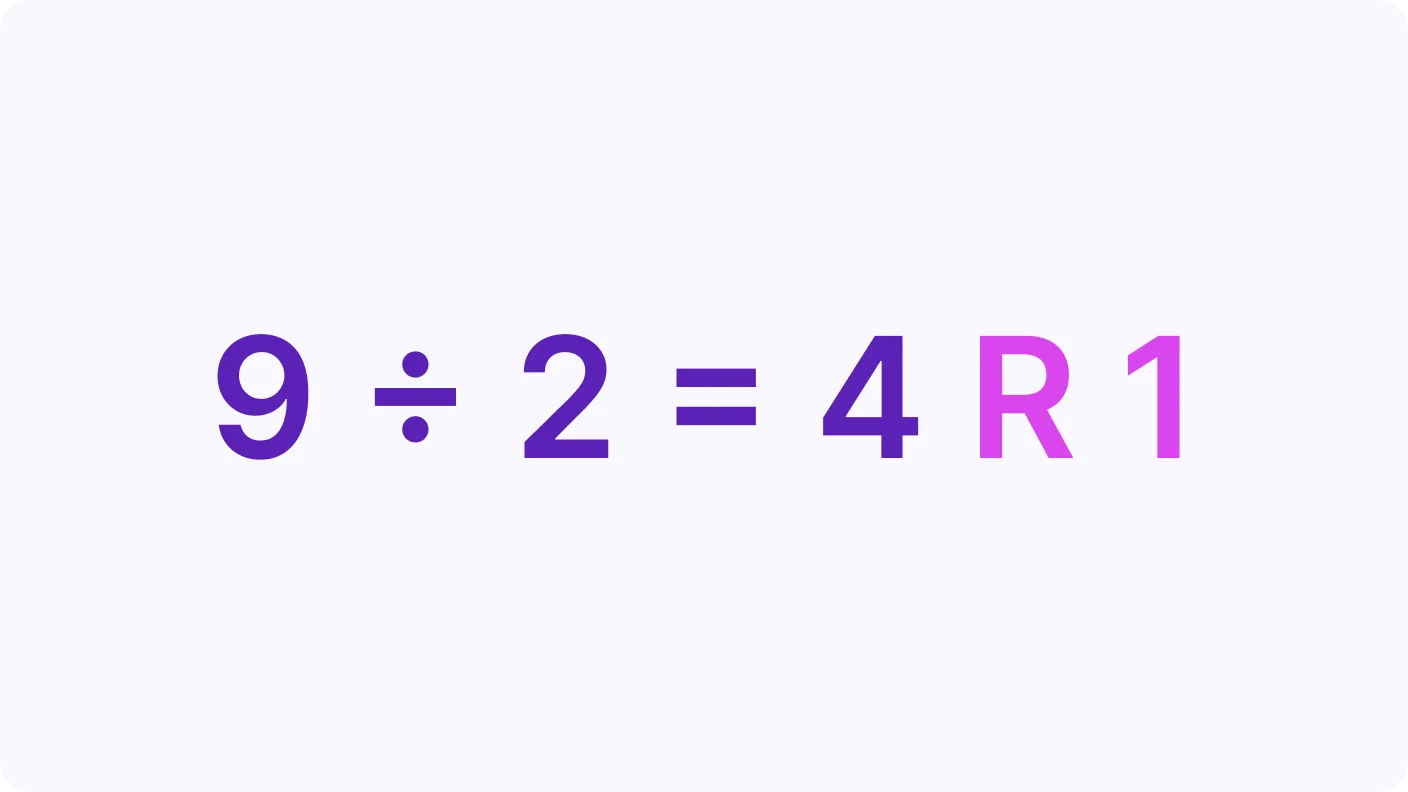
A number is divisible by another when it divides exactly, with no remainder. 9 is divisible by 3 because 9 ÷ 3 = 3 exactly. Sharing 9 bananas between 2 friends gives 4 each with 1 left over, so 9 is not divisible by 2; that leftover 1 is the remainder, and it is always smaller than the number you divide by.
Check the digits. By 2: last digit even. By 3: digits add to a multiple of 3. By 4: last two digits divide by 4. By 5: ends in 0 or 5. By 6: divisible by 2 and 3. By 8: last three digits divide by 8. By 9: digits add to a multiple of 9. By 10: ends in 0.
Add up the digits. If the total is divisible by 3, so is the number: 5 + 4 + 3 = 12, and 12 is divisible by 3, so 543 is. If the total is divisible by 9, so is the number: 1 + 9 + 8 = 18, so 198 is divisible by 9. For 45, 4 + 5 = 9, so 45 is divisible by both 3 and 9.
Look at the end of the number. A number is divisible by 4 when its last two digits make a number divisible by 4: 328 ends in 28, and 28 ÷ 4 = 7, so it works. A number is divisible by 8 when its last three digits are divisible by 8: 6,160 ends in 160, and 160 ÷ 8 = 20, so it works.
It must pass both the 2 test and the 3 test: the last digit is even and the digits add up to a multiple of 3. Take 402: the last digit is 2, so it is divisible by 2, and 4 + 0 + 2 = 6, which is divisible by 3. Because 402 passes both tests, it is divisible by 6.
Run the rules in turn. For 26: the last digit is even, so it is divisible by 2; 2 + 6 = 8 is not a multiple of 3, so not by 3; it does not end in 0 or 5, so not by 5 or 10. Dividing by 2 gives 13, a prime, so 26 is divisible only by 1, 2, 13 and 26.
What's next?
Found this one hard? Go one step back first. Feeling confident? Carry on to the next lesson.