Prime Numbers and Prime Factorisation
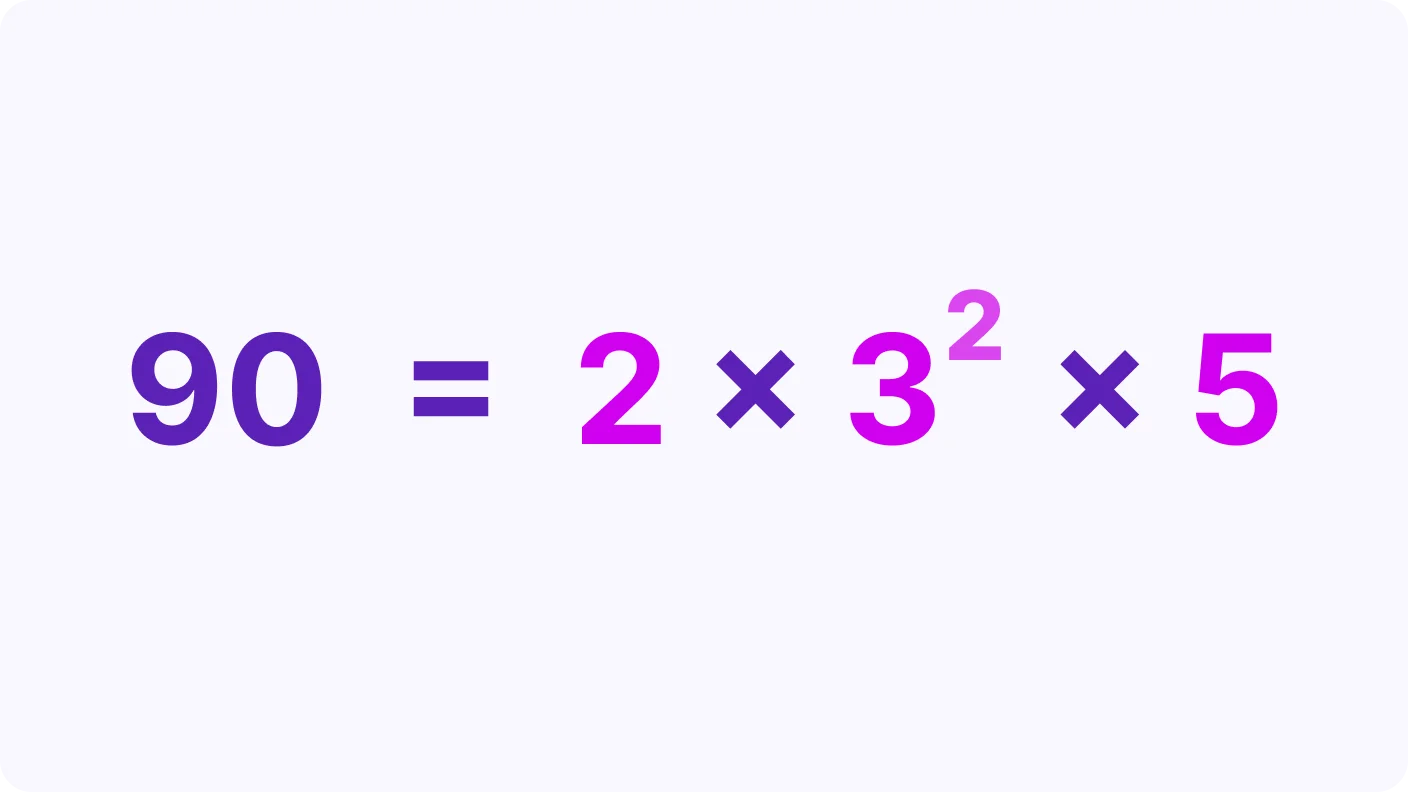
A prime number is a whole number above 1 with exactly two factors: 1 and itself. So 7 is prime, but 6 is not because it also divides by 2 and 3. Prime factorisation writes a number as a product of primes, like 90 = 2 × 3² × 5.
Video Lesson
Watch and learn the basics
🎬 Did this video explain it clearly?
Flashcards
Review key concepts visually
%20Prime%20Numbers.webp)
%20Prime%20Numbers%20below%2020.webp)
%20Prime%20Factorisation%20Division%20Method.webp)
%20Prime%20Factorisation%20Tree%20Method.webp)
What is a Prime Number?
- A prime number has exactly two different factors: 1 and itself.
- 2 is the smallest prime number.
- 0 and 1 are not prime numbers.
Prime Numbers Below 20
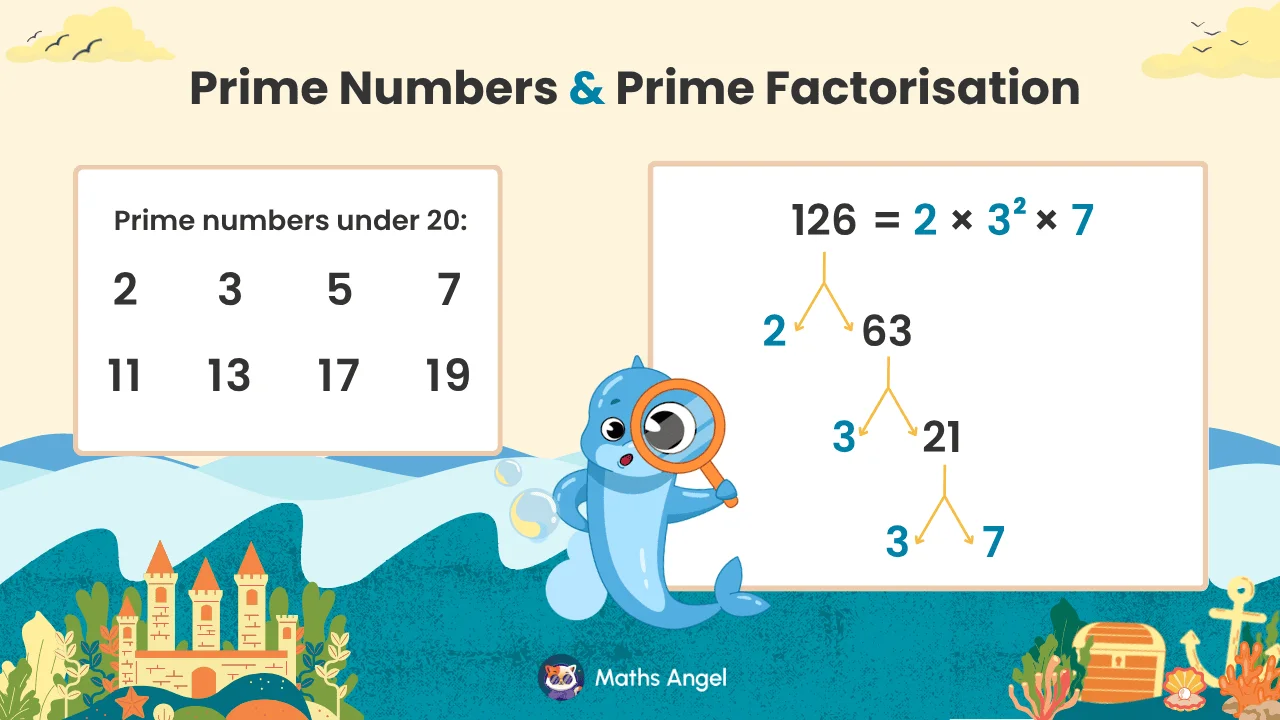
- The prime numbers below 20 are: 2, 3, 5, 7, 11, 13, 17, 19.
- Remembering them helps you factorise larger numbers.
What Does Prime Factorisation Mean?
- Prime factorisation means writing a number as a product of prime numbers only.
- For example, .
Factor Tree Method for Prime Factorisation
- The factor tree method breaks a number into smaller factors step by step.
- Keep factorising until all factors are prime numbers.
Practice Questions
Test your understanding
Which of the following is a prime number?
Correct! 🎉 +10 pointsCorrect! 🎉 Worth 10 XPNot quite right
A prime number has exactly two different factors: 1 and itself.
7 is prime because no whole number between 1 and 7 divides into it. and are composite, and 1 is not prime because it has only one factor.
What is the smallest prime number?
Correct! 🎉 +10 pointsCorrect! 🎉 Worth 10 XPNot quite right
A prime number has exactly two different factors: 1 and itself.
2 is the smallest prime, and the only even one, because its only factors are 1 and 2. 0 and 1 are not prime: 1 has just one factor, and every whole number divides into 0. 3 is prime, but it is not the smallest.
Which of the following numbers is NOT a prime number?
Correct! 🎉 +20 pointsCorrect! 🎉 Worth 20 XPNot quite right
15 is not prime because , so it has four factors: 1, 3, 5 and 15.
The other three are all prime. 2 is prime even though it is even, since its only factors are 1 and 2, and 11 and 13 have no factors other than 1 and themselves.
Write 36 as a product of its prime factors, using index notation.
Correct! 🎉 +20 pointsCorrect! 🎉 Worth 20 XPNot quite right
Split 36 until every branch is prime: , and each .
So , which in index form is 2² × 3². Check: .
Write 144 as a product of its prime factors, using index notation.
Correct! 🎉 +20 pointsCorrect! 🎉 Worth 20 XPNot quite right
Split 144 until every branch is prime: , and each .
So , which in index form is 2⁴ × 3². Check: .
Express 360 as a product of prime factors using indices.
Correct! 🎉 +30 pointsCorrect! 🎉 Worth 30 XPNot quite right
Split 360 into parts you know: .
That gives , which in index form is 2³ × 3² × 5. Check: .
Want to see the full working?
Interactive Activity
Build the prime factorisation tree
Loading interactive widget...
Frequently asked questions
The questions students bump into most on this topic
A prime number is a whole number with exactly two different factors: 1 and itself. So 2 is prime, because only 1 and 2 divide into it, but 4 is not, because 1, 2 and 4 all do. The primes below 20 are 2, 3, 5, 7, 11, 13, 17 and 19. Every whole number above 1 is made by multiplying primes.
No. A prime number must have exactly two different factors, 1 and itself, and 1 has only one factor: itself. So 1 is not prime, and 2, not 1, is the smallest prime number. Zero is not prime either.
Yes. The only factors of 2 are 1 and 2, so it has exactly two factors and is prime; it is also the smallest prime number. It is the only even prime, because every other even number has 2 as an extra factor. So not all primes are odd, but all primes except 2 are.
There are 25 prime numbers from 1 to 100: 2, 3, 5, 7, 11, 13, 17, 19, 23, 29, 31, 37, 41, 43, 47, 53, 59, 61, 67, 71, 73, 79, 83, 89 and 97. The first five are 2, 3, 5, 7 and 11, and the first ten end with 29. Below 10 there are four: 2, 3, 5 and 7.
Divide by prime numbers, smallest first, until only primes are left. For 90: 90 = 2 × 45, then 45 = 3 × 15, then 15 = 3 × 5, so 90 = 2 × 3 × 3 × 5, written with indices as 2 × 3² × 5. A factor tree shows the same steps as branches. Every number has exactly one set of prime factors, whichever route you take.
Give your child 12 counters and ask them to make equal rows: 2 rows of 6, 3 rows of 4. Then try 7 counters: the only ways are one row of 7 or seven rows of 1. A number like 7 that only makes those two arrangements is prime. Try 2, 3, 5 and 11 too.
What's next?
Found this one hard? Go one step back first. Feeling confident? Carry on to the next lesson.