How to Find HCF and LCM
HCF and LCM: the highest common factor (HCF) is the biggest factor two numbers share, and the lowest common multiple (LCM) is the smallest multiple they share. Find either by listing or prime factorisation.
Video Lesson
Watch and learn the basics
🎬 Did this video explain it clearly?
Flashcards
Review key concepts visually
%20What%20is%20HCF%20and%20LCM.webp)
%20Finding%20HCF%20and%20LCM%20by%20Listing.webp)
%20Finding%20HCF%20and%20LCM%20by%20Prime%20Factorisation.webp)
%20Finding%20HCF%20and%20LCM%20-%20Further%20Example.webp)
What Are HCF and LCM?
- HCF (Highest Common Factor) is the biggest factor the numbers share
- LCM (Lowest Common Multiple) is the smallest multiple the numbers share
Finding HCF and LCM by Listing
- For HCF, list the factors of each number and choose the largest common one
- For LCM, list the multiples of each number and choose the smallest common one
Finding HCF and LCM by Prime Factorisation
- Use prime factorisation for larger numbers or when listing would be long
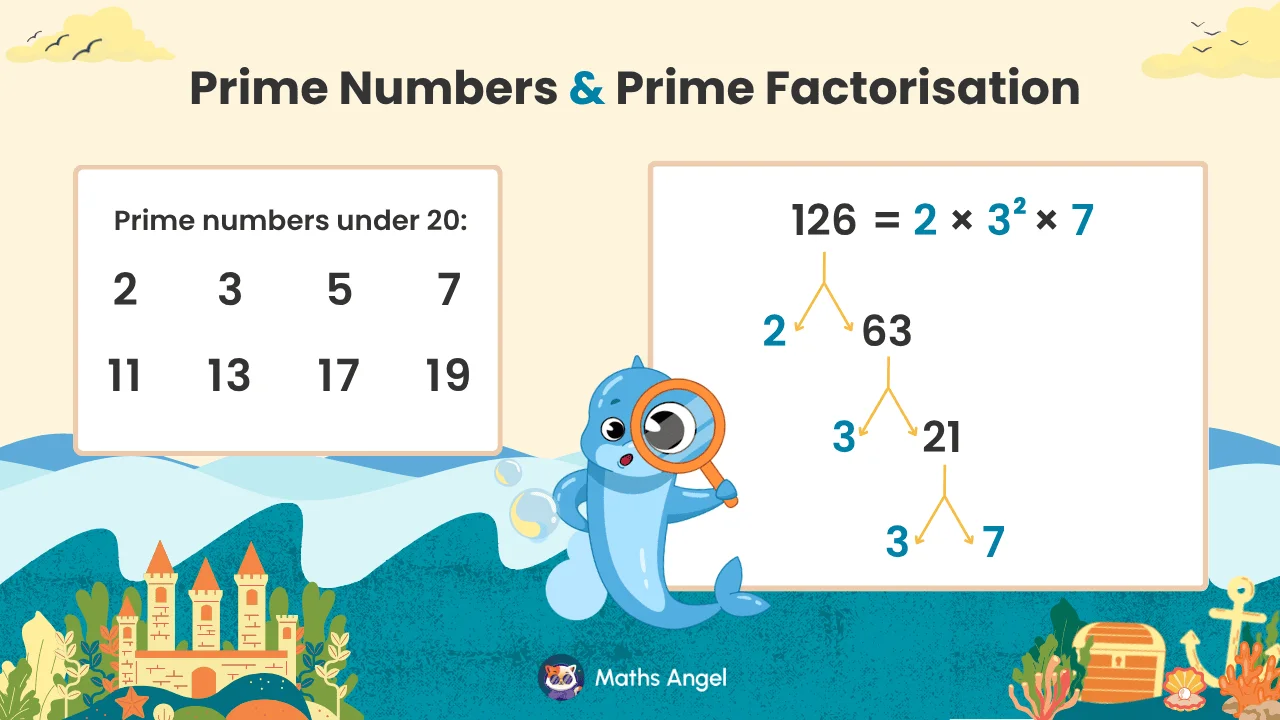
- Write each number as a product of prime factors
Using Prime Factors to Find HCF and LCM
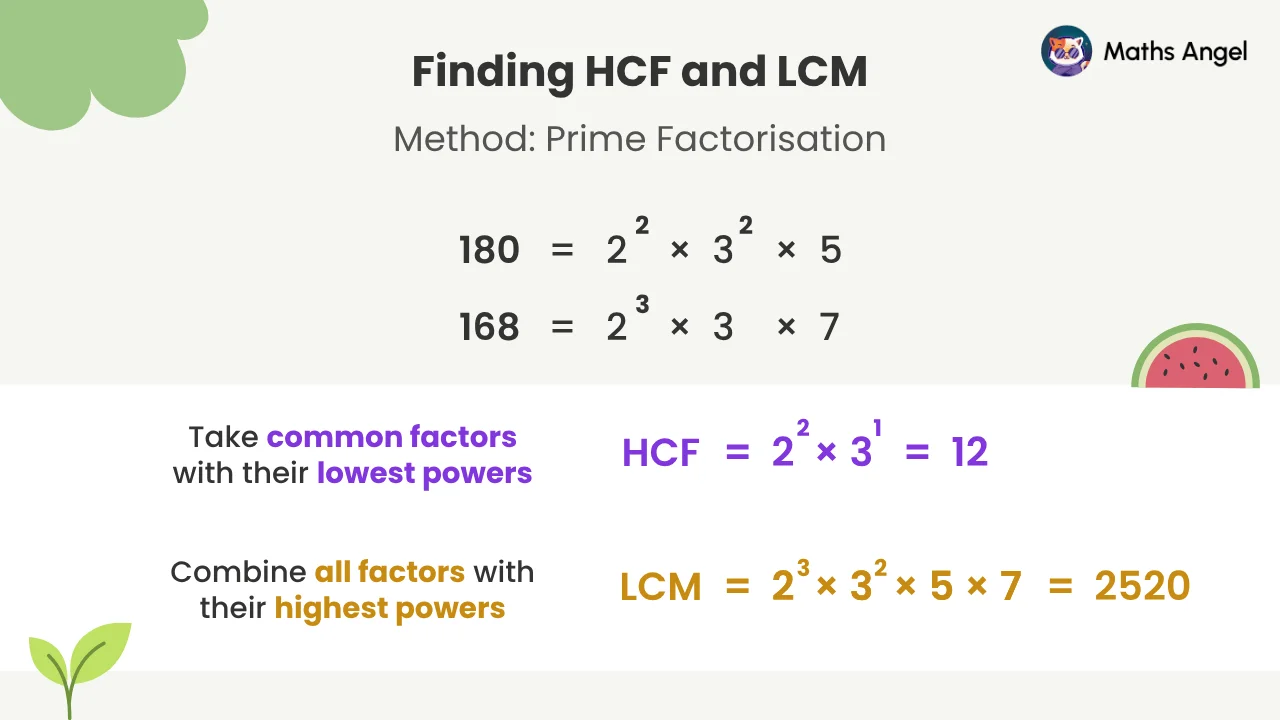
- For HCF, take the common primes with the lowest powers
- For LCM, take all primes with the highest powers
Practice Questions
Test your understanding
What is the HCF of 8 and 12?
Correct! 🎉 +10 pointsCorrect! 🎉 Worth 10 XPNot quite right
The factors of 8 are 1, 2, 4, 8. The factors of 12 are 1, 2, 3, 4, 6, 12.
The numbers appearing in both lists are 1, 2 and 4, so the highest common factor is 4.
What is the LCM of 4 and 6?
Correct! 🎉 +10 pointsCorrect! 🎉 Worth 10 XPNot quite right
Multiples of 4: 4, 8, 12, 16, 20, 24, ...
Multiples of 6: 6, 12, 18, 24, ...
The smallest number in both lists is 12, so the LCM of 4 and 6 is 12.
Note that is also a common multiple, but it is not the lowest one, and is not a multiple of either number. 2 is the highest common factor of 4 and 6, not the LCM.
What is the LCM of 15 and 20?
Correct! 🎉 +20 pointsCorrect! 🎉 Worth 20 XPNot quite right
The multiples of 15 are 15, 30, 45, 60, ... and the multiples of 20 are 20, 40, 60, ... The smallest number in both lists is 60, so the LCM is 60.
Using prime factors, and . Taking the highest power of each prime gives . The shared 5 is counted once, not twice.
What is the HCF of 45 and 75?
Correct! 🎉 +20 pointsCorrect! 🎉 Worth 20 XPNot quite right
The factors of 45 are 1, 3, 5, 9, 15, 45 and the factors of 75 are 1, 3, 5, 15, 25, 75. The largest number in both lists is 15, so the HCF is 15.
Using prime factors, and . Only one 3 and one 5 are shared, so the HCF is .
Using prime factorisation, what is the LCM of 28 and 42?
Correct! 🎉 +20 pointsCorrect! 🎉 Worth 20 XPNot quite right
and .
For the LCM, take the highest power of every prime that appears in either number: . Each shared prime (the 2 and the 7) is counted once, not once for each number.
What is the LCM of 72 and 108?
Correct! 🎉 +30 pointsCorrect! 🎉 Worth 30 XPNot quite right
and .
Taking the highest power of each prime gives the LCM: . Taking the lowest powers instead would give the HCF, .
Want to see the full working?
Interactive Activity
Visualise HCF and LCM using prime factorisation
Loading interactive widget...
Frequently asked questions
The questions students bump into most on this topic
The HCF, or highest common factor, is the biggest number that divides exactly into two or more numbers. The factors of 12 are 1, 2, 3, 4, 6 and 12, and the factors of 18 are 1, 2, 3, 6, 9 and 18, so the biggest shared factor, the HCF, is 6. The LCM is different: it is a multiple, not a factor.
The LCM, or lowest common multiple, is the smallest number that two or more numbers all divide into. The multiples of 12 are 12, 24, 36 and so on, and the multiples of 18 are 18, 36, 54, so the LCM of 12 and 18 is 36. The HCF is the biggest shared factor; the LCM is the smallest shared multiple.
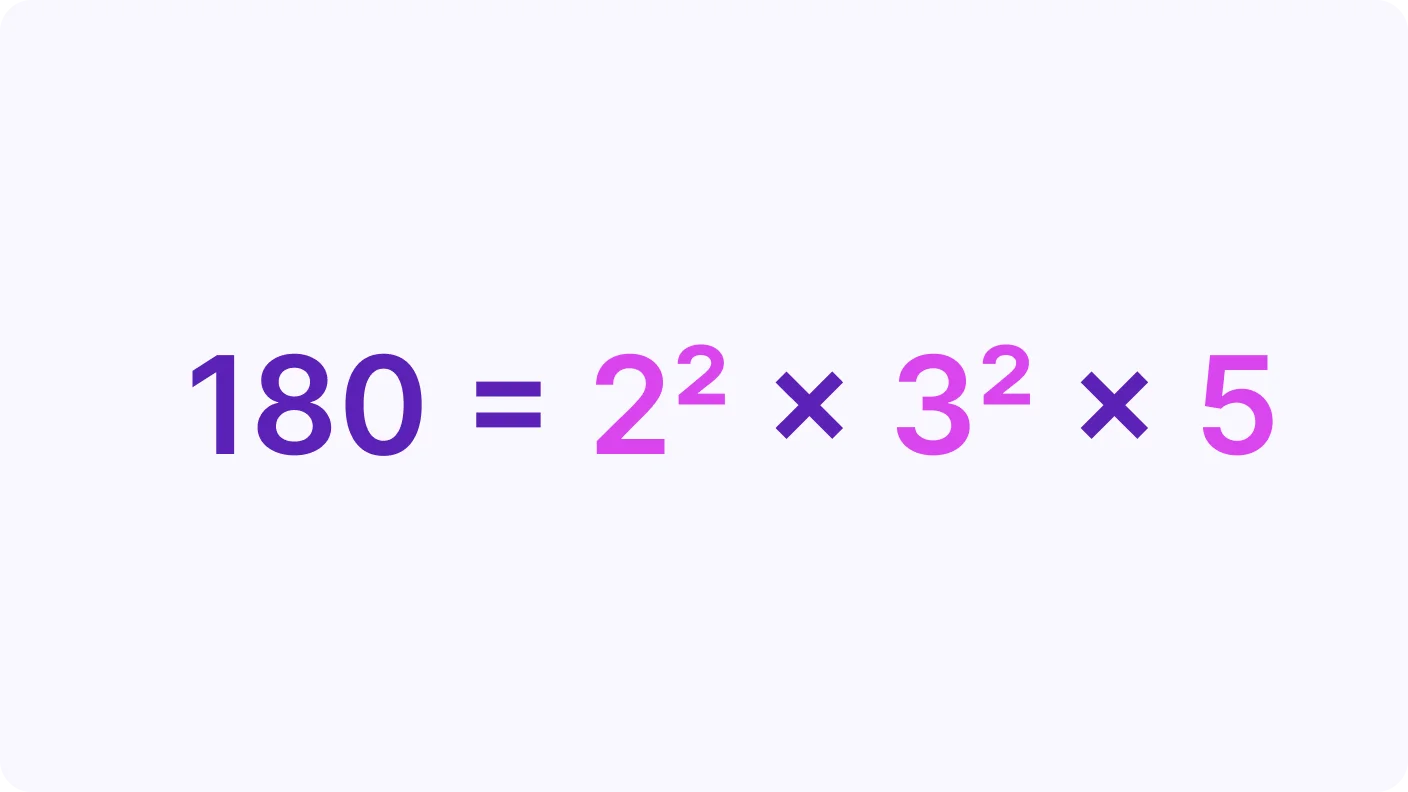
For small numbers, list the factors of each and pick the largest one they share: for 12 and 18 that is 6. For larger numbers, write each as a product of prime factors and multiply the primes they share, using the lower power of each: 180 = 2² × 3² × 5 and 168 = 2³ × 3 × 7 share 2² and 3, so the HCF is 4 × 3 = 12.
For small numbers, list the multiples of each and take the smallest one they share: for 12 and 18 that is 36. For larger numbers, write each as a product of prime factors and multiply every prime that appears, using the higher power of each: for 180 = 2² × 3² × 5 and 168 = 2³ × 3 × 7, that is 2³ × 3² × 5 × 7 = 2,520.
Write each number as a product of primes with indices. For 56 = 2³ × 7 and 100 = 2² × 5²: the HCF takes the shared primes at their lowest power, 2² = 4; the LCM takes every prime at its highest power, 2³ × 5² × 7 = 1,400. The method always works and is the one to use when listing would take too long.
Use two small numbers and two lists. For 12 and 18, write out the factors of each and circle the ones in both lists; the biggest circled number, 6, is the HCF. Then write out the times tables of 12 and 18 and circle the first number in both, 36; that is the LCM.
What's next?
Found this one hard? Go one step back first. Feeling confident? Carry on to the next lesson.