Introduction to Fractions
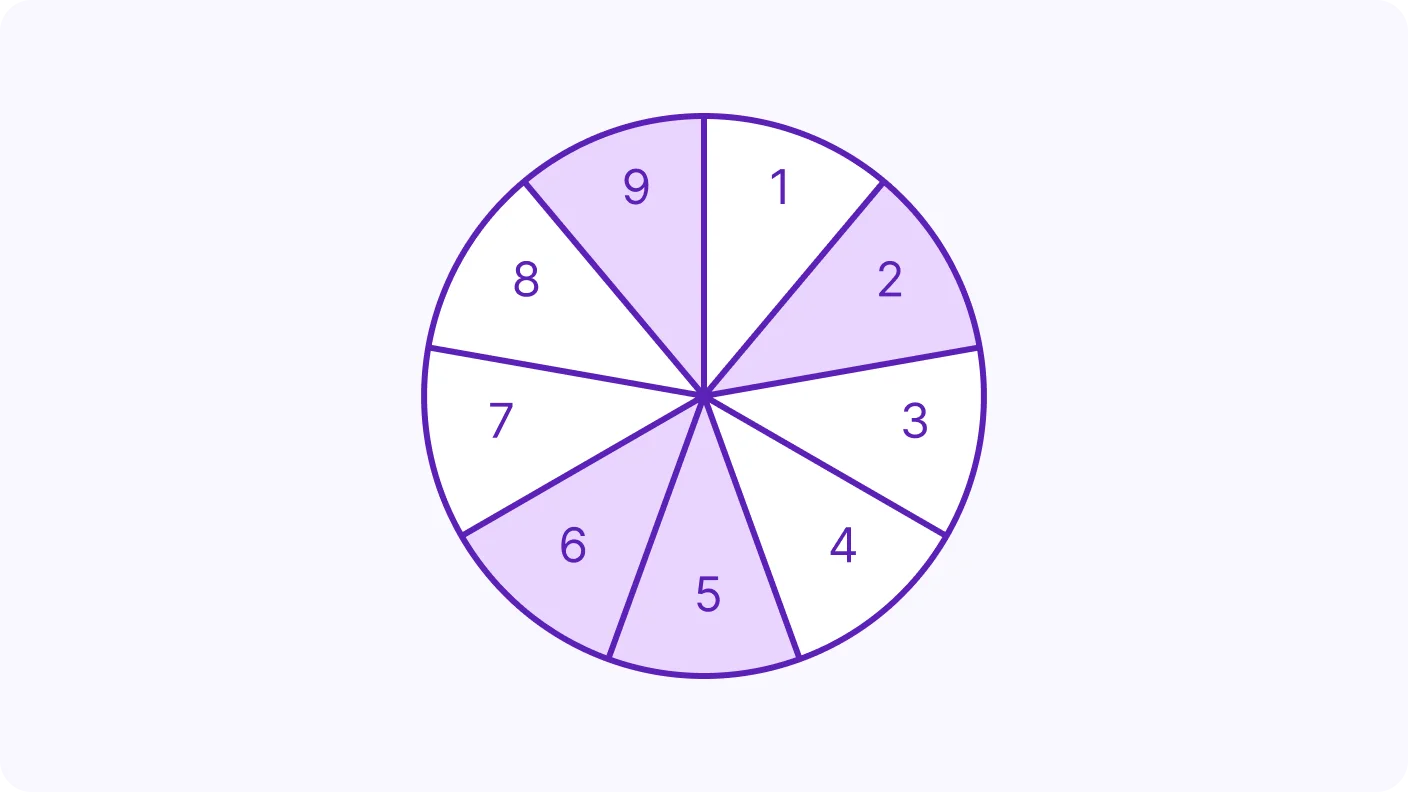
Fractions show part of a whole split into equal parts, like a pizza cut into 9 equal slices where taking 4 gives 4/9. The numerator (4) counts the parts taken; the denominator (9) counts the total equal parts.
Video Lesson
Watch and learn the basics
🎬 Did this video explain it clearly?
Flashcards
Review key concepts visually
%20Introduction%20to%20Fractions.webp)
%20What%20is%20a%20Fraction.webp)
%20Understanding%20Fractions.webp)
%20Fractions%20Examples.webp)
%20Applying%20Fractions.webp)
What is a Fraction?
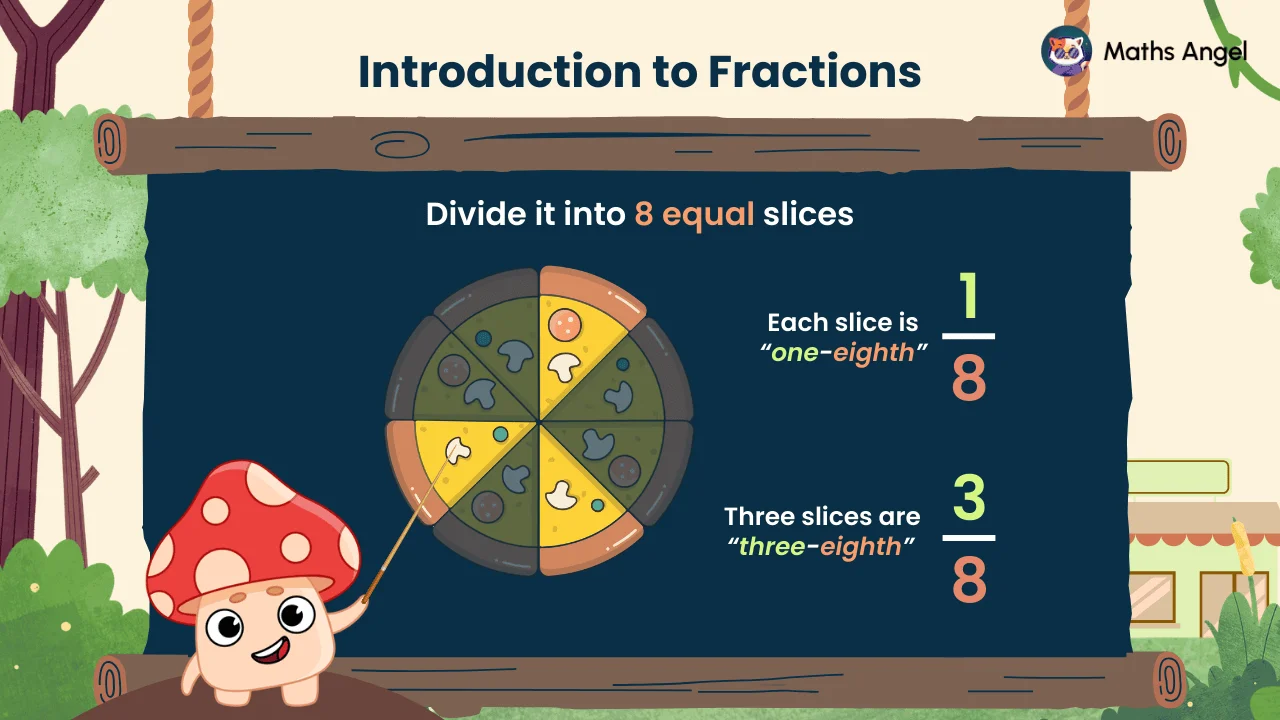
- A fraction shows part of a whole.
- For example, if a pizza is cut into 8 equal slices and you take 3, the fraction is 3/8.
Parts of a Fraction (Example: 3/8)
- The numerator (3) shows how many parts are taken.
- The denominator (8) shows how many equal parts the whole is split into.
Exam Rule: Equal Parts
- Fractions only work when the whole is divided into equal parts.
- If the parts are not equal, you cannot write a correct fraction.
How Do You Find a Fraction of an Amount?
- Divide the total by the denominator to find one part: .
- Multiply that by the numerator to get the answer: .
- So, 3/4 of .
Finding Missing Fractions
- The parts of a whole must add up to 1.
- To find a missing fraction, subtract the known fractions from 1.
Practice Questions
Test your understanding
In a fraction, what does the denominator tell us?
Correct! 🎉 +10 pointsCorrect! 🎉 Worth 10 XPNot quite right
The denominator is the bottom number of a fraction. It tells us how many equal parts the whole has been divided into.
The numerator, the top number, tells us how many of those equal parts we are talking about. In the 4 means the whole is split into 4 equal parts, and the 3 means we are considering 3 of them.
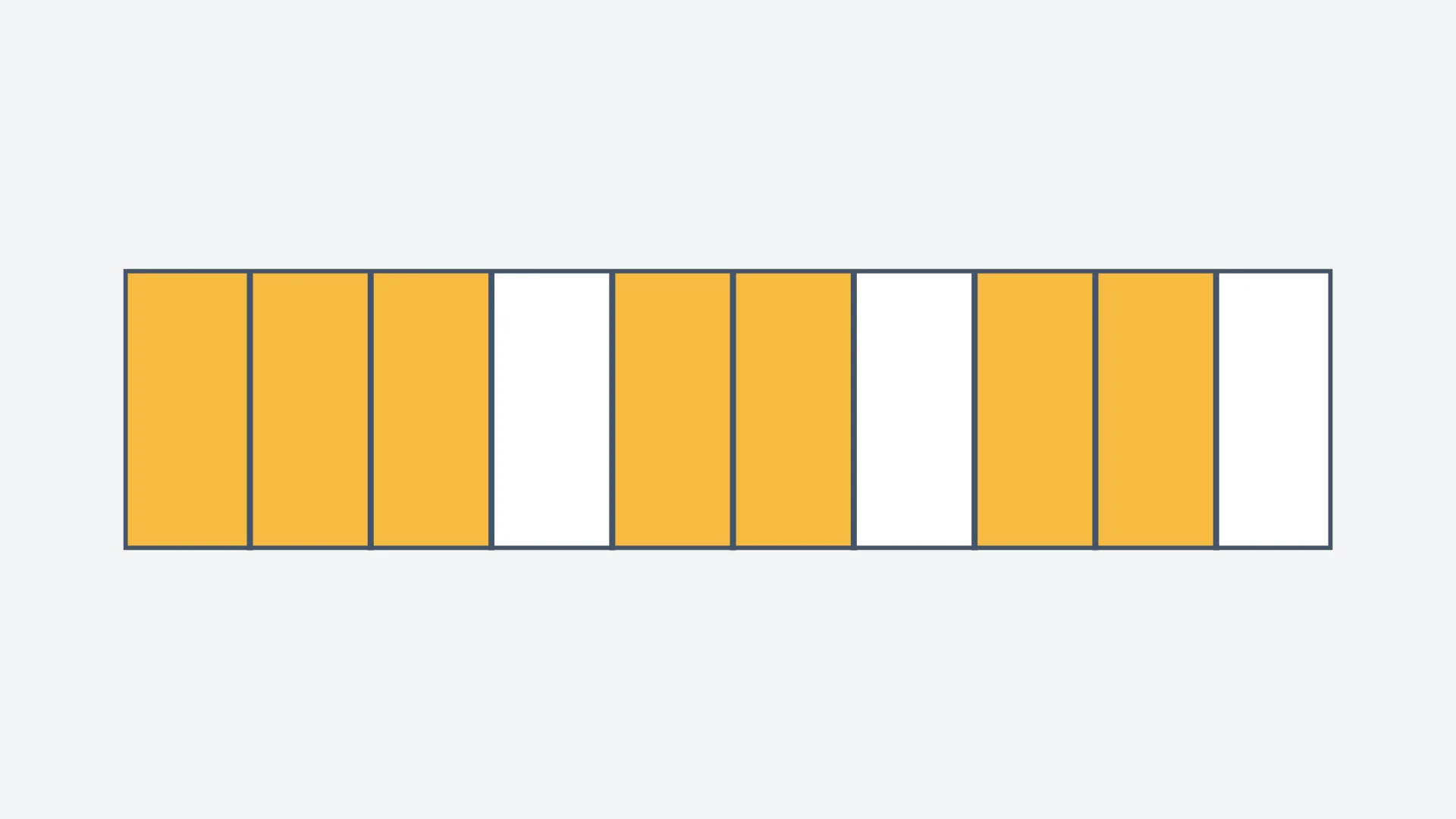
A rectangle is divided into 10 equal sections. What fraction of the rectangle is yellow?
Correct! 🎉 +10 pointsCorrect! 🎉 Worth 10 XPNot quite right
The rectangle is divided into 10 equal strips, so the denominator is 10.
Counting the yellow strips gives 7, so 7 of the 10 equal parts are yellow and the fraction is .
A team of 8 students shares 5 pizzas equally. What fraction of a pizza does each student get?
Correct! 🎉 +20 pointsCorrect! 🎉 Worth 20 XPNot quite right
Sharing 5 pizzas equally between 8 students means each student gets of a pizza.
If every pizza is cut into 8 equal slices there are 40 slices in total, and slices each. Five slices out of the 8 in one pizza is of a pizza.
If a cake is divided into 12 equal slices and 7 slices are left, what fraction of the cake has been eaten?
Correct! 🎉 +20 pointsCorrect! 🎉 Worth 20 XPNot quite right
The whole cake is 12 equal slices and 7 are left, so slices have been eaten.
The fraction eaten is the number of slices eaten out of the whole cake: .
A pool is filled to of its capacity, and it holds 60 litres when full. How much water is currently in the pool?
Correct! 🎉 +20 pointsCorrect! 🎉 Worth 20 XPNot quite right
Find one quarter first: litres.
Three quarters is then litres, so litres of water are in the pool.
A baker has of a bag of flour left, which weighs 15 kilograms. What is the total weight of a full bag of flour?
Correct! 🎉 +30 pointsCorrect! 🎉 Worth 30 XPNot quite right
Three fifths of the bag weigh , so one fifth weighs kg.
A full bag is five fifths, so it weighs kg. This is the same as kg.
Want to see the full working?
Interactive Activity
Click on the slices to select the correct fraction
Loading interactive widget...
Frequently asked questions
The questions students bump into most on this topic
A fraction is a part of a whole split into equal parts. Cut a pizza into 8 equal slices and eat 3, and you have eaten 3/8 of it. Equal is the key word: if a shape is cut into unequal pieces, you cannot write a fraction for it. When the top and bottom numbers match, as in 8/8, the fraction is one whole.
The denominator is the bottom number: it says how many equal parts the whole is divided into. The numerator is the top number: it says how many of those parts you are counting. In 4/9, a circle cut into 9 equal parts with 4 coloured in, the denominator is 9 and the numerator is 4. A horizontal bar separates them.
Divide the amount by the denominator to find one part, then multiply by the numerator. For 3/4 of 20 cm: 20 ÷ 4 = 5 cm, and 3 × 5 = 15 cm. If the amount does not divide easily, change the units first: 5/6 of 2 hours is 5/6 of 120 minutes, so 120 ÷ 6 = 20 and 5 × 20 = 100 minutes.
The parts of a whole add up to 1, so subtract the fractions you know from 1. Three friends share a £50 gift: Emma pays 4/10 and Alex 3/10, so 4/10 + 3/10 = 7/10 is covered and 3/10 is left for you. Each tenth of £50 is £5, so your share is 3 × £5 = £15.
Use food. Cut a pizza into equal slices and count them: that number goes on the bottom. Take some slices and count those: that goes on top. Three slices of eight is 3/8. Then ask what happens if the slices are different sizes, and your child will see why the parts must be equal.
What's next?
Found this one hard? Go one step back first. Feeling confident? Carry on to the next lesson.