Equivalent Fractions
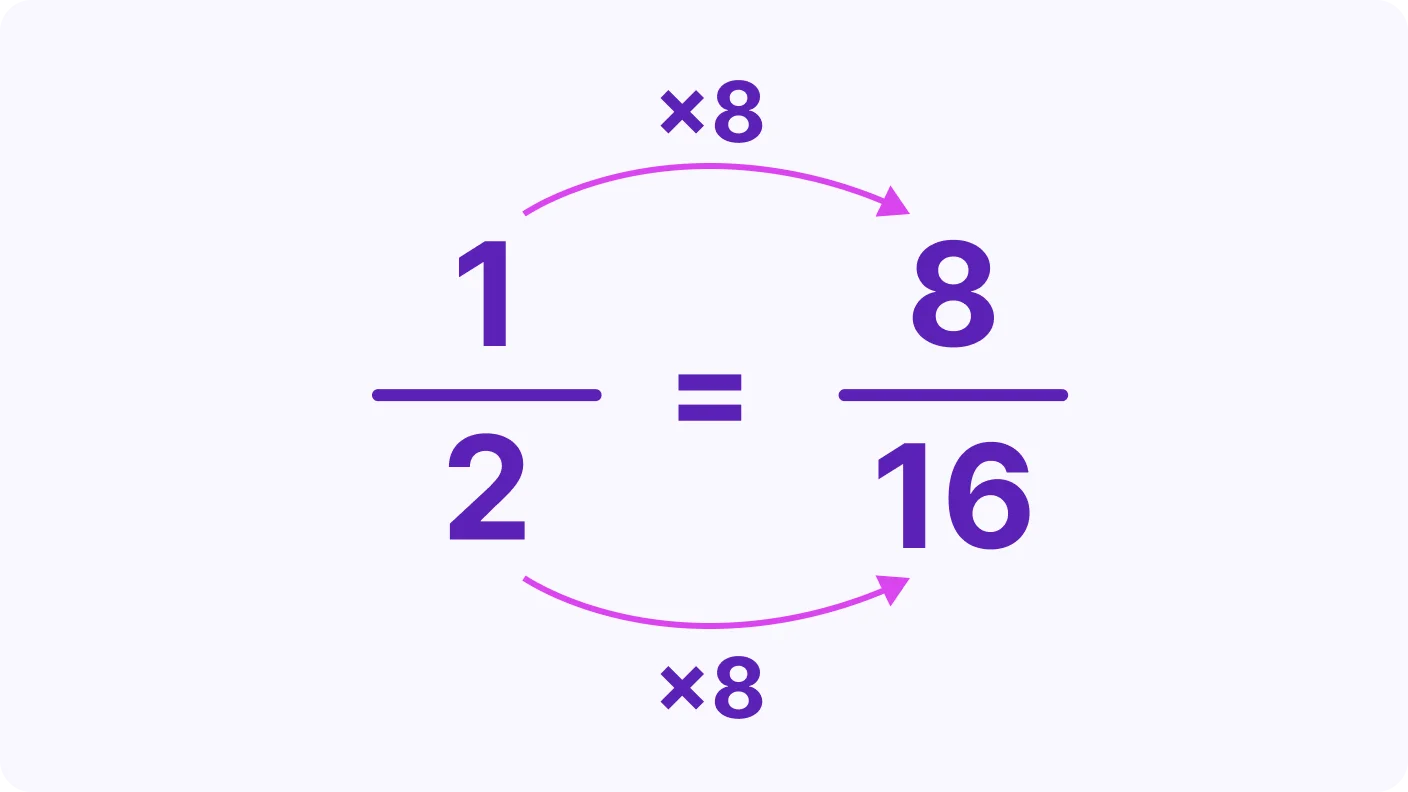
Equivalent fractions look different but have the same value, like 1/2 = 8/16. To find them, multiply top and bottom by the same number to expand, or divide to simplify. Either way, the value stays the same.
Video Lesson
Watch and learn the basics
🎬 Did this video explain it clearly?
Flashcards
Review key concepts visually
%20Expanding%20Fractions.webp)
%20Simplifying%20Fractions.webp)
%20Expanding%20and%20Simplifying%20Fractions%20Examples.webp)
%20Expanding%20and%20Simplifying%20Fractions%20Practice.webp)
%20Fully%20Simplified%20Fractions.webp)
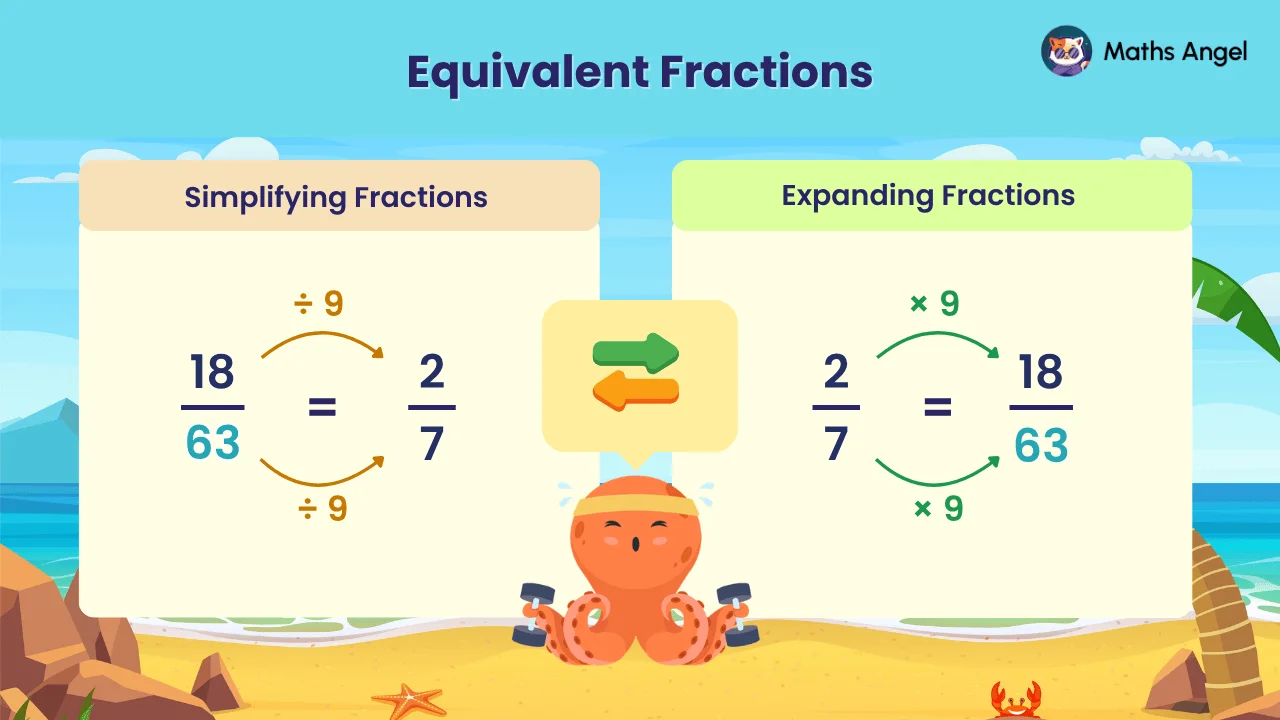
Expanding Fractions
- To expand a fraction, multiply the numerator and denominator by the same number.
- This changes how the fraction looks, but the value stays the same.
Simplifying Fractions
- To simplify a fraction, divide the numerator and denominator by the same number.
- This keeps the value the same, but makes the fraction simpler.
How to Expand Fractions
- Find the number that both the numerator and denominator are multiplied by.
- For example, , so .
- So, 2/7 can be expanded by 9 to make 18/63.
How to Simplify Fractions
- Find the number that both the numerator and denominator are divided by.
- For example, and .
- So, 72/120 can be simplified by 6 to make 12/20.
Fully Simplified Fractions
- A fraction is fully simplified when the numerator and denominator have no common factors other than 1.
- For example, 6/8 is not fully simplified, but 3/4 is.
Practice Questions
Test your understanding
Fully simplify the fraction . What is the result?
Correct! 🎉 +10 pointsCorrect! 🎉 Worth 10 XPNot quite right
The highest common factor of 15 and 20 is 5.
Dividing both parts by 5: and , so .
3 and 4 share no factor other than 1, so is fully simplified.
The numerator and denominator must be divided by the same number. Dividing them by different numbers, or dividing only one of them, changes the value of the fraction. And a fully simplified fraction does not have to have 1 on top: , not , is the answer.
Fully simplify the fraction . What is the result?
Correct! 🎉 +10 pointsCorrect! 🎉 Worth 10 XPNot quite right
The highest common factor of 18 and 27 is 9.
Dividing both parts by 9: and , so .
2 and 3 share no factor other than 1, so is fully simplified.
Simplifying means dividing both parts by the same factor. Subtracting 9 from each instead gives , which is a different number, and the simplest form does not have to have 1 on top.
Which of these fractions is already in its simplest form?
Correct! 🎉 +20 pointsCorrect! 🎉 Worth 20 XPNot quite right
A fraction is in its simplest form when the numerator and denominator share no factor other than 1.
is simplest: the only factor 5 and 7 share is 1.
Each of the others can still be cancelled:
(divide both by 4: small numbers can still have a common factor)
(divide both by 3: a fraction can simplify even when one of the numbers is odd)
(divide both by 2: look for a shared factor, not for one number dividing into the other)
Multiply the numerator and denominator of by 6. What is the resulting fraction?
Correct! 🎉 +20 pointsCorrect! 🎉 Worth 20 XPNot quite right
Multiplying the numerator and the denominator by the same number gives an equivalent fraction.
and , so .
Both parts must be multiplied by 6. Adding 6 to each instead gives ; multiplying only the denominator gives ; and scaling the top but keeping the original gap of 2 between top and bottom gives . None of these is equal to .
Fully simplify the fraction . What is the result?
Correct! 🎉 +20 pointsCorrect! 🎉 Worth 20 XPNot quite right
Write each number as a product of primes: and .
The factors they share are 3 and 5, so the highest common factor is .
Dividing both parts by 15: and , giving .
7 and 10 share no factor other than 1, so is fully simplified. Both parts must be divided by the same number, and the simplest form does not have to have 1 on top.
A fraction was expanded by a factor of 8 to become . What was the fraction in its simplest form?
Correct! 🎉 +30 pointsCorrect! 🎉 Worth 30 XPNot quite right
Undo the expansion by dividing both parts by 8: and , giving .
This is not yet fully simplified. The highest common factor of 12 and 18 is 6, and , , so the answer is .
You can also go straight there: the highest common factor of 96 and 144 is 48, and , .
An expansion is undone by dividing both parts by 8, not by subtracting 8 from each, and both parts must be divided, not just the numerator.
Want to see the full working?
Interactive Activity
Practice expanding and simplifying equivalent fractions
Loading interactive widget...
Frequently asked questions
The questions students bump into most on this topic
Equivalent fractions look different but have the same value: 1/2, 2/4, 4/8 and 8/16 all shade exactly half of a rectangle. You make them by multiplying the top and bottom by the same number, called expanding, or dividing both by the same number, called simplifying. Either way the fraction’s form changes and its value does not.
Multiply or divide the numerator and the denominator by the same number. To find the missing number in 2/7 = 18/?, notice that 2 became 18 by multiplying by 9, so multiply 7 by 9 too: 63. If the equation is easier the other way round, swap its sides: in 72/120 = ?/20, 120 became 20 by dividing by 6, so 72 ÷ 6 = 12.
Divide the top and bottom by the same number, and keep going until no number divides both. For 2/4, divide both by 2 to get 1/2. For 72/120, divide both by 6 to get 12/20, then by 4 to get 3/5. In GCSE answers, always give the fully simplified fraction unless the question says otherwise.
A fraction is fully simplified when the numerator and denominator share no common factor other than 1. Work through the easy factors in turn: if both numbers end in 0, divide by 10; if both are even, divide by 2; then try 3 and 5. The video’s example ends at 8/21, where 8 and 21 share nothing but 1, so it is done.
Multiply the top and bottom of 3/4 by the same number: by 2 gives 6/8, by 3 gives 9/12, by 4 gives 12/16, and by 25 gives 75/100. Every one is worth three quarters. The same works for any fraction: 2/3 is equivalent to 4/6, 6/9 and 8/12, and 1/2 to 2/4, 4/8 and 8/16.
Draw four identical rectangles and shade half of each, cut into 2, 4, 8 and 16 parts. Your child can see the shaded area is the same every time, even though the fractions read 1/2, 2/4, 4/8 and 8/16. Then ask what was done to the top and bottom each time.
What's next?
Found this one hard? Go one step back first. Feeling confident? Carry on to the next lesson.