Converting Time and Calculating Time
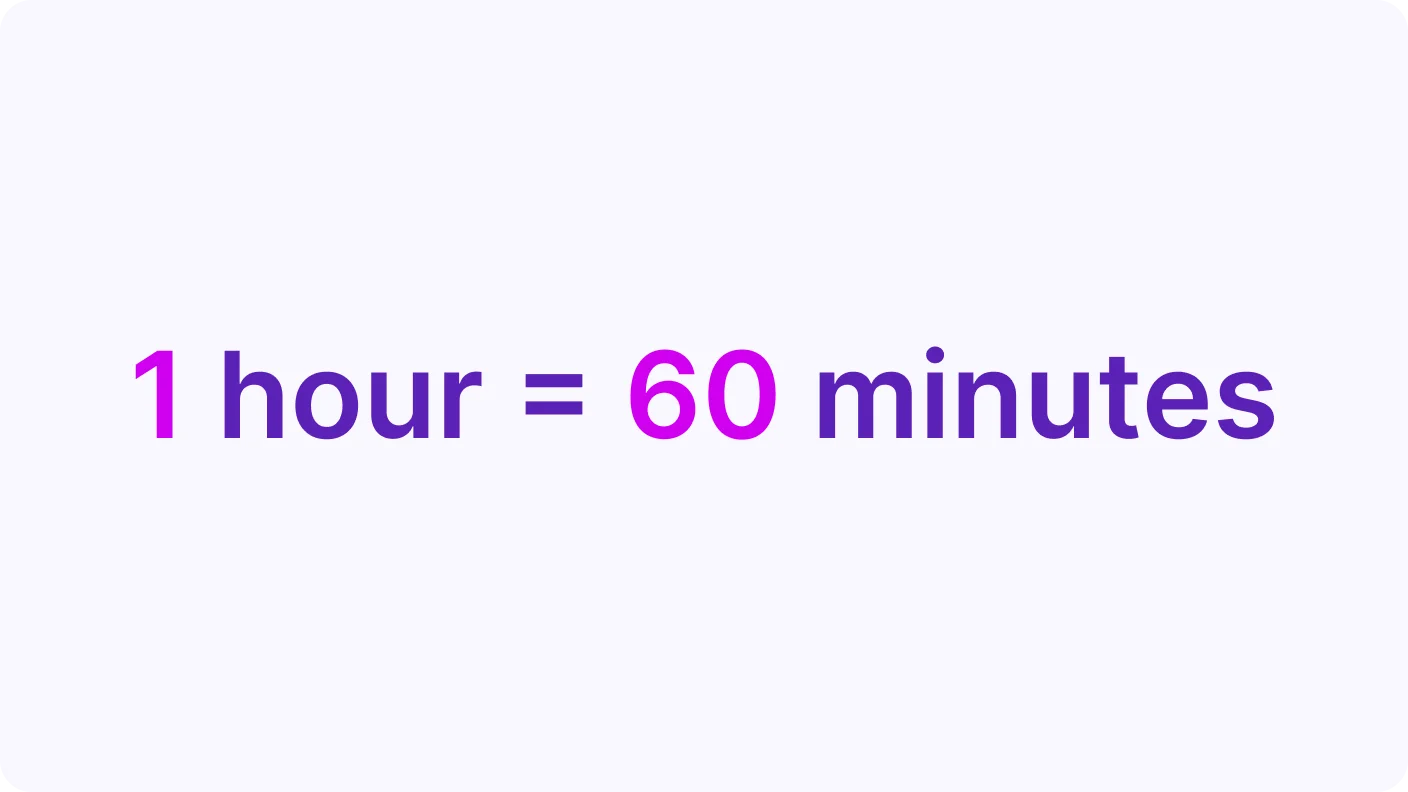
Converting time swaps between hours, minutes and seconds. You multiply for a smaller unit and divide for a larger one, so 1 h = 60 min. Calculating time means adding or subtracting minutes and seconds separately.
Video Lesson
Watch and learn the basics
🎬 Did this video explain it clearly?
Flashcards
Review key concepts visually
%20Converting%20Units%20of%20Time.webp)
%20Examples%20on%20Converting%20Units%20of%20Time.webp)
%20Adding%20Time.webp)
%20Subtracting%20Time.webp)
What are Units of Time?
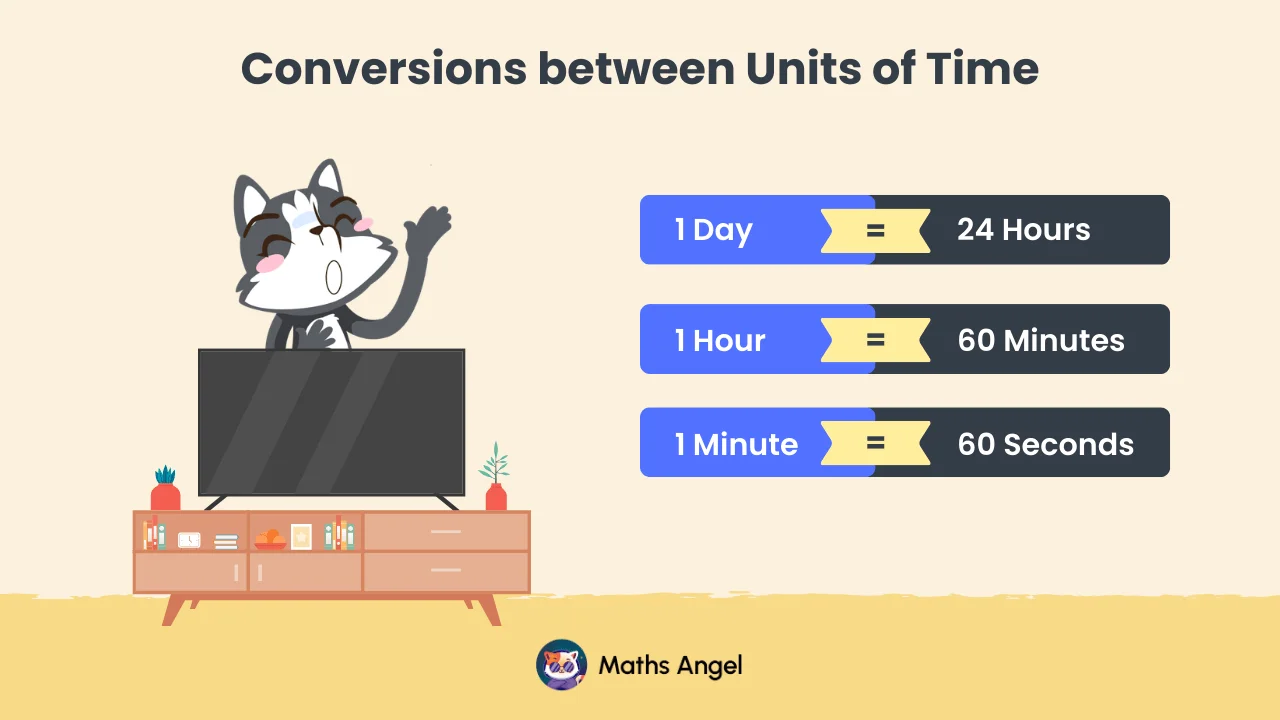
- Time is measured in seconds (s), minutes (min), hours (h), and days.
- The conversion rates you must know: min, 60 , and day.
How to Convert Units of Time?
- Converting to a smaller unit means multiplying; converting to a larger unit means dividing.
- For example, min (×60) and min (÷60).
How to Add Time?
- Add minutes and seconds separately.
- If seconds are 60 or more, convert 60 s into 1 min.
How to Subtract Time?
- Subtract minutes and seconds separately.
- If there are not enough seconds, exchange 1 min for 60 s first.
Practice Questions
Test your understanding
How many minutes are in 2 hours?
Correct! 🎉 +10 pointsCorrect! 🎉 Worth 10 XPNot quite right
There are 60 minutes in 1 hour, so multiply by 60: minutes.
Convert 180 seconds into minutes.
Correct! 🎉 +10 pointsCorrect! 🎉 Worth 10 XPNot quite right
There are 60 seconds in 1 minute, so divide by 60: minutes.
Convert 2 days and 6 hours into just hours.
Correct! 🎉 +20 pointsCorrect! 🎉 Worth 20 XPNot quite right
There are 24 hours in 1 day, so 2 days hours.
The extra 6 hours are then added on: hours.
How many minutes are there in 2 hours and 30 minutes?
Correct! 🎉 +20 pointsCorrect! 🎉 Worth 20 XPNot quite right
There are 60 minutes in 1 hour, so 2 hours minutes.
Adding the extra 30 minutes gives minutes.
A movie lasts for 2 hours and 15 minutes. How many minutes is that in total?
Correct! 🎉 +20 pointsCorrect! 🎉 Worth 20 XPNot quite right
There are 60 minutes in 1 hour, so 2 hours minutes.
Adding the extra 15 minutes gives minutes.
Subtract 15 minutes and 30 seconds from 45 minutes and 20 seconds. Give your answer in minutes and seconds.
Correct! 🎉 +30 pointsCorrect! 🎉 Worth 30 XPNot quite right
Deal with the seconds first. 20 seconds is smaller than 30 seconds, so exchange 1 minute for 60 seconds: 45 minutes 20 seconds becomes 44 minutes 80 seconds.
Now subtract each part: seconds and minutes.
So the answer is 29 minutes and 50 seconds. Check: 45 min 20 s s and 15 min 30 s s, and s min 50 s.
Want to see the full working?
Interactive Activity
Converting time units and time calculation steps.
Loading interactive widget...
Frequently asked questions
The questions students bump into most on this topic
The units you need are seconds, minutes, hours and days: 60 seconds make 1 minute, 60 minutes make 1 hour, and 24 hours make 1 day. With those three facts you can change any time into another unit, multiplying to go to a smaller unit and dividing to go to a larger one.
Divide the minutes by 60, because there are 60 minutes in an hour and hours are the larger unit. So 120 minutes = 120 ÷ 60 = 2 hours, and 90 minutes = 1.5 hours, or 1 hour 30 minutes. For 45 minutes, 45 ÷ 60 = 0.75, so 45 minutes is 0.75 of an hour, three quarters.
Multiply the hours by 60, because each hour has 60 minutes and minutes are the smaller unit. So 2 hours = 2 × 60 = 120 minutes. For a time with both, convert the hours and add the minutes: 2 hours 15 minutes is 120 + 15 = 135 minutes.
Divide the seconds by 60, because every 60 seconds make 1 minute and minutes are the larger unit. So 300 seconds = 300 ÷ 60 = 5 minutes. Going the other way, from minutes to seconds, multiply by 60: 5 minutes = 300 seconds.
Add the minutes and the seconds separately. A cycling time of 35 min 20 s plus a running time of 20 min 45 s gives 55 minutes and 65 seconds. Since 65 seconds is more than 60, swap 60 seconds for 1 minute and keep the 5 seconds left over: the total is 56 minutes 5 seconds.
Subtract the minutes and the seconds separately. If the top seconds are smaller, borrow 1 minute and turn it into 60 seconds first. For 56 min 5 s minus 54 min 23 s: 5 is less than 23, so borrow a minute to get 55 min 65 s, then 65 − 23 = 42 seconds and 55 − 54 = 1 minute. The champion was 1 minute 42 seconds faster.
What's next?
Found this one hard? Go one step back first. Feeling confident? Carry on to the next lesson.