Place Value and Rounding Numbers
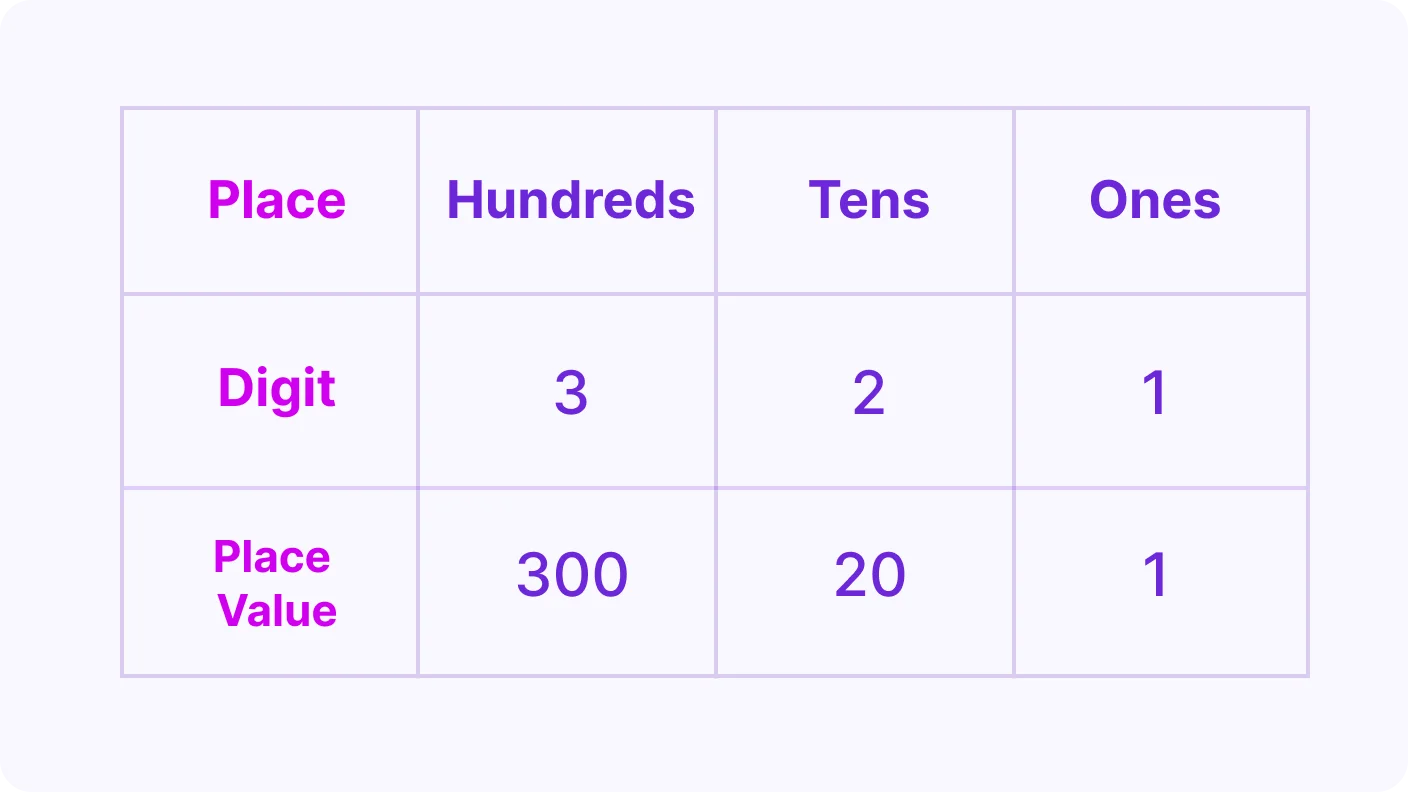
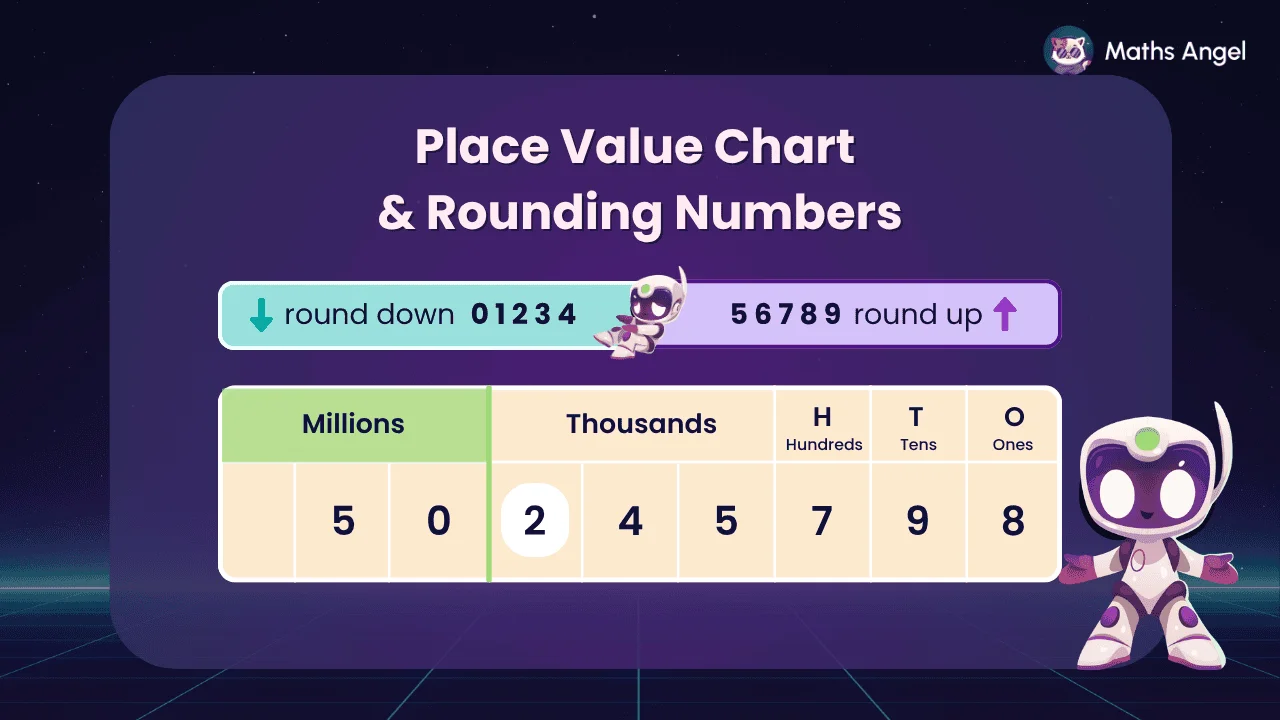
Place value is the value of each digit in a number, so in 321 the 3 is worth 300. Each column is worth ten times the one on its right. Rounding numbers makes them simpler: 5 or more rounds up, 4 or less rounds down.
Video Lesson
Watch and learn the basics
🎬 Did this video explain it clearly?
Flashcards
Review key concepts visually
%20Place%20Value%20Chart.webp)
%20Base-10%20Number%20System.webp)
%20Rounding%20Rules%20and%20Steps.webp)
%20Rounding%20down.webp)
%20Rounding%20up.webp)
What is a Place Value Chart?
- A place value chart shows the value of each digit in a number.
- For example, the digit 2 means 20 in tens but 200 in hundreds.
The Base 10 Number System
- The base 10 system uses the digits 0-9 to make all numbers.
- Moving a digit left makes the value 10 times bigger (5 → 50 → 500).
How to Round a Number?
- Find the target place you are rounding to, then look at the digit to the right.
- If the digit is 5 or more, round up; if it is 4 or less, round down.
What Does Rounding Down Mean?
- When rounding down, the target digit stays the same and the rest become zeros.
- For example, 342 rounded to the nearest 10 becomes 340.
What Does Rounding Up Mean?
- When rounding up, the target digit increases by 1 and the rest become zeros.
- For example, 685 rounded to the nearest 10 becomes 690.
Practice Questions
Test your understanding
In the number 3452, which place-value column is the digit 3 in?
Correct! 🎉 +10 pointsCorrect! 🎉 Worth 10 XPNot quite right
Read the columns from the right: 2 is in the units column, 5 in the tens, 4 in the hundreds and 3 in the thousands.
So the digit 3 is in the thousands column, where it is worth 3000.
Round 4367 to the nearest hundred.
Correct! 🎉 +10 pointsCorrect! 🎉 Worth 10 XPNot quite right
The hundreds digit of 4367 is 3, so look at the digit immediately to its right: the tens digit, 6.
Since 6 is 5 or more, round up: the hundreds digit goes from 3 to 4, and every digit to the right of it becomes zero. So 4367 rounds to 4400.
In the number 27891, what is the value of the digit 8?
Correct! 🎉 +20 pointsCorrect! 🎉 Worth 20 XPNot quite right
Read the columns of 27891 from the right: 1 unit, 9 tens, 8 hundreds, 7 thousands and 2 ten thousands.
The digit 8 sits in the hundreds column, so its value is .
Round 8946 to the nearest thousand.
Correct! 🎉 +20 pointsCorrect! 🎉 Worth 20 XPNot quite right
The thousands digit of 8946 is 8, so look at the digit immediately to its right: the hundreds digit, 9.
Since 9 is 5 or more, round up: the thousands digit goes from 8 to 9, and every digit to the right of it becomes zero. So 8946 rounds to 9000.
When rounding 76349 to the nearest hundred, which digit do you check to decide whether to round up or down?
Correct! 🎉 +20 pointsCorrect! 🎉 Worth 20 XPNot quite right
To round to the nearest hundred, first find the hundreds digit of 76349, which is 3. The digit you check is always the one immediately to its right: here the tens digit, 4.
Since 4 is less than 5, 76349 rounds down to 76300.
Round 135289 to the nearest ten thousand.
Correct! 🎉 +30 pointsCorrect! 🎉 Worth 30 XPNot quite right
The ten-thousands digit of 135289 is 3, so look at the digit immediately to its right: the thousands digit, 5.
Since 5 is 5 or more, round up: the ten-thousands digit goes from 3 to 4 and every digit to its right becomes zero. So 135289 rounds to 140000.
Want to see the full working?
Interactive Activity
Explore place value and rounding logic
Loading interactive widget...
Frequently asked questions
The questions students bump into most on this topic
Place value is the value a digit has because of its position in a number. In 321 the 3 is worth 300, the 2 is worth 20 and the 1 is worth 1. Each column is worth ten times the column to its right. The same digit is worth 20 in the tens column but 200 in the hundreds column.
A place value chart shows the value of each digit by the column it sits in. From the right, the columns are ones, tens, hundreds, thousands and ten thousands, each worth ten times the one before. To find a digit’s value, read its column: in 54,321 the 5 sits in the ten thousands column, so the number reads fifty-four thousand, three hundred and twenty-one.
The 6 in 64 is in the tens column, so its place value is 60. The 4 is in the ones column and is worth 4, and 60 + 4 = 64. The same method works for any number: find the column the digit sits in and multiply. In 370, the 7 is in the tens column, so it is worth 70.
Rounding replaces a long number with a simpler one that is close to it. Look at the digit just after the place you are rounding to. If it is 4 or less, round down: keep the rounding digit and change everything after it to zeros. If it is 5 or more, round up: add 1 to the rounding digit, then change the rest to zeros.
Find the column you are rounding to, then look at the digit to its right. To round 342 to the nearest 10, the tens digit is 4 and the next digit is 2, so it rounds down to 340. For 685, the next digit is 5, so it rounds up to 690. For the nearest 100 or 1,000, check the digit after that column.
Use a price tag. Write a number such as 321 in columns labelled hundreds, tens and ones, and ask what each digit is worth: the 3 means three hundreds, the 2 means two tens, the 1 means one. Then move a digit one column left and show it is worth ten times more.
What's next?
Found this one hard? Go one step back first. Feeling confident? Carry on to the next lesson.