Number Line and Comparing Numbers
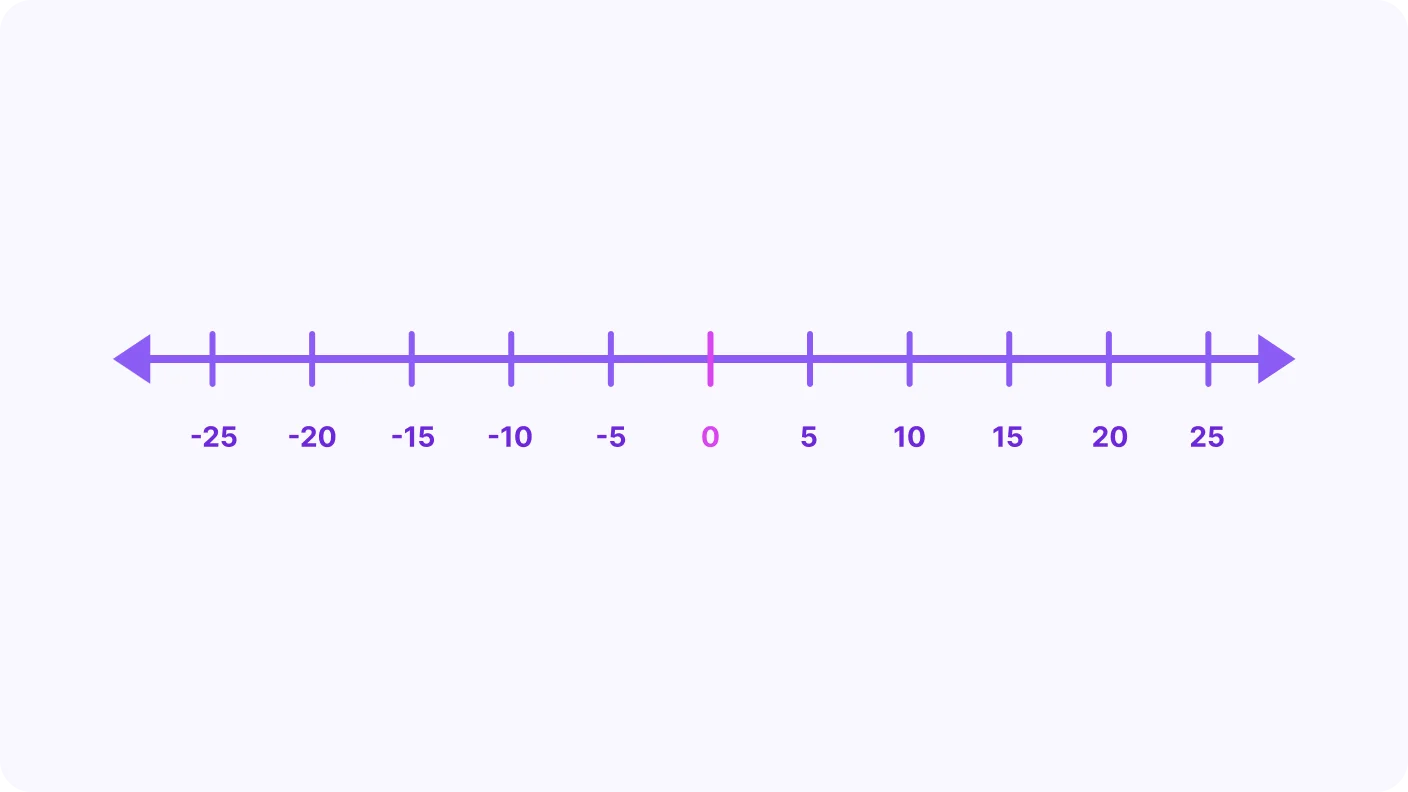
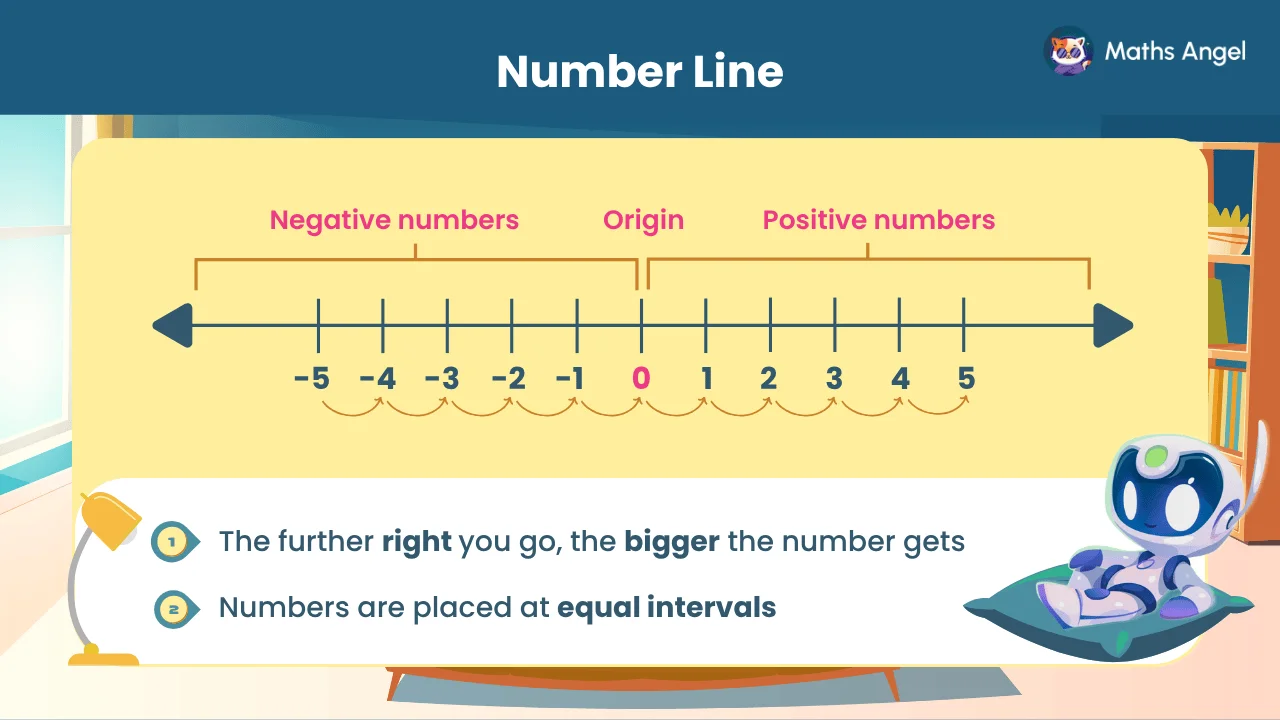
A number line places numbers in order, getting bigger as you move right. So −3 sits to the left of 2, which means −3 is smaller. Inequality symbols compare values: > means greater than and < means less than.
Video Lesson
Watch and learn the basics
🎬 Did this video explain it clearly?
Flashcards
Review key concepts visually
%20Number%20Line.webp)
%20Inequality%20Symbol.webp)
%20Comparing%20Numbers.webp)
Understanding the Number Line
- Numbers get bigger as you move right on the number line.
- Numbers are spaced at equal intervals along the line.
Using Inequality Symbols
- The symbol > means greater than and < means less than.
- The symbols ≥ and ≤ include equal to as well.
Comparing Positive Numbers
- A number with more digits is usually greater if both are positive.
- If the digits are equal, compare from left to right. The number with the first bigger digit is larger.
Practice Questions
Test your understanding
Write the inequality for this statement: "5 is less than or equal to 8."
Correct! 🎉 +10 pointsCorrect! 🎉 Worth 10 XPNot quite right
The symbol ≤ means 'is less than or equal to'. Write the two numbers in the order they appear in the sentence, with 5 on the left of the symbol: 5 ≤ 8.
The symbol ≥ means 'is greater than or equal to', so 5 ≥ 8 says 5 is at least 8, which is false. Writing 8 ≤ 5 puts the numbers the wrong way round and says 8 is at most 5, also false. Writing claims the two numbers are equal, which loses the 'less than' part of the statement.
Place 0, 10, −20 and −30 on a number line. Which number is furthest to the left?
Correct! 🎉 +10 pointsCorrect! 🎉 Worth 10 XPNot quite right
On a number line, values get smaller as you move to the left and larger as you move to the right.
Of 0, 10, −20 and −30, the smallest value is −30: it is 30 below zero, while −20 is only 20 below zero, so −30 sits further left than −20. The positive number 10 is furthest to the right, and 0 sits between the negatives and 10.
Write the inequality for this statement: "25 is greater than or equal to 16."
Correct! 🎉 +20 pointsCorrect! 🎉 Worth 20 XPNot quite right
"Greater than or equal to" is written with the symbol , and the number named first in the statement goes on the left of the symbol.
So "25 is greater than or equal to 16" is written . This is a true statement: 25 is greater than 16, and is satisfied when the left side is greater than or equal to the right side.
True or False: .
Correct! 🎉 +20 pointsCorrect! 🎉 Worth 20 XPNot quite right
The symbol means "greater than or equal to", so the statement is satisfied when one side is greater than the other or when the two sides are the same.
Here both sides are 12, so the "equal to" half of the symbol is met and is True.
Identify the greater number between 213 and 321.
Correct! 🎉 +20 pointsCorrect! 🎉 Worth 20 XPNot quite right
Both numbers have three digits, so compare them column by column starting from the left.
The hundreds digit of 321 is 3 and the hundreds digit of 213 is 2. Since , the comparison is decided straight away: 321 is the greater number.
Which is greater: 3459 or 3498?
Correct! 🎉 +30 pointsCorrect! 🎉 Worth 30 XPNot quite right
Compare the numbers column by column from the left. Both begin with 3 thousands and 4 hundreds, so those columns do not decide it.
Move to the tens column: 3498 has 9 tens and 3459 has 5 tens. Since , 3498 is the greater number, and the units digits never need to be checked.
Want to see the full working?
Interactive Activity
Visualise numbers on a line to compare their values.
Loading interactive widget...
Frequently asked questions
The questions students bump into most on this topic
A number line shows numbers in order along a straight line. Zero sits in the middle, called the origin, with negative numbers to its left and positive numbers to its right. Numbers always get bigger as you move right, so −3 sits to the left of 2 and is the smaller number. A ruler works like a number line.
Draw a straight line and mark 0 near the middle. Put the positive numbers to the right and the negative numbers to the left, and keep the gaps equal. Choose the gap to suit the range: steps of 1 for small numbers, or steps of 5 or 100 for larger ones. Then any number can be placed in its position.
The symbol > means greater than and < means less than, so 20 > 12 and 20 < 38. A hungry crocodile helps you remember: its open mouth always faces the bigger number. Adding the equals sign gives ≥, at least, and ≤, at most. So 20 ≥ 12 is true, and 20 ≤ 20 is true too, because 20 is equal to 20.
Use two rules. First, a positive number with more digits is bigger: 1001 is greater than 998 because it has one more digit. Second, if both numbers have the same number of digits, compare them digit by digit from the left and stop at the first difference: in 6749 and 6784, 4 is less than 8, so 6749 is the smaller number.
Start with a ruler: it is a number line your child can hold. Numbers get bigger as you move right, and the gaps between them are equal. Ask which of two numbers is further right, then say that one is greater. Once that is easy, add the negative numbers to the left of 0.
What's next?
Found this one hard? Go one step back first. Feeling confident? Carry on to the next lesson.