Elimination Method for Solving Simultaneous Equations
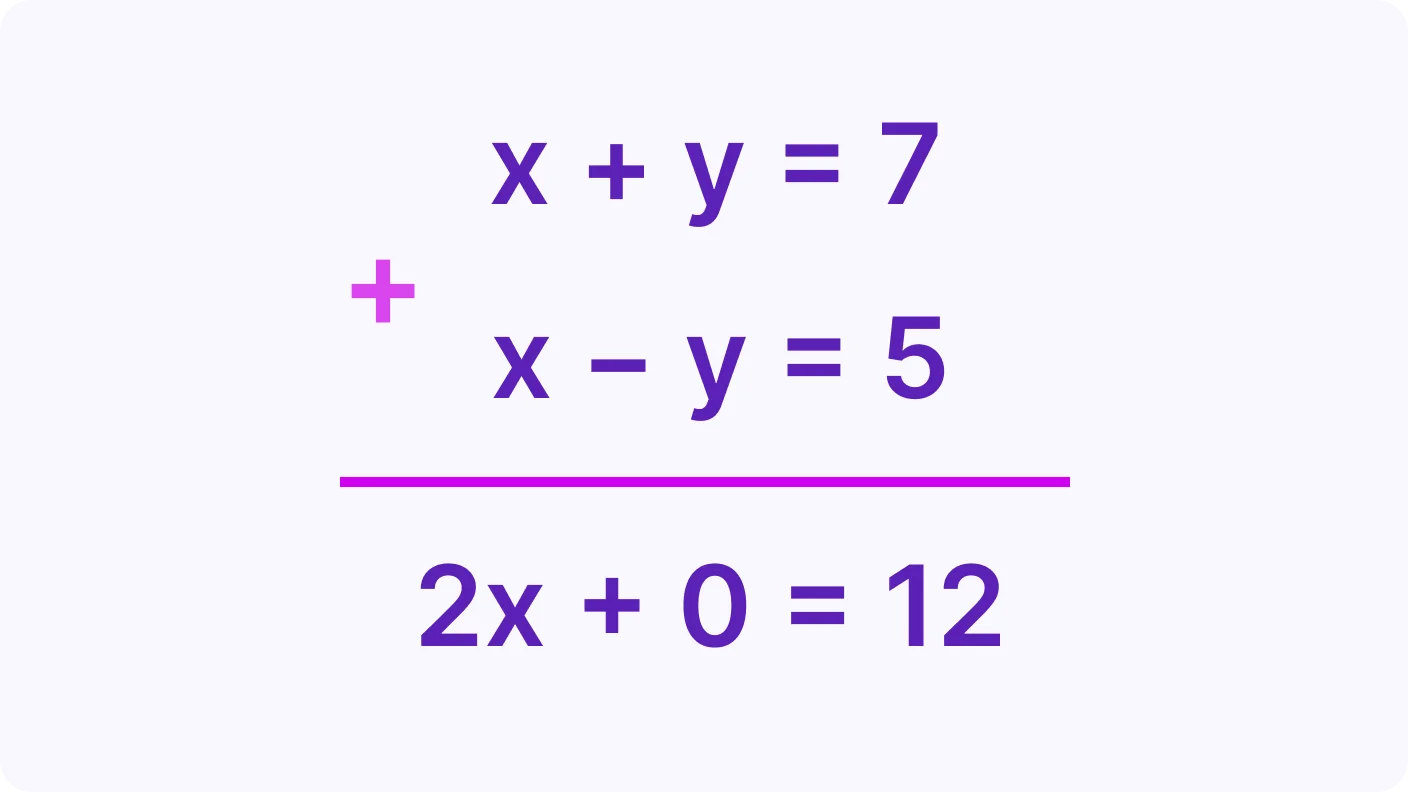
The elimination method removes one variable from simultaneous equations by adding or subtracting the two equations. The goal is to cancel one variable, leaving a single equation like 2x = 12 to solve.
Video Lesson
Watch and learn the basics
🎬 Did this video explain it clearly?
Flashcards
Review key concepts visually
%20The%20Elimination%20Method.webp)
%20Elimination%20through%20Addition.webp)
%20Elimination%20through%20Transform%20and%20Addition.webp)
%20Elimination%20Through%20Subtraction.webp)
%20Addition%20vs%20Subtraction%20Method.webp)
Elimination Method
- The elimination method removes one variable by adding or subtracting two equations.
- The aim is to get an equation like that is easy to solve.
Elimination by Addition
- Add the equations when one variable has opposite signs, like +y and −y.
- That variable cancels out, leaving an equation with one variable.
Preparing the Equations
- Transform the equations so one variable can be cancelled, like +3y and −3y.
- Exam tip: when you multiply, multiply every term on both sides of the equation.
Elimination by Subtraction
- Subtract the equations when one variable has the same sign, like +2x and +2x.
- This removes that variable so you can solve.
Finishing and Checking
- Substitute the value back to find the other variable.
- Exam tip: always check by substituting both x and y into the original equations.
Practice Questions
Test your understanding
Solve the simultaneous equations:
Correct! 🎉 +10 pointsCorrect! 🎉 Worth 10 XPNot quite right
The terms are and , so adding the equations eliminates : gives , so .
Now substitute back into : , so .
Check in the other equation: . The solution is and .
Solve the simultaneous equations:
Correct! 🎉 +10 pointsCorrect! 🎉 Worth 10 XPNot quite right
The terms are and , so adding the equations eliminates : gives , so .
Substitute into : , so .
Check in the other equation: . The solution is and .
Solve the simultaneous equations:
Correct! 🎉 +20 pointsCorrect! 🎉 Worth 20 XPNot quite right
The terms are and , so adding the equations eliminates : gives , so .
Substitute into : , so and .
Check in the other equation: . The solution is and .
Solve the simultaneous equations:
Correct! 🎉 +20 pointsCorrect! 🎉 Worth 20 XPNot quite right
Both equations have , so subtracting eliminates : gives , so .
Substitute into : , so . The answer is negative because is already bigger than 4.
Check in the other equation: . The solution is and .
Solve the simultaneous equations:
Correct! 🎉 +20 pointsCorrect! 🎉 Worth 20 XPNot quite right
Both equations have , so subtracting the first from the second eliminates : gives , so .
Substitute into : , so and .
Check in the other equation: . The solution is and .
Solve the simultaneous equations:
Correct! 🎉 +30 pointsCorrect! 🎉 Worth 30 XPNot quite right
The terms do not match yet, so multiply every term of the second equation by 2: .
Now the terms are and , so adding eliminates : gives , so .
Substitute into : , so and .
Check in the other equation: . The solution is and .
Want to see the full working?
Interactive Activity
Solve simultaneous equations step-by-step using the elimination method
Loading interactive widget...
Frequently asked questions
The questions students bump into most on this topic
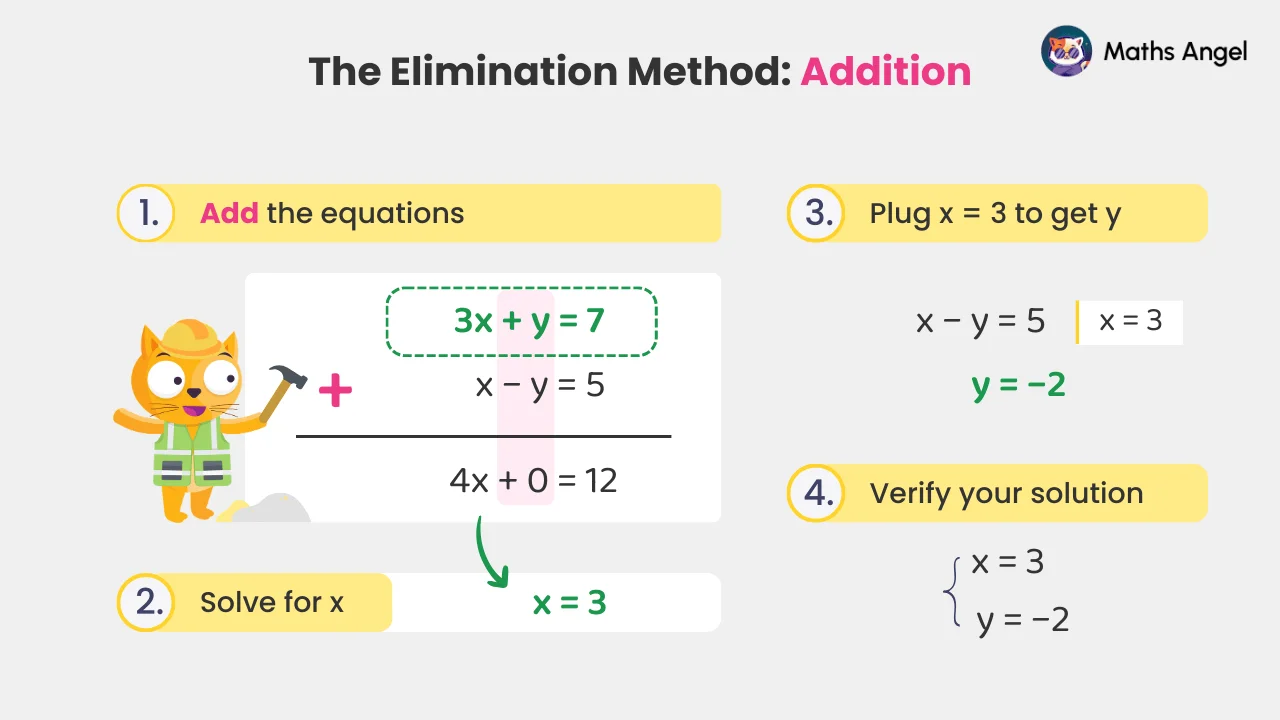
A way of solving simultaneous equations, two equations with the same two unknowns, by adding or subtracting them so that one unknown cancels out. For 3x + y = 7 and x − y = 5, adding the equations removes y and leaves 4x = 12, so x = 3. American sites call the pair a system of equations; the method is the same.
Four steps. Line up the equations and, if needed, multiply one so a pair of terms match. Add or subtract to eliminate one unknown. Solve the equation that is left. Substitute back to find the other unknown, then check both in the original equations. For 3x + y = 7 and x − y = 5: adding gives 4x = 12, so x = 3, and then y = −2.
Use elimination and show every line: multiply an equation if the terms do not match, add or subtract, solve, substitute, check. Linear simultaneous equations appear on both Foundation and Higher papers, calculator and non-calculator; pairs with a quadratic are Higher only. Marks are given for the method, so write the working even when you can see the answer.
Add when the matching terms have opposite signs, so +y and −y cancel to zero. Subtract when they have the same sign, so +2x and +2x cancel. For 2x + 5y = −10 and 2x + y = 8, the x terms match, so subtract: 4y = −18, giving y = −4.5, and then 2x − 4.5 = 8 gives x = 6.25. Both routes give the same solution.
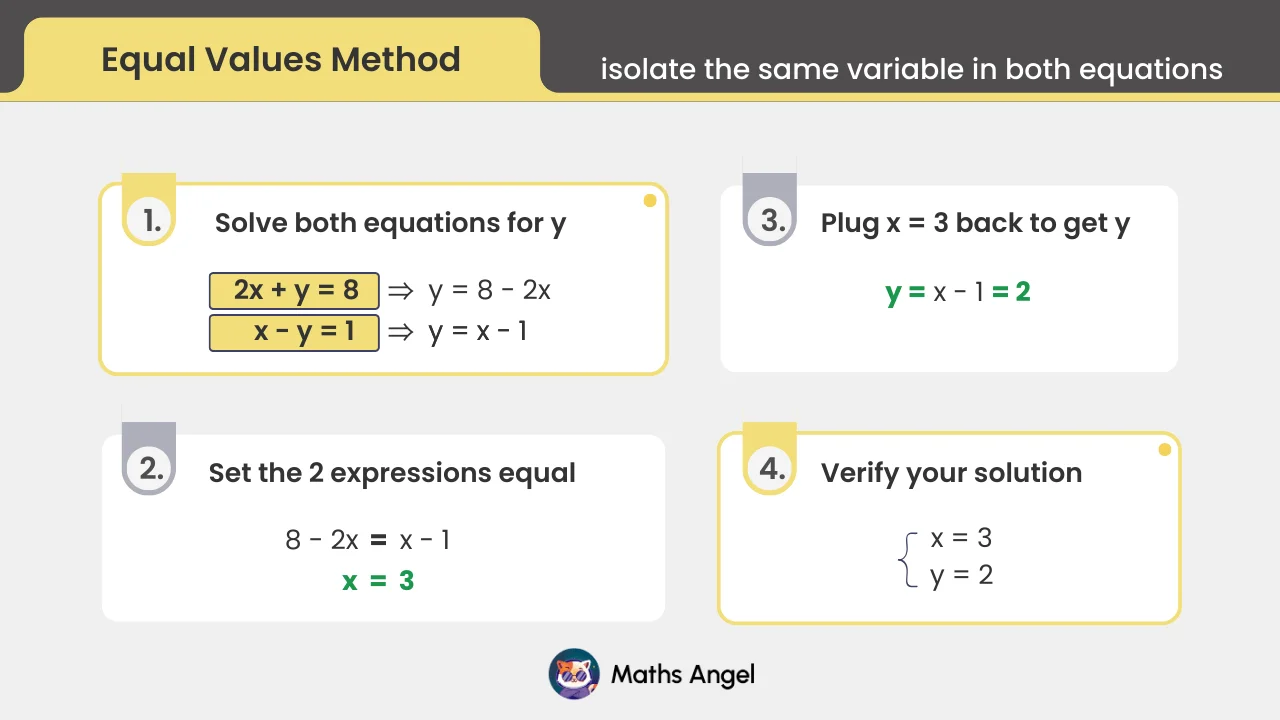
Transform one equation first: multiply every term on both sides by a number that makes a pair of coefficients match. In the video’s second example the y terms do not match, so the second equation is multiplied by 3; adding then eliminates y and gives x = 3, and substituting back gives y = 2. Multiply the whole equation, not just one side.
Substitute both values into the original equations, not the transformed ones, and confirm each one balances: for x = 3 and y = −2, 3 × 3 + (−2) = 7 is right. The two common slips are adding before the coefficients match, so nothing cancels, and skipping this check. Multiply first, then eliminate, then check.
What's next?
Found this one hard? Go one step back first. Feeling confident? Carry on to the next lesson.