Gradient and Y-Intercept in Linear Equations
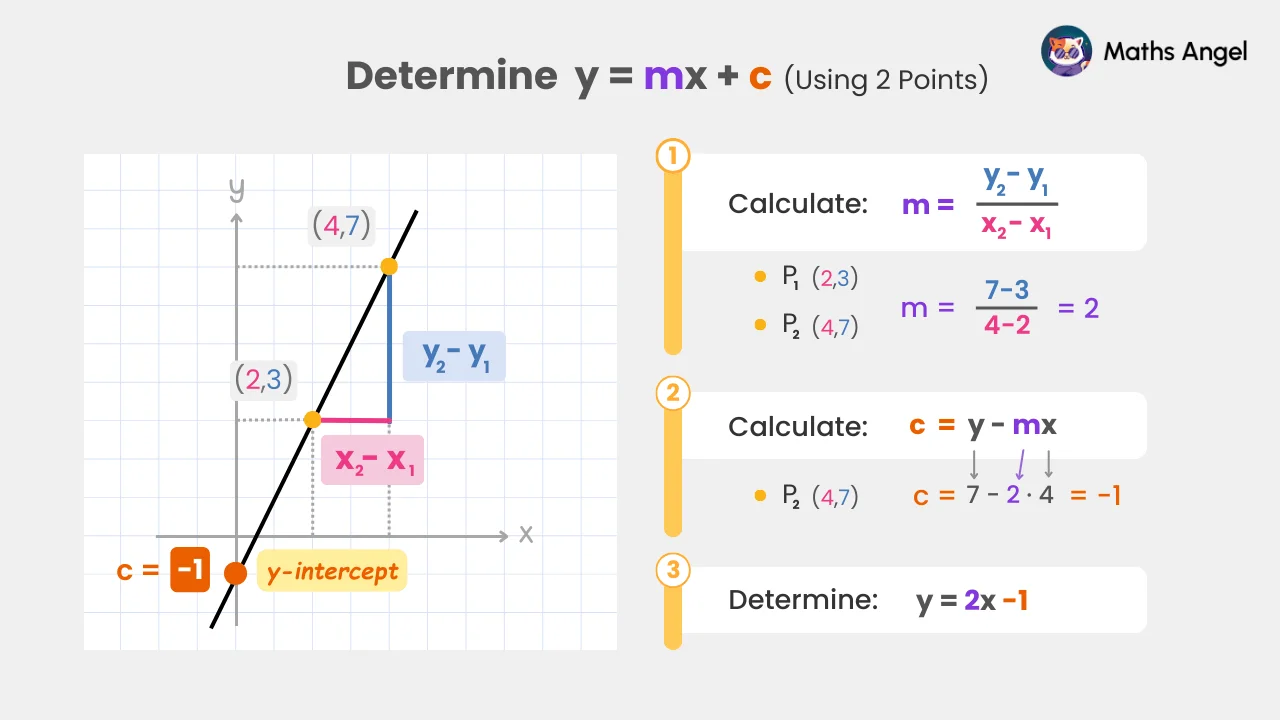
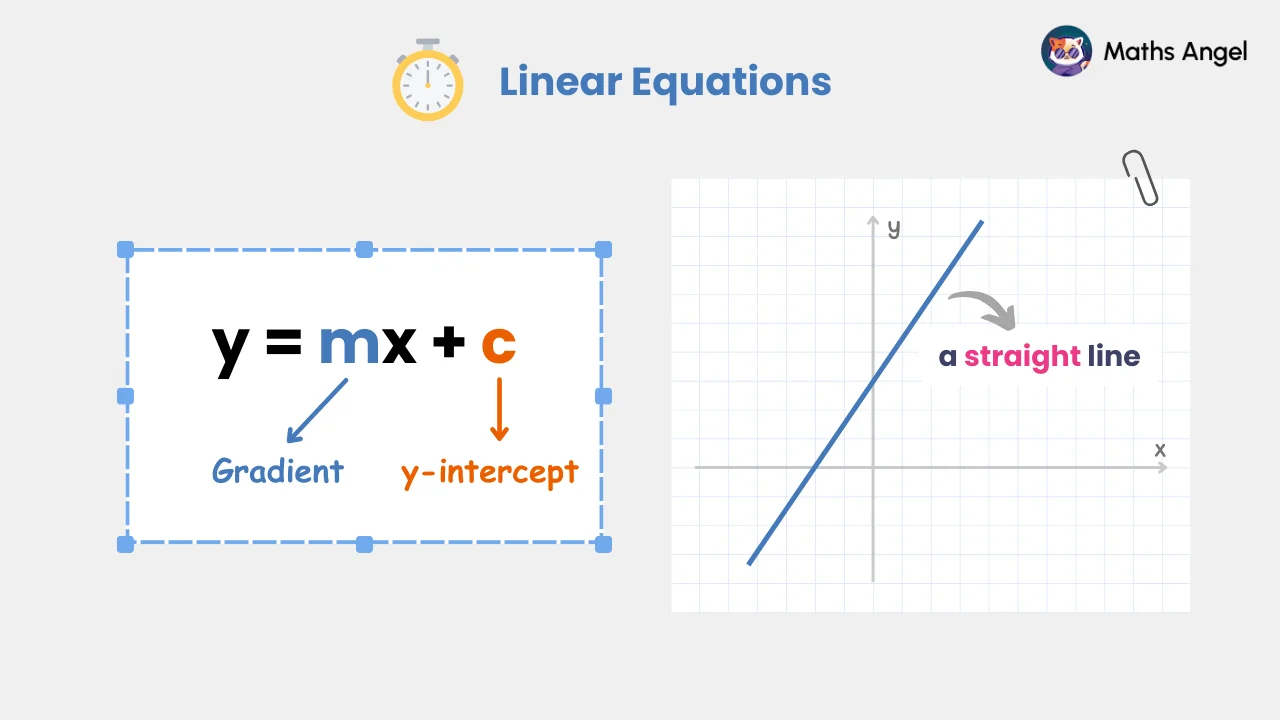
Gradient (m) and y-intercept (c) are the two parts of a straight line y = mx + c. The gradient shows how steep the line is, so m = 2 means y rises 2 as x rises 1. The y-intercept is where the line crosses the y-axis, at x = 0.
Video Lesson
Watch and learn the basics
🎬 Did this video explain it clearly?
Flashcards
Review key concepts visually
%20m%20and%20c%20in%20Linear%20Equations.webp)
%20Intercept%20Linear%20Equations.webp)
%20Slope%20of%20Linear%20Equations.webp)
%20Draw%20a%20Linear%20Equation%20y%20%3D%202x%20%2B%201.webp)
%20Draw%20a%20Linear%20Equation%20y%3D-3x%2B4.webp)
Recap: Linear Equations
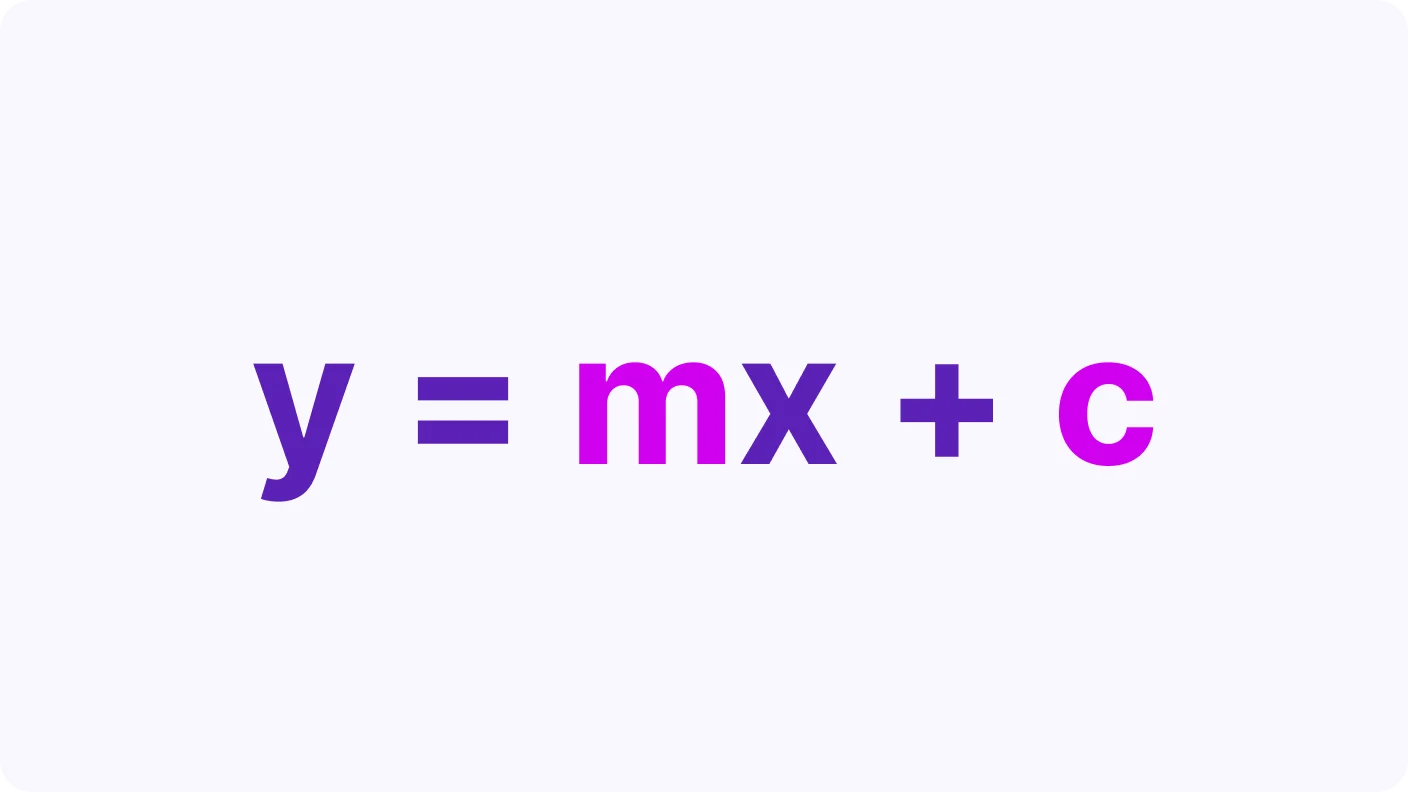
- Linear equations are usually written in the form y = mx + c.
- When you draw a linear equation, it makes a straight line on a graph.
The y-intercept (c)
- c is the y-intercept, where the line crosses the y-axis.
- This is the value of y when .
The Gradient (m)
- m is the gradient, which shows how much y changes when x increases by 1.
- If m > 0 the line goes upwards, and if m < 0 the line goes downwards.
- A larger |m| means the line is steeper.
Drawing a Linear Equation: Step 1
- Start by plotting the y-intercept using the value of c.
- This gives you the first point on the line.
Drawing a Linear Equation: Step 2
- Use the gradient m to find a second point.
- For example, if , go 1 right and 3 down from the first point.
- Join the two points to draw the straight line.
Practice Questions
Test your understanding
What is the gradient (m) of the line ?
Correct! 🎉 +10 pointsCorrect! 🎉 Worth 10 XPNot quite right
In the gradient m is the number multiplying x, and it keeps its sign.
For the coefficient of x is , so . The 3 is the y-intercept c, not the gradient.
What is the y-intercept (c) of the equation ?
Correct! 🎉 +10 pointsCorrect! 🎉 Worth 10 XPNot quite right
In the y-intercept c is the constant term, including its sign. Writing as shows that .
Check by setting : , so the line crosses the y-axis at .
Based on the equation , what is the gradient (m) of the line?
Correct! 🎉 +20 pointsCorrect! 🎉 Worth 20 XPNot quite right
The gradient is the coefficient of x in .
In nothing is written in front of x, but means , so the gradient is 1. The is the y-intercept, not the gradient.
What is the equation of the line with gradient and y-intercept ?
Correct! 🎉 +20 pointsCorrect! 🎉 Worth 20 XPNot quite right
A straight line is written as , where m is the gradient and c is the y-intercept.
Substituting and gives , which is written as .
In the equation , if the gradient is doubled, what is the new equation of the line?
Correct! 🎉 +20 pointsCorrect! 🎉 Worth 20 XPNot quite right
Doubling the gradient means multiplying by 2, which gives a new gradient of 6.
Only m changes: the y-intercept stays at . So the new equation is .
For the equation , what happens to y if x increases by 1?
Correct! 🎉 +30 pointsCorrect! 🎉 Worth 30 XPNot quite right
In the gradient m is the change in y for every increase of 1 in x. Here , so y increases by 3.
Check: at , ; at , . The rise is . The 5 is the starting value, not the rate of change.
Want to see the full working?
Interactive Activity
Gradient and Y-Intercept in linear equations
Loading interactive widget...
Frequently asked questions
The questions students bump into most on this topic
A linear equation is one whose graph is a straight line, which is where the name comes from. It is usually written y = mx + c, where m and c are numbers: y = 2x + 1 and y = −3x + 4 are linear equations. Every pair of x and y values that fits the equation is a point on the line.
The gradient is how steep a line is: how much y rises or falls for each step of 1 to the right. If the gradient is 3, each step right goes 3 up; if it is −4, each step right goes 4 down. In y = mx + c the gradient is m, the number in front of x, so the gradient of y = −2x + 1 is −2.
m is the gradient, how steep the line is and which way it slopes. c is the y-intercept, where the line crosses the y-axis. x and y are the coordinates of any point on the line. In y = 2x + 1, m is 2 and c is 1. American sites write the same line as y = mx + b and call m the slope.
The y-intercept is the point where the line crosses the y-axis. That happens when x = 0, and putting x = 0 into y = mx + c leaves y = c, so c is always the y-intercept: for y = 5x − 7 it is −7. When c is 0 the equation is just y = mx and the line passes through the origin, (0, 0).
A positive gradient slopes upwards from left to right and a negative gradient slopes downwards: y = −3x + 4 falls 3 for every step right. A gradient of 0 means y never changes, so y always equals c and the line is horizontal. The further the gradient is from 0, in either direction, the steeper the line.
You only need two points. Plot the y-intercept first: for y = 2x + 1 that is (0, 1). Then use the gradient to step to a second point: m = 2 means 1 right and 2 up, so (1, 3). Join the points with a ruler and extend the line. For y = −3x + 4, start at (0, 4) and go 1 right and 3 down.
What's next?
Found this one hard? Go one step back first. Feeling confident? Carry on to the next lesson.