
Pressure, Force and Area
Pressure, force and area are linked by pressure = force ÷ area. It shows how concentrated a force is, so 100 N spread over 2 m² gives 50 N/m². Rearrange it to get force = pressure × area.
Video Lesson
Watch and learn the basics
🎬 Did this video explain it clearly?
Flashcards
Review key concepts visually
%20What%20Are%20Pressure%2C%20Force%20and%20Area%3F.webp)
%20The%20Pressure%20Triangle.webp)
%20Example%20-%20Finding%20Force.webp)
%20Example%20-%20Finding%20Area.webp)
%20Example%20-%20Finding%20Pressure.webp)
Pressure, Force and Area Basics
- Force is a push or pull measured in newtons (N).
- Area is the size of a flat surface measured in square metres (m²).
- Pressure shows how concentrated a force is, measured in pascals (Pa).
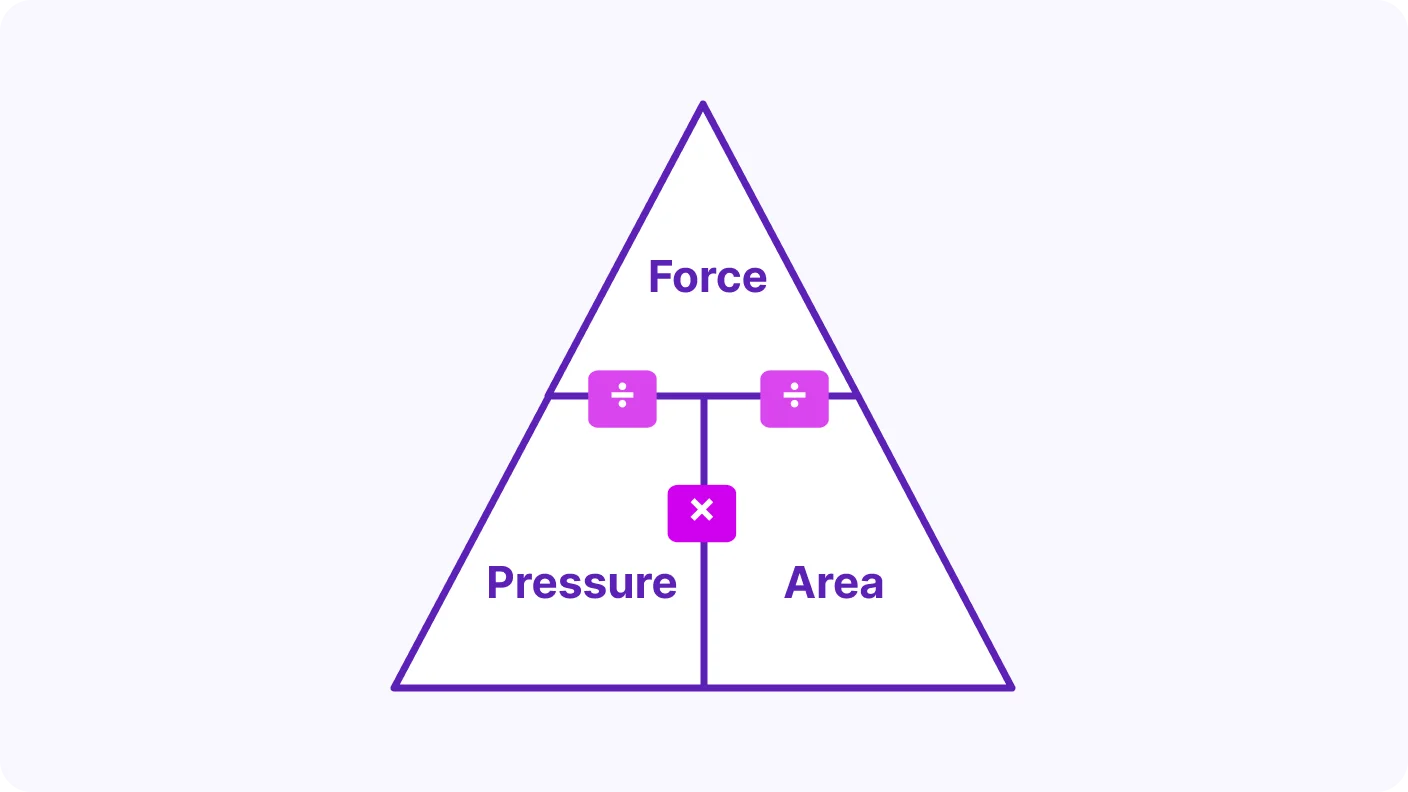
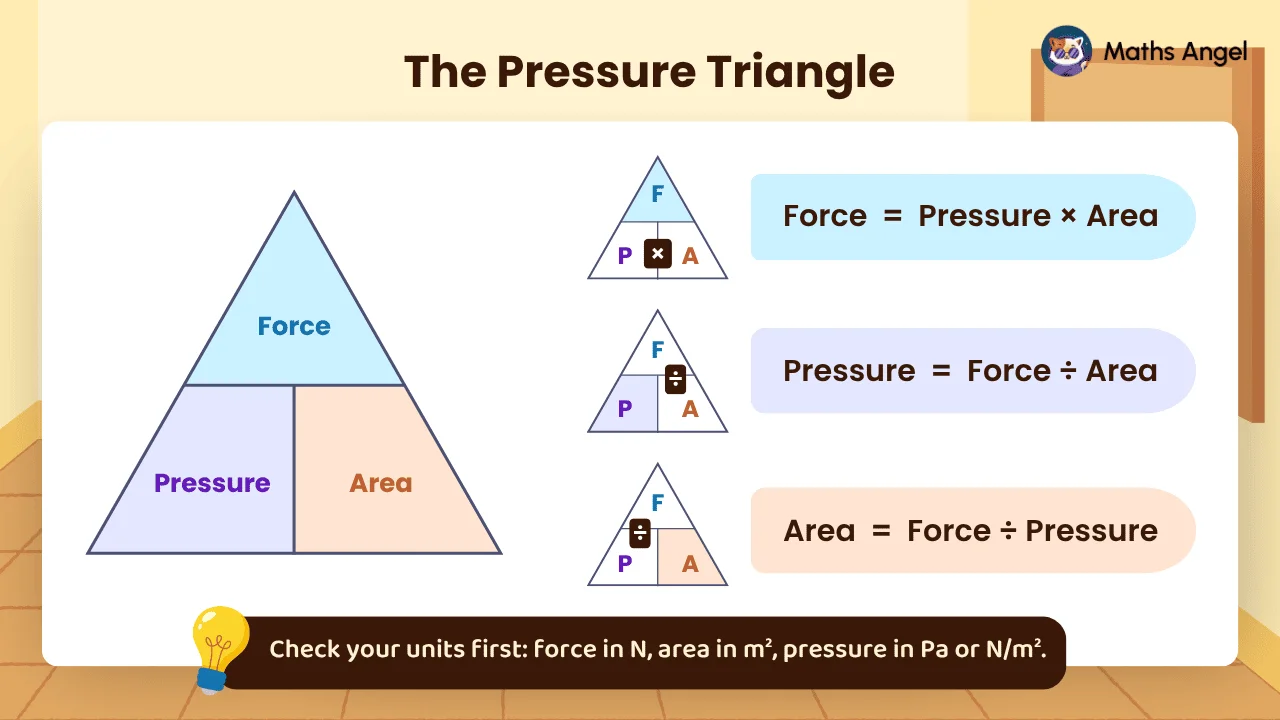
Using the Pressure Triangle
- Cover the value you want to find to reveal its formula.
- Two values side by side means multiply: .
- One value above another means divide: and .
Finding Force
- To find force, multiply pressure by area.
- 500 Pa .
Finding Area
- To find area, divide force by pressure.
- Total ski area = 800 N ÷ 2000 .
- Then ÷ 2 skis = each.
Finding Pressure
- First find one support's area: .
- Then × 4 supports for the total area: .
- To find pressure, divide force by area: Pa.
Practice Questions
Test your understanding
A fridge pushes down on the floor with a force of 1000 N over an area of . Find the pressure.
Correct! 🎉 +10 pointsCorrect! 🎉 Worth 10 XPNot quite right
Use pressure = force ÷ area.
So .
Dividing by 0.5 is the same as multiplying by 2, so the answer is bigger than 1000, not smaller: spreading 1000 N over only half a square metre gives 2000 N on every square metre.
The pressure is 2000 N/m².
A crate presses on the ground with a pressure of 900 N/m² over an area of . Find the force.
Correct! 🎉 +10 pointsCorrect! 🎉 Worth 10 XPNot quite right
Rearrange pressure = force ÷ area to get force = pressure × area.
So .
Each square metre carries 900 N, and there are 2 square metres, so the total force is 1800 N.
A force of 1800 N produces a pressure of 1200 N/m². Find the area it acts on.
Correct! 🎉 +20 pointsCorrect! 🎉 Worth 20 XPNot quite right
Use area = force ÷ pressure.
So .
The area is .
A wardrobe has a rectangular base measuring by . It presses on the floor with a force of 1350 N. Find the pressure on the floor.
Correct! 🎉 +20 pointsCorrect! 🎉 Worth 20 XPNot quite right
First find the area of the base. For a rectangle, area = length × width .
Then use pressure = force ÷ area. So .
The pressure is 1500 N/m².
Check three things: , not 9; the force must be divided by the area (), not by a single side length; and because you are dividing by a number smaller than 1, the answer is bigger than 1350, not smaller.
A square paving slab has sides of . The pressure on it is 2000 N/m². Find the force acting on the slab.
Correct! 🎉 +20 pointsCorrect! 🎉 Worth 20 XPNot quite right
First find the area of the slab. For a square, area = side × side .
Then use force = pressure × area. So .
The force is 500 N.
Take care to multiply by the area (), not by a side length () and not by the perimeter (), and to multiply rather than divide, since force = pressure × area.
A box with a square base presses on the ground with a force of 800 N. The pressure on the ground is 3200 N/m². Find the length of one side of the square base.
Correct! 🎉 +30 pointsCorrect! 🎉 Worth 30 XPNot quite right
First find the area of the base using area = force ÷ pressure. So .
For a square base, area = side × side, so the side is the square root of the area: .
The side length is .
Three steps are easy to get wrong: stopping at the area () instead of square rooting it, squaring the area instead of rooting it (), and dividing the wrong way round (, which would give a side of ).
Want to see the full working?
Interactive Activity
Tap a corner to choose what to find, then adjust the values.
Loading interactive widget...
Pressure, Force and Area frequently asked questions
The questions students bump into most on this topic
The three quantities share one formula. Pressure equals force divided by area, written P = F ÷ A. Rearranged, force equals pressure times area, and area equals force divided by pressure. The pressure triangle helps you switch between these three forms quickly.
Force is measured in newtons (N). Area is measured in square metres (m²). Pressure is measured in pascals (Pa). One pascal is the same as one newton per square metre, so a pressure given in pascals links the newton and the square metre together.
Pressure measures how concentrated a force is over an area. When the same force presses on a smaller area, it is squashed into less space, so the pressure is higher. Spreading that same force over a larger area lowers the pressure.
Cover the quantity you want to find. The other two show the operation. If they sit side by side, you multiply them. If one sits above the other, you divide the top by the bottom. This gives you the formula you need.
Cover F in the pressure triangle. Pressure and area sit side by side underneath, so you multiply them: force equals pressure times area. Make sure the pressure is in pascals and the area is in square metres, then multiply to find the force in newtons.