Absolute Frequency and Relative Frequency
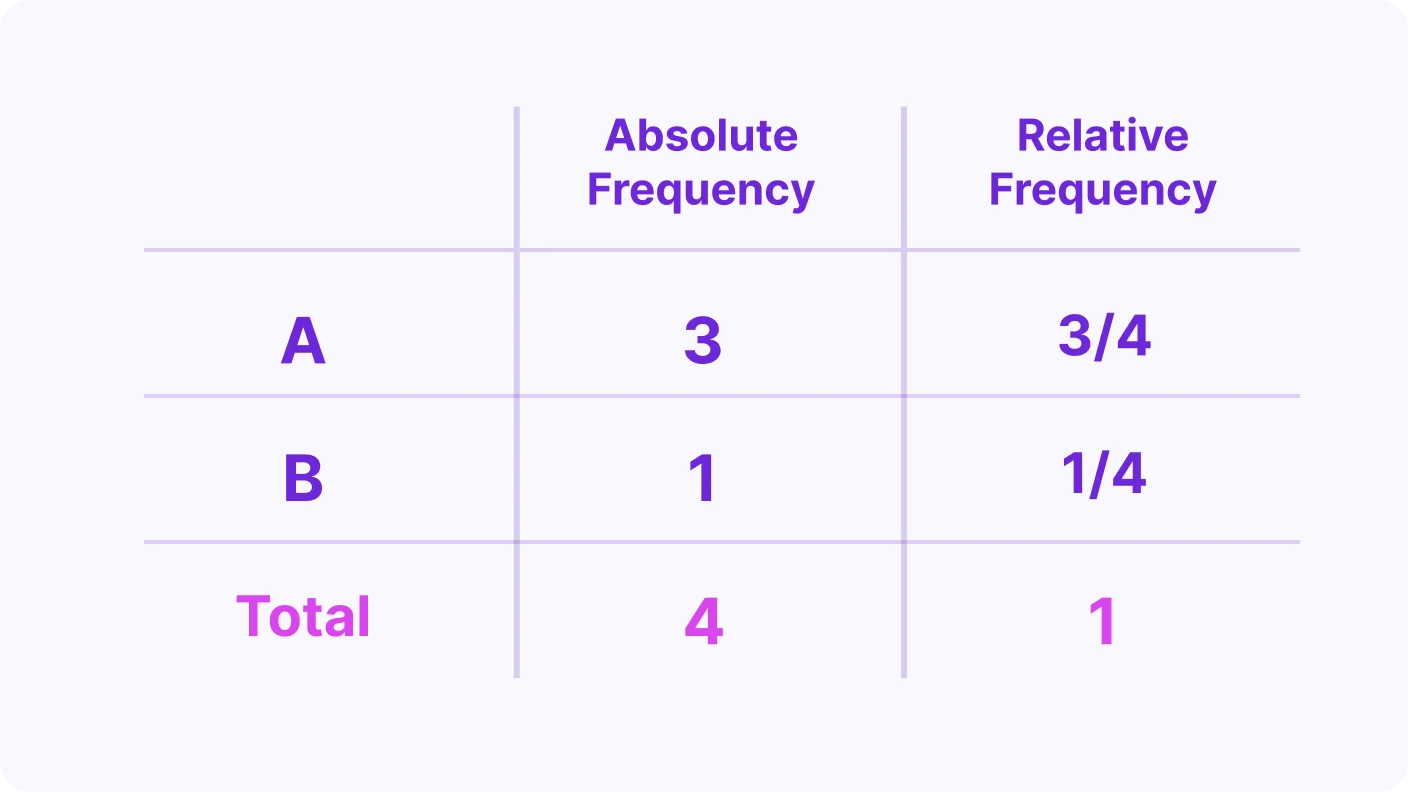
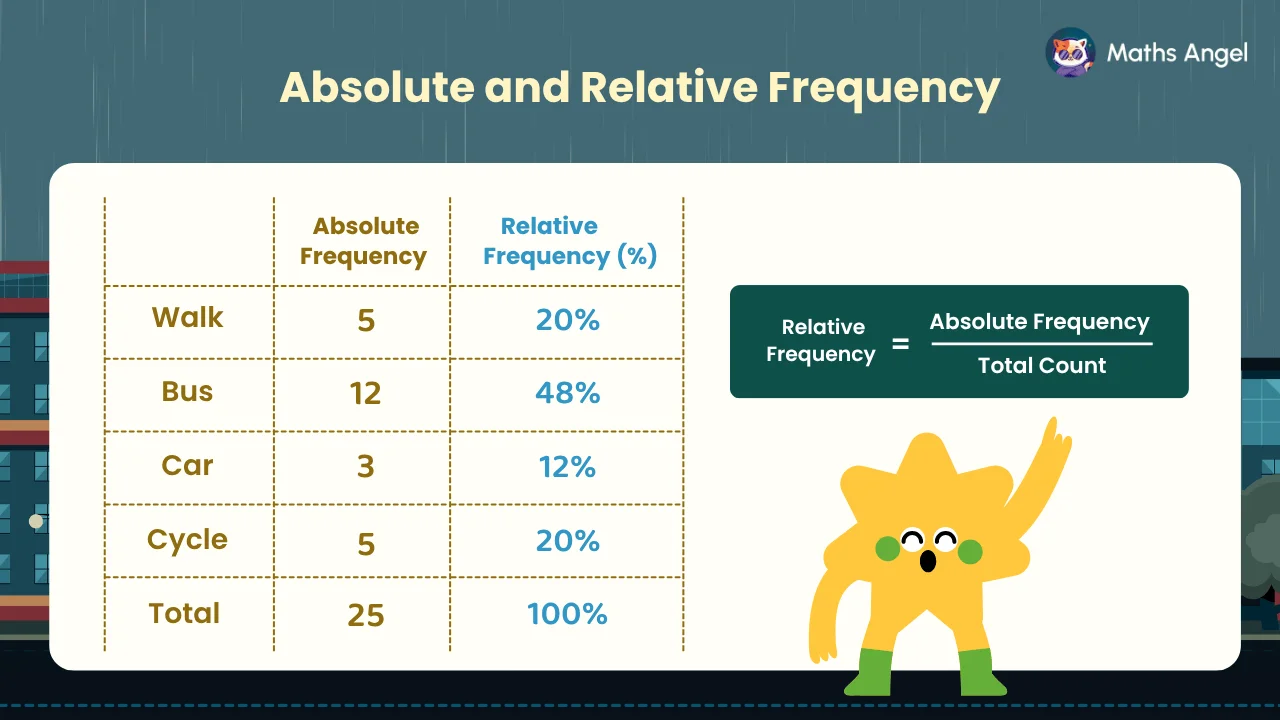
Absolute frequency is how often something happens, and relative frequency is that count divided by the total: count ÷ total. The relative frequencies always add up to 1, or 100%.
Video Lesson
Watch and learn the basics
🎬 Did this video explain it clearly?
Flashcards
Review key concepts visually
%20Absolute%20Frequency.webp)
%20Relative%20Frequency.webp)
%20Absolute%20and%20Relative%20Frequency%20Relationship.webp)
What Is Absolute Frequency?
- It tells you the exact number of times something happens
- Adding all absolute frequencies gives the total number of data values
What Is Relative Frequency?
- It tells you how big each category is, as a fraction or percentage
- Adding all relative frequencies gives 1, or
How to Calculate Absolute and Relative Frequency?
- Relative frequency = absolute frequency of the category ÷ total number
- Absolute frequency = relative frequency of the category × total number
Practice Questions
Test your understanding
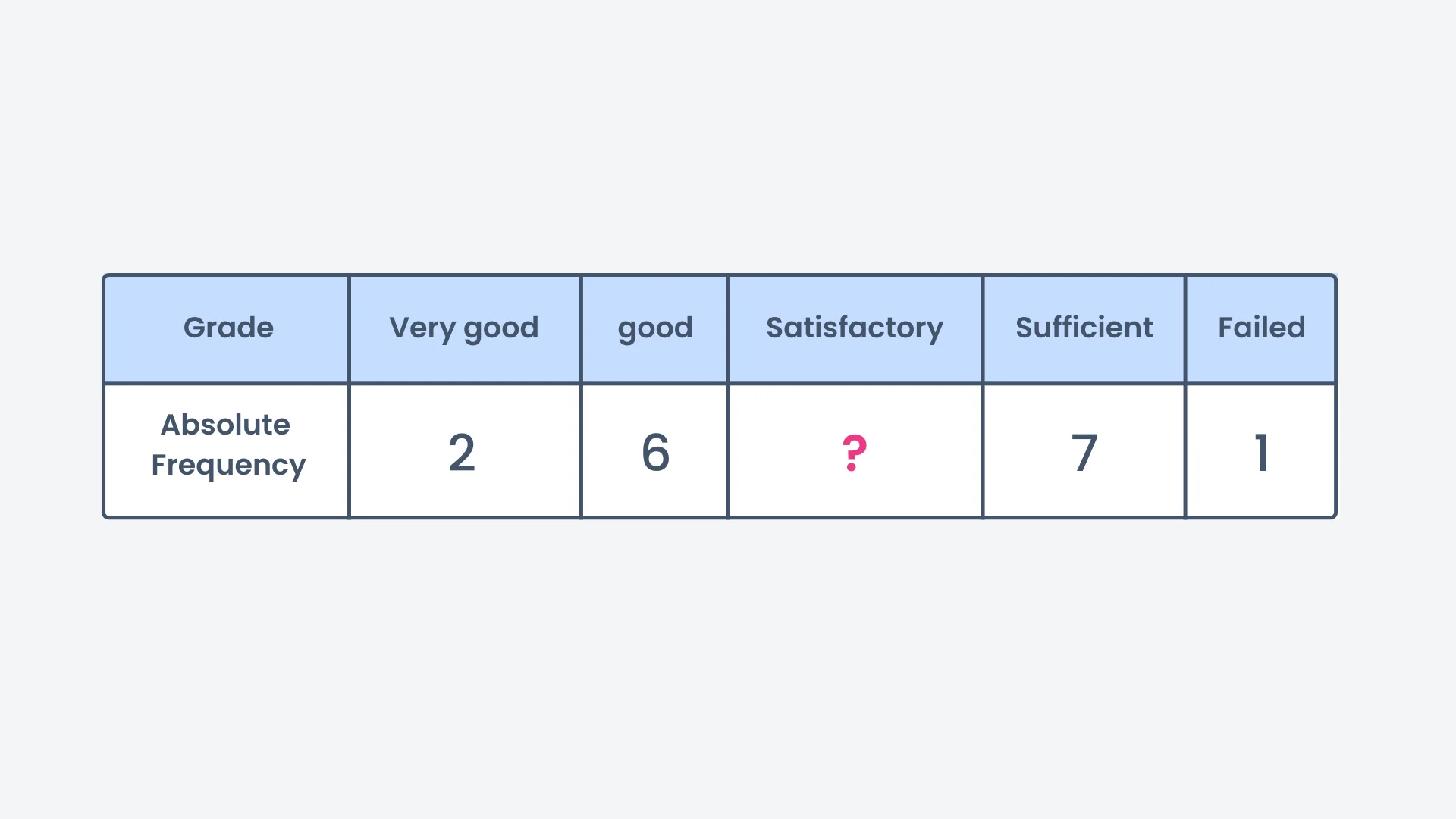
The frequency table below shows the grades achieved by a class of 25 students. How many students obtained the grade Satisfactory?
Correct! 🎉 +10 pointsCorrect! 🎉 Worth 10 XPNot quite right
All five frequencies must add up to the class total of 25 students.
The four known frequencies add to .
So the missing Satisfactory frequency is students. Checking: .
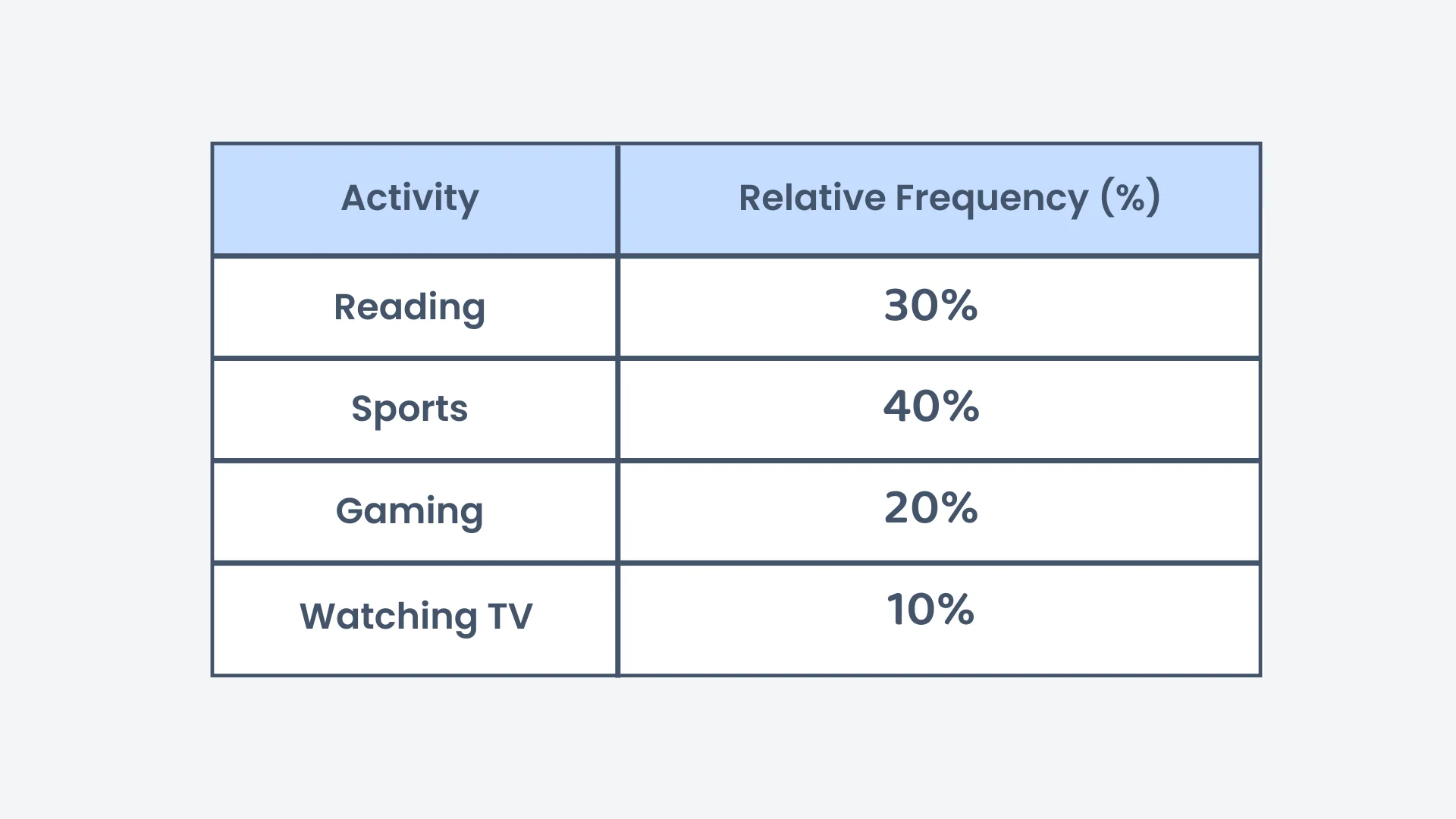
The table below shows the results of a survey of favourite activities among 50 students. How many students chose Sports as their favourite activity?
Correct! 🎉 +10 pointsCorrect! 🎉 Worth 10 XPNot quite right
A relative frequency of means 40 out of every 100, which as a decimal is .
To turn a relative frequency into an absolute frequency, multiply by the total count: .
So 20 students chose Sports. As a check, the four activities give students.
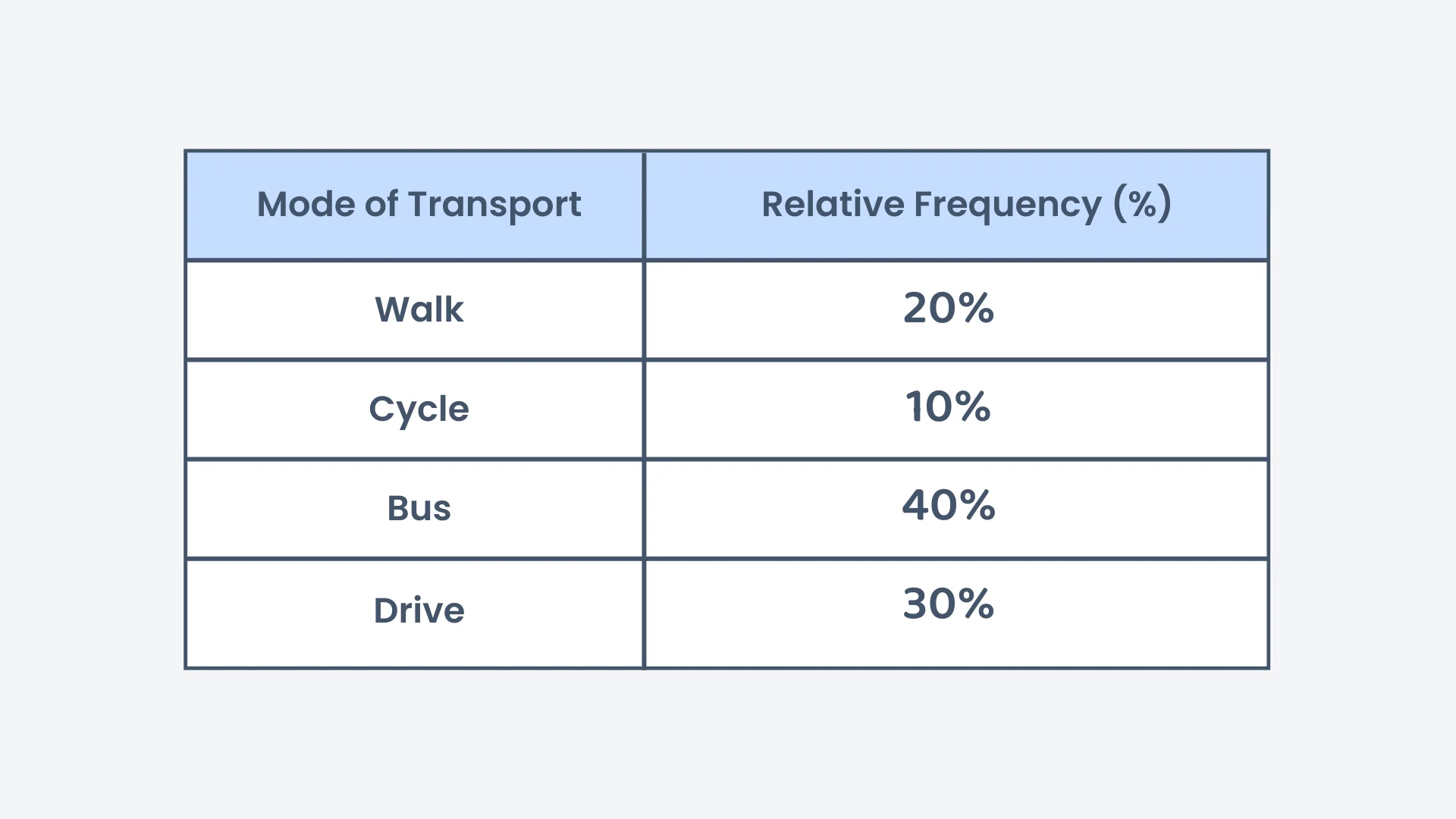
The table below shows how the 80 students in Class M travel to school. How many more students take the bus than cycle?
Correct! 🎉 +20 pointsCorrect! 🎉 Worth 20 XPNot quite right
First turn each relative frequency into an absolute frequency by multiplying by the total of 80 students.
Bus: students. Cycle: students.
"How many more" means subtract: students. Note that the answer must be a number of students, not a difference in percentages.
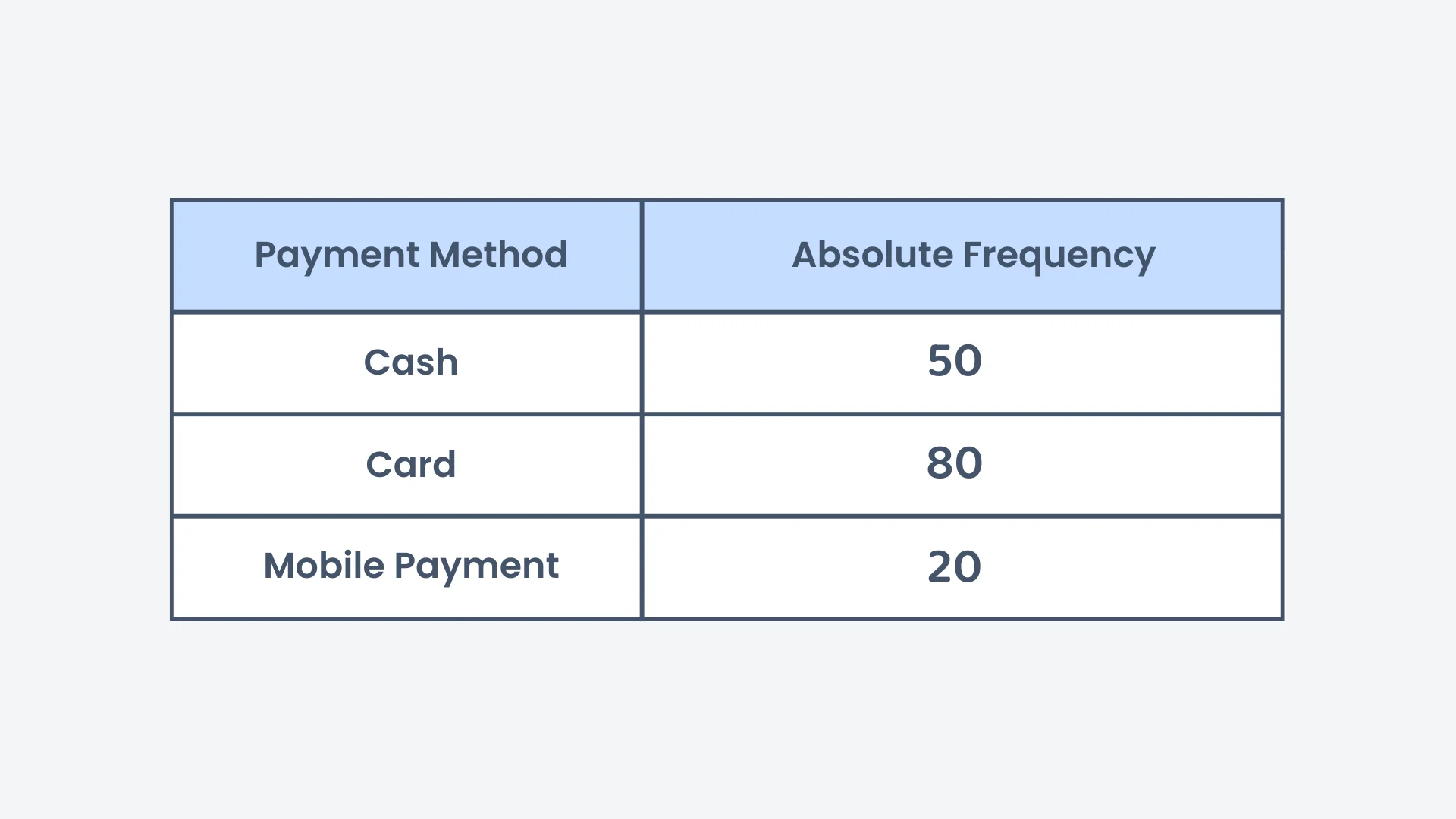
The table below shows the methods of payment used by customers at a supermarket on one day. How many degrees of a pie chart correspond to customers who paid with cash?
Correct! 🎉 +20 pointsCorrect! 🎉 Worth 20 XPNot quite right
First find the total number of customers: .
Cash was used by 50 of them, so the cash fraction is .
A full pie chart is , so the cash sector is .
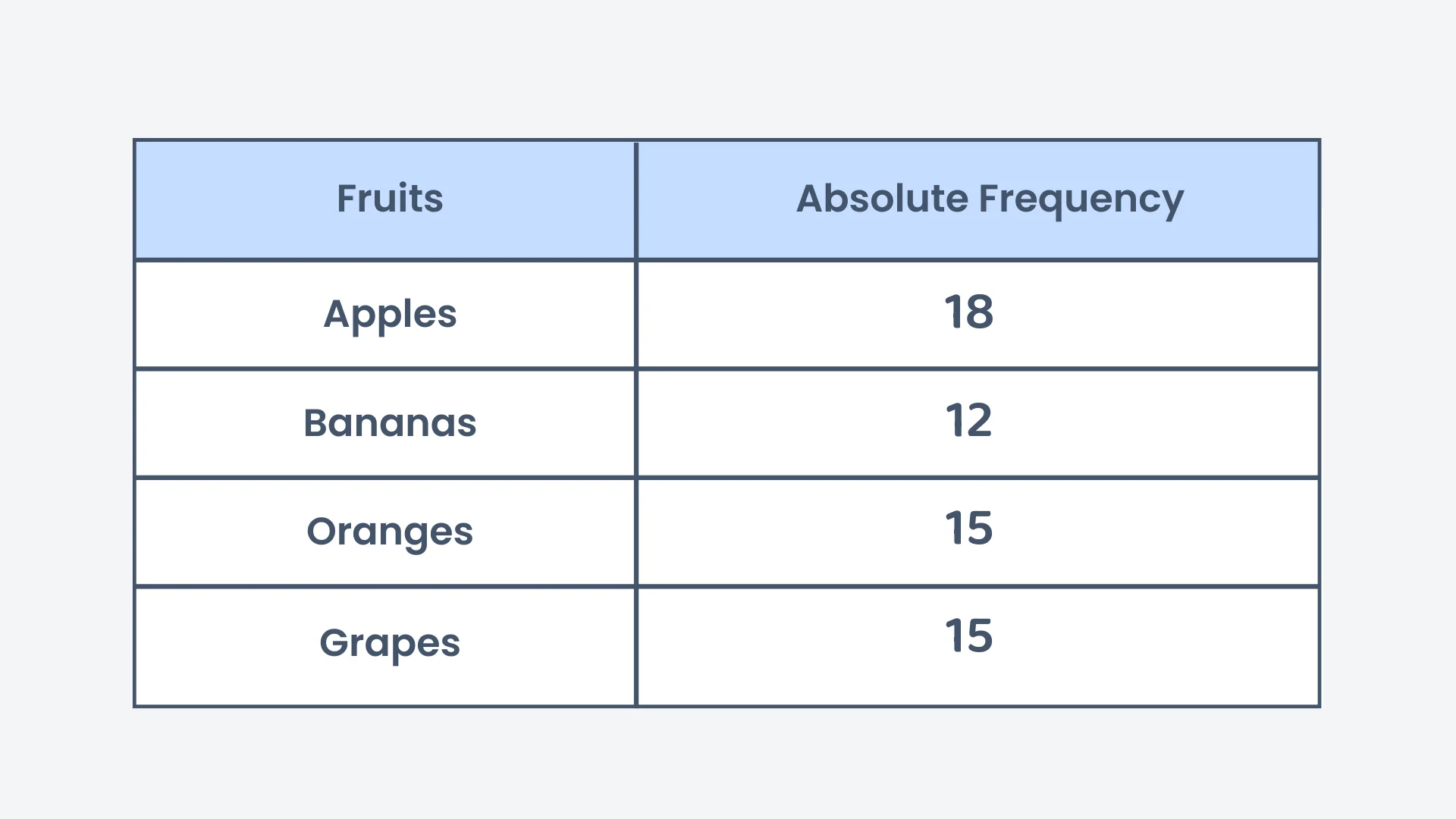
The table below shows the results of a survey on students’ favourite fruits among 60 students in Class Q. What is the relative frequency of students who prefer bananas, and how many degrees of a pie chart does this represent?
Correct! 🎉 +20 pointsCorrect! 🎉 Worth 20 XPNot quite right
The frequencies add to , which matches the class size.
Relative frequency of bananas: .
A full pie chart is , so the banana sector is .
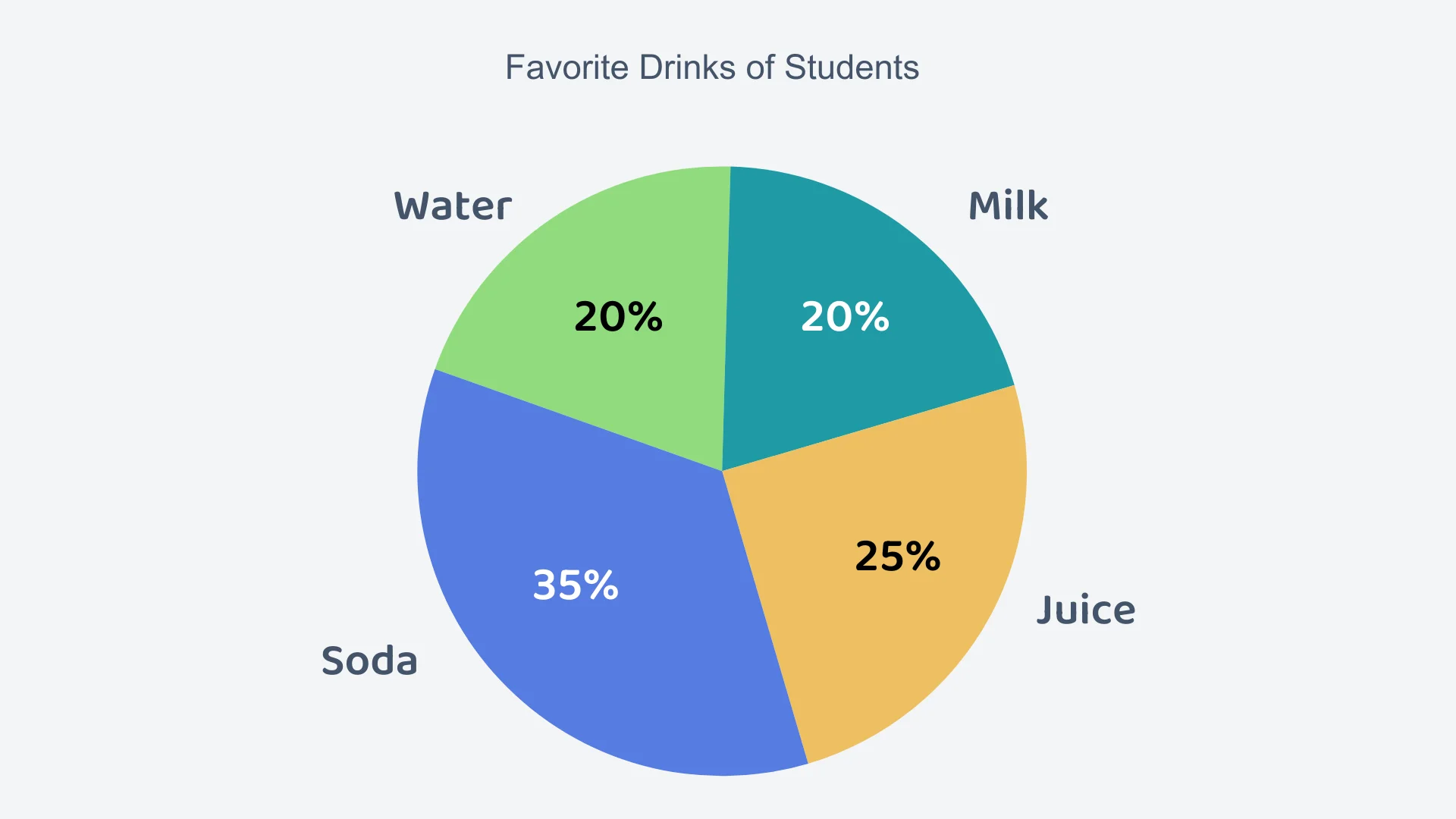
The pie chart below represents the favourite drinks of 90 students. How many students prefer Milk? How many degrees of the pie chart correspond to it?
Correct! 🎉 +30 pointsCorrect! 🎉 Worth 30 XPNot quite right
The Milk sector is labelled of the chart, which as a decimal is .
Number of students: students.
Angle: a full pie chart is , so the Milk sector is . The angle depends only on the percentage, while the number of students depends on the total of 90.
Want to see the full working?
Interactive Activity
Adjust sliders to see how absolute frequency and relative frequency are connected
Loading interactive widget...
Frequently asked questions
The questions students bump into most on this topic
Absolute frequency is the exact number of times something happens: a plain count. In Class A, 5 students walk to school, 12 take the bus, 3 go by car and 5 cycle; those are the absolute frequencies, and they add up to the total count of 25. Relative frequency turns each count into a share of that total.
Relative frequency is the proportion of the total that falls in a category: the absolute frequency divided by the total count, written as a fraction, a decimal or a percentage. In Class A, 5 of the 25 students walk to school, so the relative frequency of walking is 5/25 = 20%. All the relative frequencies together add up to 1, or 100%.
Divide the absolute frequency of the category by the total count. If 12 of 25 students take the bus, the relative frequency is 12 ÷ 25 = 0.48, or 48%. The formula also runs backwards: relative frequency × total count gives the absolute frequency, so 10% of a class of 40 is 0.1 × 40 = 4 students.
In GCSE maths relative frequency appears in two places. In frequency tables it is the share of the total in each category, as in this lesson. In probability it is the number of times an outcome happened divided by the number of trials, used as an estimate of probability: a coin that landed heads 12 times in 20 flips has a relative frequency of 12/20 = 0.6.
Use the two facts you know: absolute frequencies add up to the total count, and relative frequency × total gives the absolute frequency. In Class B, 40 students, the walking share is 10%, so 0.1 × 40 = 4 walk. The counts 4, 8, b and 12 must add to 40, so b = 16, and its relative frequency is 16 ÷ 40 = 40%.
Yes. Every item belongs to exactly one category, so the shares add up to 1, or 100%: in Class B, 10% + 20% + 40% + 30% = 100%. If yours do not, there is a mistake. For the same reason, a single relative frequency can never be more than 1; if you get a bigger number, you divided by the wrong total.
What's next?
Found this one hard? Go one step back first. Feeling confident? Carry on to the next lesson.