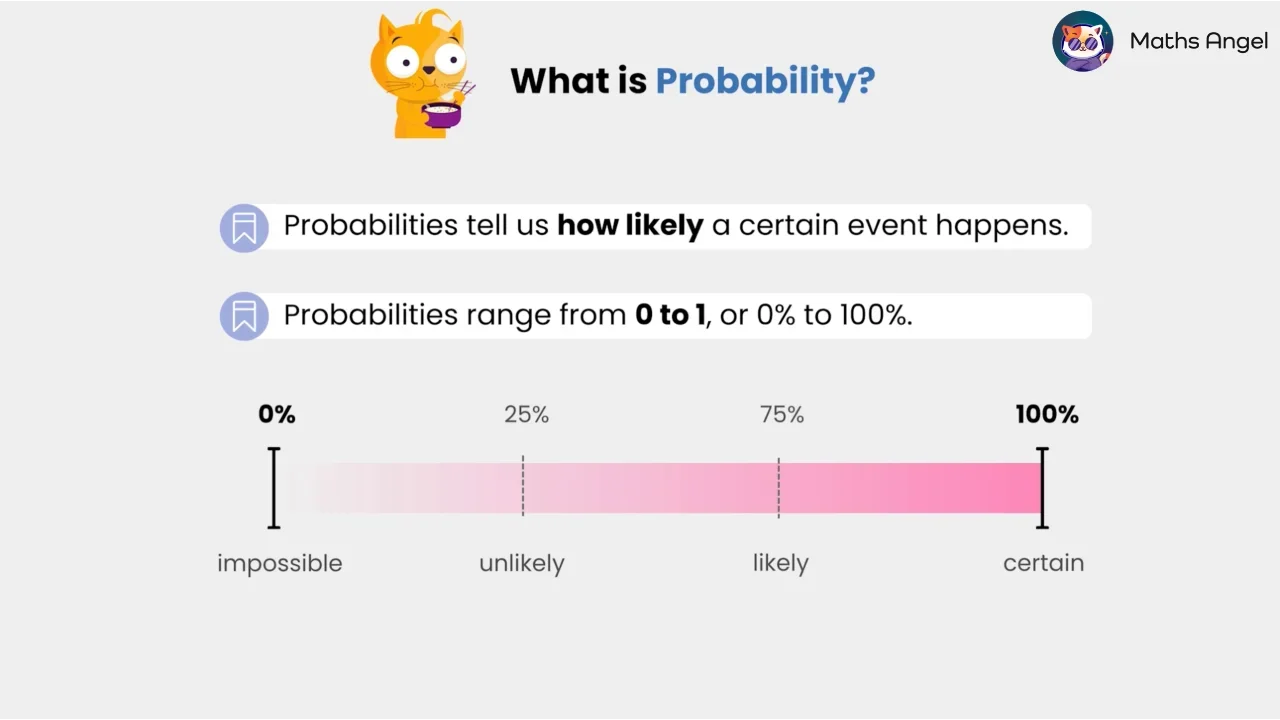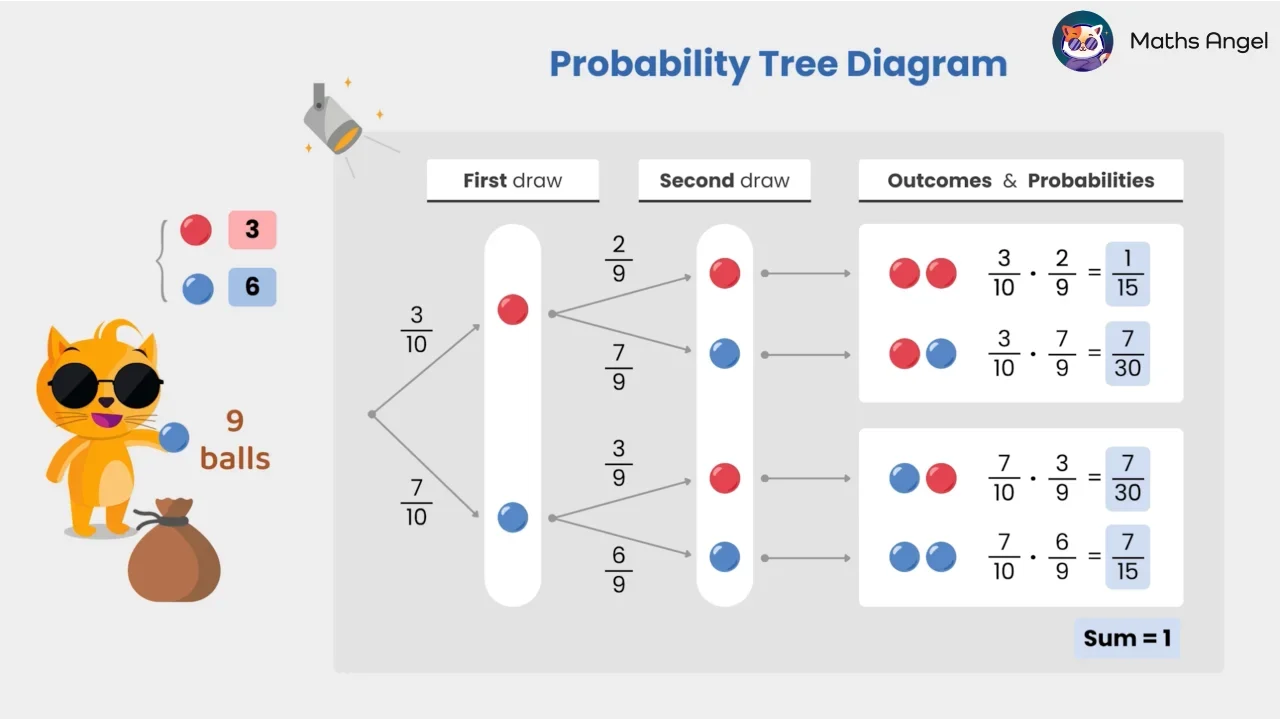
Addition Rule of Probability and Expected Frequency
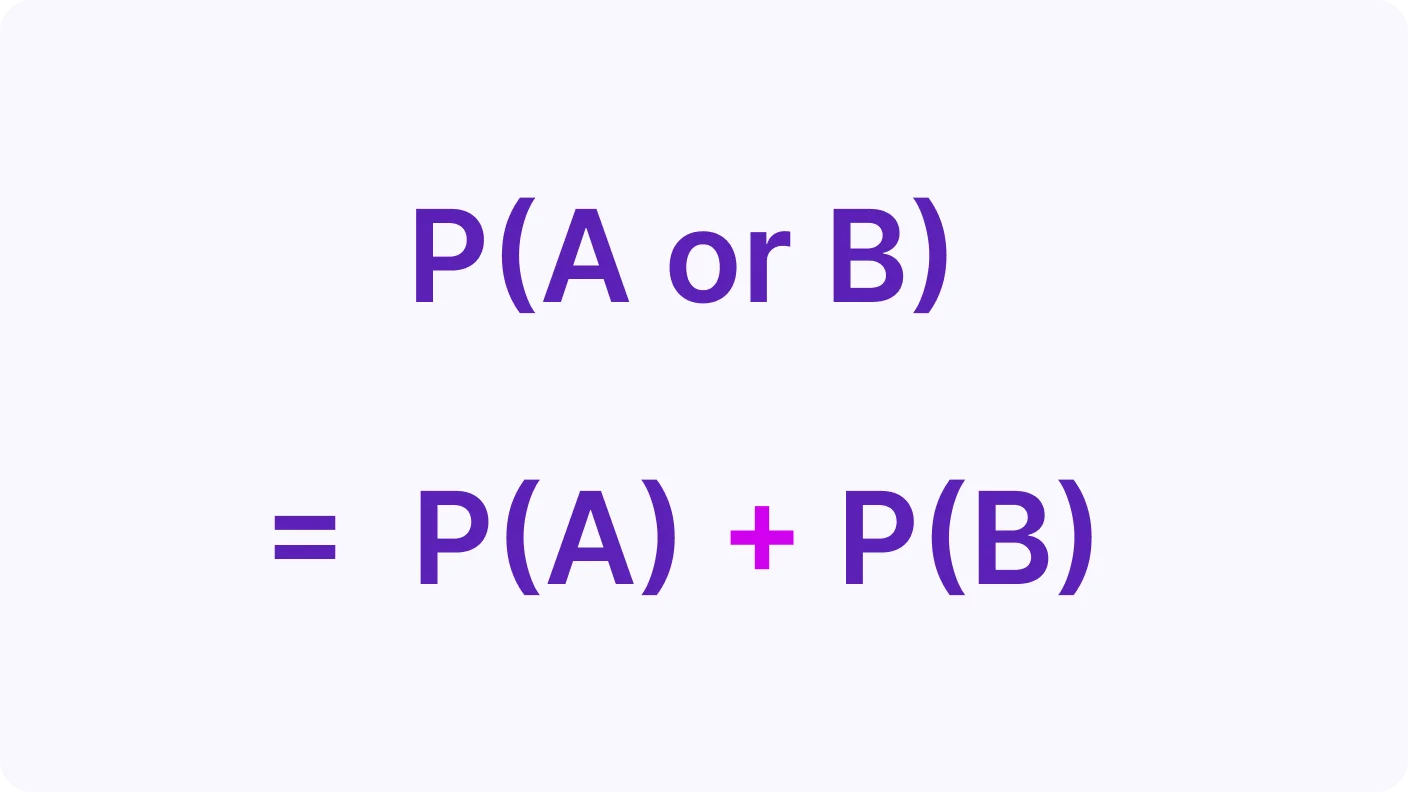
The addition rule of probability finds the chance of A or B when they are mutually exclusive (cannot both happen). Just add: P(A or B) = P(A) + P(B). Expected frequency is how often it happens: probability × number of trials.
Video Lesson
Watch and learn the basics
🎬 Did this video explain it clearly?
Flashcards
Review key concepts visually
%20Equiprobable%20Events.webp)
%20Calculating%20Probability.webp)
%20Calculating%20Probability%20Example.webp)
%20Addition%20Rule%20for%20Probabilities.webp)
%20Expected%20Absolute%20Frequency.webp)
What Are Equiprobable Events?
- Equiprobable events are events with the same chance of happening.
- When rolling a fair die, each number has an equal probability of 1/6.
Calculating Probability: Single Event
- Probability equals number of favourable outcomes ÷ total outcomes.
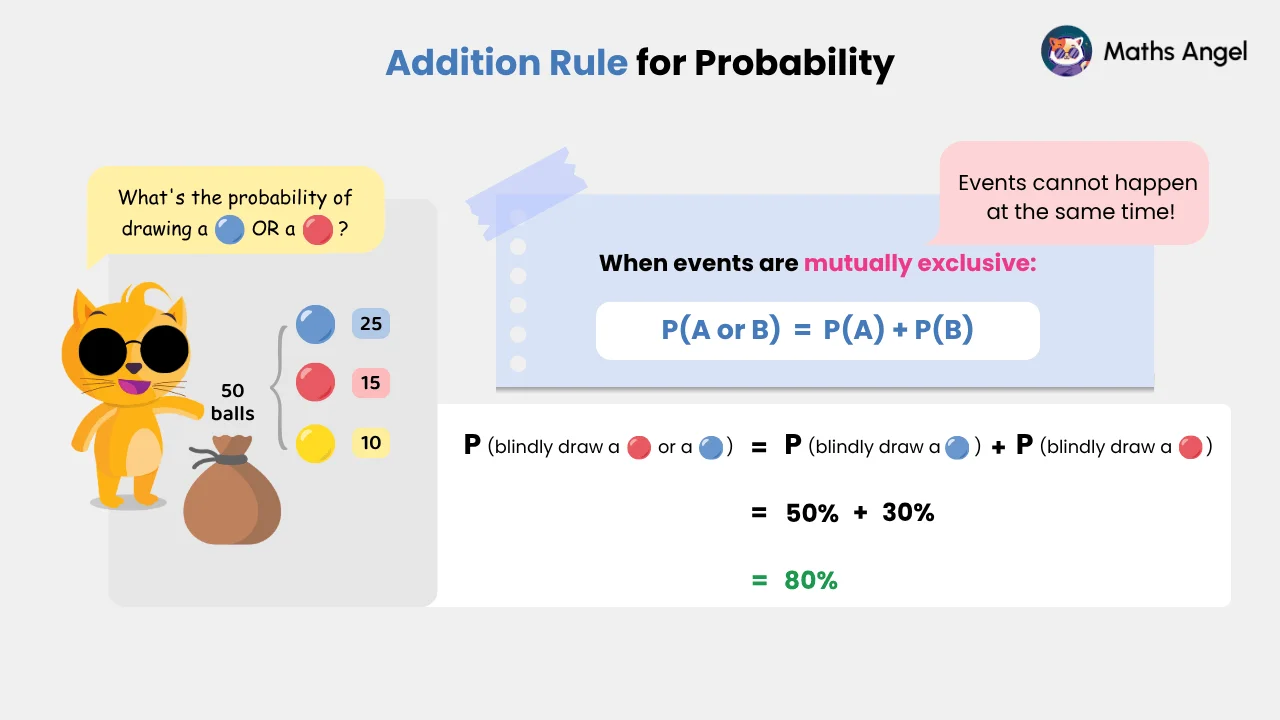
- For example, drawing a blue ball from 50 balls with 25 blue gives .
Probability of “OR” Events
- Use OR when either event can happen.
- Add the favourable outcomes for each event, then divide by the total outcomes.
Addition Rule for Probability
- Mutually exclusive events cannot happen at the same time.
- For example, a ball cannot be red and blue at the same time.
- When events are mutually exclusive, use P(A or .
Expected Absolute Frequency
- Expected absolute frequency is how often an event is expected to happen.
- It equals probability × number of trials.
- It is an estimate, so what actually happens can vary.
Practice Questions
Test your understanding
In a bag with 50 balls, there are 25 blue, 15 red, and 10 yellow balls. What is the probability of drawing a yellow ball? Give your answer in its simplest form.
Correct! 🎉 +10 pointsCorrect! 🎉 Worth 10 XPNot quite right
Probability is the number of favourable outcomes out of the total number of equally likely outcomes.
There are 10 yellow balls out of 50 balls altogether, so the probability is .
Dividing top and bottom by 10 gives . So the probability of drawing a yellow ball is .
If you roll a fair six-sided die, what is the probability of rolling either a 2 or a 6? Give your answer in its simplest form.
Correct! 🎉 +10 pointsCorrect! 🎉 Worth 10 XPNot quite right
A fair die has 6 equally likely outcomes: 1, 2, 3, 4, 5 and 6.
Two of these are favourable (a 2 and a 6), and they cannot both happen at once, so add their probabilities: .
Dividing top and bottom by 2 gives . So the probability is .
A box contains 15 red, 5 blue, and 10 green marbles. What is the probability of drawing a red or green marble? Give your answer in its simplest form.
Correct! 🎉 +20 pointsCorrect! 🎉 Worth 20 XPNot quite right
Red and green marbles: . Total marbles: .
So the probability is , which simplifies to .
A bag contains 6 red, 4 blue, and 2 yellow marbles. What is the probability of drawing a yellow or blue marble? Give your answer in its simplest form.
Correct! 🎉 +20 pointsCorrect! 🎉 Worth 20 XPNot quite right
Yellow and blue marbles: . Total marbles: .
So the probability is , which simplifies to .
You roll a fair die 60 times. How many times would you expect to roll a 3?
Correct! 🎉 +20 pointsCorrect! 🎉 Worth 20 XPNot quite right
A fair die has 6 equally likely faces, so the probability of rolling a 3 is .
Expected frequency = probability number of trials .
This is what to expect on average; an actual set of 60 rolls will not always give exactly 10 threes.
You roll a fair die 120 times. How many times would you expect to roll a number less than 3?
Correct! 🎉 +30 pointsCorrect! 🎉 Worth 30 XPNot quite right
The numbers less than 3 are 1 and 2 (3 itself is not included), so the probability is .
Expected frequency = probability number of trials .
Want to see the full working?
Interactive Activity
Addition rule of probability
Loading interactive widget...
Frequently asked questions
The questions students bump into most on this topic
Two events are mutually exclusive when they cannot happen at the same time. One ball drawn from a bag cannot be both blue and red, so “blue” and “red” are mutually exclusive; a die cannot show both a 2 and a 6. You need this before using the addition rule, because the rule only works for events that cannot overlap.
For mutually exclusive events, the probability of A or B is the sum of their probabilities: P(A or B) = P(A) + P(B). A bag holds 50 balls, 25 blue, 15 red and 10 yellow. P(blue) is 25/50 = 50% and P(red) is 15/50 = 30%, so P(blue or red) = 50% + 30% = 80%. Some sites call it the rule of sum.
“Or” means either event counts. You can count the favourable outcomes for both and divide by the total: 25 blue plus 15 red is 40 out of 50 balls, which is 0.8 or 80%. Or you can add the two probabilities, 50% + 30% = 80%. Both give the same answer when the events are mutually exclusive.
Events that have the same chance of happening. On a fair six-sided die, every face from 1 to 6 is equally likely, so the probability of each number is 1/6. The probability formula, favourable outcomes divided by total outcomes, only works when the outcomes are equiprobable, which is why questions say “fair” die or “at random”.
Multiply the probability by the number of trials. Rolling a fair die 60 times, the probability of a 3 is 1/6, so the expected frequency of a 3 is 1/6 × 60 = 10 times. For a number less than 3 in 120 rolls, the probability is 2/6 = 1/3, so the expected frequency is 1/3 × 120 = 40.
Expected frequency is a prediction: probability × trials, so about 10 threes in 60 rolls. Actual frequency is what really happens when you roll, which might be 8, 10 or 13. Each roll is independent and random, so the expected value is a best guess, not a promise. Over more rolls, the actual frequency usually gets closer to the expected one.
What's next?
Found this one hard? Go one step back first. Feeling confident? Carry on to the next lesson.