Probability Tree Diagrams
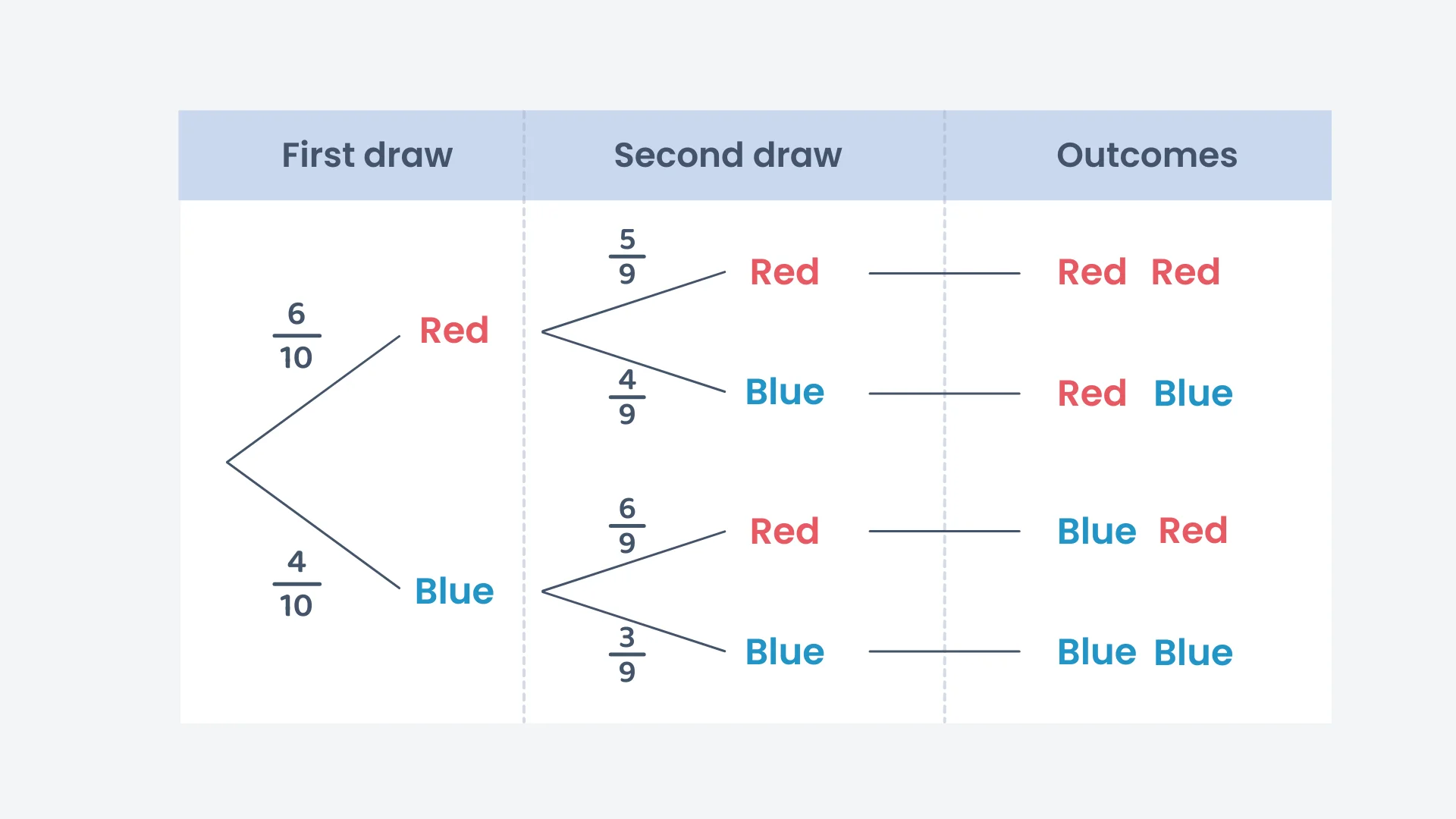
A probability tree diagram shows all possible outcomes of a two-stage event step by step. You multiply along the branches to find one path. Then add the paths for a combined event.
Video Lesson
Watch and learn the basics
🎬 Did this video explain it clearly?
Flashcards
Review key concepts visually
%20What%20is%20a%20Probability%20Trees%20Diagrams.webp)
%20How%20to%20Draw%20Probability%20Trees%20Diagrams.webp)
%20Probability%20Tree%20Diagram%20Outcomes.webp)
%20Finding%20Probabilities%20with%20Probability%20Tree%20Diagram.webp)
%20Calculating%20Probabilities%20using%20Probability%20Tree%20Diagrams.webp)
What Is a Probability Tree Diagram?
- A probability tree diagram shows all possible outcomes step by step.
- It is used for two-stage events, like drawing one ball at a time.
Drawing the Probability Tree Correctly
- Write fractions on every branch so probabilities are clear.
- After the first outcome, update the probabilities for what is left.
Finding the Probability of a Single Outcome
- You multiply the probabilities along one path.
- This gives the probability of one specific result.
Finding the Probability of a Combined Event
- A combined event means more than one path fits the question.
- You add the probabilities of paths like red-red and blue-blue.
Probability of At Least One Event Happening
- You can add all paths where the event happens.
- Or do 1 − probability of the opposite to save time and check your answer.
Practice Questions
Test your understanding
In a bag with 10 balls (6 red and 4 blue), what is the probability of drawing a red ball on the first draw? Give your answer as a fraction in its simplest form.
Correct! 🎉 +10 pointsCorrect! 🎉 Worth 10 XPNot quite right
On the first draw the bag holds 6 red balls out of 10 balls altogether, so P(red) = .
Dividing the numerator and denominator by 2 gives .
The probability is the number of red balls compared with the total number of balls, not with the number of blue balls.
In a bag with 10 balls (6 red and 4 blue), what is the probability of drawing a blue ball on the first draw? Give your answer as a fraction in its simplest form.
Correct! 🎉 +10 pointsCorrect! 🎉 Worth 10 XPNot quite right
On the first draw the bag holds 4 blue balls out of 10 balls altogether, so P(blue) = .
Dividing the numerator and denominator by 2 gives .
The probability is the number of blue balls compared with the total number of balls, not with the number of red balls.
A bag holds 10 balls: 6 red and 4 blue. The first ball drawn is blue and is not replaced.
What is the probability that the second ball drawn is also blue? Give your answer in its simplest form.
Correct! 🎉 +20 pointsCorrect! 🎉 Worth 20 XPNot quite right
The blue ball drawn first is not put back, so 3 of the original 4 blue balls are left and only 9 balls remain in the bag.
So the probability is . This is the lower 'blue then blue' branch of the tree diagram.
A bag holds 6 red balls and 4 blue balls. The first ball drawn is blue and is not replaced.
What is the probability that the second ball drawn is red? Give your answer in its simplest form.
Correct! 🎉 +20 pointsCorrect! 🎉 Worth 20 XPNot quite right
The blue ball drawn first is not replaced, so all 6 red balls are still in the bag but only 9 balls remain in total.
So the probability is , the 'blue then red' branch of the tree diagram.
A bag holds 6 red balls and 4 blue balls. Two balls are drawn without replacement.
What is the probability of drawing a red ball first and then a blue ball? Give your answer in its simplest form.
Correct! 🎉 +20 pointsCorrect! 🎉 Worth 20 XPNot quite right
Multiply along the branches. . The red ball is not replaced, so 4 of the 9 balls left are blue and .
.
A bag holds 6 red balls and 4 blue balls. Two balls are drawn without replacement.
What is the probability of drawing one red ball and one blue ball, in either order? Give your answer in its simplest form.
Correct! 🎉 +30 pointsCorrect! 🎉 Worth 30 XPNot quite right
Two branches of the tree give one ball of each colour.
Red then blue: . Blue then red: .
Add the two branches: .
Want to see the full working?
Interactive Activity
Use a tree diagram to visualise how probabilities are calculated.
Loading interactive widget...
Frequently asked questions
The questions students bump into most on this topic
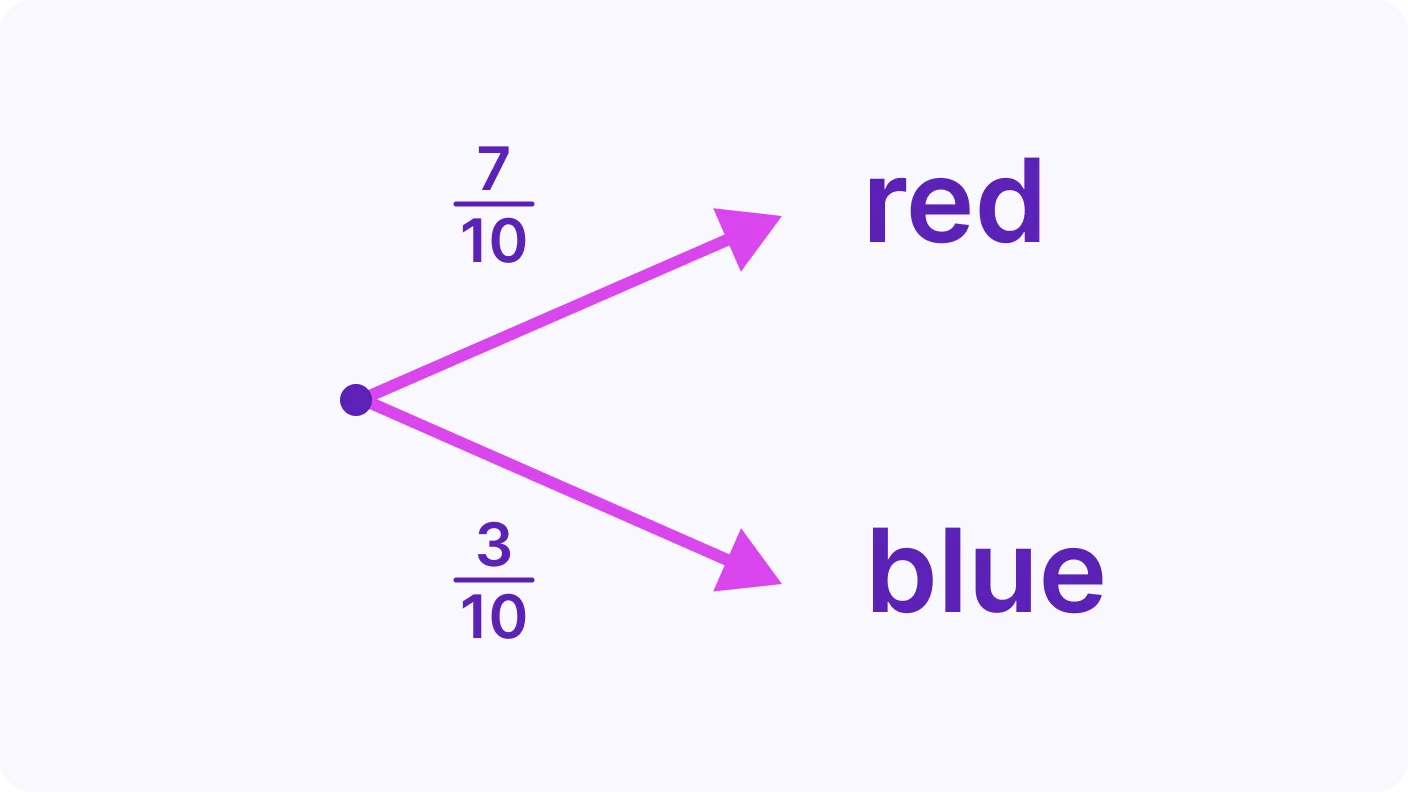
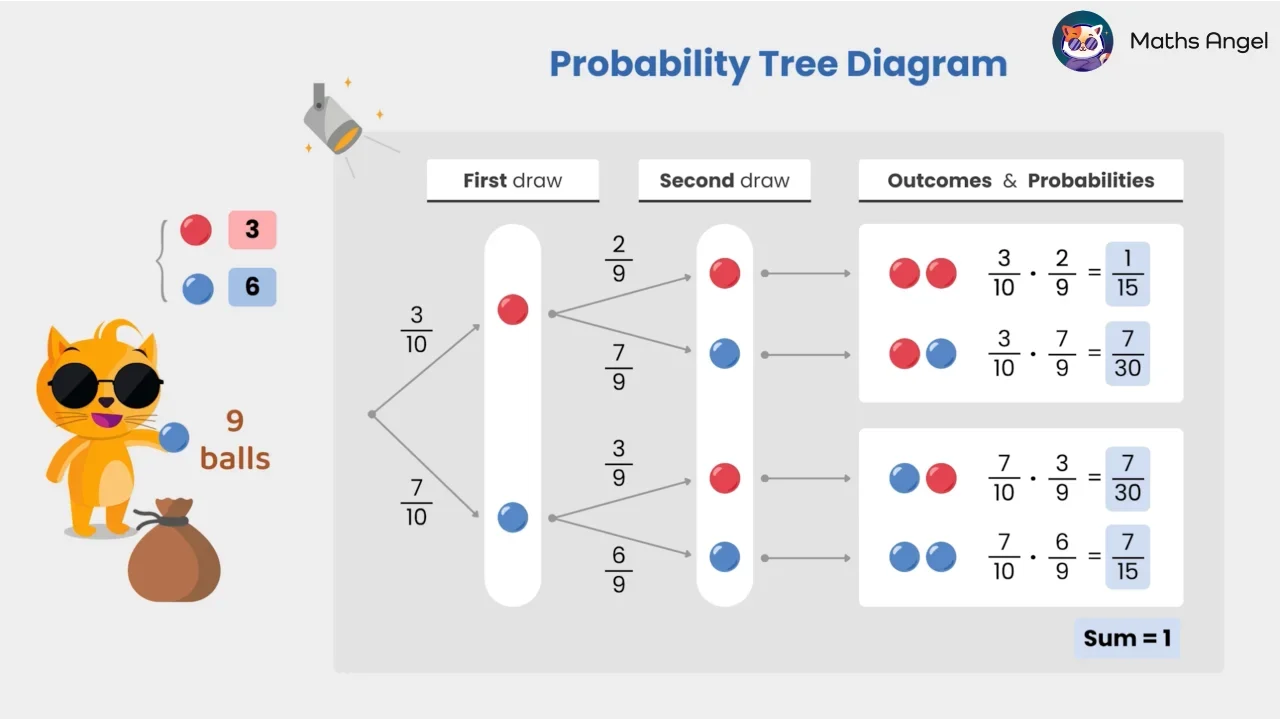
A diagram that shows every possible outcome of an experiment with two or more stages, with the probability written on each branch. For two balls drawn from a bag of 3 red and 7 blue, the first draw gives two branches, red and blue, and each of those splits again for the second draw, so four outcomes appear: red-red, red-blue, blue-red and blue-blue.
Start from one point and draw a branch for each outcome of the first draw, with its probability on it: red 3/10, blue 7/10. From each branch end, draw the second-draw branches with updated probabilities: after a red, 2/9 red and 7/9 blue; after a blue, 3/9 red and 6/9 blue. Write a fraction on every branch and check each pair adds to 1.
Multiply along a path to get one outcome; add paths to combine outcomes. Red then red is 3/10 × 2/9 = 1/15, and blue then blue is 7/10 × 6/9 = 7/15. “Two balls the same colour” means red-red or blue-blue, so add: 1/15 + 7/15 = 8/15. Along means multiply, across means add.
The first ball is not put back, so the second draw has fewer balls and its probabilities depend on what came out first. After a red from 3 red and 7 blue, 9 balls are left, 2 red and 7 blue, so the second-draw branches are 2/9 and 7/9. After a blue, they are 3/9 and 6/9. With replacement, the second draw would copy the first.
Either add every path that includes it, or subtract the one path that does not from 1. For at least one blue, the paths red-blue, blue-red and blue-blue add to 14/15. Faster: the only path with no blue is red-red, 1/15, so the answer is 1 − 1/15 = 14/15. Both routes agree, which makes the second a good check.
Add the probabilities of all the final outcomes: they must total 1. For the bag, 1/15 + 7/30 + 7/30 + 7/15 = 1. Each pair of branches from one point should add to 1 as well, such as 2/9 + 7/9. If either check fails, a branch probability is wrong, usually because the second draw was not updated.
What's next?
Found this one hard? Go one step back first. Feeling confident? Carry on to the next lesson.