Converting Quadratics: Standard Form and Vertex Form
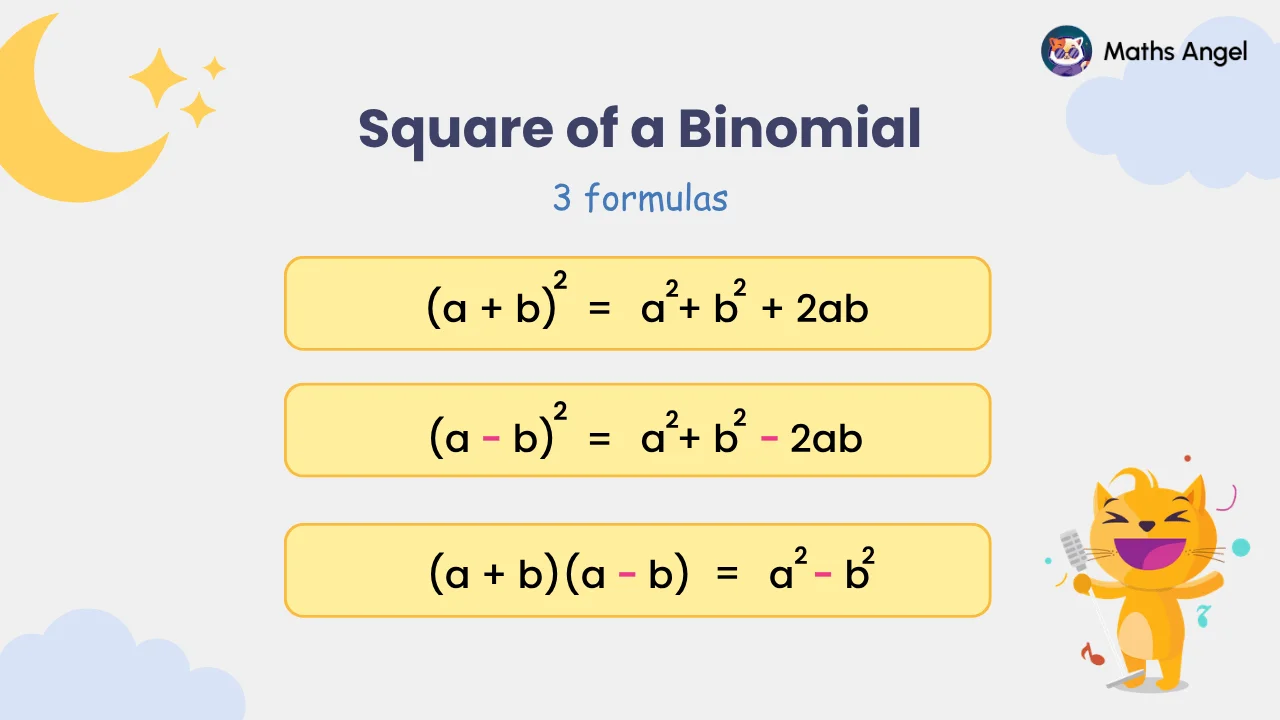
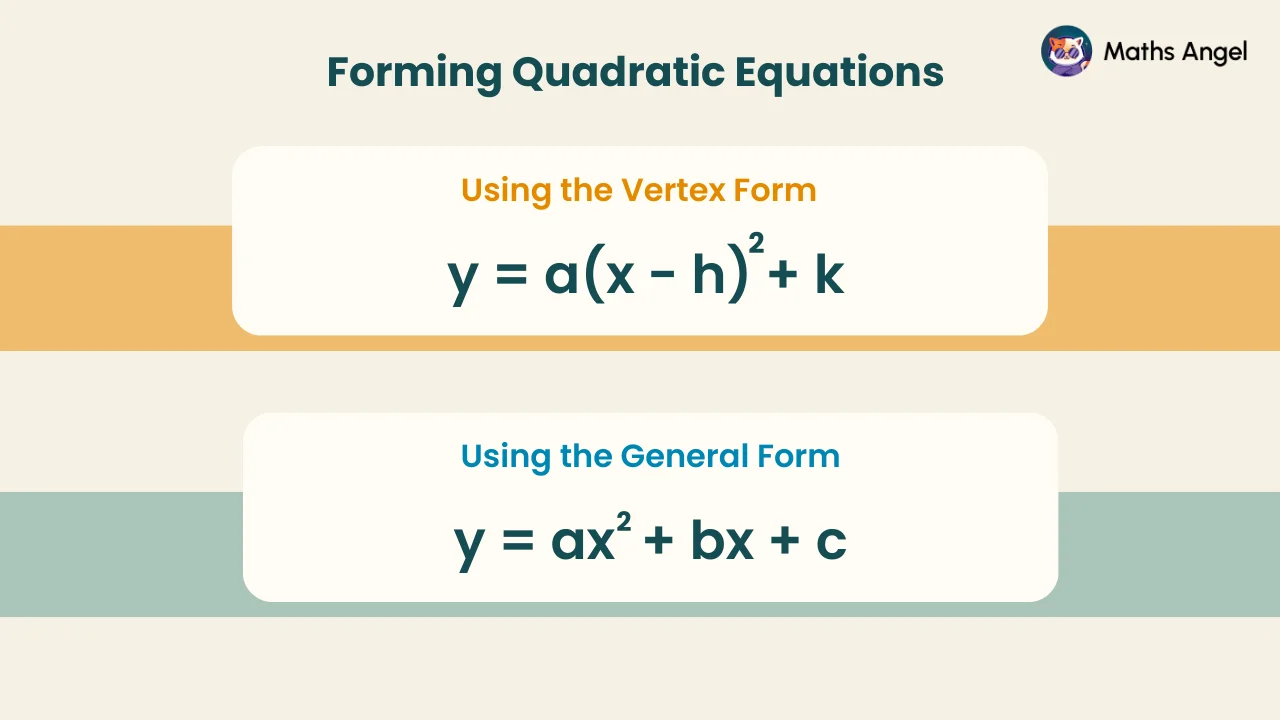
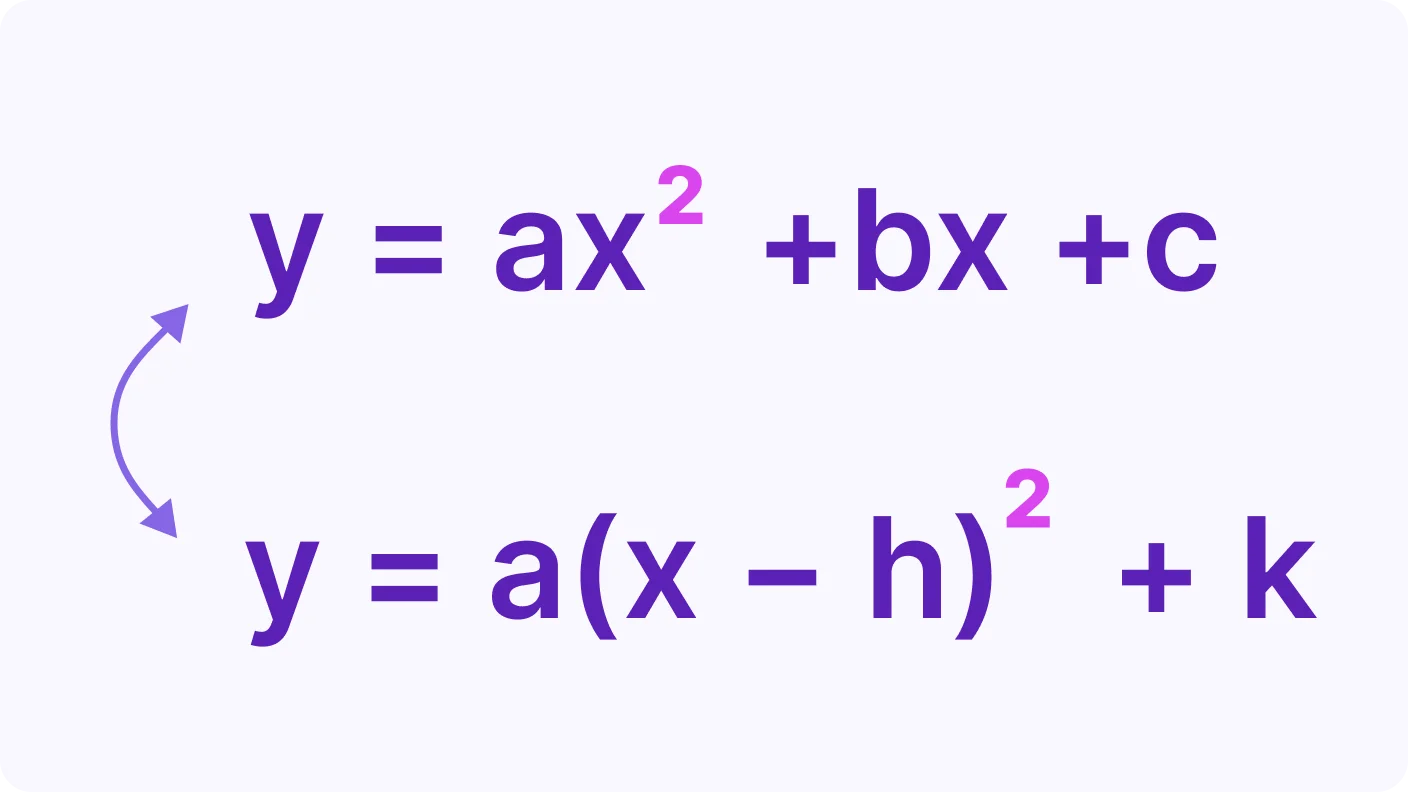
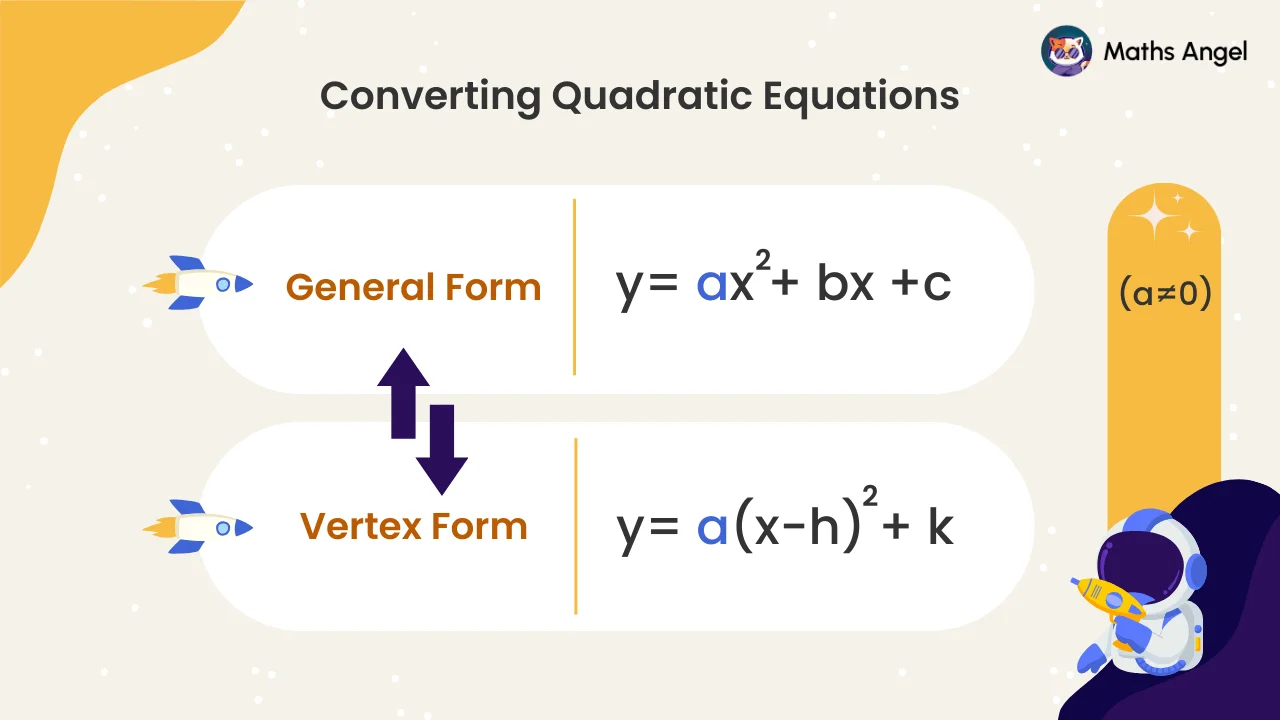
Completing the square turns standard form, y = ax² + bx + c, into vertex form, y = a(x − h)² + k: two ways of writing the same quadratic. Expanding the brackets changes it back.
Video Lesson
Watch and learn the basics
🎬 Did this video explain it clearly?
Flashcards
Review key concepts visually
%20General%20Form%20and%20Vertex%20Form.webp)
%20Converting%20Vertex%20to%20General%20Form.webp)
%20Converting%20General%20to%20Vertex%20Form.webp)
%20Converting%20General%20to%20Vertex%20Form.webp)
What are Standard Form and Vertex Form?
- Standard (general) form:
- Vertex form:
Converting Vertex Form to Standard Form
- Expand the square using , then expand the brackets
- Don't forget the constant at the end (this is a very common mistake)
Converting Standard Form to Vertex Form
- Only factor out from the and terms. Ignore the constant
- E.g.
Completing the Square
- When completing the square, anything added inside must be undone outside
- E.g.
Practice Questions
Test your understanding
Convert the quadratic equation into general form.
Correct! 🎉 +10 pointsCorrect! 🎉 Worth 10 XPNot quite right
To convert from vertex form to general form, start by expanding to get . Then distribute the 3 to every term: .
Finally, subtract the 4 that sits outside the brackets: .
Simplifying, we get .
Convert the quadratic equation into general form.
Correct! 🎉 +10 pointsCorrect! 🎉 Worth 10 XPNot quite right
To convert from vertex form to general form, start by expanding to get . Then distribute the 4 to every term: .
Finally, add the 2 that sits outside the brackets: .
Simplifying, we get .
Convert the quadratic equation into vertex form.
Correct! 🎉 +20 pointsCorrect! 🎉 Worth 20 XPNot quite right
Complete the square on the terms, carrying the through every line.
Half of 4 is 2, and , so . The cancels the extra 4 that squaring the bracket creates.
Put that back into the equation, keeping the : .
Simplifying, .
Convert the quadratic equation into vertex form.
Correct! 🎉 +20 pointsCorrect! 🎉 Worth 20 XPNot quite right
Complete the square on the terms, keeping the throughout. Half of is , and , so .
Put that back into the equation: .
Simplifying, .
Convert the quadratic equation into vertex form.
Correct! 🎉 +20 pointsCorrect! 🎉 Worth 20 XPNot quite right
Complete the square on the terms, keeping the throughout. Half of is , and , so .
Put that back into the equation: .
Simplifying, .
Convert the quadratic equation into vertex form.
Correct! 🎉 +30 pointsCorrect! 🎉 Worth 30 XPNot quite right
First factor 3 out of the and terms: .
Complete the square inside the brackets. Half of is , and , so . That gives .
Multiplying the 3 back into everything inside the brackets, the becomes to subtract: .
Simplifying, .
Want to see the full working?
Interactive Activity
Explore how to convert vertex form to general form
Loading interactive widget...
Frequently asked questions
The questions students bump into most on this topic
Completing the square rewrites a quadratic from the general form, ax² + bx + c, into the vertex form, a(x − h)² + k, by turning the x² and x terms into a squared bracket. It shows the turning point straight away, which helps with sketching and with solving. It is a Higher-tier GCSE topic, usually placed at grades 7 to 9.
Halve the number in front of x, write a squared bracket with that half, then subtract its square. For x² + 4x + 5: half of 4 is 2, so write (x + 2)², which is x² + 4x + 4; subtract the extra 4 and keep the + 5, giving (x + 2)² + 1. To check, expand your answer and see that you get back the original expression.
Factor the number in front of x² out of the x² and x terms only, then complete the square inside the bracket. For 3x² + 18x + 25: write 3(x² + 6x) + 25, then half of 6 is 3, so 3[(x + 3)² − 9] + 25 = 3(x + 3)² − 27 + 25 = 3(x + 3)² − 2. The same works when a is negative: keep the sign when you factor it out.
Read it off the vertex form: y = a(x − h)² + k has its turning point at (h, k). For y = 3(x + 3)² − 2, the bracket is zero when x = −3, so the turning point is (−3, −2), a minimum because a is positive. For y = −2(x − 2)² + 3 it is (2, 3), a maximum because a is negative. Watch the sign: (x + 3) means h = −3.
Expand the squared bracket, multiply by the number outside, then add the constant and collect like terms. For y = 2(x − 3)² − 5: (x − 3)² = x² − 6x + 9, so 2(x² − 6x + 9) − 5 = 2x² − 12x + 18 − 5 = 2x² − 12x + 13. Forgetting the constant at the end is the common slip. American sites call the general form standard form.
Because squaring the bracket adds a number that was not there. (x + 3)² is x² + 6x + 9, but the original expression only had x² + 6x, so you subtract the extra 9 to keep the value the same. Halving the coefficient of x is what makes the bracket produce the right x term: 2 × 3 = 6.
What's next?
Found this one hard? Go one step back first. Feeling confident? Carry on to the next lesson.