How to Write Quadratic Equations in Vertex Form and Standard Form
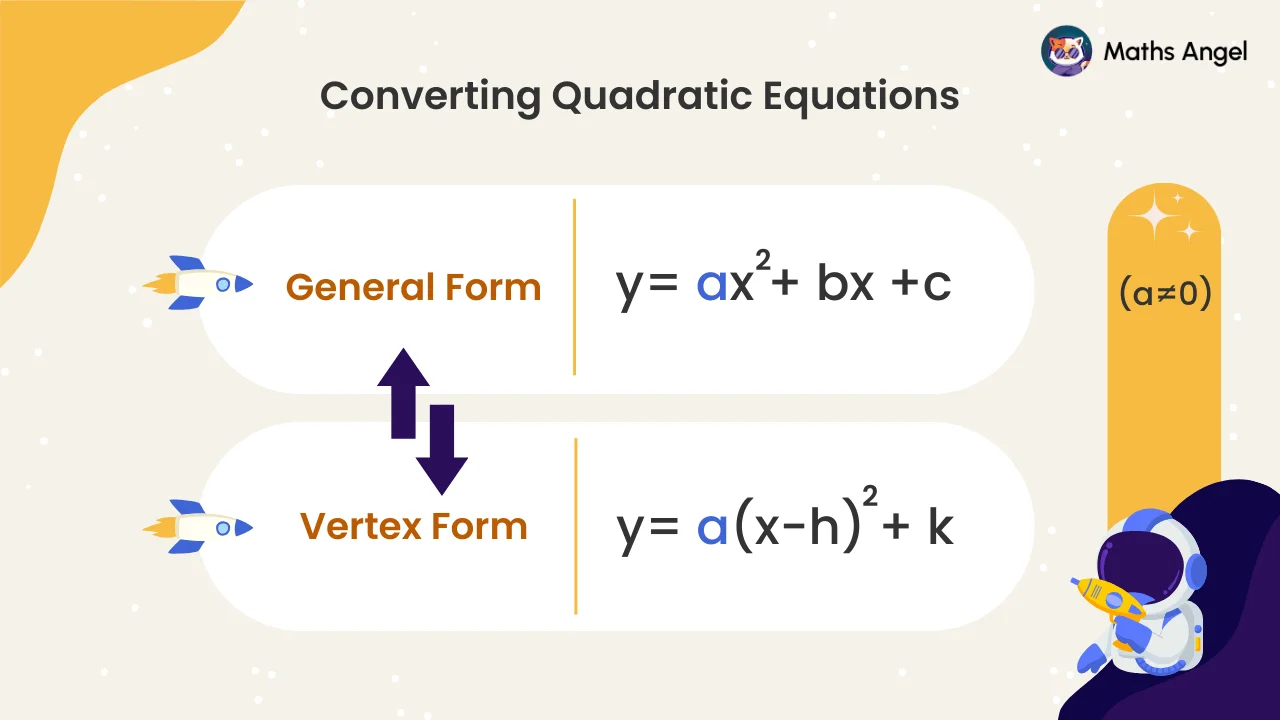
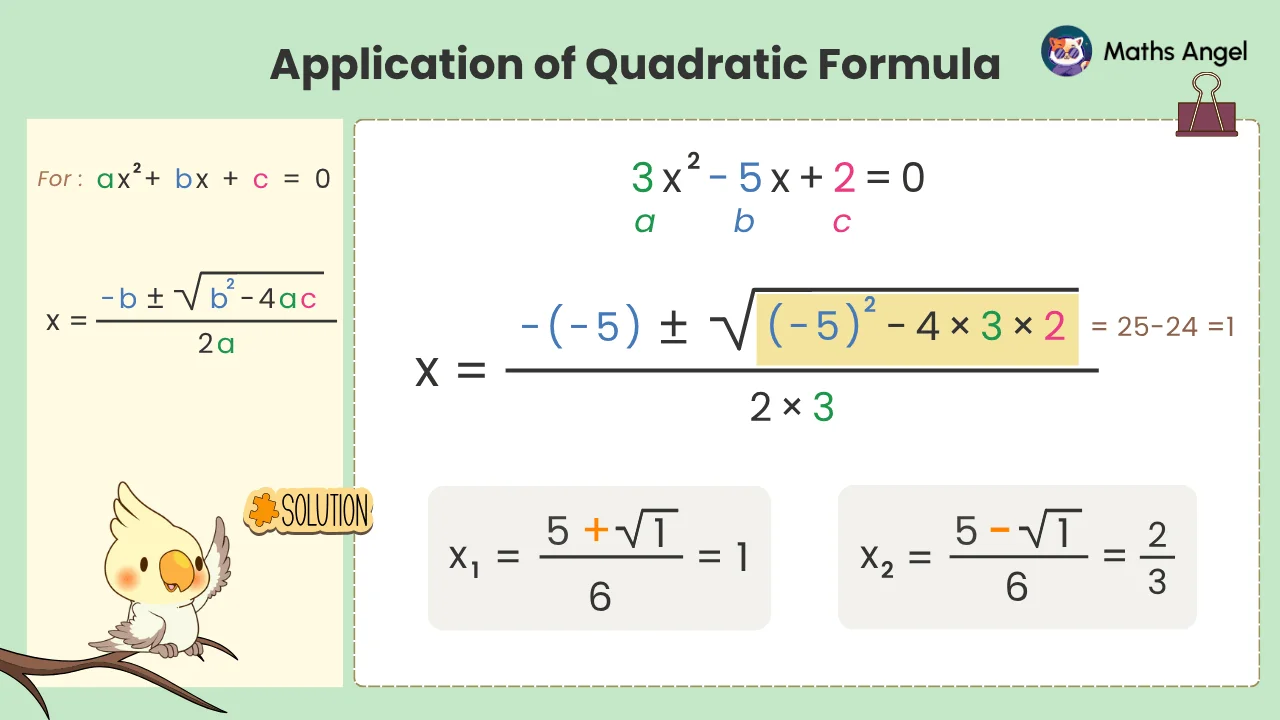
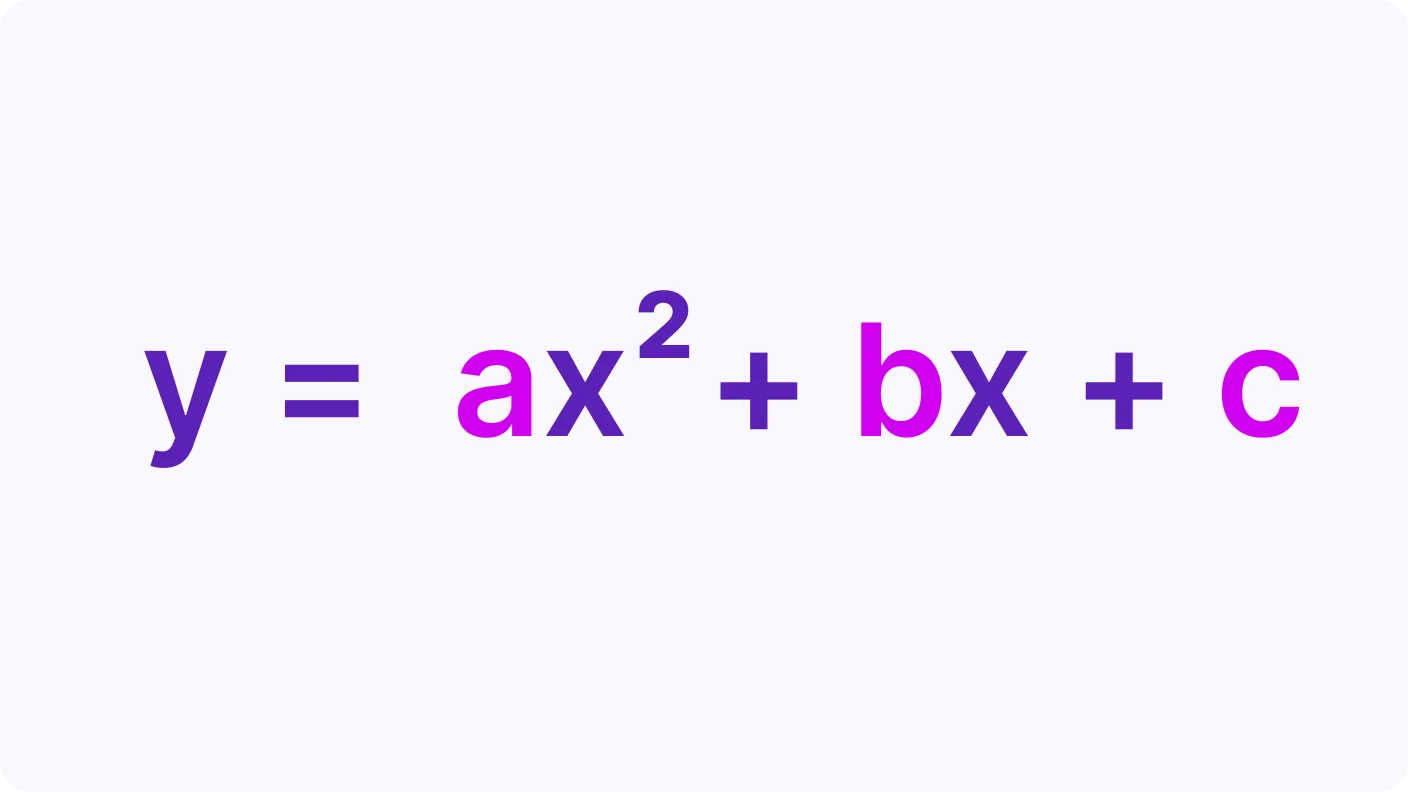
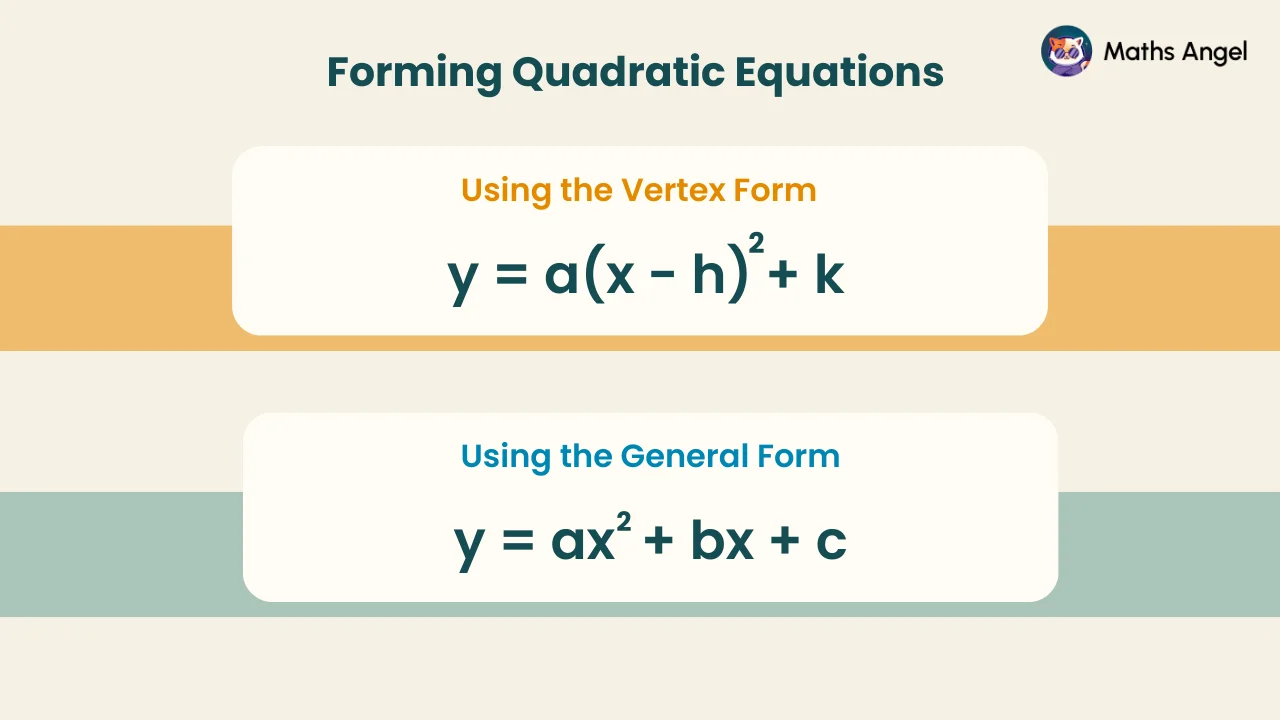
Vertex form writes a quadratic as y = a(x − h)² + k, where (h, k) is the vertex. Once you know the vertex, substitute one more point to find a. Standard form, y = ax² + bx + c, is used instead when you know three points.
Video Lesson
Watch and learn the basics
🎬 Did this video explain it clearly?
Flashcards
Review key concepts visually
%20Determining%20Quadratic%20Equations.webp)
%20Determining%20quadratic%20equations%20through%20vertex%20form.webp)
%20Determining%20quadratic%20equations%20through%20General%20Form.webp)
%20Application%20of%20Quadratic%20Equations.webp)
Forms of Quadratic Equations
- Quadratics can be written in vertex form or standard form.
- Use vertex form when you know the vertex, and standard form when you know points on the parabola.
Using the Vertex Form
- If the vertex is (2, 3), start with .
- Substitute the point (3, 1) to make an equation and find the value of a.
Using the Standard Form
- Substitute three known points to make three equations.
- Solve the equations together using substitution or elimination to find a, b, and c.
Applying Quadratics to a Real-Life Situation
- The equation models the shape of a bridge.
- Substituting shows the height is above , so the lorry can drive through.
Practice Questions
Test your understanding
The vertex of a parabola is at (1, 2) and . What is the quadratic equation in vertex form?
Correct! 🎉 +10 pointsCorrect! 🎉 Worth 10 XPNot quite right
Vertex form is , where is the vertex.
Here and , so the equation starts as . Note the sign changes only inside the bracket: a vertex at gives , while the y-value 2 is written exactly as it is.
Since , the equation is .
The vertex of a parabola is at (2, −3) and . What is the quadratic equation in vertex form?
Correct! 🎉 +10 pointsCorrect! 🎉 Worth 10 XPNot quite right
Vertex form is , where is the vertex.
Here and , so the equation starts as . Only the x-value changes sign inside the bracket; the y-value keeps its minus sign as the constant.
Since , the equation is . The 2 multiplies the bracket, so it cannot be left out.
Given the vertex of a parabola is (1, 2) and it passes through the point (2, 3), what is the quadratic equation in vertex form?
Correct! 🎉 +20 pointsCorrect! 🎉 Worth 20 XPNot quite right
Start from the vertex (1, 2), so the equation is .
Substitute the point (2, 3): , which gives .
Subtract 2 from both sides: .
So the equation is .
Given the vertex of a parabola is (2, 3) and it passes through the point (3, 1), what is the quadratic equation in vertex form?
Correct! 🎉 +20 pointsCorrect! 🎉 Worth 20 XPNot quite right
Start from the vertex (2, 3), so the equation is .
Substitute the point (3, 1): , which gives .
Subtract 3 from both sides: .
So the equation is .
Given the vertex of a parabola is (1, −3) and it passes through the point (2, 0), what is the quadratic equation in vertex form?
Correct! 🎉 +20 pointsCorrect! 🎉 Worth 20 XPNot quite right
Start from the vertex (1, −3), so the equation is .
Substitute the point (2, 0): , which gives .
Add 3 to both sides: .
So the equation is , keeping the vertex y-value as the constant.
Given three points on a parabola: (1, 2), (2, 5), and (0, 1), what is the quadratic equation in standard form?
Correct! 🎉 +30 pointsCorrect! 🎉 Worth 30 XPNot quite right
Write the equation as and substitute each point.
From (0, 1): , because makes the other two terms zero.
From (1, 2): , so .
From (2, 5): , so , and dividing every term by 2 gives .
Subtracting from gives , and then .
So the equation is .
Want to see the full working?
Interactive Activity
Follow the step-by-step guide to find the equation in vertex form
Loading interactive widget...
Frequently asked questions
The questions students bump into most on this topic
Vertex form writes a quadratic as y = a(x − h)² + k, where (h, k) is the vertex, the turning point of the parabola, and a sets how wide it is and which way it opens. Standard form is y = ax² + bx + c. UK exam papers call vertex form the completed-square form; it is the same thing.
If you can see the vertex, use vertex form. With vertex (2, 3), write y = a(x − 2)² + 3; then substitute one more point on the curve to find a. The parabola passes through (3, 1), so 1 = a(3 − 2)² + 3, which gives a = −2. The equation is y = −2(x − 2)² + 3.
Use vertex form when you know the vertex: substitute it, and one more point is enough to find a. Use standard form when you do not know the vertex but have three points on the curve, because there are three unknowns, a, b and c. Vertex plus one point, or three points: that is the rule for how much information you need.
Substitute each point into y = ax² + bx + c to get three equations, then solve them together. A point with x = 0 gives c at once, because ax² and bx both vanish: in the video, c = 3. Putting c into the other two equations and solving gives a = 2 and b = −1, so the equation is y = 2x² − x + 3.
A tunnel 6 m wide and 5 m high has a parabola-shaped roof. Its highest point (0, 5) is the vertex, so y = ax² + 5, and the roof meets the ground at (3, 0), which gives a = −5/9. At 1 m from the centre the height is −5/9 + 5, about 4.4 m, so a lorry 4 m high and 2 m wide fits through.
What's next?
Found this one hard? Go one step back first. Feeling confident? Carry on to the next lesson.