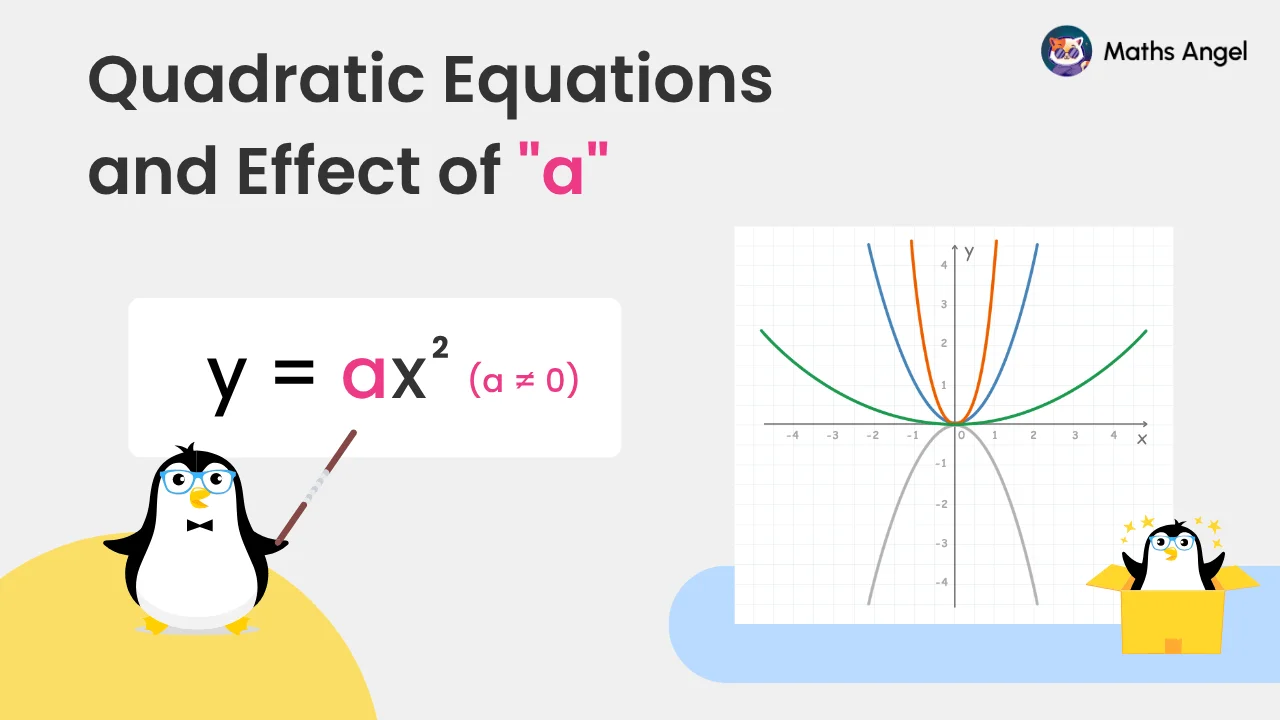
Solving Simple Quadratic Equations
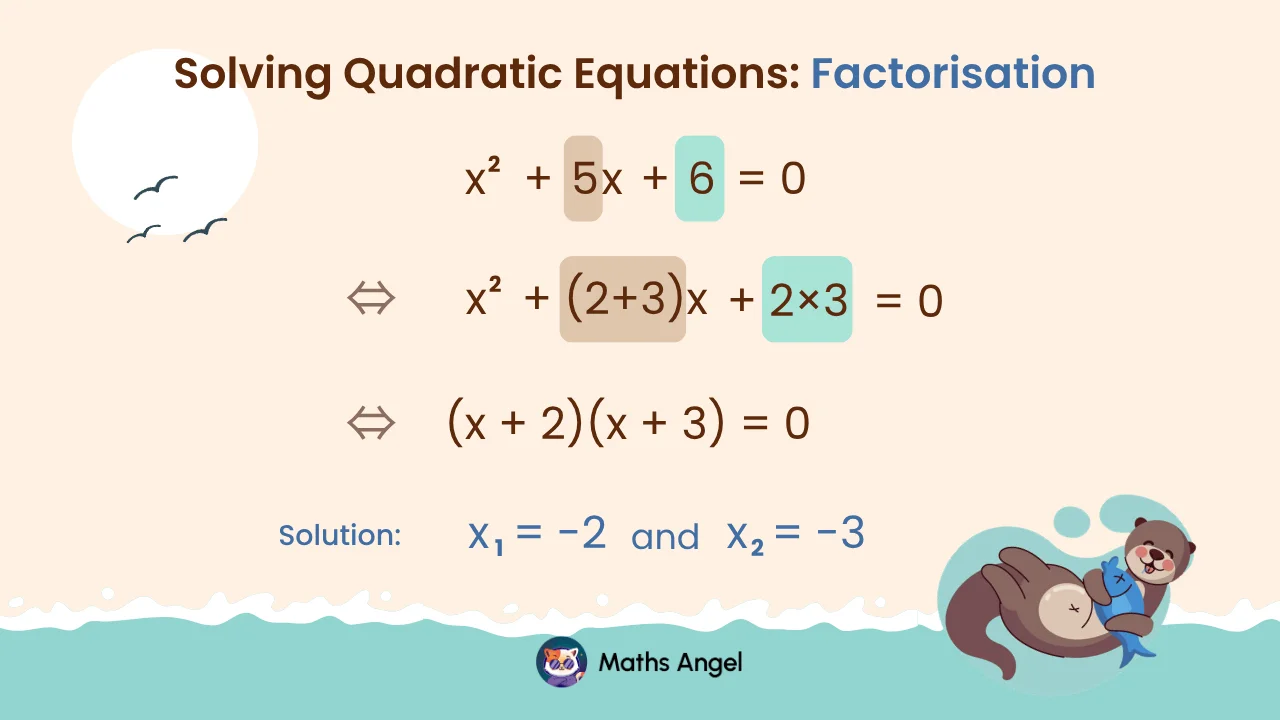
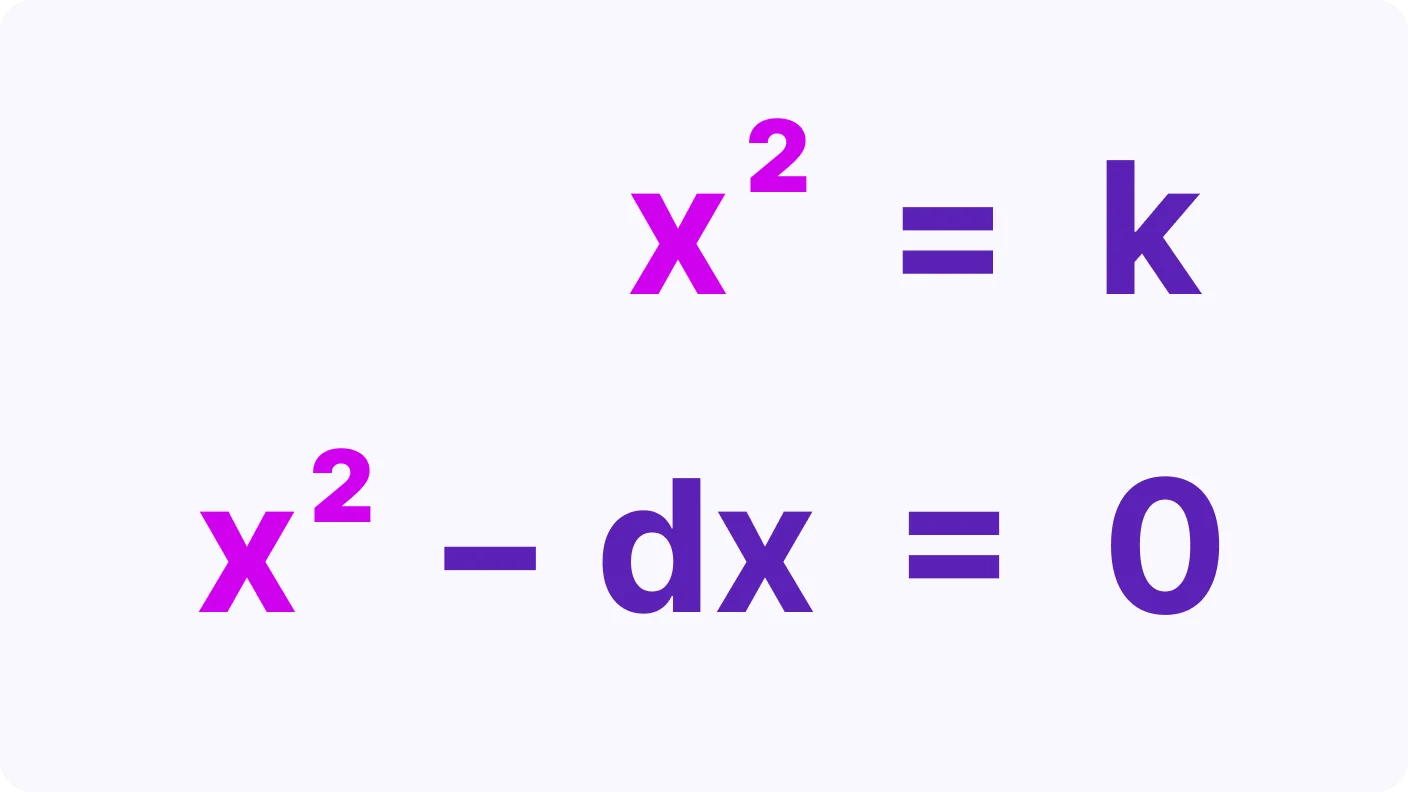
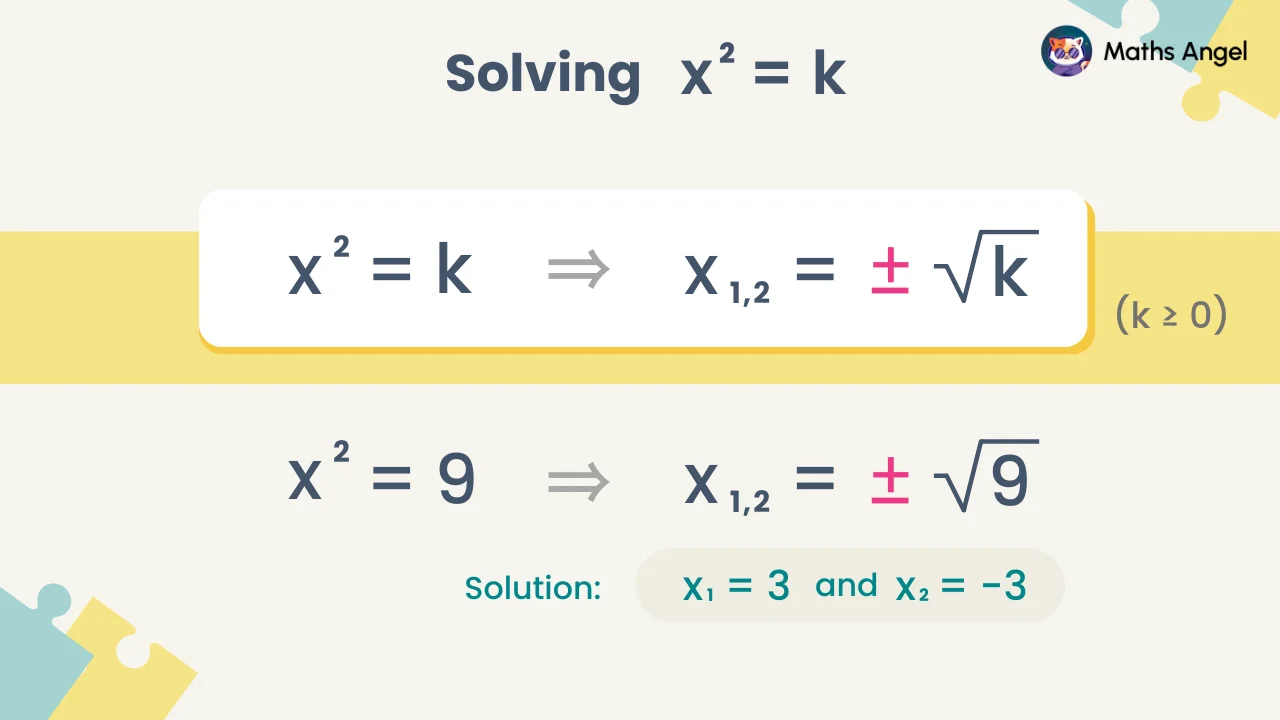
Solving simple quadratic equations means finding the x values that make them true. For x² = k, take the square root to get x = ±√k, so x² = 9 gives x = 3 or −3. For x² − dx = 0, factorise to x(x − d) = 0, so x = 0 or x = d.
Video Lesson
Watch and learn the basics
🎬 Did this video explain it clearly?
Flashcards
Review key concepts visually
%20Solving%20Simple%20Quadratics.webp)
%20Solving%20Quadratic%20Equations%20Example.webp)
%20Solving%20Quadratic%20Equations%20No%20Solution.webp)
%20Solving%20Quadratic%20Equations%20Factorising.webp)
%20Solving%20Quadratic%20Equations%20Example.webp)
%20Overview%20Solving%20Simple%20Quadratic%20Equations.webp)
Solving Equations of the Form
- If , take the square root to get . Important: this only works when .
- For example, solving gives , so the solutions are and .
Example: Solving
- Rearrange by adding 12 to both sides so it becomes , which is now in the form .
- Divide both sides by 3 to simplify and get .
- Take the square root to get , so the solutions are and .
When There Is No Real Solution
- If equals a negative number, there is no real solution because no real number squares to a negative.
- For example, has no real solution, so −5 is not an answer.
Solving Equations of the Form
- Factorise to get .
- Set each factor equal to zero to get and .
Example:
- First make the coefficient of equal to 1 by dividing by 5, which helps to simplify the calculations.
- Factorise to get , so the solutions are or .
Solving Simple Quadratic Equations (Summary)
- If an equation is in the form , the solutions are and this only works when .
- If an equation is in the form , factorise to and the solutions are and .
Practice Questions
Test your understanding
Solve the equation .
Correct! 🎉 +10 pointsCorrect! 🎉 Worth 10 XPNot quite right
To solve , square root both sides, remembering that a positive number has two square roots, one positive and one negative.
.
Both work: and . So the solutions are and .
What's the solution for ?
Correct! 🎉 +10 pointsCorrect! 🎉 Worth 10 XPNot quite right
means , and a product is zero only when one of the factors is zero, so the only solution is .
Check it by squaring: . Zero is a genuine solution: it is not the same as 'no solution'.
This is a repeated (double) root, so unlike there is one value, not a pair. And does not work, because , not 0.
What's the solution for ?
Correct! 🎉 +20 pointsCorrect! 🎉 Worth 20 XPNot quite right
Squaring any real number gives an answer that is zero or positive: and , because two negatives multiply to give a positive.
So no real number can square to give , and has no real solutions.
Watch the sign: the answers and belong to the different equation .
What's the solution for ?
Correct! 🎉 +20 pointsCorrect! 🎉 Worth 20 XPNot quite right
Add 64 to both sides to isolate the squared term: .
Square-rooting gives two answers, because and . So and .
Two checks worth making: the becomes when it crosses the equals sign, and the square root must be taken, keeping both signs.
What's the solution for ?
Correct! 🎉 +20 pointsCorrect! 🎉 Worth 20 XPNot quite right
Add 81 to both sides to isolate the squared term: .
Square-rooting gives two answers, because and . So and .
The final step really is a square root, not a halving: half of 81 is 40.5, and , nowhere near 81.
What is the solution for ?
Correct! 🎉 +30 pointsCorrect! 🎉 Worth 30 XPNot quite right
Add 125 to both sides: .
Divide both sides by 5 to leave the squared term on its own: .
Square-rooting gives two answers, because and . So and .
Both final steps matter: divide by the 5 in front, then take the square root, keeping both signs.
Want to see the full working?
Interactive Activity
Practice solving simple quadratic equations step-by-step
Loading interactive widget...
Frequently asked questions
The questions students bump into most on this topic
If the equation has the form x² = k, take the square root of both sides and remember the ± sign: x² = 9 gives x = 3 or x = −3. If there is a number in front of x² or a constant on the same side, rearrange first: 3x² − 12 = 0 becomes 3x² = 12, then x² = 4, so x = 2 or x = −2.
Usually two, the positive and negative square roots, because both square to the same number: x² = 25 gives 5 and −5. It has one solution when k is 0, since only 0 squares to 0. It has no real solution when k is negative: x² = −25 has no answer, because no real number squared is negative, so −5 is not a solution.
Factorise out the x: x² − dx = 0 becomes x(x − d) = 0, which is true when x = 0 or when x − d = 0, so the solutions are 0 and d. For x² + 2x = 0, x(x + 2) = 0 gives x = 0 or x = −2. For 5x² = 25x, divide by 5 and bring everything to one side first: x² − 5x = 0, so x = 0 or x = 5.
Because x = 0 is one of the solutions, and dividing by x throws it away. 5x² = 25x divided by x gives x = 5, which is only half the answer; factorising instead, x(x − 5) = 0, keeps both x = 0 and x = 5. You can never divide by something that might be zero.
Yes, to use the square-root method or to factorise out x neatly, so divide both sides by the coefficient first. 5x² − 125 = 0 becomes 5x² = 125, then x² = 25, so x = 5 or x = −5. Dividing both sides by the same number keeps the equation balanced.
What's next?
Found this one hard? Go one step back first. Feeling confident? Carry on to the next lesson.