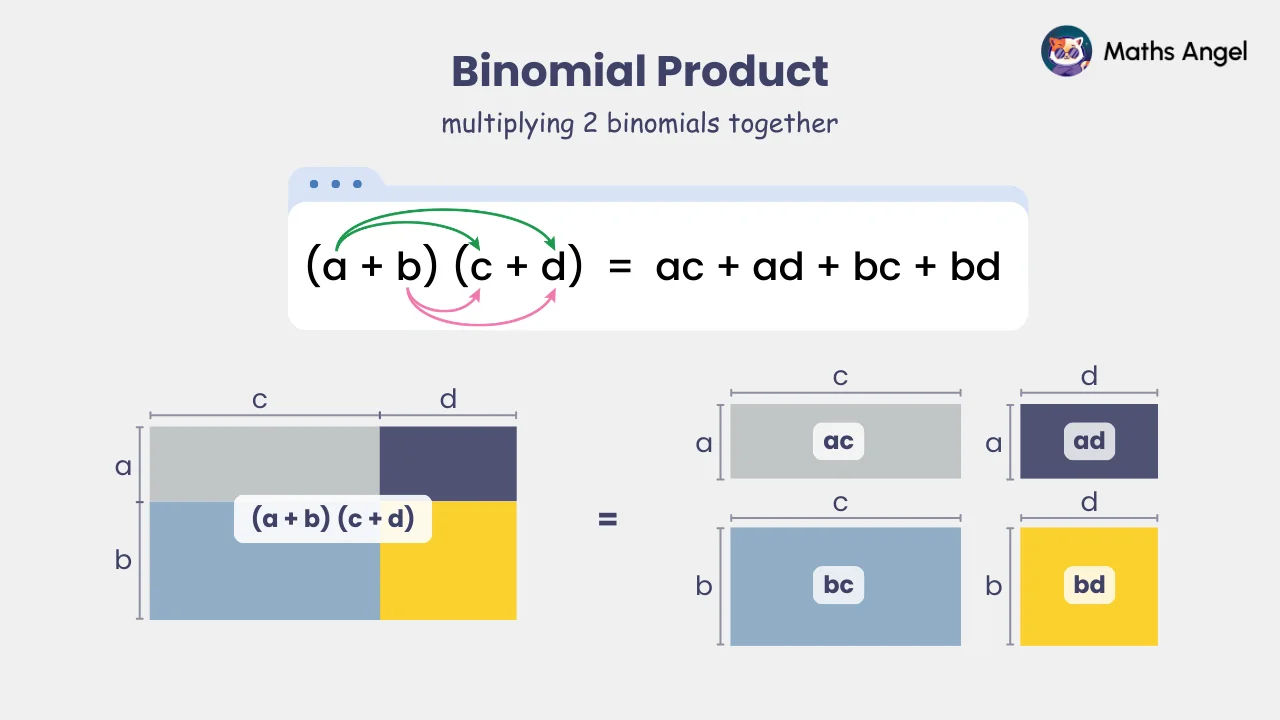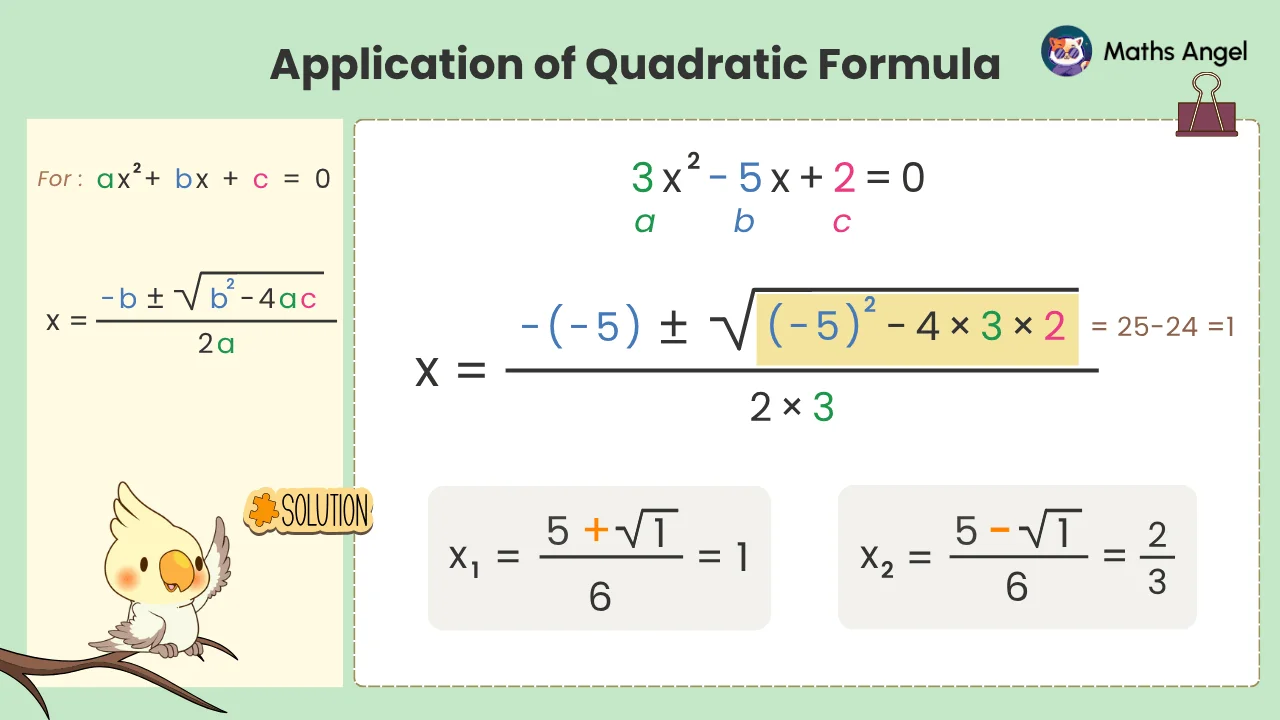
Solving Quadratic Equations by Factorising
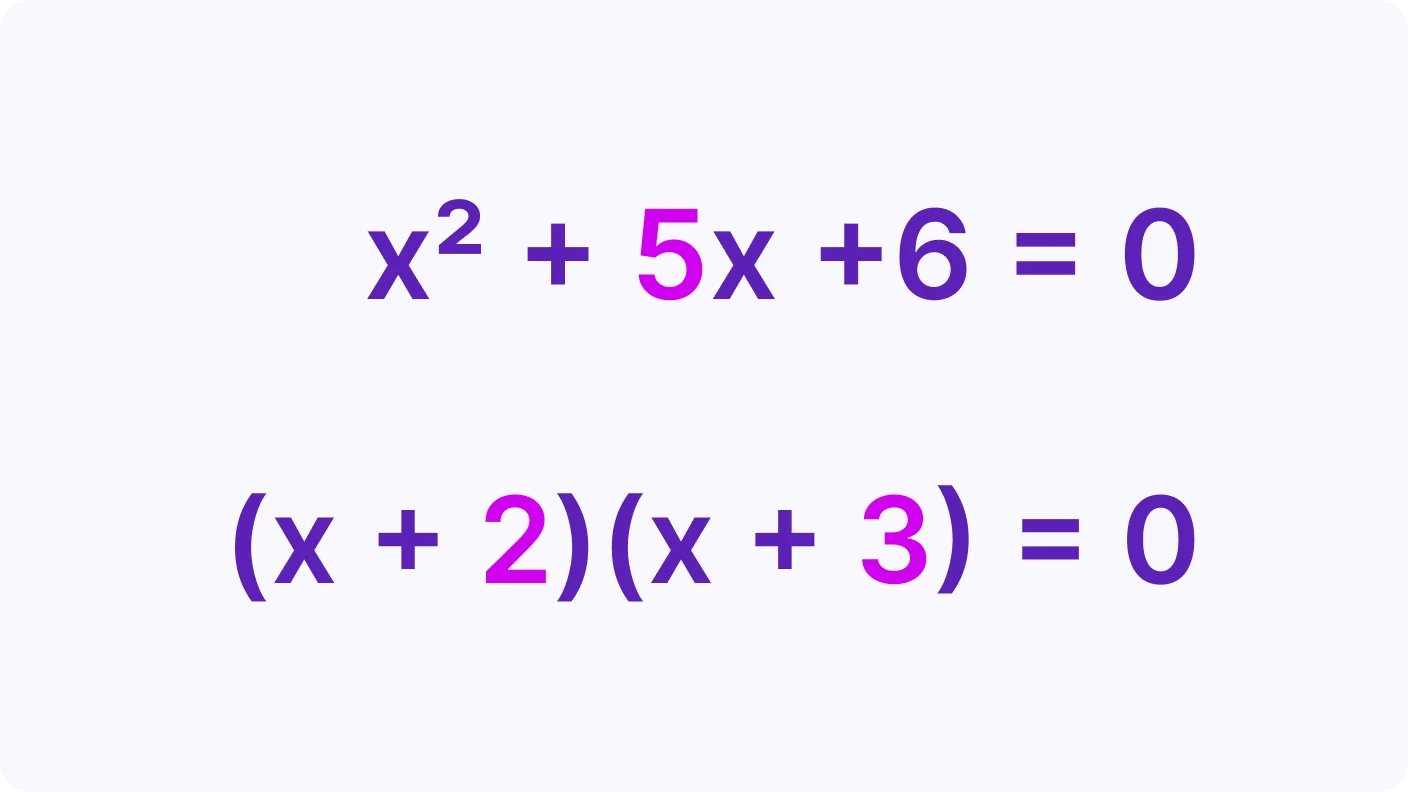
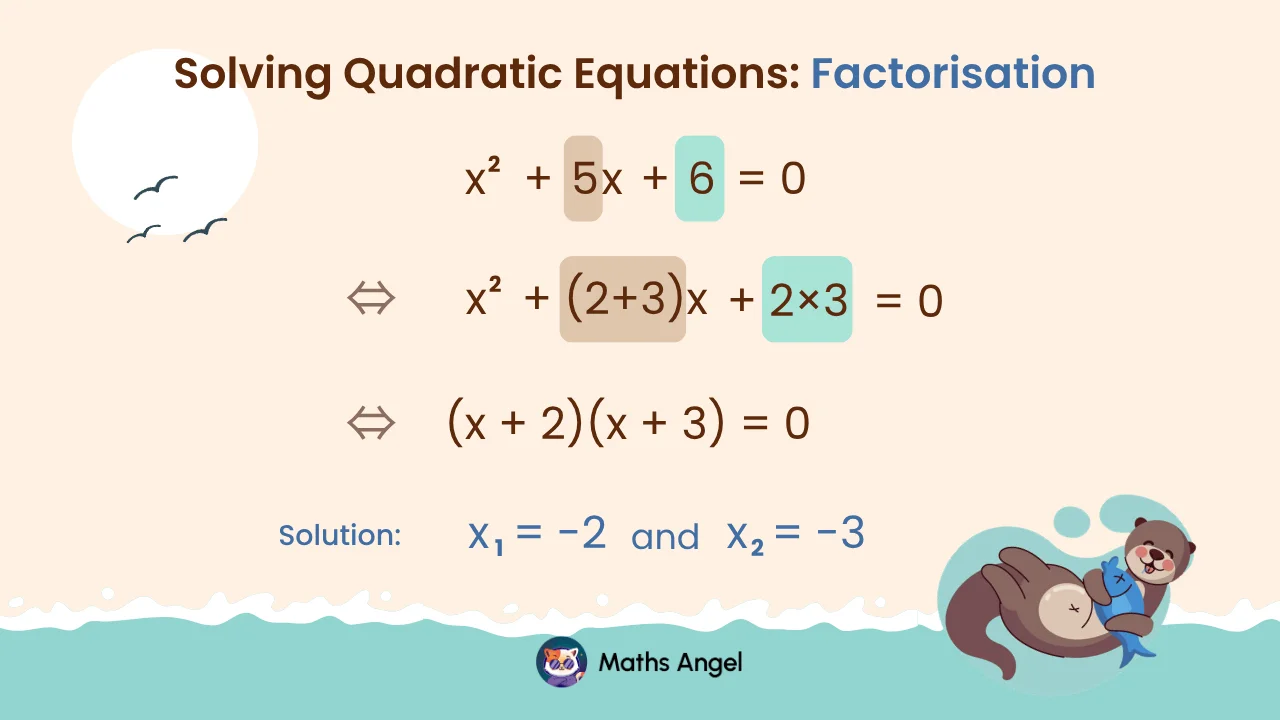
Solving quadratic equations by factorising means writing x² + 5x + 6 = 0 as (x + 2)(x + 3) = 0. You find two numbers that multiply to 6 and add to 5. Then set each bracket to zero to get x = -2 and x = -3.
Video Lesson
Watch and learn the basics
🎬 Did this video explain it clearly?
Flashcards
Review key concepts visually
%20Factorisation%20Method.webp)
%20Solving%20Quadratic%20Equations.webp)
%20Practice%20Solving%20Quadratic%20Equations%20by%20Factorising.webp)
Preparing the Equation
- Make sure the equation is written as
- Rearrange first if needed so the equation is equal to zero
Factorising the Quadratic
- Find two numbers m and n that multiply to c and add to b
- Write the equation as
- Example:
Finding the Solutions
- Set each bracket equal to zero: or
- Solve to find both values of x: and
Practice Questions
Test your understanding
What are the solutions for the equation ?
Correct! 🎉 +10 pointsCorrect! 🎉 Worth 10 XPNot quite right
If two things multiply to give 0, at least one of them must be 0, so set each bracket equal to zero.
gives , and gives .
The solutions are and . Notice the signs flip: a inside the bracket gives a solution of .
What are the solutions for the equation ?
Correct! 🎉 +10 pointsCorrect! 🎉 Worth 10 XPNot quite right
If two things multiply to give 0, at least one of them must be 0, so set each bracket equal to zero.
gives , and gives .
The solutions are and . Each solution is the opposite sign to the number in its bracket.
Factorise the quadratic equation: .
Correct! 🎉 +20 pointsCorrect! 🎉 Worth 20 XPNot quite right
For we need two numbers that multiply to give and add to give . Both conditions must hold.
The pairs multiplying to 10 are 1 and 10 (adding to 11) and 2 and 5 (adding to 7). Only 2 and 5 fit both.
So the factorised form is . Checking: .
Factorise the quadratic equation: .
Correct! 🎉 +20 pointsCorrect! 🎉 Worth 20 XPNot quite right
For we need two numbers that multiply to give and add to give . Since the product is positive and the sum is negative, both numbers must be negative.
The pairs multiplying to 28 are and , and , and and . Only and add to .
So the factorised form is . Checking: .
Factorise the quadratic equation: .
Correct! 🎉 +20 pointsCorrect! 🎉 Worth 20 XPNot quite right
For we need two numbers that multiply to give and add to give . Since the product is negative, one number is positive and one is negative.
The pairs multiplying to include and 2 (adding to ), and 3 (adding to ) and and 6 (adding to 3). Only and 3 fit both conditions.
So the factorised form is . Checking: .
Solve this quadratic equation using factorisation: .
Correct! 🎉 +30 pointsCorrect! 🎉 Worth 30 XPNot quite right
Every term has a factor of 5, so divide the whole equation by 5: .
Now find two numbers that multiply to and add to 6. These are and 8, so .
Setting each bracket to zero gives , so , and , so . The solutions are and .
Want to see the full working?
Interactive Activity
Practice factorising quadratic expressions step-by-step
Loading interactive widget...
Frequently asked questions
The questions students bump into most on this topic
Find two numbers that multiply to give the constant and add to give the number in front of x, then write them in two brackets. For x² + 7x + 12, list the factor pairs of 12: 1 and 12, 2 and 6, 3 and 4. Only 3 and 4 add to 7, so x² + 7x + 12 = (x + 3)(x + 4). Expand the brackets to check.
Factorise, then set each bracket equal to zero, because two things only multiply to zero if one of them is zero. (x + 3)(x + 4) = 0 gives x + 3 = 0 or x + 4 = 0, so x = −3 or x = −4. The factorised form is the same equation written differently, so it has the same solutions.
The roots are the solutions: the values of x that make the equation equal to zero. x² + 5x + 6 = 0 factorises to (x + 2)(x + 3) = 0, so its roots are −2 and −3. On the graph of y = x² + 5x + 6, the roots are where the curve crosses the x-axis. Factorising is the quickest way to find them when it works.
Keep the sign when you list the factor pairs: one number will be positive and the other negative. For x² + 3x − 18, the pairs for −18 include 3 and −6, −3 and 6, 2 and −9. Only −3 and 6 add to 3, so the equation becomes (x − 3)(x + 6) = 0 and the solutions are x = 3 and x = −6.
Divide out a common factor first: 5x² + 30x − 80 = 0 becomes x² + 6x − 16 = 0, which factorises as usual: x = 2 or x = −8. With no common factor, as in 2x² + 7x + 3, find two numbers that multiply to a × c = 6 and add to 7: 6 and 1. Split the middle term into 6x + x and factorise in pairs: (2x + 1)(x + 3).
No. It works when the numbers are whole and a pair that fits exists, which is why it is worth trying first; otherwise use completing the square or the quadratic formula. Check by expanding: (x + 2)(x + 3) gives x² + 5x + 6, so it matches. Factorising with a = 1 is around grade 4 to 5 at GCSE; with a ≠ 1 it is grade 6 to 7.
What's next?
Found this one hard? Go one step back first. Feeling confident? Carry on to the next lesson.