Solving Quadratic Equations: Quadratic Formula
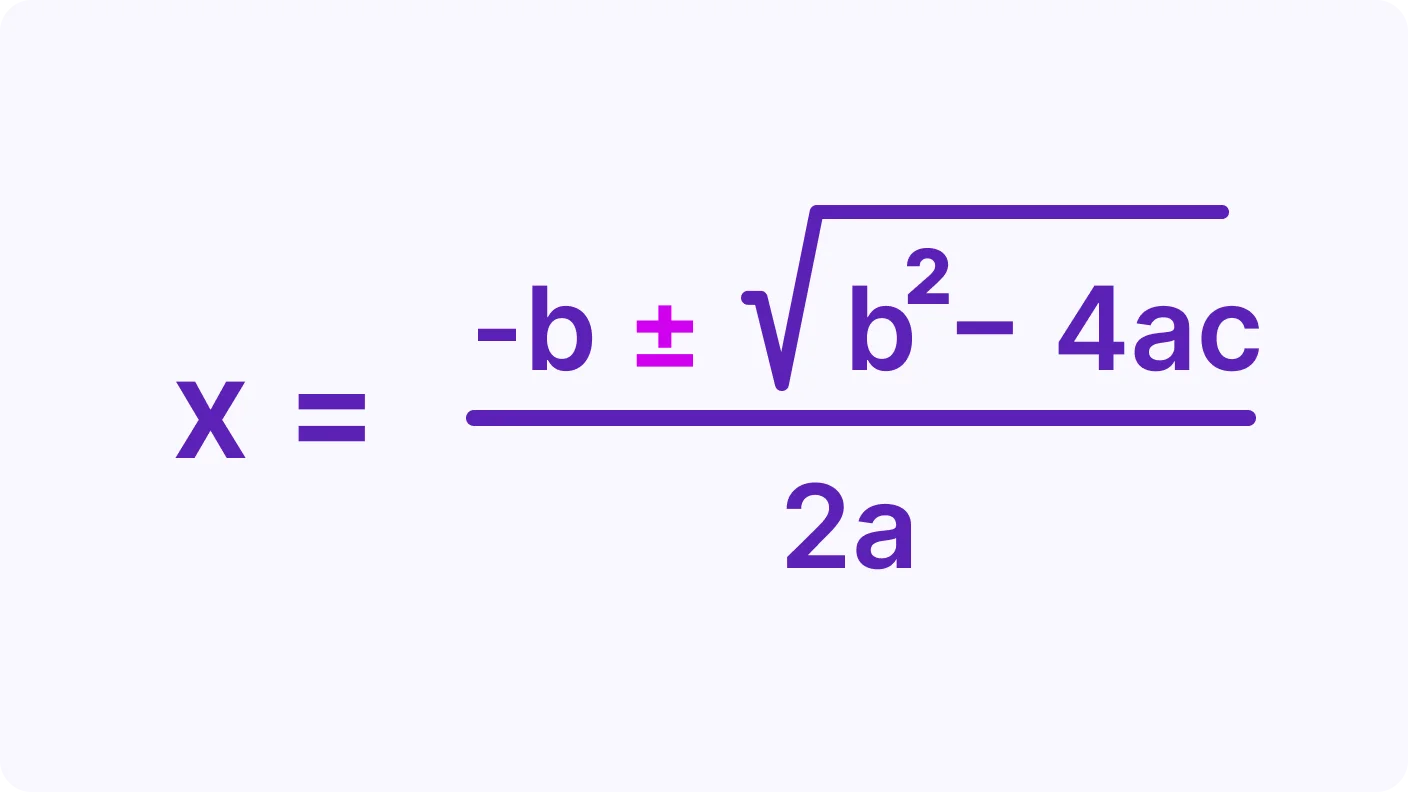
The quadratic formula solves any equation written as ax² + bx + c = 0, even when it won't factorise. Put a, b and c into x = (−b ± √(b² − 4ac)) ÷ 2a to find the roots. Its discriminant, b² − 4ac, gives the number of solutions.
Video Lesson
Watch and learn the basics
🎬 Did this video explain it clearly?
Flashcards
Review key concepts visually
%20The%20Quadratic%20Formula.webp)
%20Example%20of%20How%20to%20Use%20the%20Quadratic%20Formula.webp)
%20How%20to%20Apply%20the%20Quadratic%20Formula.webp)
The Quadratic Formula and the Discriminant
- For any quadratic in the form , the solutions are given by .
- The part under the square root, , is called the discriminant and tells you how many solutions there are.
- If the discriminant is negative, there are no real solutions, so you can stop calculating.
Example: Using the Quadratic Formula
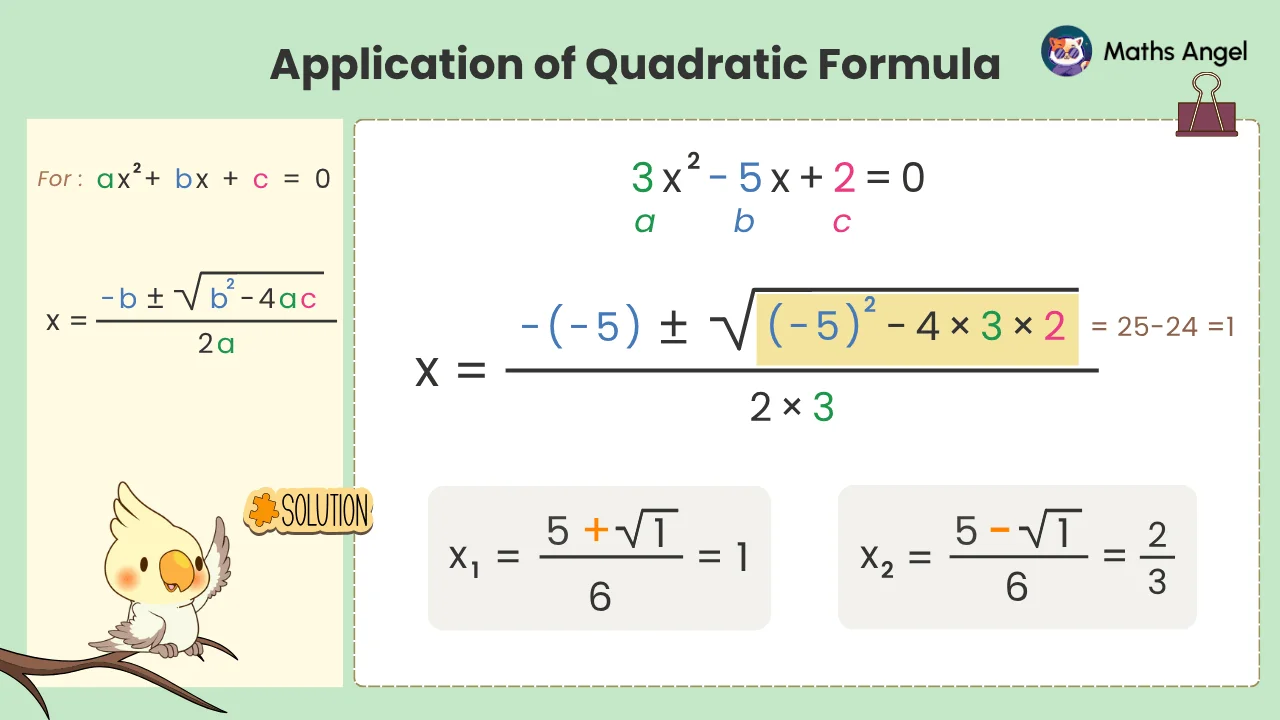
- For , substitute , , and into the formula.
- The discriminant is , which means there are two different real solutions.
- Substituting gives , so the solutions are and .
Example: Rearranging Before Using the Formula
- First rearrange into the form : .
- Simplify by dividing every term by 2 to get , which makes the calculations much easier.
- Substitute , , and into the quadratic formula to find the solutions.
Practice Questions
Test your understanding
What is the quadratic formula?
Correct! 🎉 +10 pointsCorrect! 🎉 Worth 10 XPNot quite right
For any equation in the form , the quadratic formula is .
Two details matter: the numerator starts with (the whole of is divided by , not just the root), and the expression under the root is , called the discriminant.
What does a negative discriminant tell you about the roots of a quadratic equation?
Correct! 🎉 +10 pointsCorrect! 🎉 Worth 10 XPNot quite right
The discriminant is , the part under the square root in the quadratic formula. Its sign tells you how many real roots the equation has.
If there are two distinct real roots. If there is exactly one (repeated) real root. If the formula asks you to square root a negative number, and no real number squares to give a negative, so there are no real roots.
What is the discriminant of the quadratic equation ?
Correct! 🎉 +20 pointsCorrect! 🎉 Worth 20 XPNot quite right
The discriminant is . For the coefficients are , and (note that is the constant in the equation, not the 0 on the right-hand side).
.
A discriminant of 0 means the equation has exactly one repeated real root: here , since .
For the equation , what are the roots?
Correct! 🎉 +20 pointsCorrect! 🎉 Worth 20 XPNot quite right
Here , and . The discriminant is , so .
The quadratic formula gives .
So and . The whole numerator is divided by , and the brackets around matter: .
For the equation , what are the roots?
Correct! 🎉 +20 pointsCorrect! 🎉 Worth 20 XPNot quite right
Here , and . The discriminant is , so . Note the double negative: .
The quadratic formula gives .
So and .
For the equation , what are the roots?
Correct! 🎉 +30 pointsCorrect! 🎉 Worth 30 XPNot quite right
Here , and . The discriminant is , so .
The quadratic formula gives .
So and . Both the and the are divided by .
Want to see the full working?
Interactive Activity
Solve quadratic equations interactively using the formula
Loading interactive widget...
Frequently asked questions
The questions students bump into most on this topic
For any equation ax² + bx + c = 0, x = (−b ± √(b² − 4ac)) ÷ 2a. Put in a, b and c and it gives the solutions, even when the equation will not factorise. GCSE students are expected to learn it; whether it appears on a formula sheet has changed from year to year, so check the current rules for your exam board.
Write the equation as ax² + bx + c = 0 and read off a, b and c. For 3x² − 5x + 2 = 0: a = 3, b = −5, c = 2. Work out the discriminant, b² − 4ac = 25 − 24 = 1, then x = (5 ± √1) ÷ 6. That gives x = 6 ÷ 6 = 1 and x = 4 ÷ 6 = 2/3. Keep the signs of b and c when you substitute.
The part under the square root, b² − 4ac. It tells you how many solutions there are before you finish: positive means two different real roots, zero means one repeated root, and negative means no real roots, so you can stop. For x² + 4x + 4 = 0 it is 16 − 16 = 0, so there is one root; for 3x² − 5x + 2 = 0 it is 1, so two.
For any quadratic equation, and especially one that will not factorise or has awkward numbers. Try factorising first when the numbers are small and whole; if no pair of numbers works, or the question asks for answers to a number of decimal places, go straight to the formula. It needs the equation in the form ax² + bx + c = 0.
Yes: move every term to one side so the equation equals zero, then simplify. 6 = −4x² + 14x becomes 4x² − 14x + 6 = 0; dividing every term by 2 gives 2x² − 7x + 3 = 0, which is easier. Then a = 2, b = −7, c = 3, the discriminant is 49 − 24 = 25, and x = (7 ± 5) ÷ 4, so x = 3 or x = 1/2.
No single person. Babylonian scribes were solving quadratic problems about 4,000 years ago, the Indian mathematician Brahmagupta wrote down a general rule in the 7th century, and the formula took its modern algebraic shape in Europe in the 1500s and 1600s. It is famous because it is the one method that solves every quadratic, which is why every GCSE student meets it.
What's next?
Found this one hard? Go one step back first. Feeling confident? Carry on to the next lesson.