Solving Equations with 2 Variables
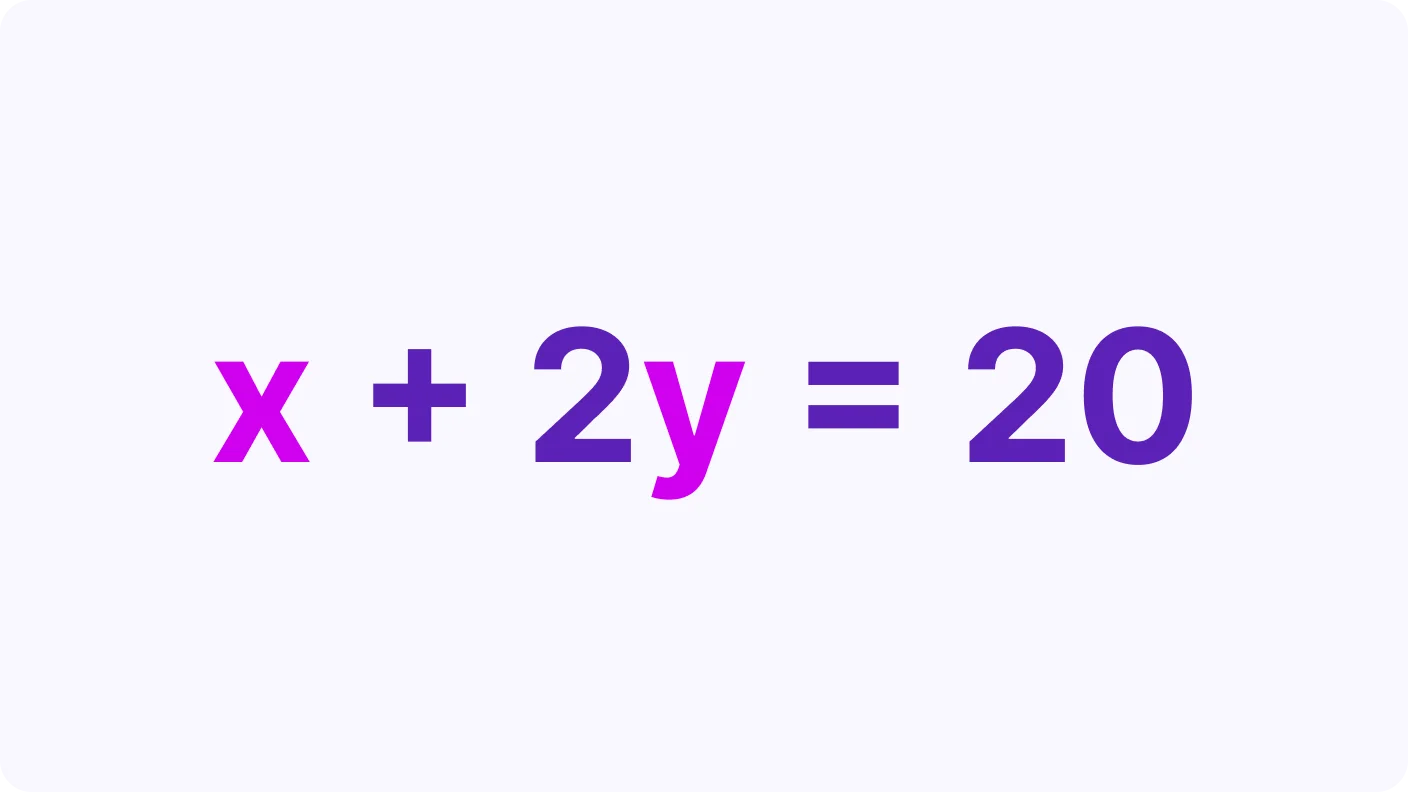
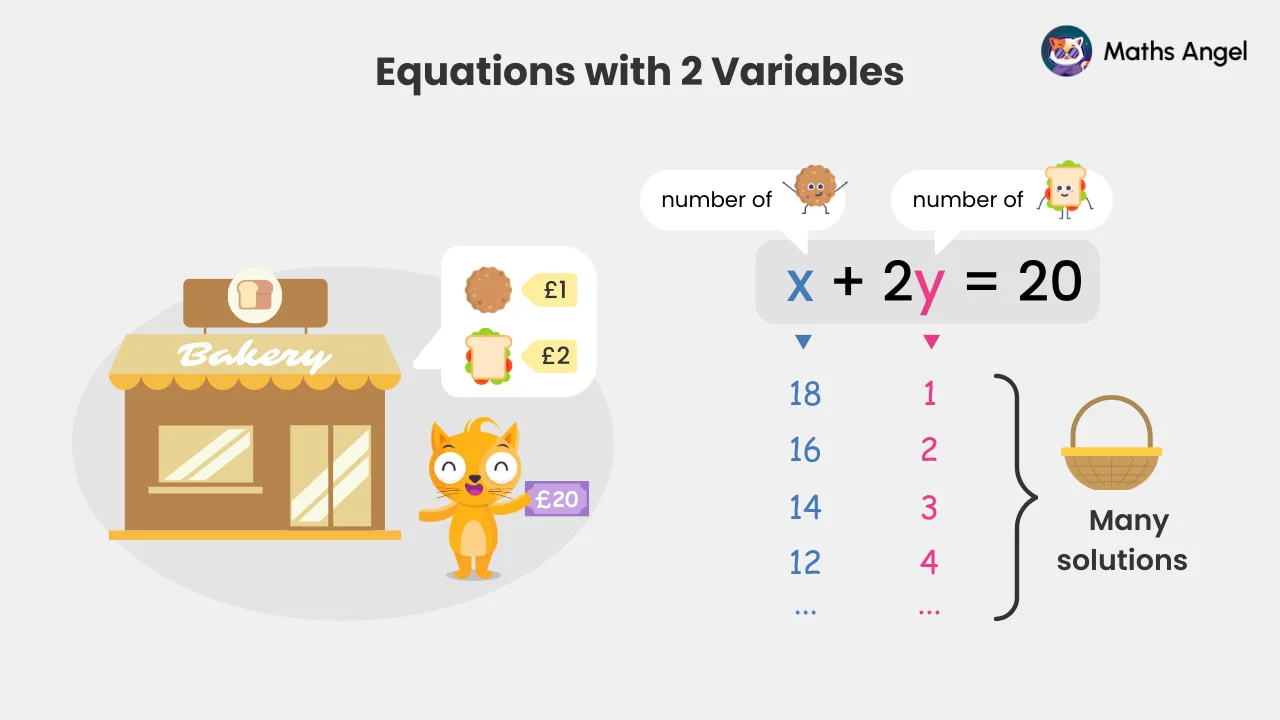
Equations with two variables have two unknowns in one equation, like x + 2y = 20. You solve it by substituting a value for one variable to find the other, so x = 10 gives y = 5. They have many solution pairs, not just one.
Video Lesson
Watch and learn the basics
🎬 Did this video explain it clearly?
Flashcards
Review key concepts visually
%20Equations%20with%202%20Variables.webp)
%20Solving%20Equation%20with%202%20variables.webp)
%20Solving%20Equations%20with%202%20Variables%20Graphically.webp)
Equations with Two Variables
- An equation like has two unknowns.
- There are many solutions because lots of number pairs can work.
Solving by Substitution
- Substitute the value you know into the equation to solve for the other variable.
- For example, if , substitute it in to get . Solving for y, we get .
Solving Graphically
- Rewrite the equation as to draw the line.
- This means every point on the line is a solution to the equation.
- The point (8, 6) is a solution because it lies on the line.
Practice Questions
Test your understanding
You spend all of your £20 on snacks and waters. Each snack costs £2, and each water costs £1. Use x for the number of snacks and y for the number of waters. Which equation represents this?
Correct! 🎉 +10 pointsCorrect! 🎉 Worth 10 XPNot quite right
Each snack costs £2, so snacks cost pounds.
Each water costs £1, so waters cost pounds.
The two costs together come to £20, so the equation is .
You have £30. Each apple costs £3, and each orange costs £2. Use x for the number of apples and y for the number of oranges. Which equation represents this situation?
Correct! 🎉 +10 pointsCorrect! 🎉 Worth 10 XPNot quite right
Each apple costs £3, so x apples cost . Each orange costs £2, so y oranges cost .
The two costs are added together and the total spent is £30, so the equation is .
You have £40. Each pencil costs £2, and each eraser costs £3. If you buy 5 pencils, how many erasers can you still afford?
Correct! 🎉 +20 pointsCorrect! 🎉 Worth 20 XPNot quite right
With x pencils at £2 and y erasers at £3, the total spend is .
Buying 5 pencils costs , so £10 is spent and , leaving £30.
Each eraser costs £3, so . You can still afford 10 erasers.
You have £40. Each pencil costs £2, and each eraser costs £3. If you buy 8 erasers, how many pencils can you still afford?
Correct! 🎉 +20 pointsCorrect! 🎉 Worth 20 XPNot quite right
With x pencils at £2 and y erasers at £3, the total spend is .
Buying 8 erasers costs , so £24 is spent and , leaving £16.
Each pencil costs £2, so . You can still afford 8 pencils.
You have £40. Each pencil costs £2, and each eraser costs £3. If you buy 6 pencils and 3 erasers, how much money will you have left?
Correct! 🎉 +20 pointsCorrect! 🎉 Worth 20 XPNot quite right
The total cost is , where x is the number of pencils and y is the number of erasers.
Buying 6 pencils and 3 erasers costs , so £21 is spent.
Subtracting from the £40 you started with, , so you have £19 left.
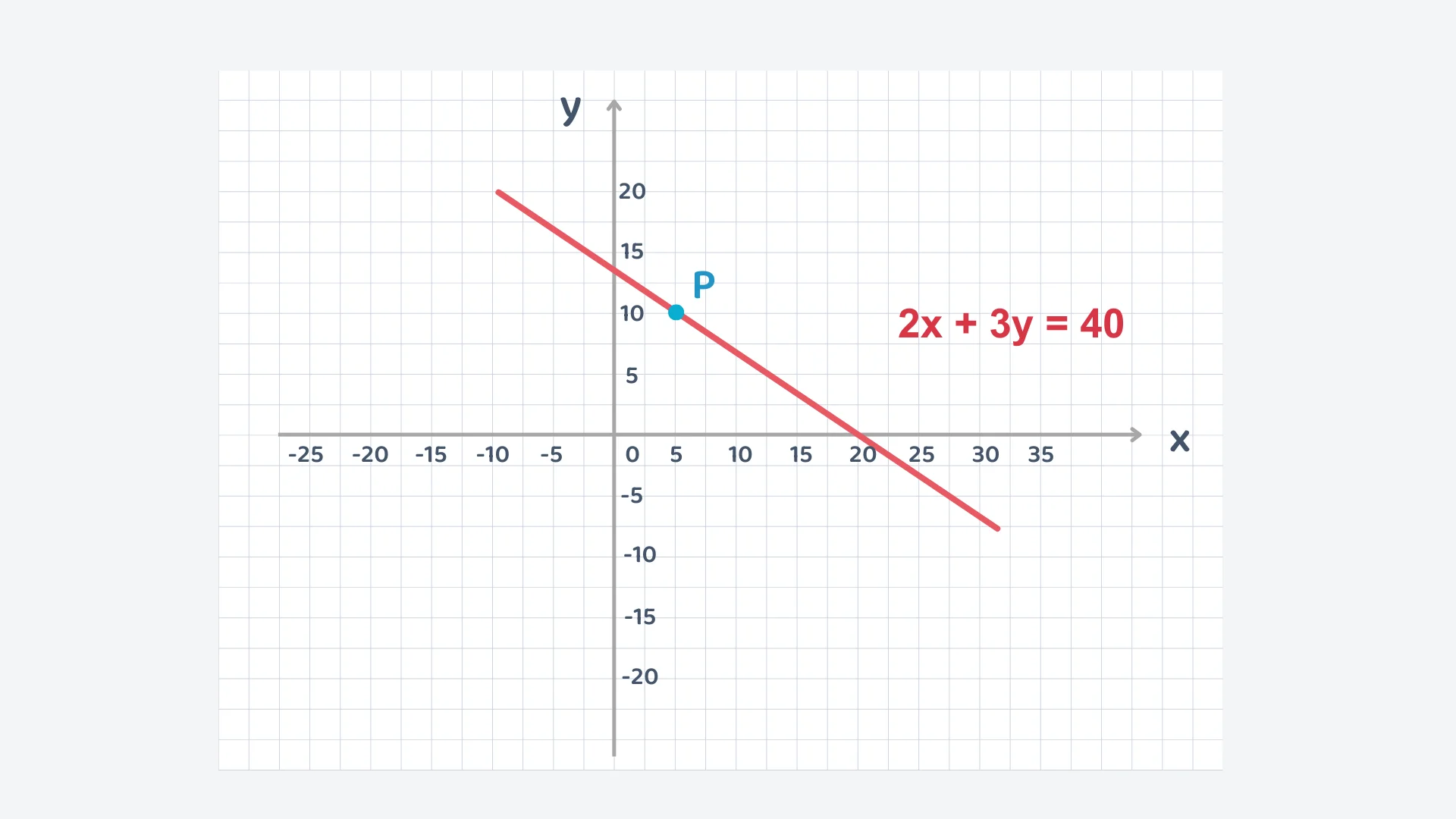
You have £40. Each pencil costs £2, and each eraser costs £3. In the graph below, what does point P mean?
Correct! 🎉 +30 pointsCorrect! 🎉 Worth 30 XPNot quite right
The line shows the equation , where x is the number of pencils at £2 each and y is the number of erasers at £3 each. Every point on the line is a combination that uses the whole £40.
Point P is at and . Checking: 5 pencils cost £10, 10 erasers cost £30, and .
So P means you can buy 5 pencils and 10 erasers, spending exactly £40 with nothing left over.
Want to see the full working?
Interactive Activity
Solving equations with 2 variables
Loading interactive widget...
Frequently asked questions
The questions students bump into most on this topic
An equation with two unknowns, such as x + 2y = 20. It comes from a situation with two things to choose: with £20 at a bakery where cookies cost £1 and sandwiches £2, x cookies and y sandwiches must satisfy x + 2y = 20. Unlike an equation in one variable, it does not have a single answer.
Choose a value for one variable, substitute it, and solve for the other. In x + 2y = 20, buying 10 cookies means x = 10, so 10 + 2y = 20, 2y = 10 and y = 5 sandwiches. Flip it: with 8 sandwiches, y = 8, so x + 16 = 20 and x = 4 cookies. To pin down one pair you need a second equation, which is where simultaneous equations come in.
Many. Each value you pick for one variable gives a matching value for the other, so x + 2y = 20 is satisfied by (10, 5), (4, 8), (12, 4), (8, 6) and more. On a graph, every point on the line is a solution. That is why a second equation is needed to find one particular pair.
Rearrange it to make y the subject, then draw the line. x + 2y = 20 becomes y = 10 − 0.5x: a y-intercept of 10 and a gradient of −0.5. Plot the line and read solutions off it: at x = 12, y = 4, so 12 cookies and 4 sandwiches; at x = 8, y = 6.
What's next?
Found this one hard? Go one step back first. Feeling confident? Carry on to the next lesson.