Solving Simultaneous Equations Graphically
Solving simultaneous equations graphically means drawing both equations as lines. The crossing point solves both equations. There is one solution if lines cross, no solution if parallel, and infinite solutions if they overlap.
Video Lesson
Watch and learn the basics
🎬 Did this video explain it clearly?
Flashcards
Review key concepts visually
%20Simultaneous%20Equations.webp)
%20Finding%20the%20Solution%20of%20System%20of%20Equations.webp)
%20Possible%20Solutions%20in%20Simultaneous%20Equations.webp)
Simultaneous Linear Equations
- When and form a set of simultaneous equations, they are solved together.
- We look for x and y values that make both equations true at the same time.
Solving Simultaneous Equations Graphically
- Rearrange both equations into y = mx + c form.
- Plot both lines and find where they intersect.
- The point of intersection is the solution of the simultaneous equations.
Solutions of Simultaneous Linear Equations
- There is one solution if the lines intersect once.
- There is no solution if the lines are parallel.
- There are infinite solutions if the lines overlap exactly.
Practice Questions
Test your understanding
How many solutions do the following simultaneous equations have?
Correct! 🎉 +10 pointsCorrect! 🎉 Worth 10 XPNot quite right
Both lines have the same gradient of 2, but different y-intercepts (0 and 2). Equal gradients with different intercepts means the lines are parallel, so they never meet.
You can see it algebraically too: setting gives , which is impossible.
Because no point lies on both lines, these simultaneous equations have no solution.
How many solutions do the following simultaneous equations have?
Correct! 🎉 +10 pointsCorrect! 🎉 Worth 10 XPNot quite right
Both lines have the same gradient of , but different y-intercepts (3 and 5). Equal gradients with different intercepts means the lines are parallel, so they never cross.
Algebraically, setting gives , which is impossible.
So no point satisfies both equations: these simultaneous equations have no solution.
How many solutions do the following simultaneous equations have?
Correct! 🎉 +20 pointsCorrect! 🎉 Worth 20 XPNot quite right
The gradients are different ( and ), so the lines are not parallel and must cross exactly once.
Setting the right-hand sides equal: , so and . Substituting back, .
The lines meet at the single point , so there is one solution. The pair , counts as one solution, not two.
How many solutions do the following simultaneous equations have?
Correct! 🎉 +20 pointsCorrect! 🎉 Worth 20 XPNot quite right
Rearrange each equation into form first: becomes (gradient 1), and becomes (gradient ).
The gradients are different, so the lines cross exactly once. Adding the two original equations eliminates : , so , and then .
The graphs meet at the single point , so there is one solution.
How many solutions do the following simultaneous equations have?
Correct! 🎉 +20 pointsCorrect! 🎉 Worth 20 XPNot quite right
Divide every term of the second equation by 2: becomes , which is exactly the first equation.
Both equations describe the same line, , so the graphs lie on top of each other rather than crossing at a single point.
Every point on that line satisfies both equations, , , and so on, so there are infinitely many solutions.
Emily and James’ combined age is 30 years. Emily is 6 years older than James. What are their ages?
Correct! 🎉 +30 pointsCorrect! 🎉 Worth 30 XPNot quite right
Let x be Emily's age and y be James' age. The two facts give and (Emily is the older one, so it is her age minus his that equals 6).
On a graph these two lines cross at . Adding the equations gives the same answer algebraically: , so , and substituting into gives .
Check both facts: and . So Emily is 18 and James is 12.
Note that the 6-year gap is shared between them (each is 3 years either side of the halfway age of 15), so you cannot just add all 6 years to one of them.
Want to see the full working?
Interactive Activity
Find the intersection of the two lines
Loading interactive widget...
Frequently asked questions
The questions students bump into most on this topic
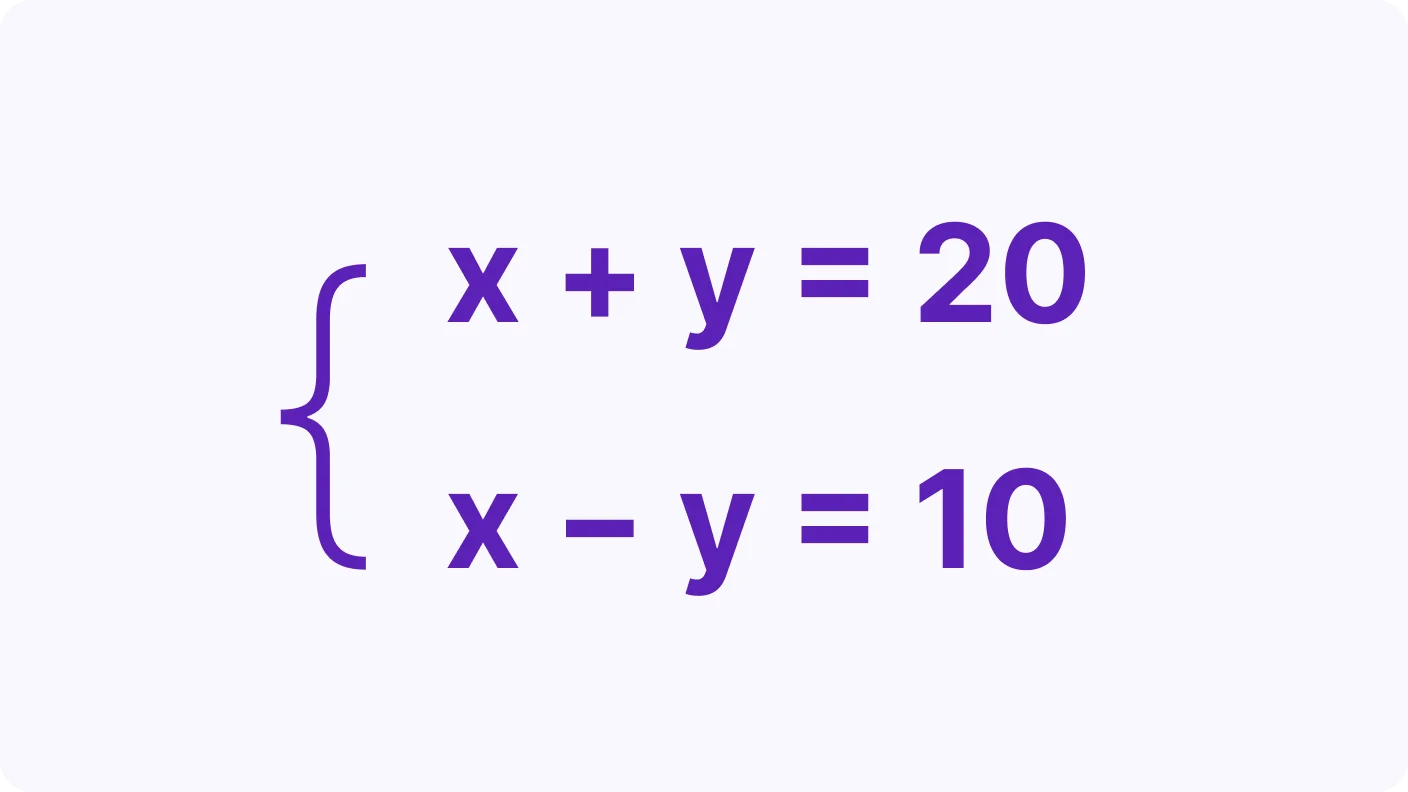
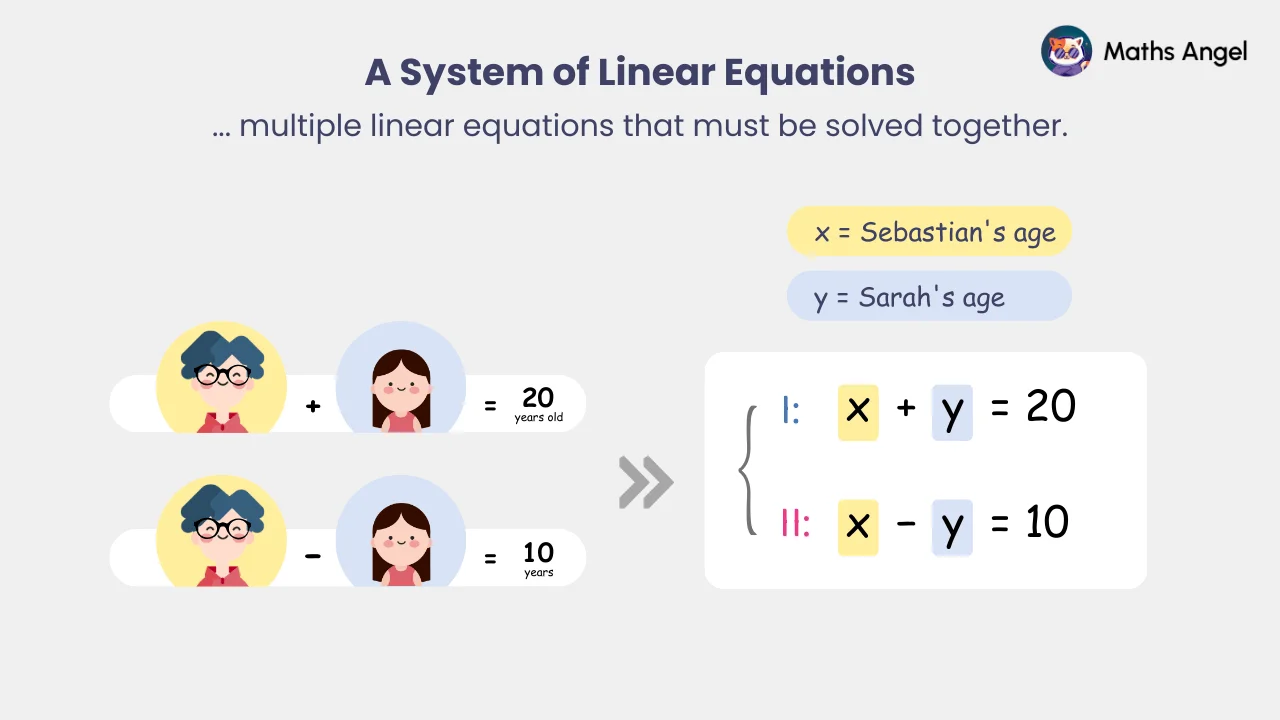
Two equations with the same two unknowns that must be true at the same time. Sebastian and Sarah are 20 years old together, and Sebastian is 10 years older: with their ages x and y, x + y = 20 and x − y = 10. The solution is the one pair of values that fits both. American sites call this a system of equations.
Rearrange each equation into y = mx + c, draw both lines on the same grid, and read off where they cross. x + y = 20 becomes y = −x + 20, and x − y = 10 becomes y = x − 10. The lines cross at (15, 5), so x = 15 and y = 5: Sebastian is 15 and Sarah is 5. Check the pair in both original equations.
Every point on a line satisfies that line’s equation. The crossing point is the only point on both lines at once, so it is the only pair of values that satisfies both equations, which is exactly what a solution to simultaneous equations means. Any other point fits one equation but not the other.
There is no solution. Parallel lines never cross, so no pair of values fits both equations. It happens when the two equations have the same gradient but different y-intercepts, such as y = x − 1 and y = x + 3. If you reach a false statement like 0 = 4 when solving by algebra, the lines are parallel.
When the two lines are the same line, which happens when the equations turn out identical after rearranging: x + y = 1 and 2x + 2y = 2 are the same line, because the second is just the first doubled. Every point on it satisfies both equations, so there are infinitely many solutions. So: lines that cross, one solution; parallel, none; identical, infinitely many.
What's next?
Found this one hard? Go one step back first. Feeling confident? Carry on to the next lesson.