Simultaneous Equations: Equal Values and Substitution Method
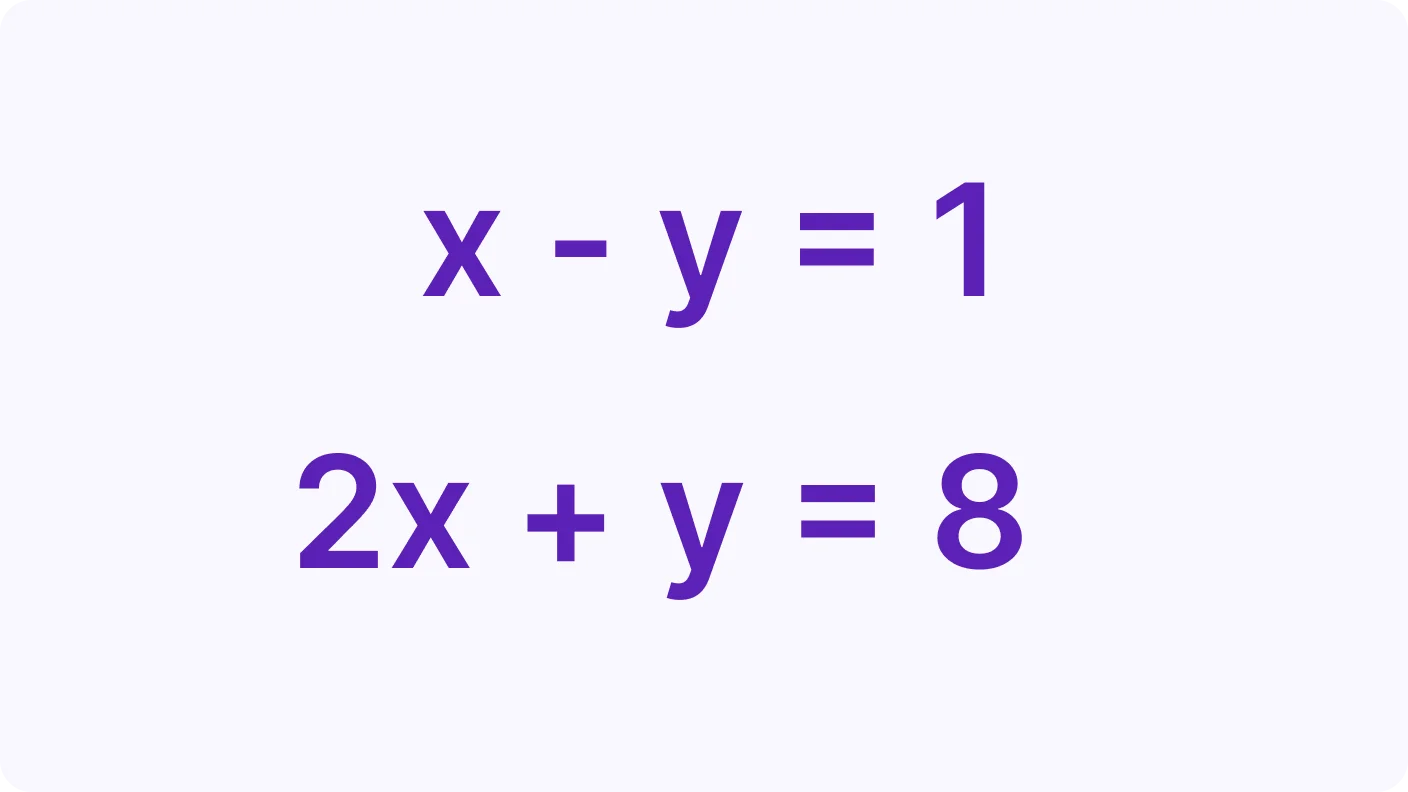
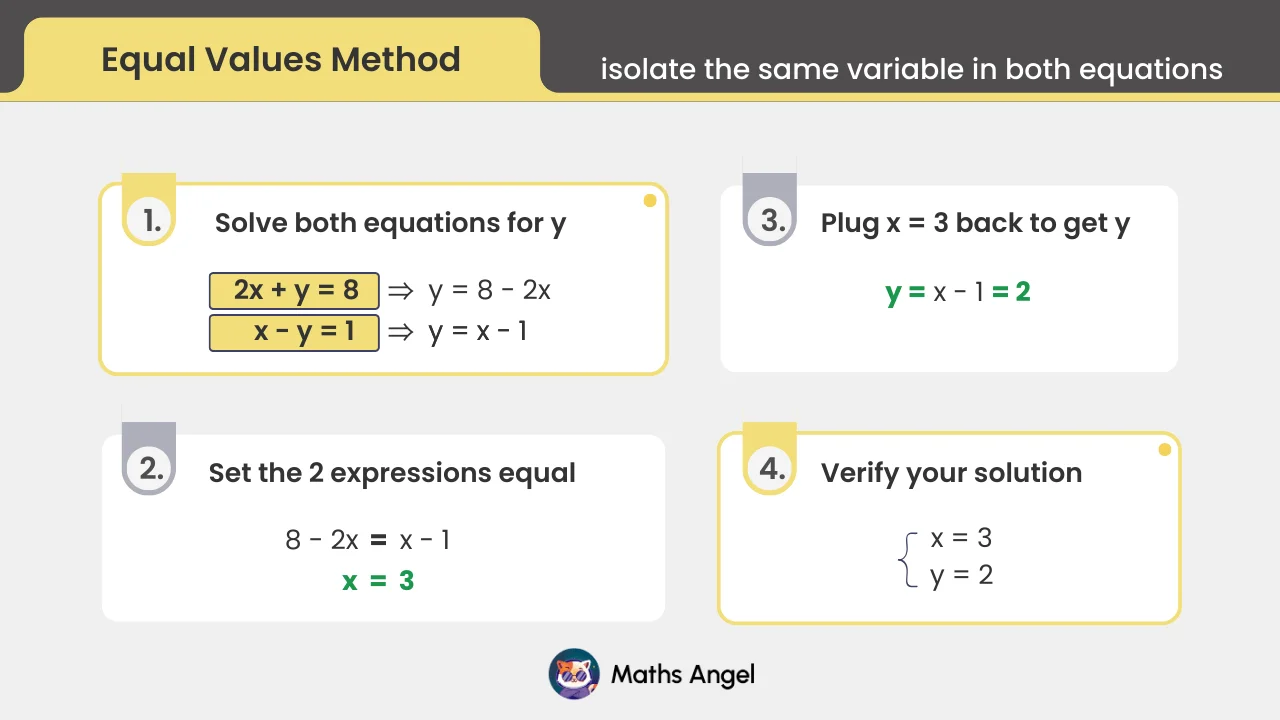
Simultaneous equations are two equations that share one solution. To solve, the equal values method rearranges both to y = x − 1 and y = 8 − 2x, then sets them equal. The substitution method puts x = y + 1 into the other equation.
Video Lesson
Watch and learn the basics
🎬 Did this video explain it clearly?
Flashcards
Review key concepts visually
%20Equal%20Value%20Methods.webp)
%20Substitution%20Method.webp)
%20Equal%20Values%20vs%20Substitution%20Method.webp)
Equal Values Method
- Make the same variable (like y) the subject in both equations.
- Set the two expressions equal and solve for x.
- Substitute the x value back to find y.
Substitution Method
- Rearrange one equation to express one variable in terms of the other, for example .
- Substitute this into the other equation so it has only one variable, then solve.
- Exam tip: always substitute both values back into the original equations to check.
Choosing the Right Method
- Use equal values when the same variable is easy to make the subject.
- Use substitution when one equation is easy to rearrange to remove one variable.
- Both methods give the same solution for x and y.
Practice Questions
Test your understanding
Do and satisfy both of these simultaneous equations?
Correct! 🎉 +10 pointsCorrect! 🎉 Worth 10 XPNot quite right
A pair of values is a solution only if it makes every equation true, so check both, putting each value into its own letter.
First equation: . This matches the right-hand side, 5, so it is satisfied.
Second equation: , and . This is satisfied too.
Both equations are true, so yes: , is the solution.
We have the following simultaneous equations. Do , satisfy these simultaneous equations?
Correct! 🎉 +10 pointsCorrect! 🎉 Worth 10 XPNot quite right
A pair of values only satisfies simultaneous equations if it works in every equation, so check both.
First equation: , so is satisfied.
Second equation: , but we need 8, and .
The second equation fails, so , do not satisfy the simultaneous equations. The answer is No.
Solve the simultaneous equations:
Correct! 🎉 +20 pointsCorrect! 🎉 Worth 20 XPNot quite right
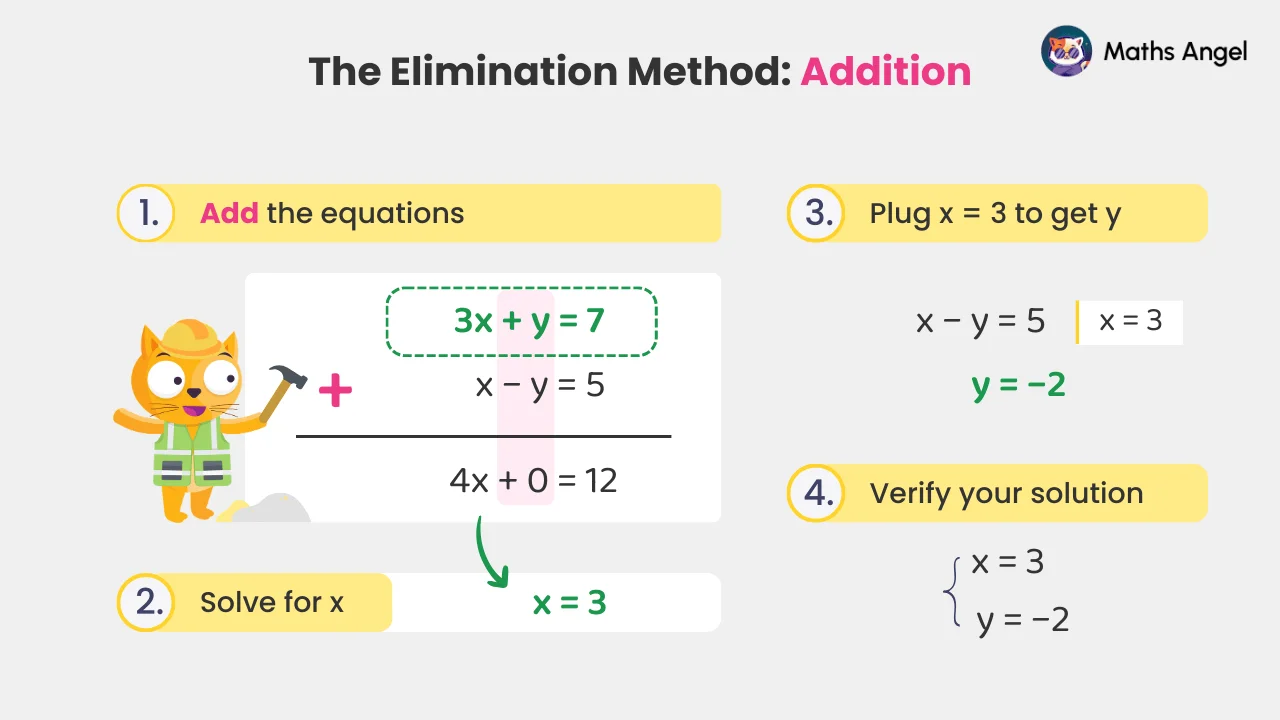
Add the two equations to remove : , which gives , so .
Substitute into : , so .
Check in the second equation: . Correct. So the solution is , .
Solve the simultaneous equations:
Correct! 🎉 +20 pointsCorrect! 🎉 Worth 20 XPNot quite right
Both equations give , so the two expressions must be equal: .
Subtract from both sides: . Subtract 2 from both sides: .
Substitute into : .
Check in the other equation: . Correct. So the solution is , .
Solve the simultaneous equations:
Correct! 🎉 +20 pointsCorrect! 🎉 Worth 20 XPNot quite right
The first equation already gives , so substitute into the second equation: .
Collect like terms: . Subtract 2 from both sides: , so .
Substitute back into : .
Check: . Correct. So the solution is , .
Solve the simultaneous equations:
Correct! 🎉 +30 pointsCorrect! 🎉 Worth 30 XPNot quite right
Subtract the second equation from the first to remove : , which gives , so .
Substitute into : , so .
Check in both equations: and . Correct. So the solution is , .
Want to see the full working?
Interactive Activity
Solve simultaneous equations step-by-step using equal values and substitution
Loading interactive widget...
Frequently asked questions
The questions students bump into most on this topic
Both turn two equations in x and y into one equation in a single unknown. The equal values method makes the same variable the subject of both equations and sets the two expressions equal. The substitution method makes a variable the subject of one equation and replaces it in the other. Each then solves, substitutes back and checks.
Make y the subject of both equations, then set the right-hand sides equal, because both equal y. For y = x − 1 and y = 8 − 2x: x − 1 = 8 − 2x, so 3x = 9 and x = 3. Put x = 3 into the simpler equation, y = x − 1, to get y = 2. The solution is x = 3, y = 2.
Make one variable the subject of one equation, then substitute that expression into the other equation. From y = x − 1, replace y in the first equation with x − 1; it now has only x, and solving gives x = 3. Substitute back to get y = 2. It does not matter which equation or variable you start with, so pick the easiest to rearrange.
Whichever needs the least rearranging; both give the same answer. If both equations are already written as y = something, set them equal. If one equation has a variable on its own, or one that is easy to isolate, substitute it into the other. For most GCSE pairs written as ax + by = c, elimination, in the next lesson, is quickest.
Substitute both values into both original equations and confirm each one is true. For x = 3 and y = 2: y = x − 1 gives 2 = 3 − 1, true; and the first equation balances as well. If either fails, the pair is not the solution, however neat the working looked. The check is the last step of both methods.
What's next?
Found this one hard? Go one step back first. Feeling confident? Carry on to the next lesson.