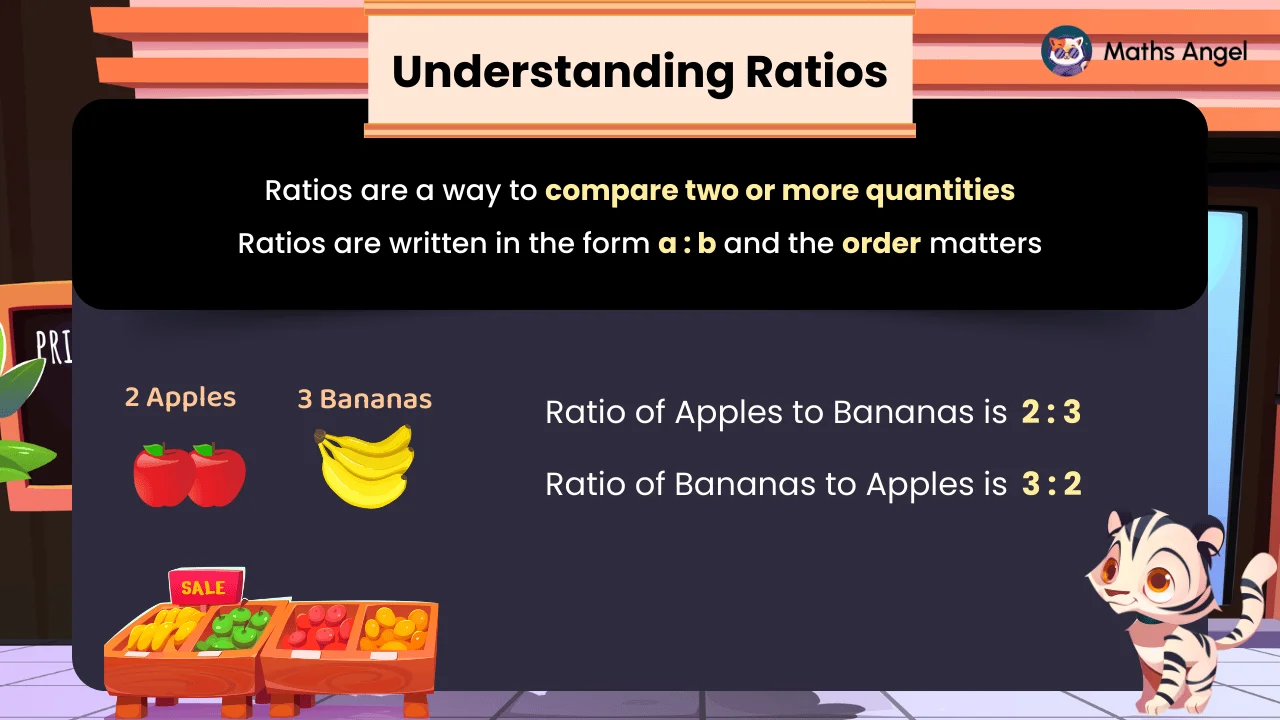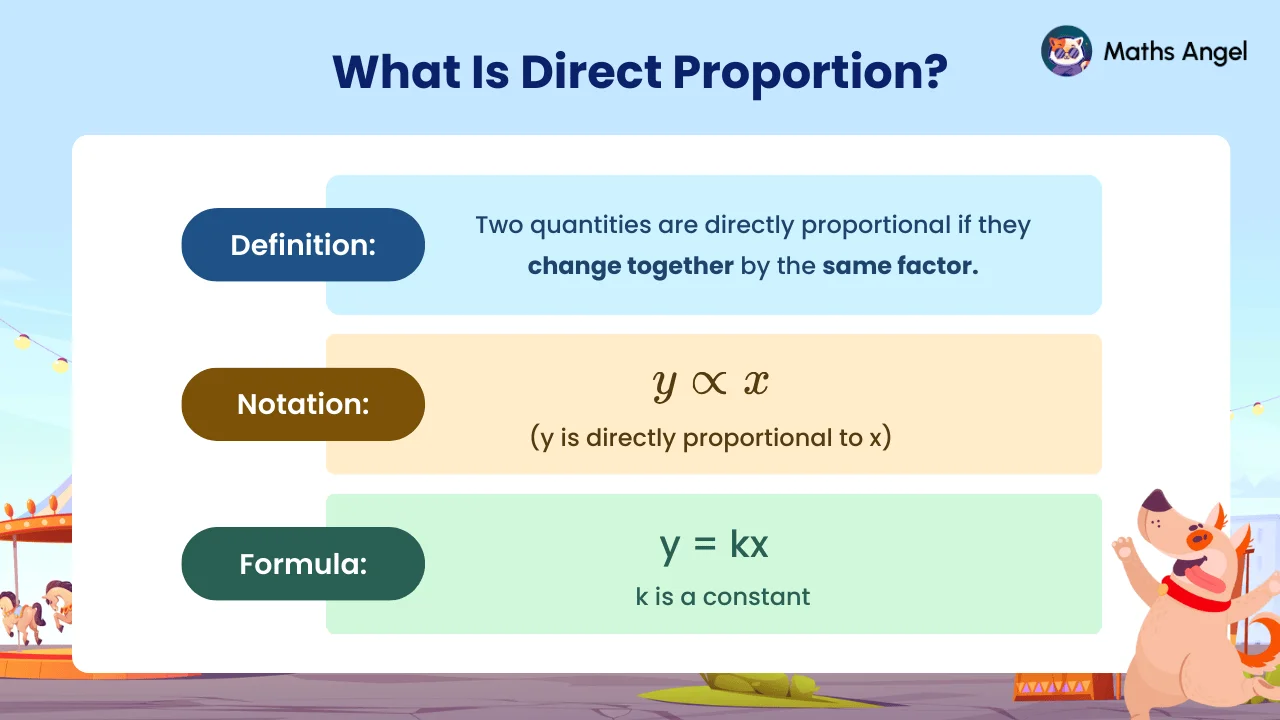
Directly Proportional and Inversely Proportional
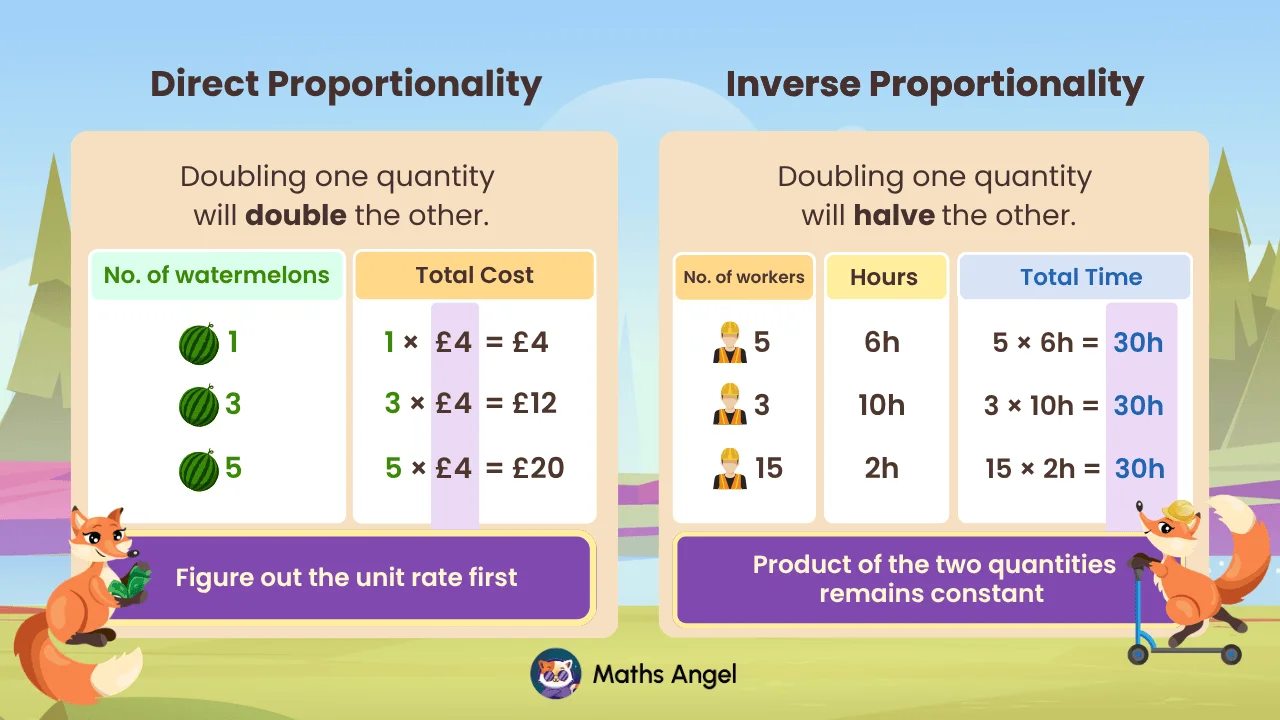
Directly proportional means two amounts rise at the same rate, so doubling one doubles the other. For example, if 1 watermelon costs £4, then 2 cost £8. Inversely proportional is the opposite: doubling one halves the other.
Video Lesson
Watch and learn the basics
🎬 Did this video explain it clearly?
Flashcards
Review key concepts visually
%20Direct%20Proportion.webp)
%20Inverse%20Proportion.webp)
%20Direct%20Proportion%20vs%20Inverse%20Proportion.webp)
What Is Direct Proportionality?
- In direct proportion, doubling one value will double the other.
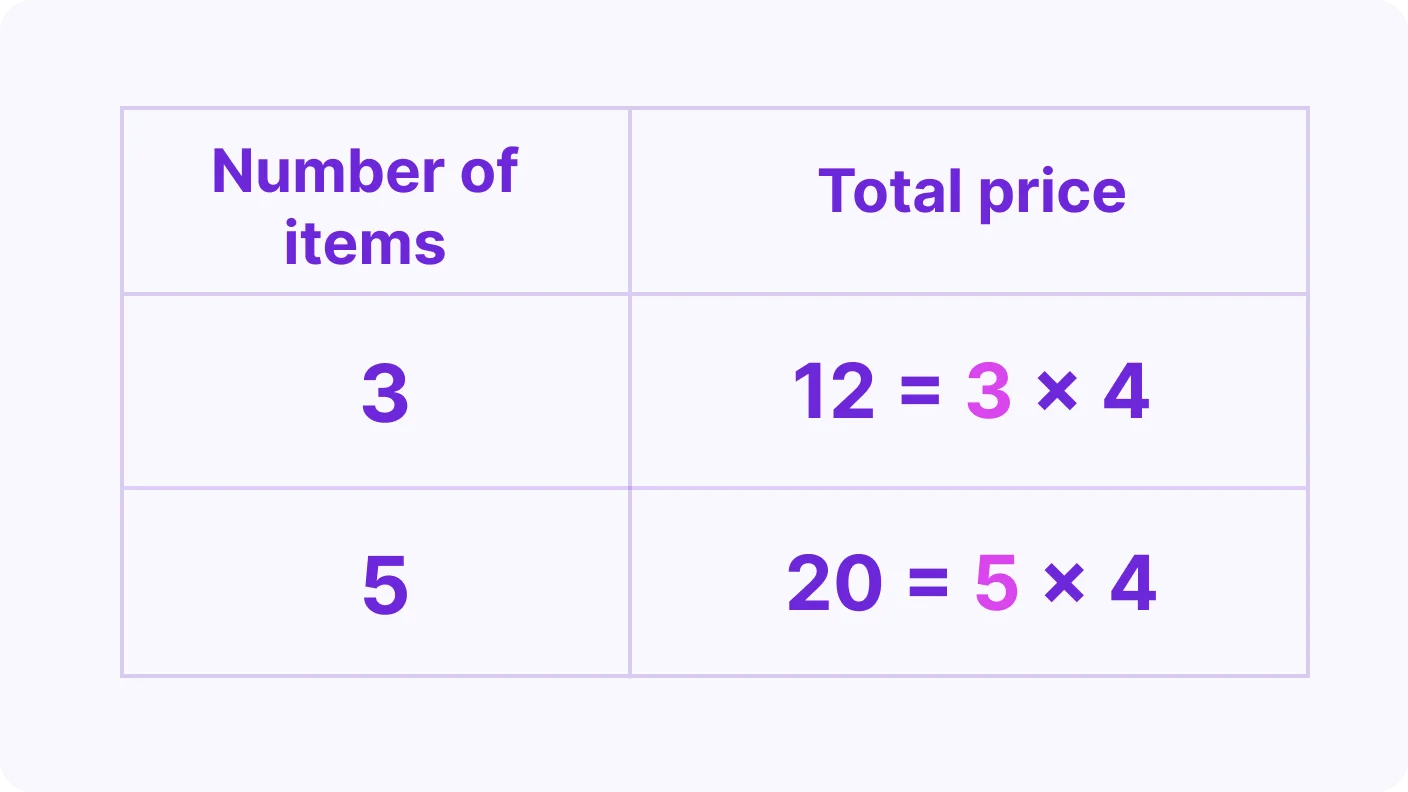
- If 1 watermelon costs £4, then 2 cost £8 and 4 cost £16.
What Is Inverse Proportionality?
- In inverse proportion, doubling one value will halve the other.
- For a task, 15 people take 2 hours, but 30 people only take 1 hour.
Spotting the Difference Quickly
- In direct proportion, the unit rate stays the same.
- In inverse proportion, the product of the two quantities stays the same.
Practice Questions
Test your understanding
At a supermarket, 3 watermelons cost £12 in total. How much would 7 watermelons cost if each watermelon costs the same?
Correct! 🎉 +10 pointsCorrect! 🎉 Worth 10 XPNot quite right
Find the cost of one watermelon first: £ £4.
Then scale up to 7 watermelons: 7 × £ £28.
So 7 watermelons cost £28.
(£16 comes from adding just one extra £4 to the £12; but seven watermelons is four more than three, so you must add four lots of £4, not one.)
A factory task takes 5 workers 6 hours to complete. How many hours will it take if 10 workers are available?
Correct! 🎉 +10 pointsCorrect! 🎉 Worth 10 XPNot quite right
This is inverse proportion: more workers means less time, but the amount of work stays the same.
Total work worker-hours.
With 10 workers: hours.
So the task takes 3 hours.
(Doubling the number of workers halves the time. It does not double it, and it does not simply take 5 hours off.)
A construction job requires 8 workers and 15 days to complete. How many days would it take if only 5 workers are available?
Correct! 🎉 +20 pointsCorrect! 🎉 Worth 20 XPNot quite right
Workers and days are inversely proportional, so workers × days stays the same. The job is worker-days. With only 5 workers, the time needed is days. Fewer workers means more days, so the answer must be larger than 15.
A train covers in 6 hours. How much time will it take to cover at the same speed?
Correct! 🎉 +20 pointsCorrect! 🎉 Worth 20 XPNot quite right
At a steady speed, distance and time are in direct proportion. The speed is , so takes hours (7 hours 30 minutes).
A car consumes 12 litres of fuel to travel . How far can the car travel with 18 litres of fuel?
Correct! 🎉 +20 pointsCorrect! 🎉 Worth 20 XPNot quite right
Fuel and distance are in direct proportion. The car's fuel efficiency is per litre. That is the distance for one litre, not the answer. For 18 litres, multiply: .
A project requires 16 workers to complete in 12 days. How many more workers would be required to complete the project in 8 days?
Correct! 🎉 +30 pointsCorrect! 🎉 Worth 30 XPNot quite right
Workers and days are inversely proportional, so workers × days stays constant: worker-days. To finish in 8 days you need workers. The question asks how many more workers are needed, so subtract the 16 already on the job: .
Want to see the full working?
Interactive Activity
Adjust the constant k to see how direct and inverse proportion affect a data table
Loading interactive widget...
Frequently asked questions
The questions students bump into most on this topic
Two quantities are directly proportional when they increase at the same rate: double one and the other doubles, triple one and the other triples. If 3 watermelons cost £12, then one costs £4, 5 cost £20 and 8 cost £32. In GCSE questions the key is the unit rate, the value of one item, which stays the same throughout.
Two quantities are inversely proportional when one goes up as the other goes down, so that doubling one halves the other. If 5 workers take 6 hours for a task, 10 workers take 3 hours and 30 workers take 1 hour. Their product stays the same: 5 × 6 = 10 × 3 = 30 × 1 = 30 work hours. That constant product is the key in GCSE questions.
Use the doubling test. If doubling one quantity doubles the other, they are directly proportional: twice as many watermelons cost twice as much. If doubling one quantity halves the other, they are inversely proportional: twice as many workers need half the time. Decide this first, because it tells you which method to use.
Find the unit rate first, then multiply. If 3 watermelons cost £12, one costs £12 ÷ 3 = £4, so 5 cost 5 × £4 = £20 and 8 cost £32. It works backwards too: someone who spent £40 bought £40 ÷ £4 = 10 watermelons. Divide to get one, then multiply to get many.
Find the constant product, then divide. If 5 workers take 6 hours, the product is 5 × 6 = 30 work hours. With 3 workers, ask “3 times what is 30?”: 10 hours. With only 2 hours available, ask “what times 2 is 30?”: 15 workers. Multiply the pair you know, then divide by the new quantity.
Shopping is direct proportion: the more watermelons you buy at £4 each, the more you pay, at the same rate. Sharing a job is inverse proportion: the more workers on a factory task, the fewer hours it takes, while the total work hours stay at 30. Speed and journey time work the same way: twice the speed, half the time.
What's next?
Found this one hard? Go one step back first. Feeling confident? Carry on to the next lesson.