
Distributive Property
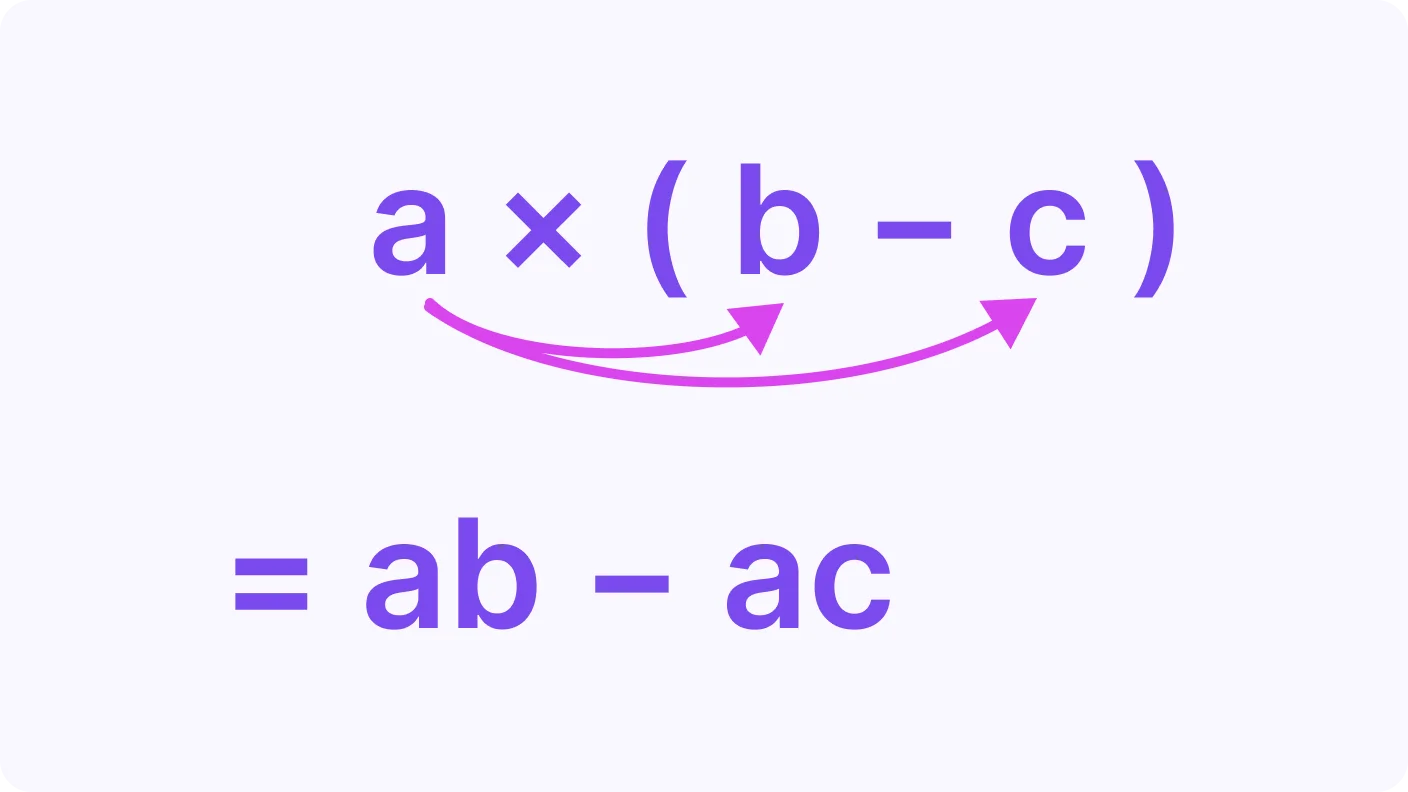
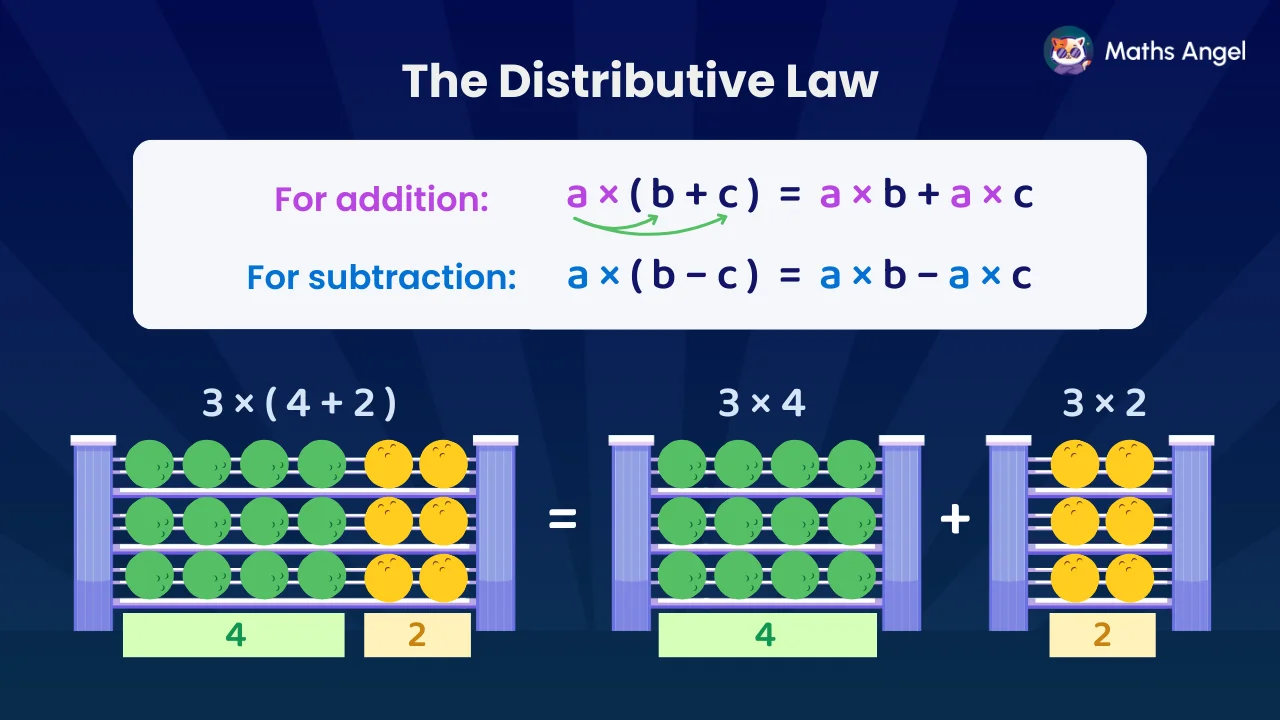
The distributive property means multiplying the number outside the brackets by each term inside, so a × (b + c) = a × b + a × c and a × (b − c) = a × b − a × c. It works both ways to expand brackets or factorise.
Video Lesson
Watch and learn the basics
🎬 Did this video explain it clearly?
Flashcards
Review key concepts visually
%20The%20Distributive%20Law.webp)
%20Applying%20the%20Distributive%20Law.webp)
%20Distributive%20Law%20for%20Multiple%20Numbers.webp)
%20Remarks%20on%20the%20Distributive%20Law.webp)
What is the Distributive Property?
- The distributive property means multiplying a number across brackets.
- It is written as .
Applying the Distributive Property
- Multiply the number outside the brackets by each term inside.
- This can be used to expand brackets or simplify calculations.
Distributive Property with More Than Two Terms
- The distributive property also works with more than two terms.
- For example, .
Should I Use the Distributive Property with Division?
- Do not use the distributive property when dividing.
- When there is division, it is usually better to calculate inside the brackets first.
Practice Questions
Test your understanding
4 × (25 + 6)
Correct! 🎉 +10 pointsCorrect! 🎉 Worth 10 XPNot quite right
Calculate inside the brackets first: . Then multiply: .
8 × (50 + 2)
Correct! 🎉 +10 pointsCorrect! 🎉 Worth 10 XPNot quite right
Apply order of operations: , then .
7 × (80 − 3)
Correct! 🎉 +20 pointsCorrect! 🎉 Worth 20 XPNot quite right
Subtract first: . Then multiply: .
8 × (70 − 5)
Correct! 🎉 +20 pointsCorrect! 🎉 Worth 20 XPNot quite right
Use brackets first: . Then multiply: .
8 × 51
Correct! 🎉 +20 pointsCorrect! 🎉 Worth 20 XPNot quite right
Straight multiplication: .
12 × 102
Correct! 🎉 +30 pointsCorrect! 🎉 Worth 30 XPNot quite right
Break it down: and . Add them: .
Want to see the full working?
Interactive Activity
Click the number to distribute it to the terms inside
Loading interactive widget...
Distributive Property frequently asked questions
The questions students bump into most on this topic
Yes. The distributive law works with subtraction in the same way as addition. When you multiply a number by a difference in brackets, multiply the outside number by each part. Then subtract the results instead of adding them. The method does not change.
Generally no. The distributive law is mainly a property of multiplication, so avoid using it with division. It only works when the brackets sit on the left, such as (19 + 2) ÷ 3. Even then it rarely helps, so simply work out 21 ÷ 3 = 7.
It works because regrouping never changes a total. Picture 3 rows with 4 green and 2 yellow balls in each. You can count them as 3 × (4 + 2), or add (3 × 4) and (3 × 2). Both routes reach the same total, so the two methods always agree.
You use the distributive law to simplify calculations and make mental maths quicker. By breaking a tricky number into easier parts, you can multiply step by step in your head. It also works in two directions, letting you expand brackets or factorise by taking out a common number.
Break the large number into parts that are easy to multiply, then share the multiplication across all of them. To work out 5 × 221, split 221 into 200 + 20 + 1. This gives (5 × 200) + (5 × 20) + (5 × 1), which adds up to 1105.