Deriving and Evaluating Expressions with One Variable
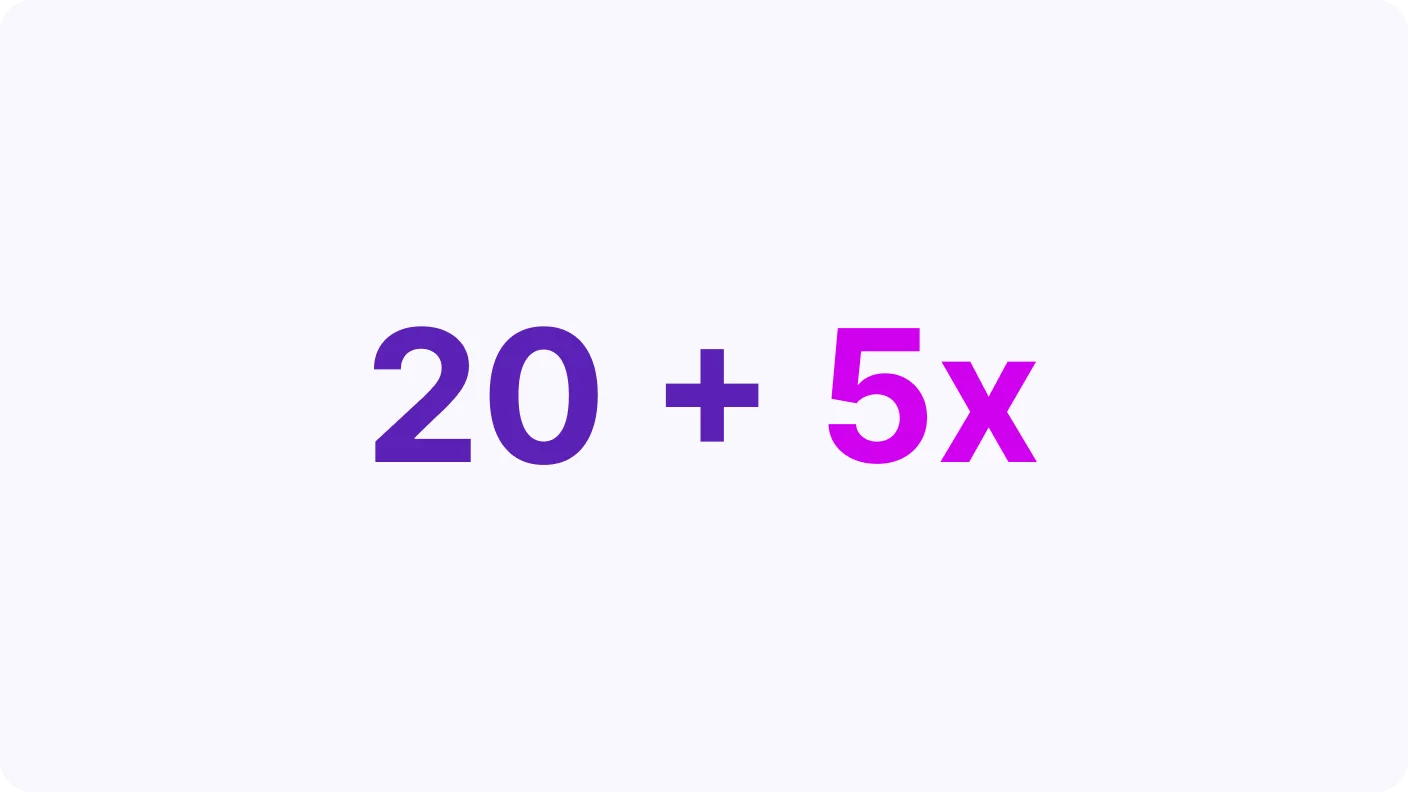
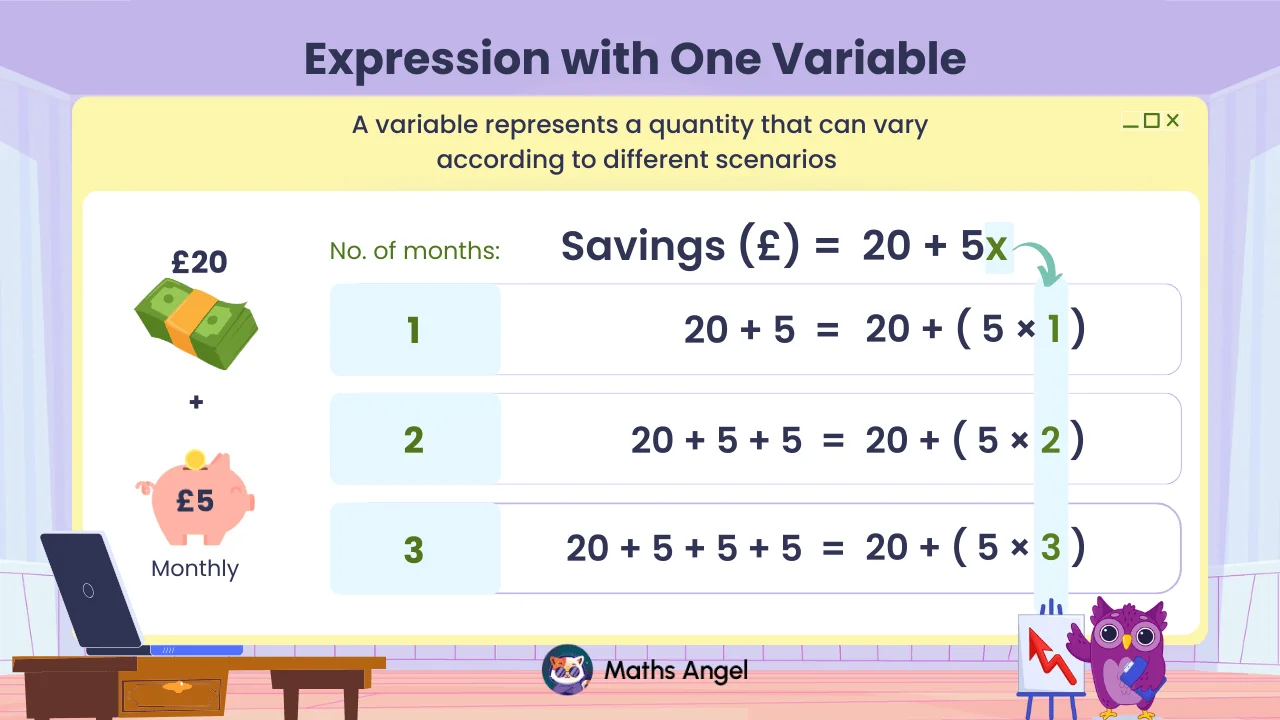
Expressions with one variable combine numbers with a letter, like 20 + 5x. Here 20 is the starting amount and 5x adds 5 for each x. To evaluate it, replace the letter with a number: when x = 8, 20 + 5 × 8 = 60.
Video Lesson
Watch and learn the basics
🎬 Did this video explain it clearly?
Flashcards
Review key concepts visually
%20Expression%20with%20One%20Variable.webp)
%20Evaluate%20Expression%20with%20One%20Variable.webp)
%20How%20to%20Form%20An%20Expression.webp)
%20How%20to%20Evaluate%20An%20Expression.webp)
Understanding Variables
- A variable is a letter that stands for a number that can change.
- For example, x can represent the number of months passed.
Understanding Expressions
- An expression is formed by combining numbers and variables.
- It shows how a value changes and has no equals sign.
Forming Expressions
- Example 1: 20 + 5x means start with 20 and add 5 for each x.
- Example 2: 50 − 3y means start with 50 and subtract 3 for each y.
Evaluating Expressions
- To evaluate an expression, you replace the variable with a number.
- You then calculate to find the value of the expression.
Practice Questions
Test your understanding
Julia has £20 in savings. Each month, she saves an additional £5. How much will she have in savings in total after 5 months?
Correct! 🎉 +10 pointsCorrect! 🎉 Worth 10 XPNot quite right
The expression is , where x is the number of months.
Multiplication comes before addition, so after 5 months Julia has (£) in savings in total.
A library has 200 books. Every week, 10 new books are added. How many books will the library have after 3 weeks?
Correct! 🎉 +10 pointsCorrect! 🎉 Worth 10 XPNot quite right
The expression is , where x is the number of weeks.
Multiplication comes before addition, so after 3 weeks the library has books.
You start with £100, and you spend £8 each day. How much money will you have left after 12 days?
Correct! 🎉 +20 pointsCorrect! 🎉 Worth 20 XPNot quite right
The expression is , where x is the number of days.
In 12 days you spend , so you have (£) left.
A factory starts with 1000 units of a product. They produce 125 units every day. After how many days will they have a total of 2000 units?
Correct! 🎉 +20 pointsCorrect! 🎉 Worth 20 XPNot quite right
The equation is , where x is the number of days.
Subtract 1000 from both sides: . Then divide both sides by 125: days.
A gardener plants 15 flowers each day. They start with 50 flowers already planted. How many flowers will they have after 7 days?
Correct! 🎉 +20 pointsCorrect! 🎉 Worth 20 XPNot quite right
The expression is , where x is the number of days.
Multiplication comes before addition, so after 7 days the gardener has flowers in total.
A photographer charges £50 for a session. They charge an additional £30 for each photo after the first. How much will the photographer charge after 12 photos?
Correct! 🎉 +30 pointsCorrect! 🎉 Worth 30 XPNot quite right
The first photo is covered by the £50 session fee, so only the photos after the first cost £30 each. The expression is .
With 12 photos, , so there are photos to charge for: (£).
Want to see the full working?
Interactive Activity
Build and evaluate expressions with one variable
Loading interactive widget...
Frequently asked questions
The questions students bump into most on this topic
An expression is a combination of numbers and letters joined by operations, with no equals sign. 20 + 5x is an expression: it means start with 20 and add 5 for every x. Other examples are 50 − 3y, 5x and 3 + 2. An expression does not have an answer on its own; it takes a value once you know what the letter stands for.
A variable is a letter, usually x or y, that stands for a number that can change; it is called a variable because its value can vary. In Julia’s savings, 20 + 5x, the x is the number of months: it can be 8, 12 or 20, and the expression gives her savings for each. One rule replaces a new sum every time.
An expression has no equals sign; an equation does. 20 + 5x is an expression: you can evaluate it for any value of x, but you cannot solve it. 20 + 5x = 60 is an equation: it says the expression equals 60, and you can solve it to find x = 8. An equation is two expressions with an equals sign between them.
5x means 5 times x. When a number is written directly in front of a letter, you multiply them; the times sign is left out. If x is 8, then 5x is 5 × 8 = 40, so Julia’s savings 20 + 5x come to 20 + 40 = £60. In the same way 3y means 3 times y, and x on its own means 1x.
Replace the letter with the number, then work it out, doing the multiplication before the addition. For 20 + 5x with x = 8: 20 + 5 × 8 = 20 + 40 = 60. For 50 − 3y with y = 10: 50 − 3 × 10 = 50 − 30 = 20. Exam papers call this evaluating the expression.
Find the fixed amount and the amount that repeats, then use a letter for the number of repeats. Julia starts with £20 and saves £5 a month: after x months she has 20 + 5x. You have £50 and each pack of snacks costs £3: after buying y packs you have 50 − 3y left. Starting amount, then plus or minus the repeated amount times the letter.
What's next?
Found this one hard? Go one step back first. Feeling confident? Carry on to the next lesson.