Simplifying Expressions
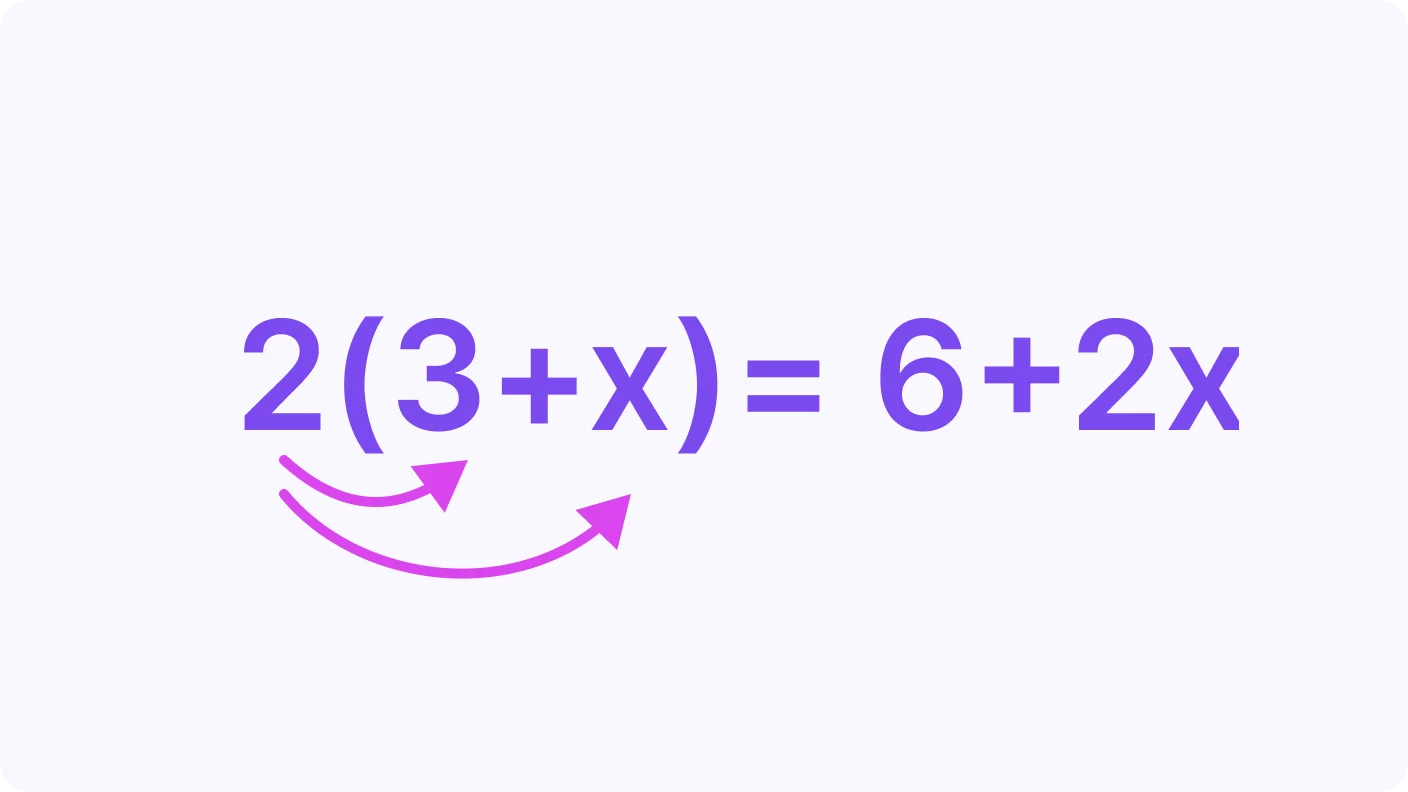
Simplifying expressions means rewriting them in their shortest equal form. First expand brackets, like 2(3 + x) = 6 + 2x, then collect like terms. Only terms with the same letter and power can be collected.
Video Lesson
Watch and learn the basics

🎬 Did this video explain it clearly?
Flashcards
Review key concepts visually
%20How%20to%20Simplify%20Expressions.webp)
%20Simplify%20Expressions%20Example.webp)
%20Simplify%20Expressions%20Practice.webp)
How to Simplify an Expression?
- Expand brackets first using the distributive law.
- Then collect like terms by adding or subtracting their coefficients.
Collecting Like Terms
- Like terms have the same variable and the same power (e.g. 2x² and 3x²).
- To collect like terms, add or subtract the numbers, then keep the variable the same.
Important Signs and Common Mistakes
- A minus sign before brackets changes the sign of every term inside.
- Terms with different powers (e.g. x and x²) are not like terms and cannot be collected.
Practice Questions
Test your understanding
Fully simplify the expression: .
Correct! 🎉 +10 pointsCorrect! 🎉 Worth 10 XPNot quite right
All three terms are like terms - each is a number of ys - so their coefficients can be combined. Different coefficients do not stop terms being alike.
Work left to right: , then .
The minus sign belongs to the , so that term is subtracted, not added: .
So the expression fully simplifies to .
Expand and simplify: .
Correct! 🎉 +10 pointsCorrect! 🎉 Worth 10 XPNot quite right
Use the distributive law: every term inside the bracket is multiplied by the 5 outside.
and .
So . Both terms inside the bracket must be multiplied, not just the first; the 5 is multiplied by the 2, not added to it; and and are unlike terms, so they cannot be combined before expanding.
Expand and simplify: .
Correct! 🎉 +20 pointsCorrect! 🎉 Worth 20 XPNot quite right
Multiply each term inside the bracket by the 5 outside, keeping the sign with the term it belongs to.
and .
So .
Expand and fully simplify: .
Correct! 🎉 +20 pointsCorrect! 🎉 Worth 20 XPNot quite right
Expand the bracket first: and , so .
The expression becomes .
Now collect the like terms: . The has no like term, so it stays as it is and cannot be merged into the term.
The simplified expression is .
Expand and fully simplify: .
Correct! 🎉 +20 pointsCorrect! 🎉 Worth 20 XPNot quite right
Expand the bracket first: and , so .
The expression becomes .
Only and are like terms: . The 10 is a number on its own, so the cannot be taken away from it.
The simplified expression is .
Expand and fully simplify: .
Correct! 🎉 +30 pointsCorrect! 🎉 Worth 30 XPNot quite right
Expand each bracket, taking the sign in front of the bracket with it.
.
For the second bracket the multiplier is : and , so .
Now collect like terms: and .
The simplified expression is .
Want to see the full working?
Interactive Activity
Simplifying Expressions: Expand brackets and collect terms
Loading interactive widget...
Frequently asked questions
The questions students bump into most on this topic
Two steps: expand any brackets, then collect like terms. For 2(3 + x) − 5x, expanding gives 6 + 2x − 5x, and collecting the x terms gives 6 − 3x. The expression is now as short as it can be and has exactly the same value. With no brackets, just collect: 3x + 4x + 2x = 9x. That is the whole GCSE skill.
Like terms have the same letter raised to the same power. 6x and −4x are like terms; so are 3x² and 2x², and so are plain numbers such as −3 and 20. 3x is a like term with any other x term, but x and x² are not like terms, because the powers differ. Only like terms can be collected.
Add or subtract the numbers in front, the coefficients, and keep the letter the same. 6x − 4x = 2x, and −3 + 20 = 17, so 6x − 3 − 4x + 20 becomes 2x + 17. For 5y + 3y − 2y, 5 + 3 − 2 = 6, so it is 6y. American sites call this combining like terms; it is the same step.
Multiply every term inside the brackets by the term outside; this is the distributive law. 3(2x − 1) is 3 × 2x and 3 × (−1), so 6x − 3. 4(−x + 5) is −4x + 20. Then collect like terms: 6x − 3 − 4x + 20 = 2x + 17. Watch the signs when the term inside is negative.
It works like multiplying by −1, so every sign inside flips. −(x − 3) becomes −x + 3. In 3(−2x + x²) − (x − 3), the first bracket gives −6x + 3x² and the second gives −x + 3; collecting the x terms, −6x − x = −7x, so the expression is 3x² − 7x + 3. The x² term stays alone because nothing else has x².
What's next?
Found this one hard? Go one step back first. Feeling confident? Carry on to the next lesson.