Simplifying Expressions with Multiple Variables
Simplifying expressions with multiple variables means writing them in their shortest form. You collect like terms with the same letters, so 2a + 3b + 5a - b becomes 7a + 2b. You also use exponents, writing x × y × y as xy².
Video Lesson
Watch and learn the basics
🎬 Did this video explain it clearly?
Flashcards
Review key concepts visually
%20Expression%20with%20Multiple%20Variables.webp)
%20Exponents%20to%20Simplify%20Expressions.webp)
%20Collecting%20Like%20Terms%20to%20Simplify%20Expressions.webp)
%20Simplifying%20Expressions%20with%20Multiple%20Variables%20Example.webp)
Expressions with Multiple Variables
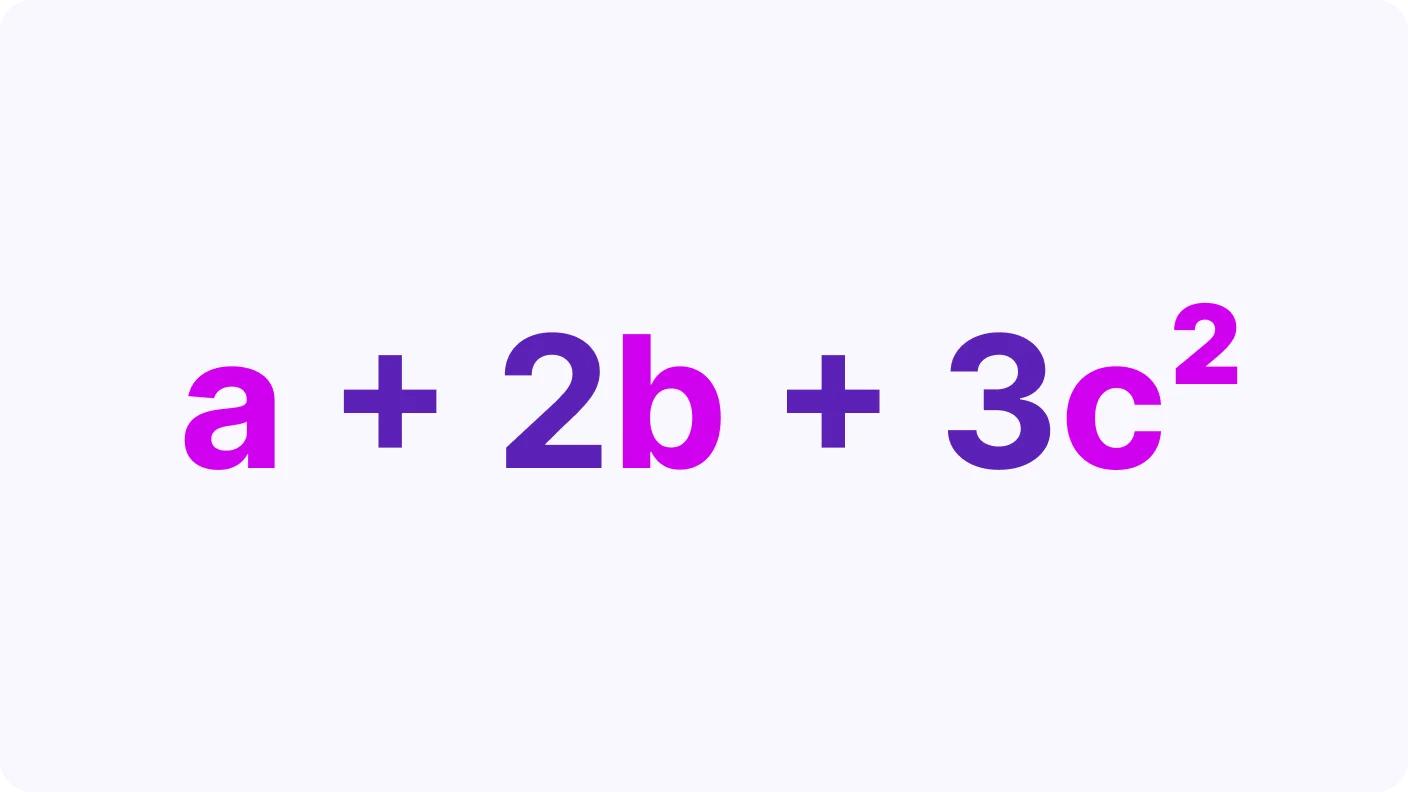
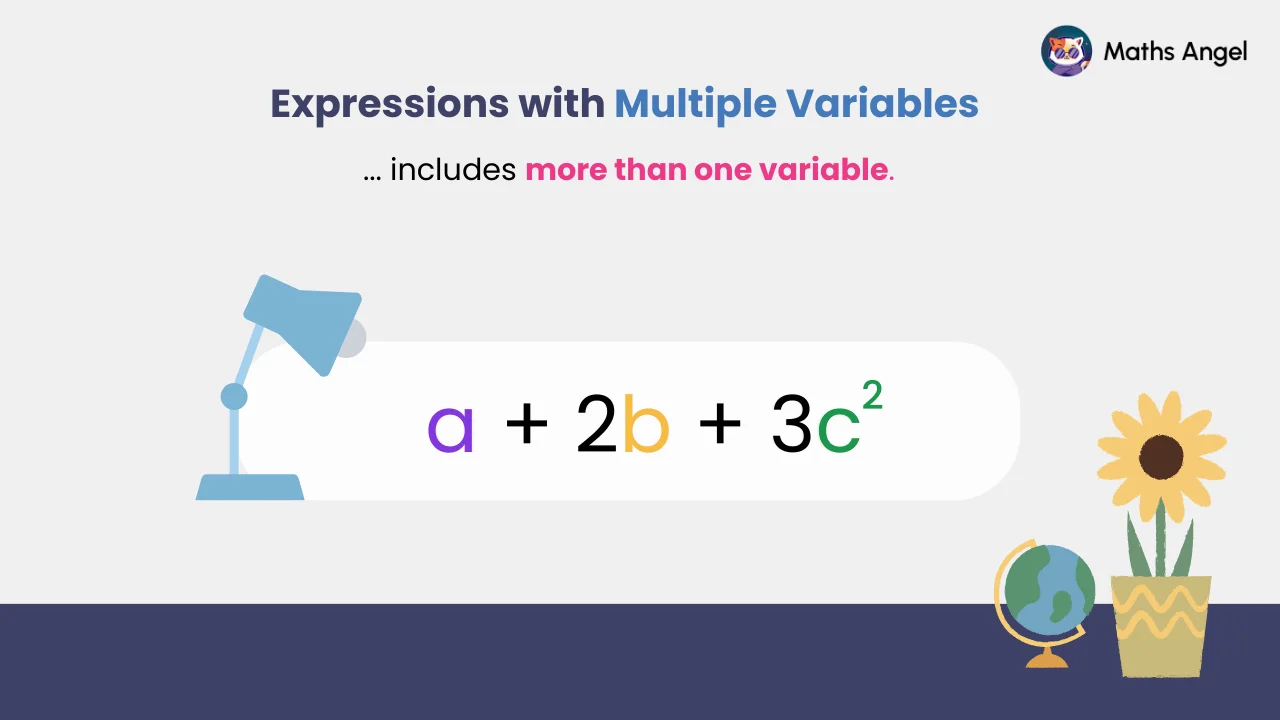
- An expression has multiple variables if it has more than one letter.
- For example, has the variables a, b, and c.
Using Exponents to Simplify
- Exponents are used for repeated multiplication.
- For example, can be written as .
Collecting Like Terms
- Like terms have the same variables with the same powers.
- For example, a and are not like terms and cannot be combined.
- To collect like terms, add or subtract the coefficients, for example .
Simplifying an Expression Step by Step
- First expand brackets using the distributive law.
- Then use exponents and collect like terms to simplify fully.
Practice Questions
Test your understanding
Simplify the expression: .
Correct! 🎉 +10 pointsCorrect! 🎉 Worth 10 XPNot quite right
A power records how many equal factors are being multiplied. Here x is used as a factor 3 times, so
.
Two checks worth making: the index counts the x's (three), not the multiplication signs (two); and multiplying is not the same as adding: would be , which is different from .
Fully simplify .
Correct! 🎉 +10 pointsCorrect! 🎉 Worth 10 XPNot quite right
and are like terms (both are a number of x), so they can be collected into one term.
Add the coefficients and keep the same letter: , so .
The coefficients are added, not multiplied, the letter stays a single x (adding x terms never produces ), and terms with different coefficients are still like terms.
Are and like terms?
Correct! 🎉 +20 pointsCorrect! 🎉 Worth 20 XPNot quite right
No. Like terms must contain exactly the same letters raised to exactly the same powers; only the coefficients may differ.
In the letter a has index 1. In it has index 2. The powers are different, so the terms are not like terms and cannot be collected into a single term.
Note also that means , while means . These are only equal when or .
Fully simplify .
Correct! 🎉 +20 pointsCorrect! 🎉 Worth 20 XPNot quite right
Collect the terms in a and the terms in b separately, keeping each sign with its term.
a terms: .
b terms: . Remember means , so .
Different coefficients do not stop terms being like terms, and a and b are different letters, so and cannot be combined any further.
The simplified expression is .
Are and like terms?
Correct! 🎉 +20 pointsCorrect! 🎉 Worth 20 XPNot quite right
No. Like terms must have exactly the same letters raised to exactly the same powers.
Written out, and . Both use a and b, but the powers are swapped: the first has and the second has .
Because the powers do not match, the terms are not like terms and cannot be added together.
Fully simplify .
Correct! 🎉 +30 pointsCorrect! 🎉 Worth 30 XPNot quite right
Deal with each type of term separately.
terms: .
terms: multiplication can be done in any order, so is the same as , and means . So .
and are not like terms (one is , the other ), so they stay apart.
The simplified expression is .
Want to see the full working?
Interactive Activity
Simplifying Expressions with Multiple Variables
Loading interactive widget...
Frequently asked questions
The questions students bump into most on this topic
Three steps: expand any brackets, write repeated letters with exponents, then collect like terms. For 2a + 3b + 5a − b, the a terms give 2a + 5a = 7a and the b terms give 3b − b = 2b, so the expression is 7a + 2b. Terms with different letters stay separate; you cannot add an a to a b.
Yes. Like terms have the same letters with the same exponents, and the order of the letters does not matter, because multiplication can be done in any order. So 3xy − yx = 2xy, and 2a²b and 5a²b are like terms. But 4ab² and 3a²b are not, because the exponents sit on different letters.
Because their exponents are different: a has an exponent of 1 and a² has an exponent of 2, so they stand for different things, a and a × a. Like terms need the same letters and the same exponents. So a + a² cannot be shortened, just as 2a and a² stay as two separate terms.
The coefficient is the number in front of the letters in a term: in 5ab it is 5, and in ab it is 1, even though the 1 is not written. Collecting like terms means adding the coefficients and keeping the letters: ab − 2ab + 5ab is (1 − 2 + 5)ab, which is 4ab.
Count how many times each letter is multiplied and write that as the exponent. x × x × x is x³, and x × y × y is xy², because y appears twice. The order does not matter: y × x × y is also xy², since multiplication is commutative. Write the letters in alphabetical order so like terms are easy to spot.
What's next?
Found this one hard? Go one step back first. Feeling confident? Carry on to the next lesson.