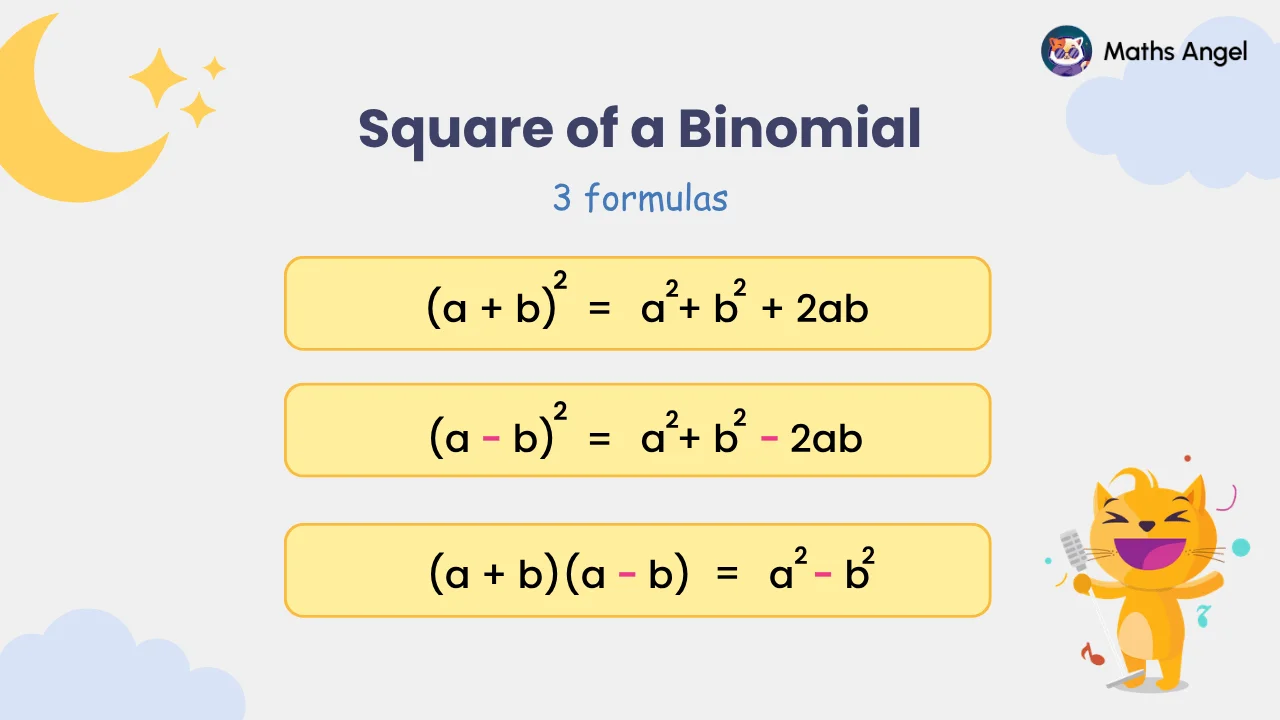
Expanding Double Brackets
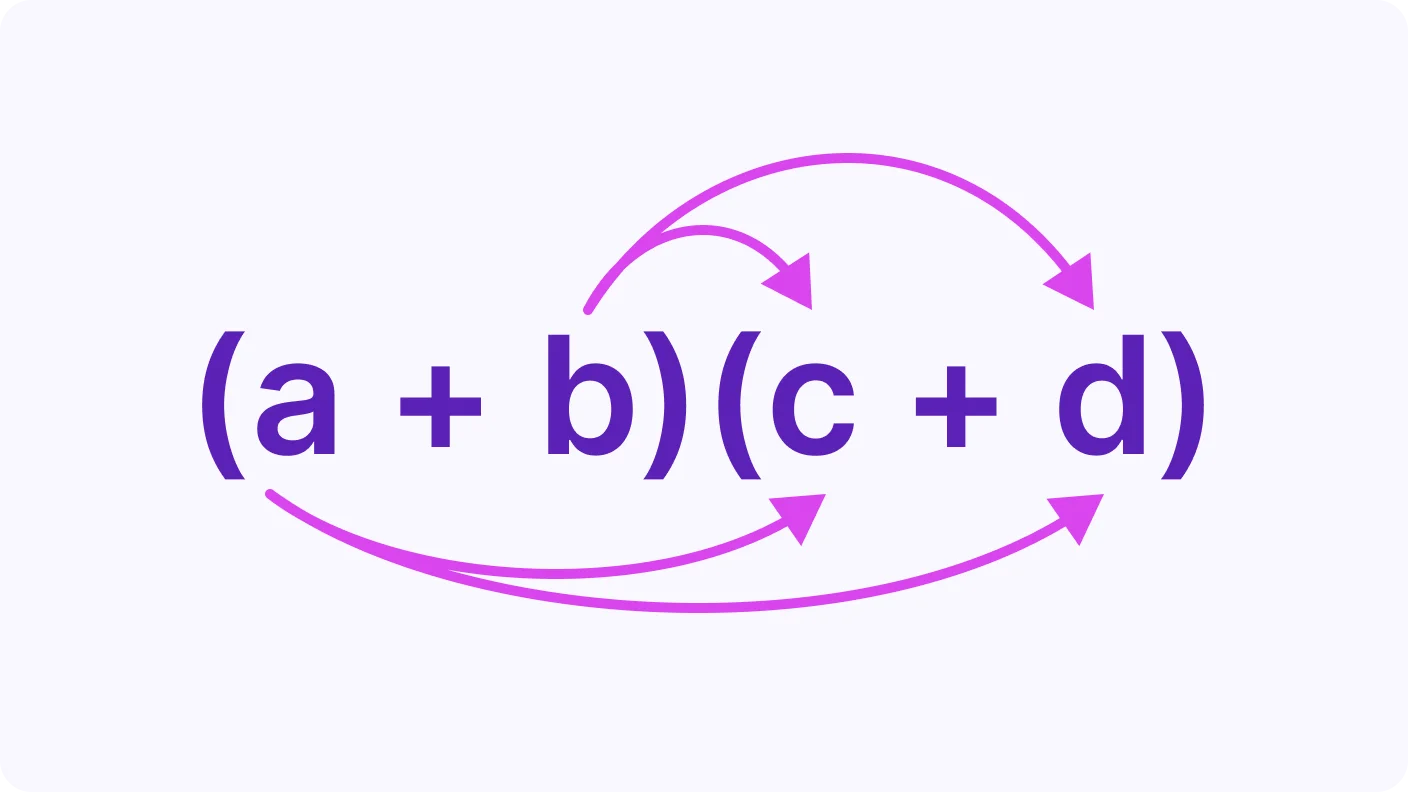
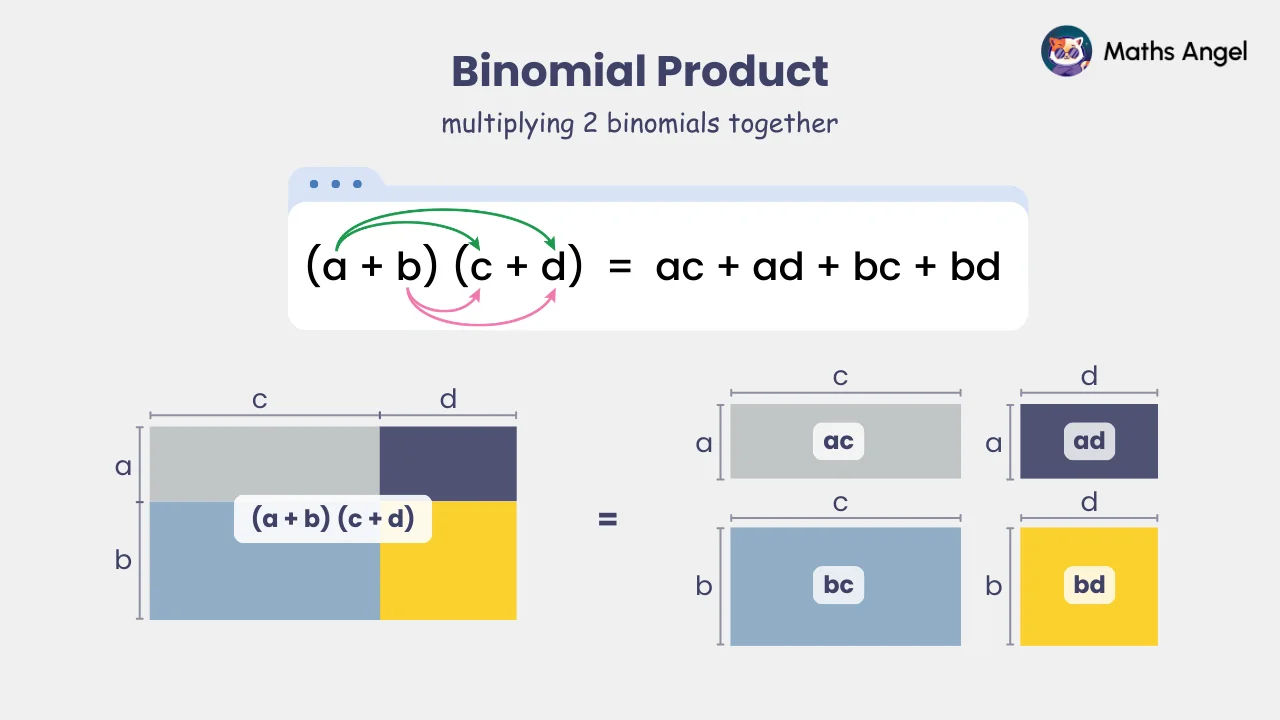
Expanding double brackets means multiplying every term in one bracket by each term in the other. This binomial product uses (a+b)(c+d) = ac+ad+bc+bd to give four terms. You then collect like terms.
Video Lesson
Watch and learn the basics
🎬 Did this video explain it clearly?
Flashcards
Review key concepts visually
%20The%20Distributive%20Law.webp)
%20Expanding%20Double%20Brackets%20(Formula).webp)
%20Expanding%20Double%20Brackets%20(Example%201).webp)
%20Expanding%20Double%20Brackets%20(Example%202).webp)
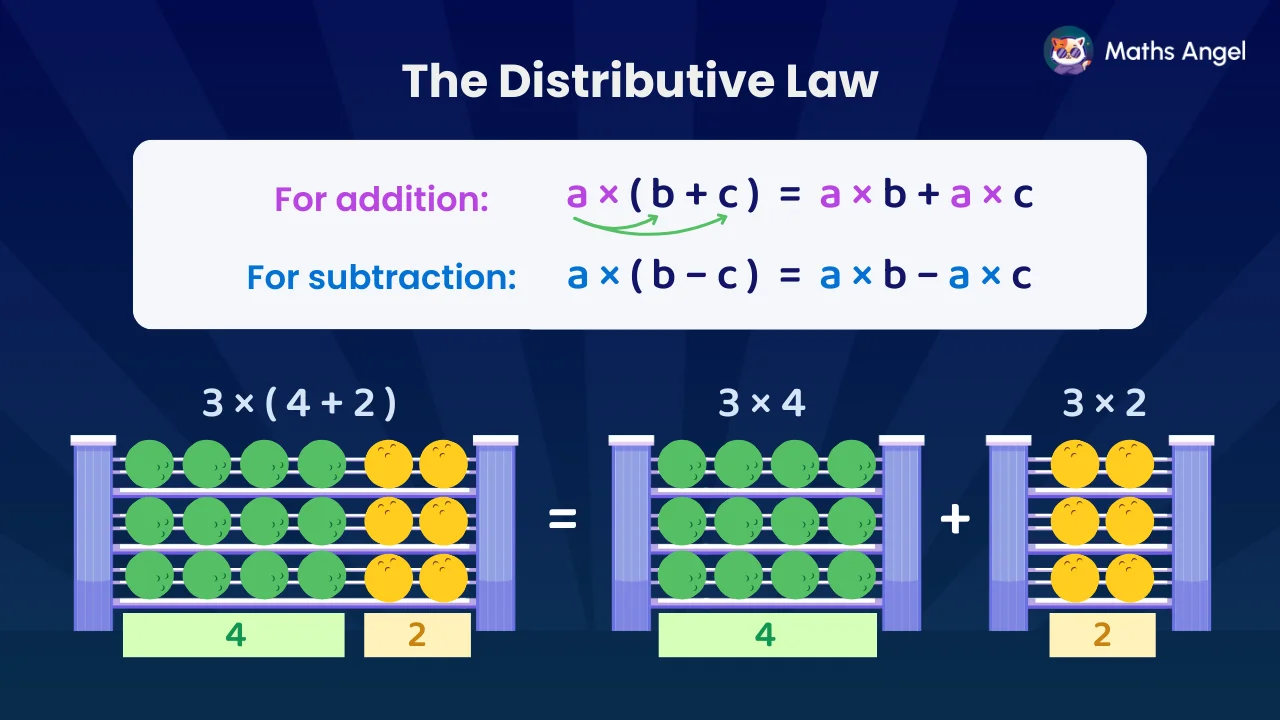
The Distributive Law
- The distributive law means multiplying a term by everything inside the brackets.
- For example, .
Binomial Products: Formula
- A binomial product means multiplying two brackets together.
- For , multiply every pair to get .
Expanding Two Brackets: Example
- Always include the signs when multiplying terms.
- For example, .
Expanding with Negatives
- Rewrite subtraction as adding a negative before expanding.
- For example, .
Practice Questions
Test your understanding
Expand and simplify .
Correct! 🎉 +10 pointsCorrect! 🎉 Worth 10 XPNot quite right
Multiply every term in the first bracket by every term in the second bracket.
, , and .
Now collect the like terms: .
Expand and simplify .
Correct! 🎉 +10 pointsCorrect! 🎉 Worth 10 XPNot quite right
Multiply every term in the first bracket by every term in the second bracket.
, , and .
Now collect the like terms: .
Expand and simplify .
Correct! 🎉 +20 pointsCorrect! 🎉 Worth 20 XPNot quite right
Multiply every term in the first bracket by every term in the second bracket.
, , and .
Now collect the like terms: .
Expand and simplify .
Correct! 🎉 +20 pointsCorrect! 🎉 Worth 20 XPNot quite right
Multiply every term in the first bracket by every term in the second bracket, keeping careful track of the signs.
, , and (a negative times a negative gives a positive).
Now collect the like terms: .
Expand and simplify .
Correct! 🎉 +20 pointsCorrect! 🎉 Worth 20 XPNot quite right
Multiply every term in the first bracket by every term in the second bracket, keeping careful track of the signs.
, , and .
Now collect the like terms: .
Expand and simplify .
Correct! 🎉 +30 pointsCorrect! 🎉 Worth 30 XPNot quite right
Multiply every term in the first bracket by every term in the second bracket, keeping careful track of the signs.
, (a negative times a negative gives a positive), and .
Now collect the like terms: .
Want to see the full working?
Interactive Activity
Expanding double brackets: distribute and collect like terms
Loading interactive widget...
Frequently asked questions
The questions students bump into most on this topic
A binomial is a bracket with two terms, like (a + b). Expanding double brackets means multiplying two binomials together and removing the brackets: (a + b)(c + d) = ac + ad + bc + bd. Every term in the first bracket multiplies every term in the second, giving four products, like two pairs of friends who each say hello to the other pair.
Multiply each term in the first bracket by each term in the second, keeping the signs. For (2x − 1)(3x + 2): 2x × 3x = 6x², 2x × 2 = 4x, −1 × 3x = −3x and −1 × 2 = −2. Then collect like terms: 6x² + 4x − 3x − 2 = 6x² + x − 2. American sites call the order of the four products FOIL.
“Simplify” means collect the like terms after you expand. For (x + 3)(x + 2): the four products are x², 2x, 3x and 6, and the two x terms combine, so the answer is x² + 5x + 6. For (x − 2)(2x − 3): 2x² − 3x − 4x + 6 = 2x² − 7x + 6. Always finish by combining the middle terms.
Treat each minus as part of its term, so −1 is “plus negative 1”, then multiply with the signs. For (−3x + 2)(5 − y): −3x × 5 = −15x, −3x × (−y) = 3xy, 2 × 5 = 10 and 2 × (−y) = −2y. The result is −15x + 3xy + 10 − 2y, with no like terms to collect. Negative times negative is positive.
Expand two of the brackets first, then multiply the result by the third bracket, term by term. For (x + 1)(x + 2)(x + 3): (x + 1)(x + 2) = x² + 3x + 2, then (x² + 3x + 2)(x + 3) = x³ + 3x² + 3x² + 9x + 2x + 6, which collects to x³ + 6x² + 11x + 6. Lay the working out in a grid to avoid missing a product.
Because the two terms in a bracket are added, not multiplied: (a + b) means a plus b. You only multiply across the brackets, pairing each term of the first with each term of the second. In the video’s picture, a and b arrive together, so they do not need to say hello to each other, only to c and d.
What's next?
Found this one hard? Go one step back first. Feeling confident? Carry on to the next lesson.