Square of a Binomial
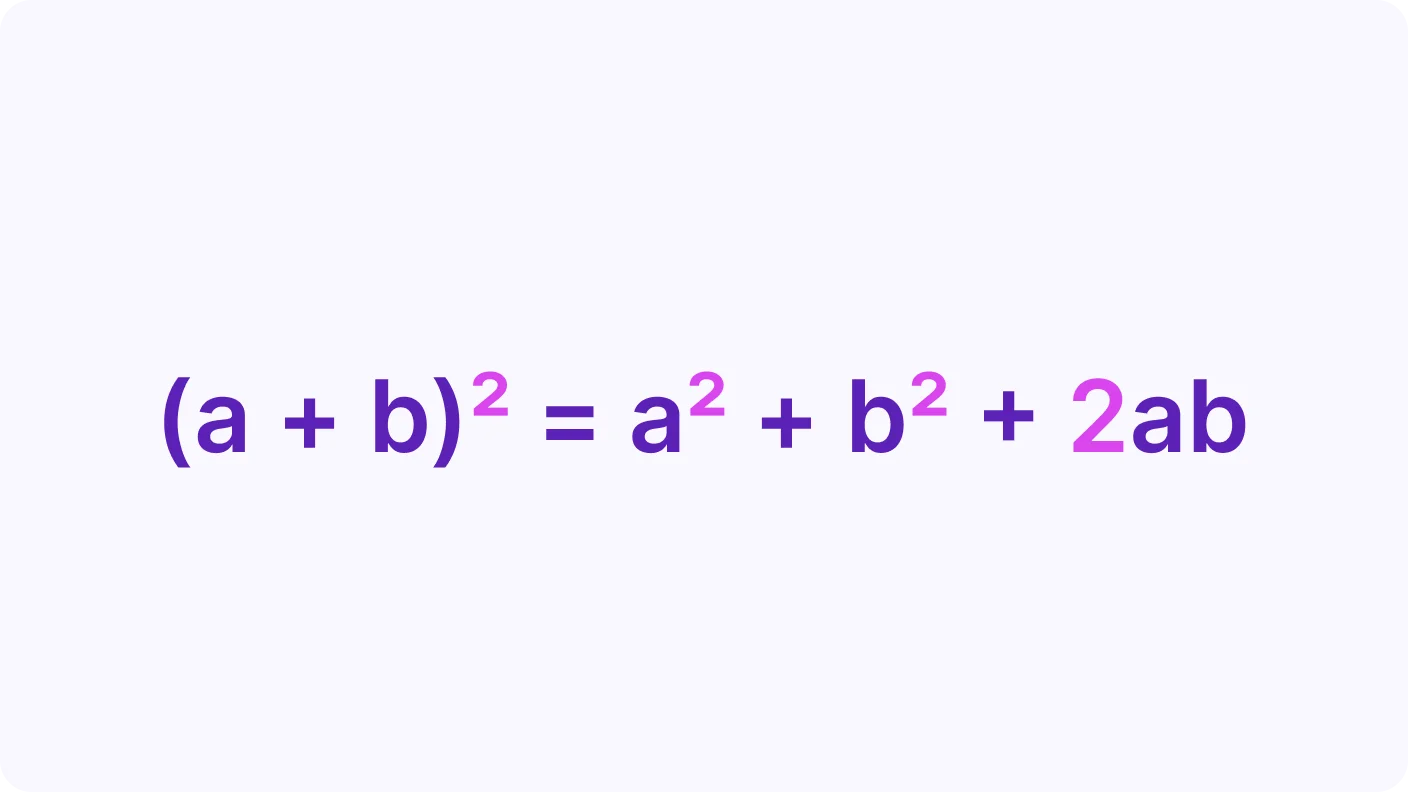
The square of a binomial means multiplying a bracket by itself, giving (a + b)² = a² + 2ab + b². The middle 2ab appears because the product ab turns up twice. The difference of squares rule gives (a + b)(a − b) = a² − b².
Video Lesson
Watch and learn the basics
🎬 Did this video explain it clearly?
Flashcards
Review key concepts visually
%20Square%20of%20a%20Binomial%20Derivation.webp)
%20Square%20of%20a%20Binomial%20Visualisation.webp)
%20Square%20of%20a%20Binomial%203%20Formulas.webp)
%20Square%20of%20a%20Binomial%20Formula%201%20Example.webp)
%20Square%20of%20a%20Binomial%20Formula%202%20Example.webp)
%20Square%20of%20a%20Binomial%20Formula%203%20Example.webp)
Squaring a Binomial: Where the Formula Comes From
- Squaring a binomial means multiplying it by itself, like .
- The middle term appears twice, which is why we get .
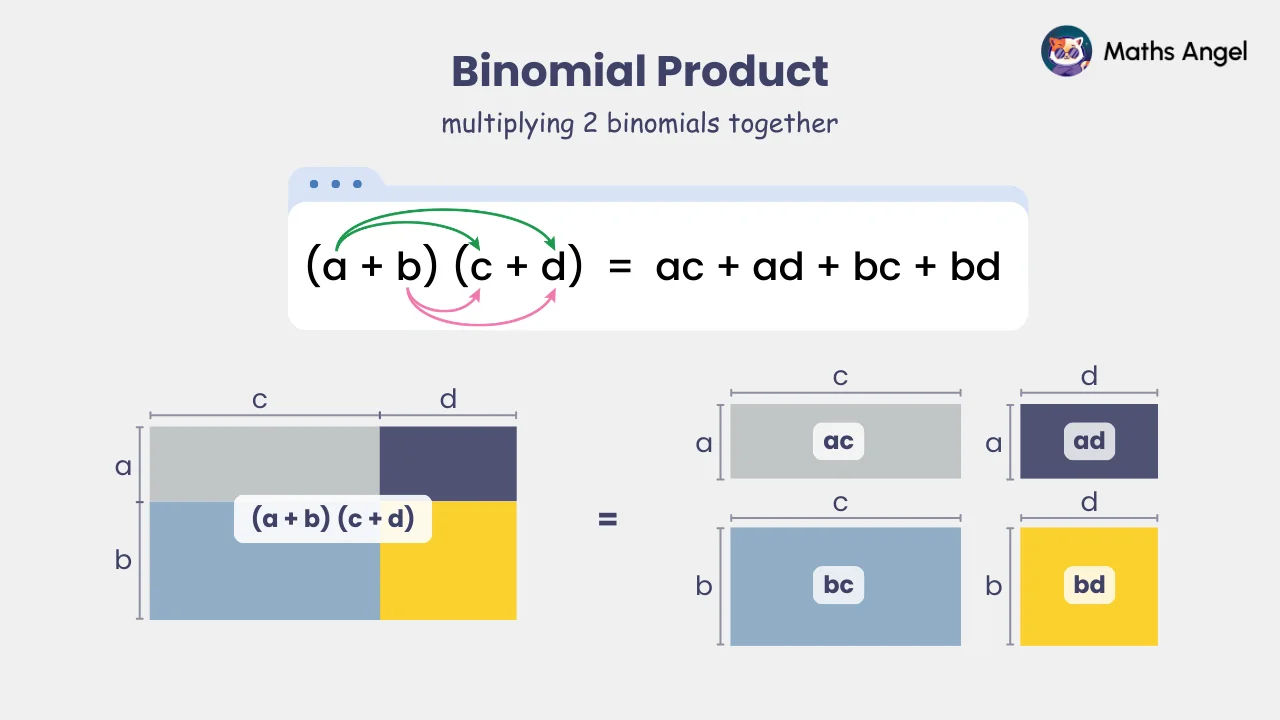
Squaring a Binomial: See It Visually
- The square splits into four parts showing , , and two rectangles.
- Adding the areas gives .
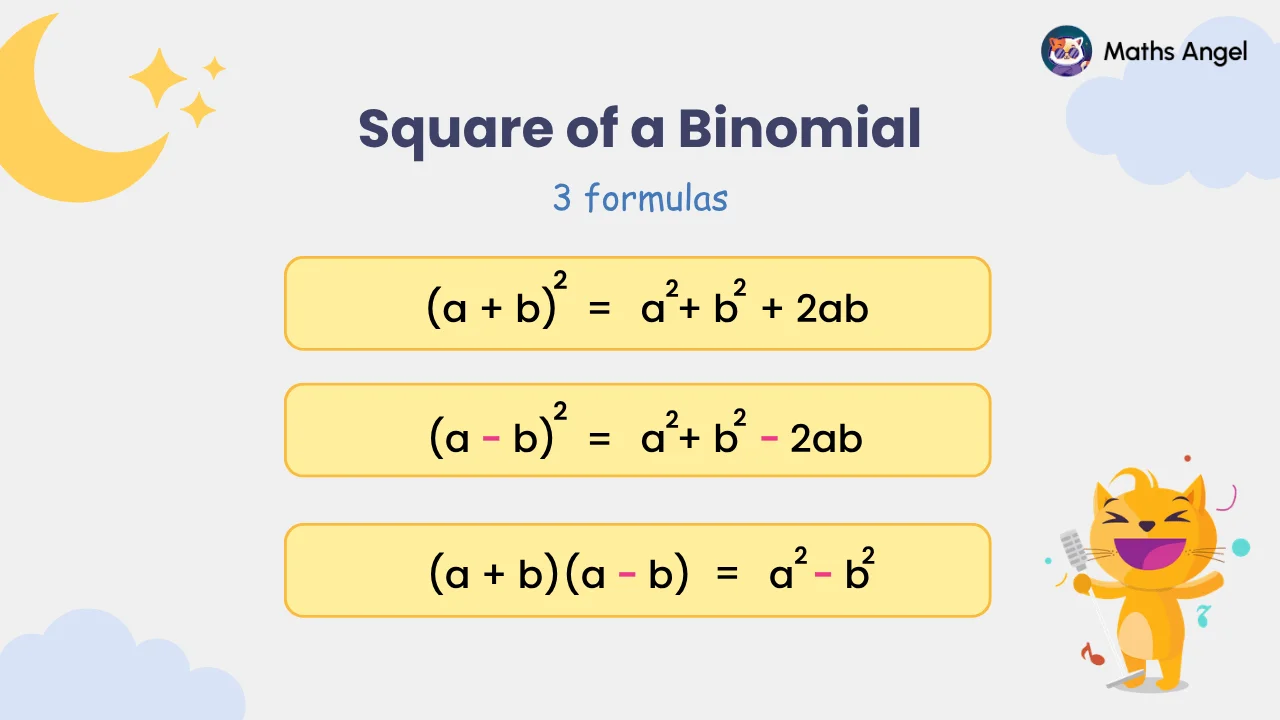
The 3 Key Formulas
- .
- .
- .
Using : Example
- Identify a and b including their signs, for example in we have and .
- Work out squares first, then add the end term to get .
Using : Example
- Identify a and b including the minus sign, for example in we have and .
- Work out squares first, then subtract the end term to get .
Using : Example
- Check the brackets use the same terms with different signs, for example .
- Square both terms and subtract to get .
Practice Questions
Test your understanding
Simplify .
Correct! 🎉 +10 pointsCorrect! 🎉 Worth 10 XPNot quite right
means , so every term in the first bracket must multiply every term in the second.
Using with and : square x to get ; multiply x by 3 and double it, giving ; square 3 to get 9.
So .
The middle term is the one most often lost: the two cross-products and add to , which is why squaring the terms separately, , is wrong. The constant is , not .
Simplify .
Correct! 🎉 +10 pointsCorrect! 🎉 Worth 10 XPNot quite right
Use with and .
Square the first term to get . The middle term is . Squaring the last term gives , which is positive because a negative multiplied by a negative is positive.
So .
Simplify .
Correct! 🎉 +20 pointsCorrect! 🎉 Worth 20 XPNot quite right
Use with and .
Square the first term: . The 2 is squared as well as the x. The middle term is ; there are two identical cross products of each, so they must be added together. Square the last term: .
So .
Simplify .
Correct! 🎉 +20 pointsCorrect! 🎉 Worth 20 XPNot quite right
Use with and .
Square the first term: . The 2 is squared as well as the x. The middle term is ; there are two identical cross products of each. Square the last term: , positive because a negative times a negative is positive.
So .
Simplify .
Correct! 🎉 +20 pointsCorrect! 🎉 Worth 20 XPNot quite right
This is a difference of two squares: , with and .
Expanding in full gives , and the two middle terms cancel out. Square the first term: . The 3 is squared as well as the x. Square the second term: , and it is subtracted because .
So .
Simplify .
Correct! 🎉 +30 pointsCorrect! 🎉 Worth 30 XPNot quite right
Use with and .
Square the first term: . The 3 is squared as well as the x. There are two identical cross products of , so the middle term is . Square the last term: .
So .
Want to see the full working?
Interactive Activity
Explore the Square of a Binomial with the area model.
Loading interactive widget...
Frequently asked questions
The questions students bump into most on this topic
(a + b)² = a² + 2ab + b², and (a − b)² = a² − 2ab + b². Square the first term, add or subtract twice the product of the two terms, then add the square of the second term. Both come from multiplying the bracket by itself. “Square of a binomial” is the American name; UK papers say “expand (x + 3)²”.
Either write it as the bracket times itself and expand, or use the formula. For (x + 3)²: a = x and b = 3, so x² + 2 × x × 3 + 9 = x² + 6x + 9. For (−2x + 3)²: a = −2x and b = 3, so (−2x)² + 2 × (−2x) × 3 + 3² = 4x² − 12x + 9. Identify a and b with their signs before you start.
Because (a + b)² means (a + b)(a + b), and multiplying out gives a², ab, ba and b²: the product ab appears twice, which is where the middle term 2ab comes from. Picture a square with sides a + b: it splits into an a² square, a b² square and two ab rectangles. Leaving out the 2ab is the most common slip.
Only the sign of the middle term. (a + b)² = a² + 2ab + b² and (a − b)² = a² − 2ab + b²; the squared terms are positive in both. Look at the sign inside the bracket to choose: for (5x − 2y)², a = 5x and b = 2y, so it is 25x² − 20xy + 4y².
(a + b)(a − b) = a² − b². When the two brackets have the same terms with opposite signs, the middle products +ab and −ab cancel, leaving the first square minus the second. So (3x + 4)(3x − 4) = 9x² − 16. GCSE papers call this the difference of two squares and use it in both directions.
What's next?
Found this one hard? Go one step back first. Feeling confident? Carry on to the next lesson.