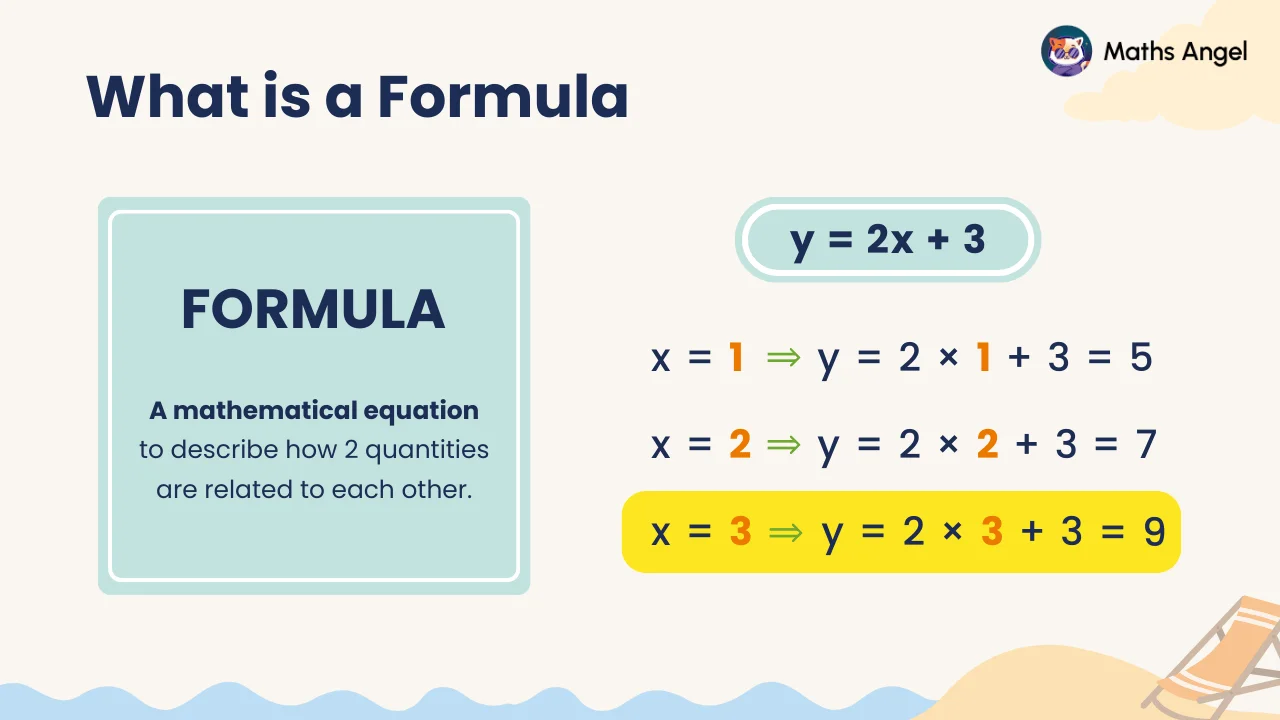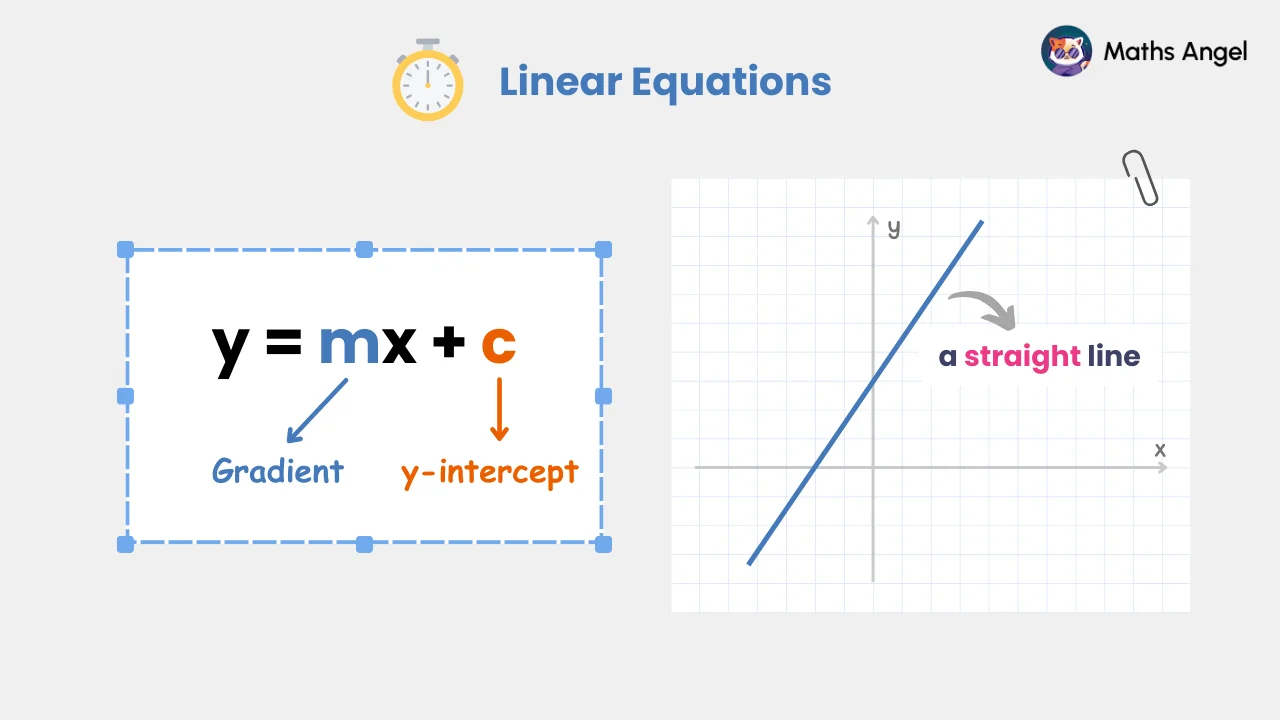
Introduction to Mapping
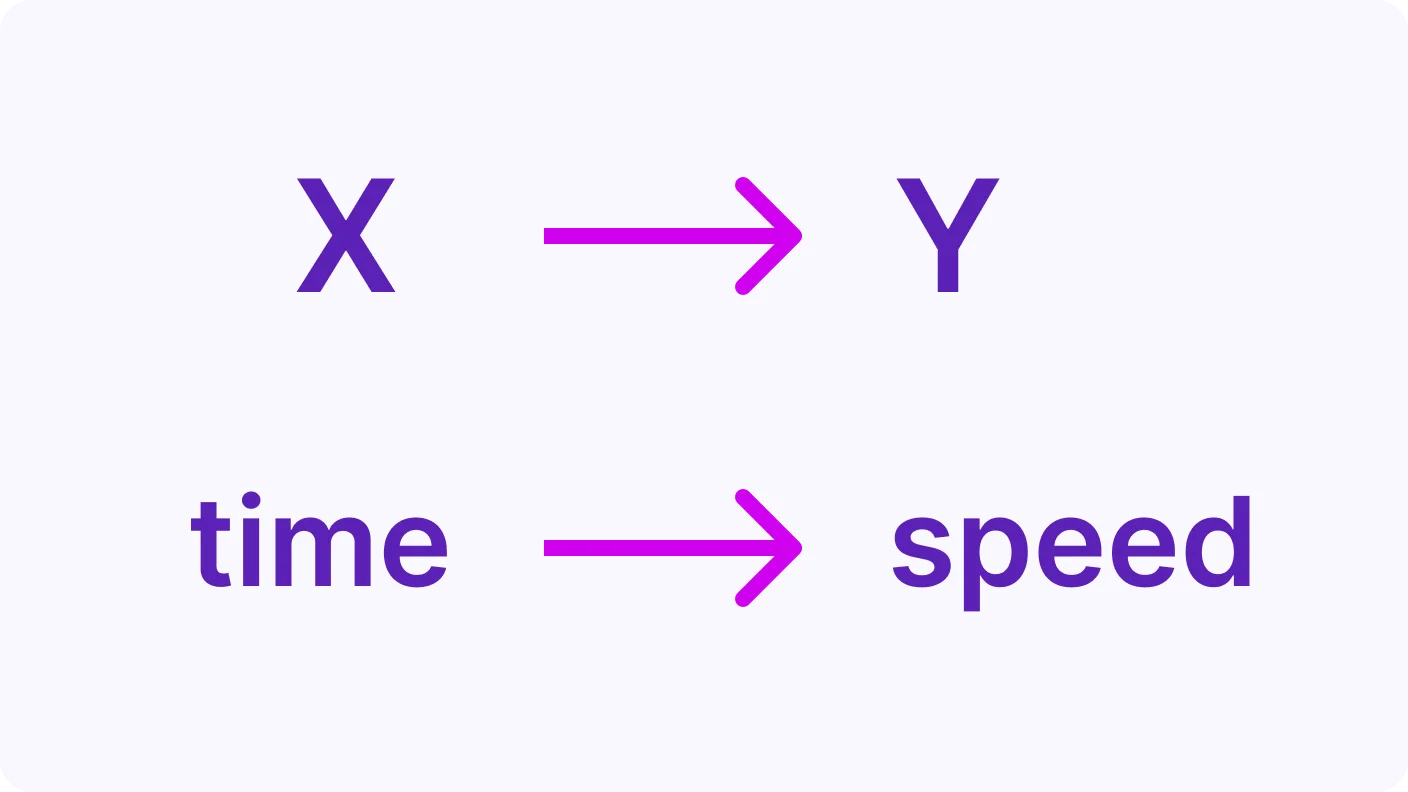
Mapping in maths links each input to one output, describing how two quantities relate, and is often drawn as a function machine. For example, time is mapped to speed, so each hour has a matching speed value.
Video Lesson
Watch and learn the basics
🎬 Did this video explain it clearly?
Flashcards
Review key concepts visually
%20Mapping%20Definition%20and%20Example.webp)
%20Mapping%20Through%20Table%20and%20Graph.webp)
%20Mapping%20Example%20Types%20of%20Balls%20and%20Their%20Weight.webp)
What Is a Mapping?
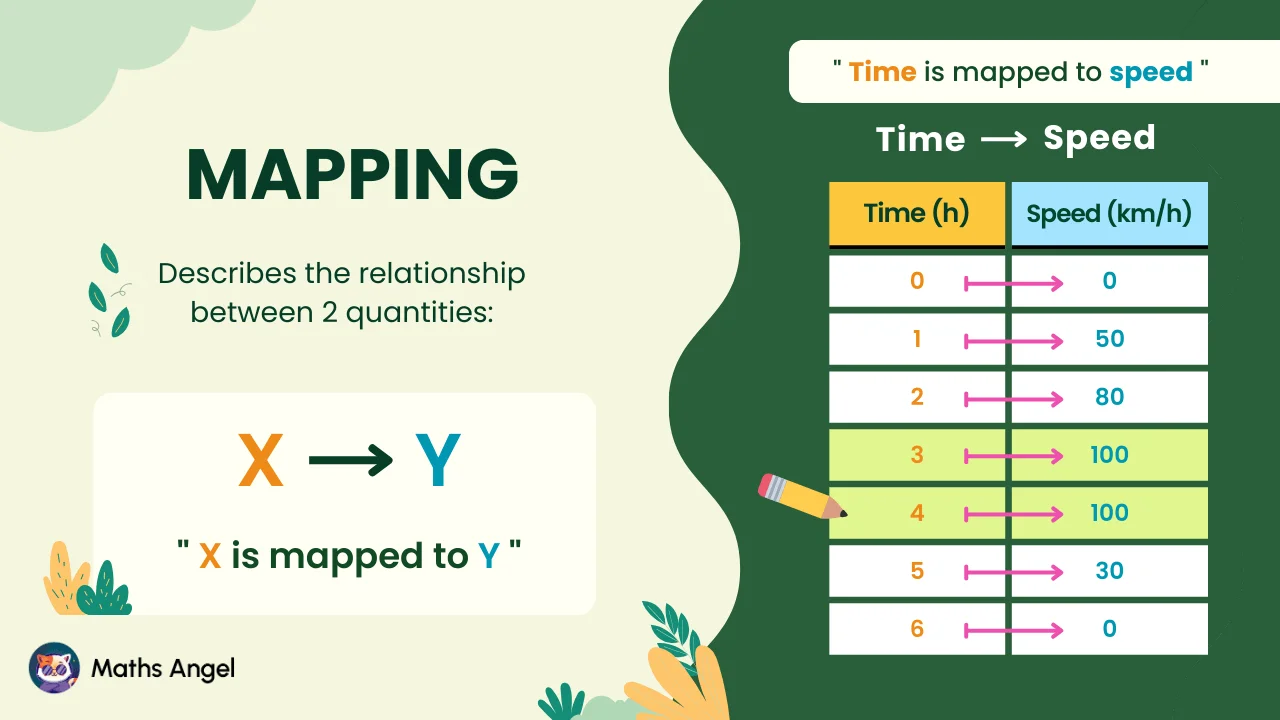
- A mapping shows how one value links to another value. We say X is mapped to Y using an arrow.
- For example, time is mapped to speed, so each time value has a corresponding speed.
How to Visualise Mapping?
- You can use a table and a graph to visualise the mapping.
- A table shows exactly which X value matches each Y value.
- A graph shows visually how Y changes when X changes.
Using Mappings in Real Life
- Categories, such as types of balls, can be mapped to weights.
- Each input and its corresponding output can be shown in a table or graph.
- When the input is discrete categories, you should not join the points with a line.
Practice Questions
Test your understanding
If time (in hours) is mapped to speed (in km/h), which quantity is the input?
Correct! 🎉 +10 pointsCorrect! 🎉 Worth 10 XPNot quite right
In a mapping, the input is the quantity you start with and the output is what it is mapped to.
Here time is mapped to speed, so time is the input and speed is the output. A mapping runs one way, so the two quantities cannot both be inputs, and distance is not part of this mapping at all.
Which of the following is an example of a mapping?
Correct! 🎉 +10 pointsCorrect! 🎉 Worth 10 XPNot quite right
A mapping is any rule that links each input to an output.
Speed during a trip maps each time to a speed; the weights of different balls map each type of ball to a weight; plant heights over time map each time to a height.
Every one of them pairs an input with an output, so all of them are mappings.
Which of the following should not be joined up with a connected line on a graph?
Correct! 🎉 +20 pointsCorrect! 🎉 Worth 20 XPNot quite right
Joining points with a line claims that the values in between mean something.
Types of balls are separate categories. There is nothing 'in between' a tennis ball and a football, so those points must be left unjoined (a bar chart suits them better).
Sales over 6 months, temperature over 24 hours and a car's speed all change along a continuous time scale, so joining those points is fine.
After 3 hours of driving, the car's speed was /h. What does this mean in mapping terms?
Correct! 🎉 +20 pointsCorrect! 🎉 Worth 20 XPNot quite right
In this mapping, time is the independent variable (the input) and speed is the dependent variable (the output).
So the input 3 hours is mapped to the output /h, which can be written as .
Reading it the other way round would describe a different mapping altogether.
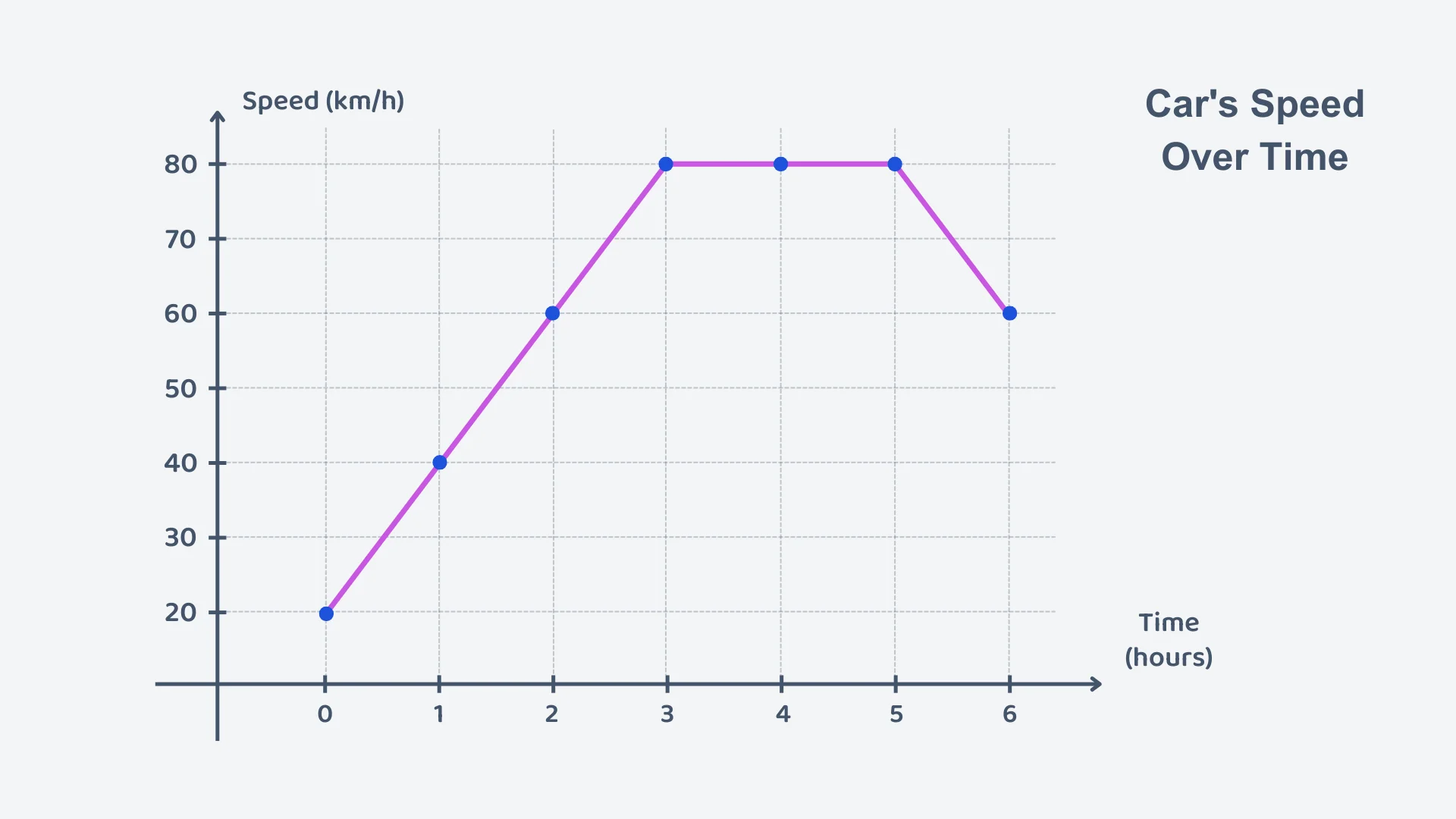
The graph shows a car's speed over time. The line is flat between the 3rd and 5th hours. What does this mean?
Correct! 🎉 +20 pointsCorrect! 🎉 Worth 20 XPNot quite right
On a speed-time graph the height of the line gives the speed, and its slope shows how the speed is changing.
Between 3 and 5 hours the line stays level at /h, so the speed is not changing: the car keeps going at a constant /h.
A flat line here does not mean the car has stopped: for that the line would have to sit on 0.
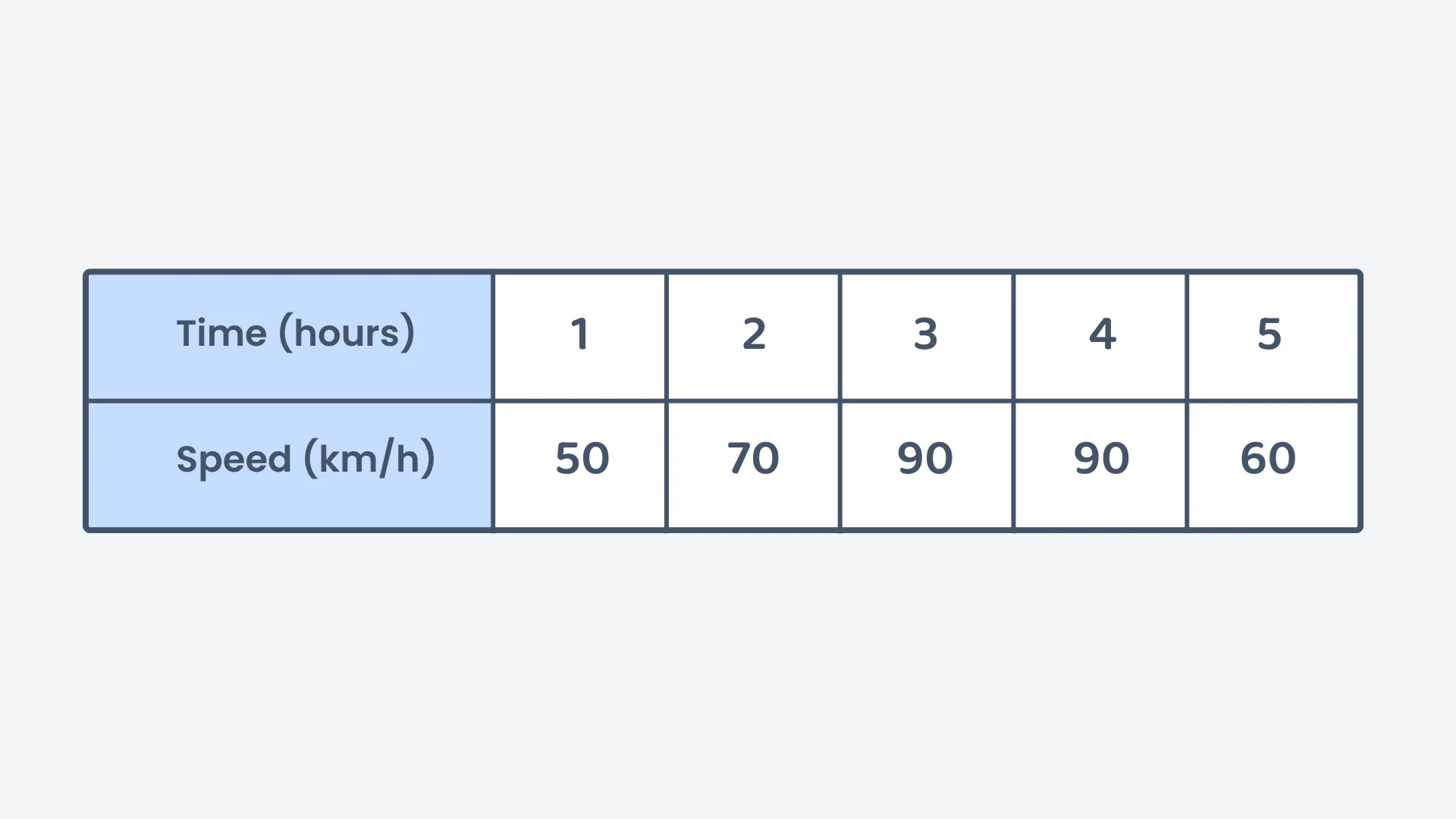
The table shows a car's speed at each hour of a journey. Which statement is true?
Correct! 🎉 +30 pointsCorrect! 🎉 Worth 30 XPNot quite right
Read along the speed row: 50, 70 and /h at 1, 2 and 3 hours, so the speed rises over the first 3 hours.
It is /h again at 4 hours, so it stays constant for that hour, and then it drops to /h at 5 hours.
Two different inputs (3 hours and 4 hours) can be mapped to the same output (/h). That is still a perfectly valid mapping.
Want to see the full working?
Interactive Activity
Understand mapping concepts with real-life examples
Loading interactive widget...
Frequently asked questions
The questions students bump into most on this topic
A mapping links each input to an output and describes how two quantities are related. On a car journey, time is mapped to speed: after 2 hours the speed was 80 km/h, after 3 hours 100 km/h. It is written with an arrow from the input to the output, and we say “time is mapped to speed”.
In three ways. An arrow from the input to the output shows the direction: time → speed. A table of values lists each input with its output. A graph plots each pair as a point, with the input on the x-axis and the output on the y-axis, so the coordinates carry the same information as the table.
Yes. Different inputs may share an output, and that is not a problem. On the car journey, the speed was 100 km/h after 3 hours and still 100 km/h after 4 hours, so two different times map to the same speed. On the graph that shows as a flat section, meaning the speed stayed constant.
Only when the input is a continuous quantity such as time. Joining the car’s speed points shows it accelerated for 3 hours, held its speed for an hour and slowed for the last 2. When the inputs are separate categories, such as types of ball mapped to their weights, do not join the points: there is nothing in between a tennis ball and a golf ball.
Both give the output for each input. A table shows the exact values, so you can read that a basketball weighs 600 grams. A graph makes comparison easier: the highest point shows at a glance that basketballs are the heaviest, and the points at the bottom show that tennis balls and golf balls are the lightest.
A function machine is a mapping drawn as a box: an input goes in, a rule is applied, an output comes out. With the rule “multiply by 2, then add 1”, the input 3 gives the output 7. It is the same idea as mapping time to speed, with the rule written out, and it is how the next lessons introduce formulas and functions.
What's next?
Found this one hard? Go one step back first. Feeling confident? Carry on to the next lesson.