Introduction to Formulas
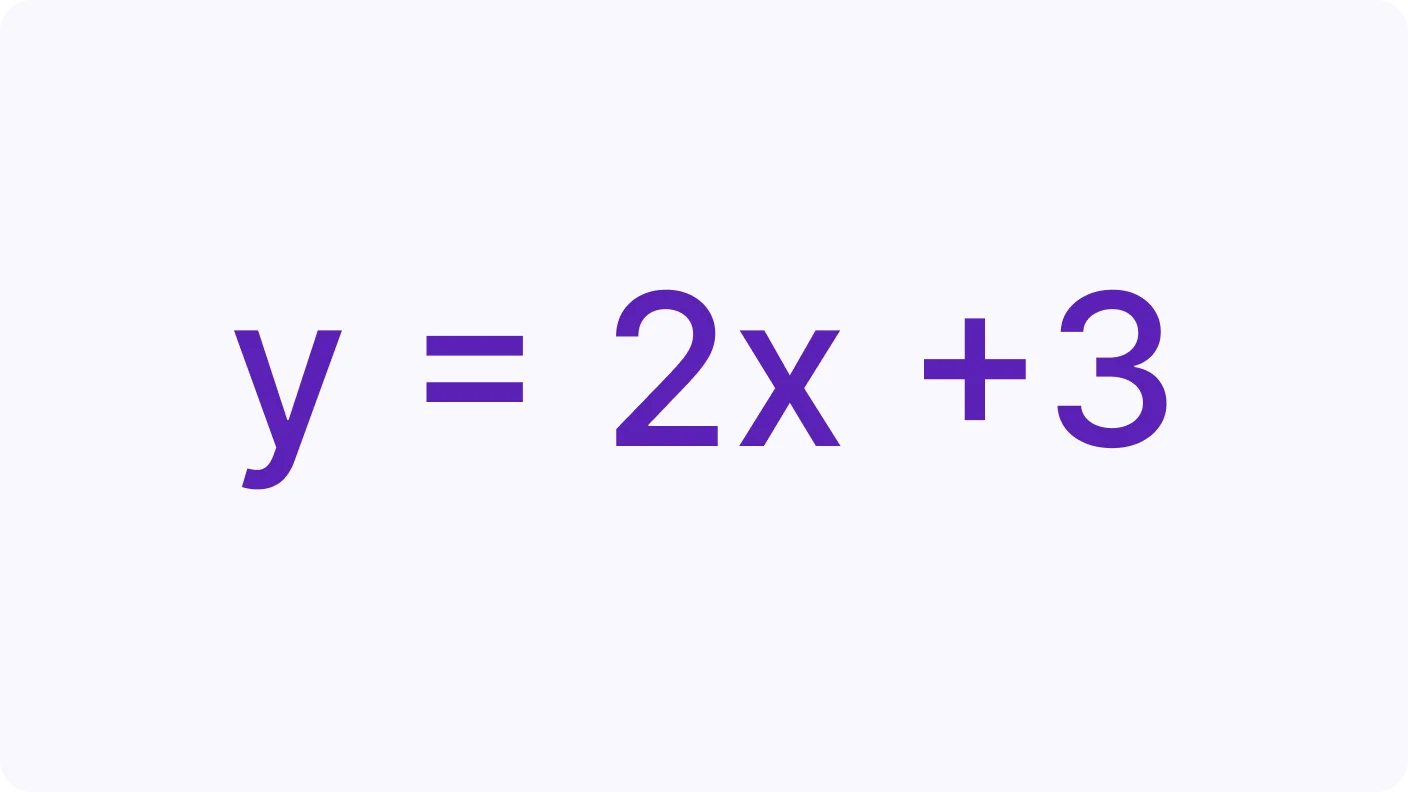
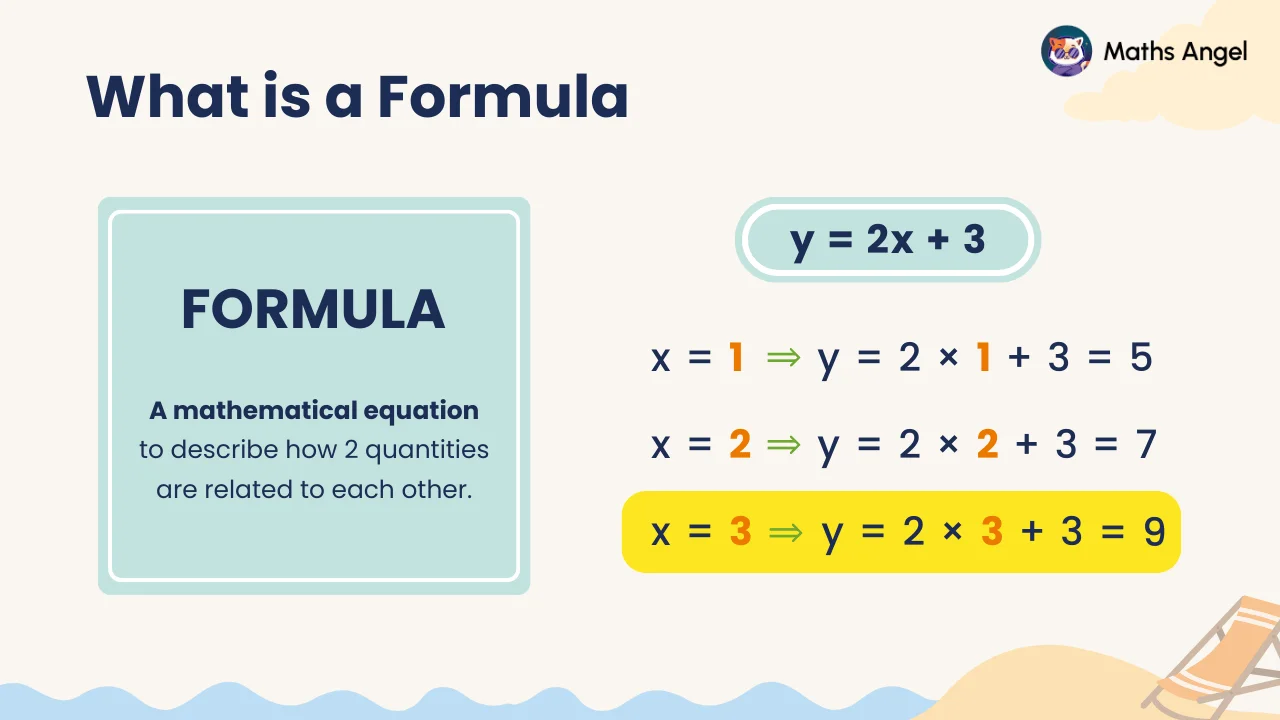
A formula is a maths rule that links two variables, like y = 2x + 3. Whichever value you pick for x, the rule gives one matching y. To find it, substitute your value in place of x and work it out: if x = 1, then y = 2 × 1 + 3, so y = 5.
Video Lesson
Watch and learn the basics
🎬 Did this video explain it clearly?
Flashcards
Review key concepts visually
%20What%20is%20a%20Formula.webp)
%20Visualising%20Formulas.webp)
%20Applying%20Formulas.webp)
What Is a Formula?
- A formula is a mathematical rule that links two quantities.
- You substitute x values into a formula to find the corresponding y values.
How to Visualise a Formula?
- Use the formula to make a table of x and y values.
- Then plot these values on a graph to see the pattern.
Using Formulas to Solve Problems
- A formula can represent real-life situations like saving money.
- You substitute values to solve specific problems.
Practice Questions
Test your understanding
If , what is y when ?
Correct! 🎉 +10 pointsCorrect! 🎉 Worth 10 XPNot quite right
Substitute into the formula. Remember means , and the multiplication is done before the addition.
.
The formula for the distance travelled by a car is , where y is the distance in miles and x is the number of hours driven. How far will it travel after 3 hours?
Correct! 🎉 +10 pointsCorrect! 🎉 Worth 10 XPNot quite right
Substitute into the formula: .
The car travels 300 miles. Note that and are unlike terms, so they cannot be combined into before substituting, and the must still be added after working out .
If , what is x when ?
Correct! 🎉 +20 pointsCorrect! 🎉 Worth 20 XPNot quite right
Substitute : .
Add 7 to both sides (the inverse of subtracting 7): .
Divide both sides by 4 (the inverse of multiplying by 4): .
A company’s total revenue y is represented by , where x is the number of products sold. How many products must be sold to reach a revenue of £4800?
Correct! 🎉 +20 pointsCorrect! 🎉 Worth 20 XPNot quite right
Substitute : .
Add 200 to both sides (the inverse of subtracting 200): .
Divide both sides by 500: .
So 10 products must be sold.
The total cost of a gym membership is calculated by , where x is the number of months and y is the total cost in pounds. If the total cost is £200, how many months did the member sign up for?
Correct! 🎉 +20 pointsCorrect! 🎉 Worth 20 XPNot quite right
Substitute , because £200 is the total cost: .
Subtract 50 from both sides: .
Divide both sides by 30: .
The member signed up for 5 months.
A company charges a £200 setup fee and £50 for printing each book. If you print more than 10 books, you get a discount on the total cost. How many books can be printed for £720?
Correct! 🎉 +30 pointsCorrect! 🎉 Worth 30 XPNot quite right
For more than 10 books there is a discount, so you pay of the full cost: .
Set : .
Divide both sides by 0.9: .
Subtract the £200 setup fee from both sides: .
Divide both sides by 50: .
Since , the discount really does apply, so 12 books can be printed.
Want to see the full working?
Interactive Activity
Explore How Input Changes Output
Loading interactive widget...
Frequently asked questions
The questions students bump into most on this topic
A formula is a rule, written as an equation, that links two quantities: if you know one, it tells you the other. y = 2x + 3 is a formula. When x is 1, y is 2 × 1 + 3 = 5; when x is 2, y is 7; when x is 3, y is 9. “Formulas” and “formulae” are both correct plurals.
A mapping shows how two quantities are related, often with an arrow: countries are mapped to their capitals. A formula is a mapping written as a mathematical equation, so y = 2x + 3 maps each x to its matching y. Every formula is a mapping; a formula is the kind you can calculate with.
Replace the letter with the value you know, then work it out. For y = 2x + 3 with x = 3: y = 2 × 3 + 3 = 9. For a car whose distance is y = 60x + 120 after x hours, 3 hours gives y = 60 × 3 + 120 = 300 miles. Multiply before you add, and keep the units in mind.
First make a table of values: choose some x values and use the formula to find each y. For y = 2x + 3, x = 1, 2, 3 gives y = 5, 7, 9. Then plot each pair as a point, with x across and y up. For this formula all the points fall on a straight line, which shows the pattern at a glance.
Turn the situation into a formula, then substitute or use a table. Shoes cost £80; you have £20 saved and save £12 a week. Your savings after x weeks are y = 20 + 12x. You need y = 80: try values in a table, and when x = 5, y = 20 + 12 × 5 = 80. So the shoes take 5 weeks.
A formula links two or more variables with a rule you use again and again: y = 2x + 3 gives a y for every x. An equation is true only for particular values and is there to be solved: 2x + 3 = 9 has the one answer x = 3. An expression such as 2x + 3 has no equals sign. GCSE papers ask you to tell the three apart.
What's next?
Found this one hard? Go one step back first. Feeling confident? Carry on to the next lesson.