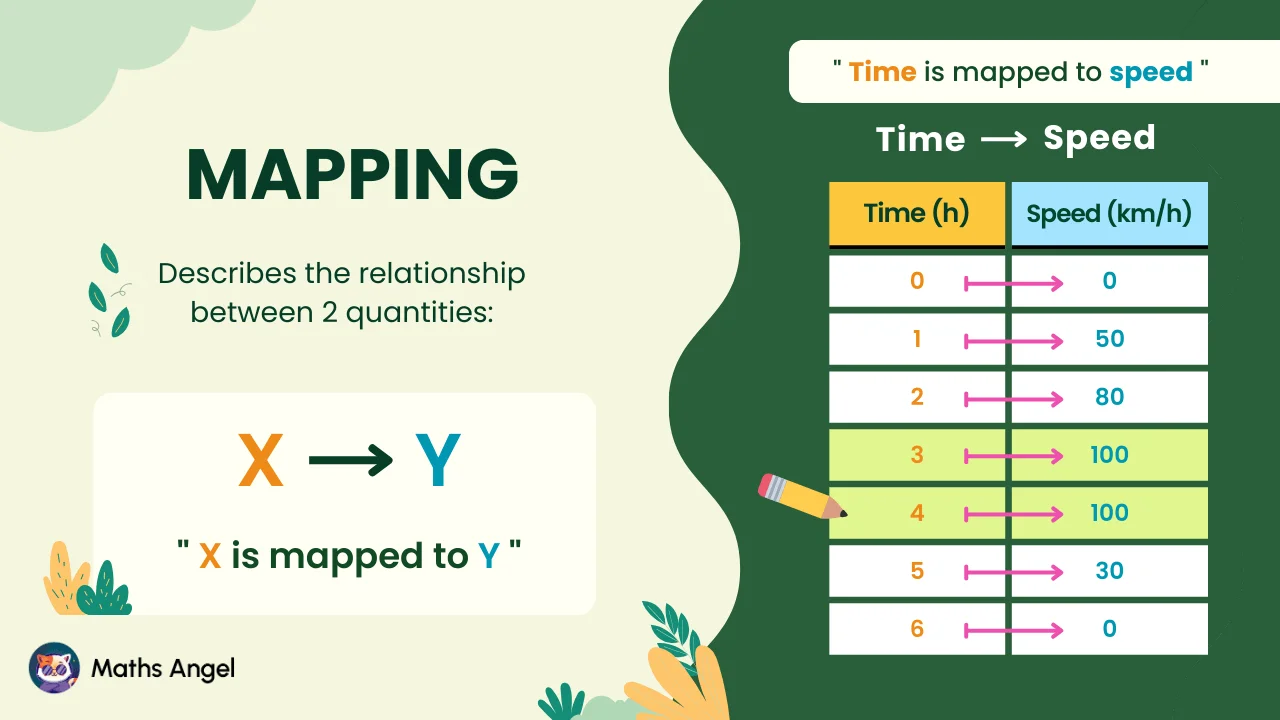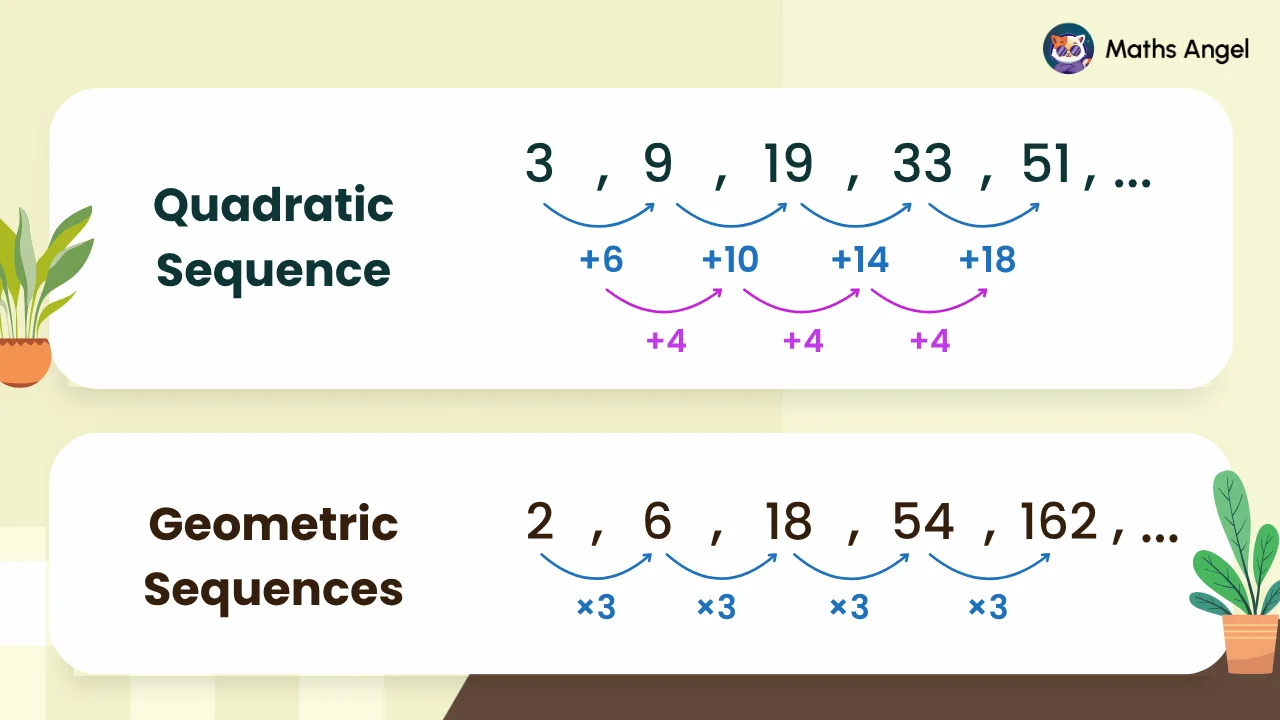
Introduction to Functions and Graphs
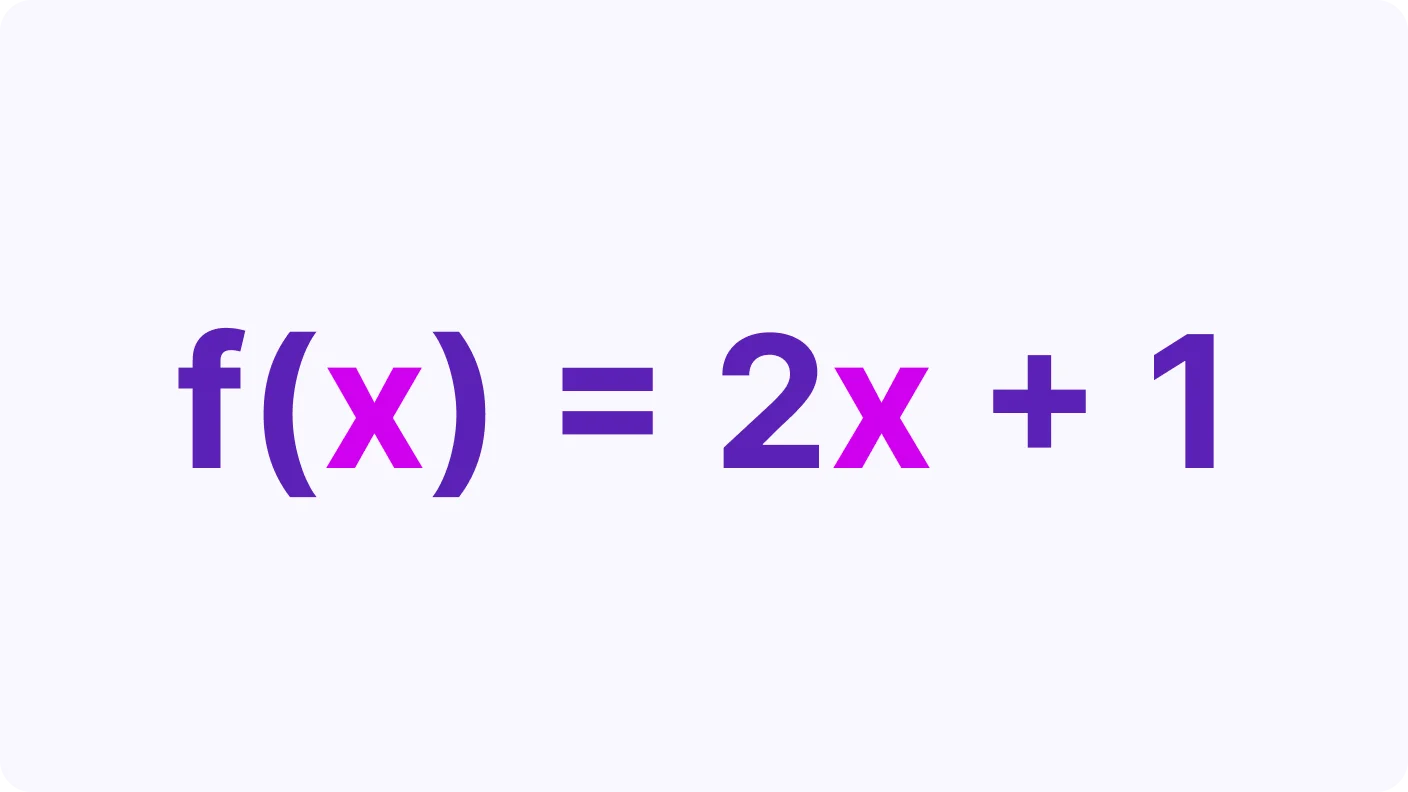
A function takes each input and turns it into exactly one output. Put x = 3 into the rule f(x) = 2x + 1 to get f(3) = 7. Show it with a table of values, then plot the points as a graph.
Video Lesson
Watch and learn the basics
🎬 Did this video explain it clearly?
Flashcards
Review key concepts visually
%20Function%20Notation.webp)
%20Plot%20a%20Graph.webp)
%20Graphs%20that%20do%20not%20represent%20a%20function.webp)
%20Reading%20Function%20Values%20from%20Graphs.webp)
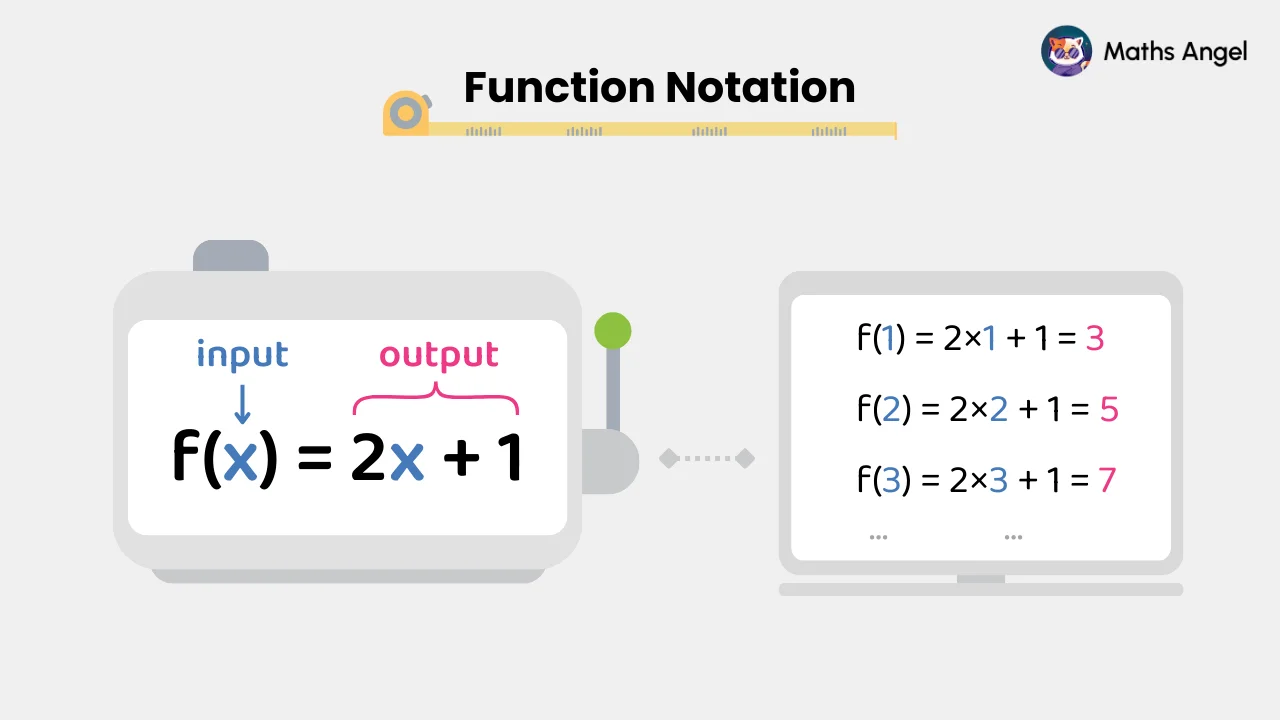
What Does Function Notation f(x) Mean?
- shows the output when the input is x.
- To find , substitute into the rule.
- For example, if , then .
How to Graph a Function?
- First create a table by choosing x-values and finding the matching f(x) values.
- Then plot the points on a graph and join them with a straight or smooth line.
Does a Graph Represent a Function?
- A graph is a function if each x-value has only one y-value.
- If one x-value has more than one y-value, it is not a function.
Reading Function Values from Graphs
- To find f(x), go to the x-value and read the y-value on the graph.
- Solving means the y-value is zero. This happens where the graph crosses the x-axis.
Practice Questions
Test your understanding
What is the output of the function when ?
Correct! 🎉 +10 pointsCorrect! 🎉 Worth 10 XPNot quite right
Substituting means replacing x in the rule with the value given.
.
The multiplication is done before the addition, so work out first.
What is the output of the function when ?
Correct! 🎉 +10 pointsCorrect! 🎉 Worth 10 XPNot quite right
Replace x in the rule with 2.
.
Multiply first, then subtract; the minus sign belongs to the 3.
For the function , what is the value of ?
Correct! 🎉 +20 pointsCorrect! 🎉 Worth 20 XPNot quite right
The 3 inside the brackets means we replace x with 3.
.
Do the multiplication first, then take away 4.
For the function , what is the value of x when ?
Correct! 🎉 +20 pointsCorrect! 🎉 Worth 20 XPNot quite right
Substitute 7 for to get the equation .
Add 5 to both sides: .
Divide both sides by 3: .
Check: , as required.
For the function , what is the value of ?
Correct! 🎉 +20 pointsCorrect! 🎉 Worth 20 XPNot quite right
Substitute into the rule, keeping the negative in brackets:
.
Multiplying 5 by a negative number gives a negative answer, and adding the 8 then brings it back up to . Stopping at misses the last step.
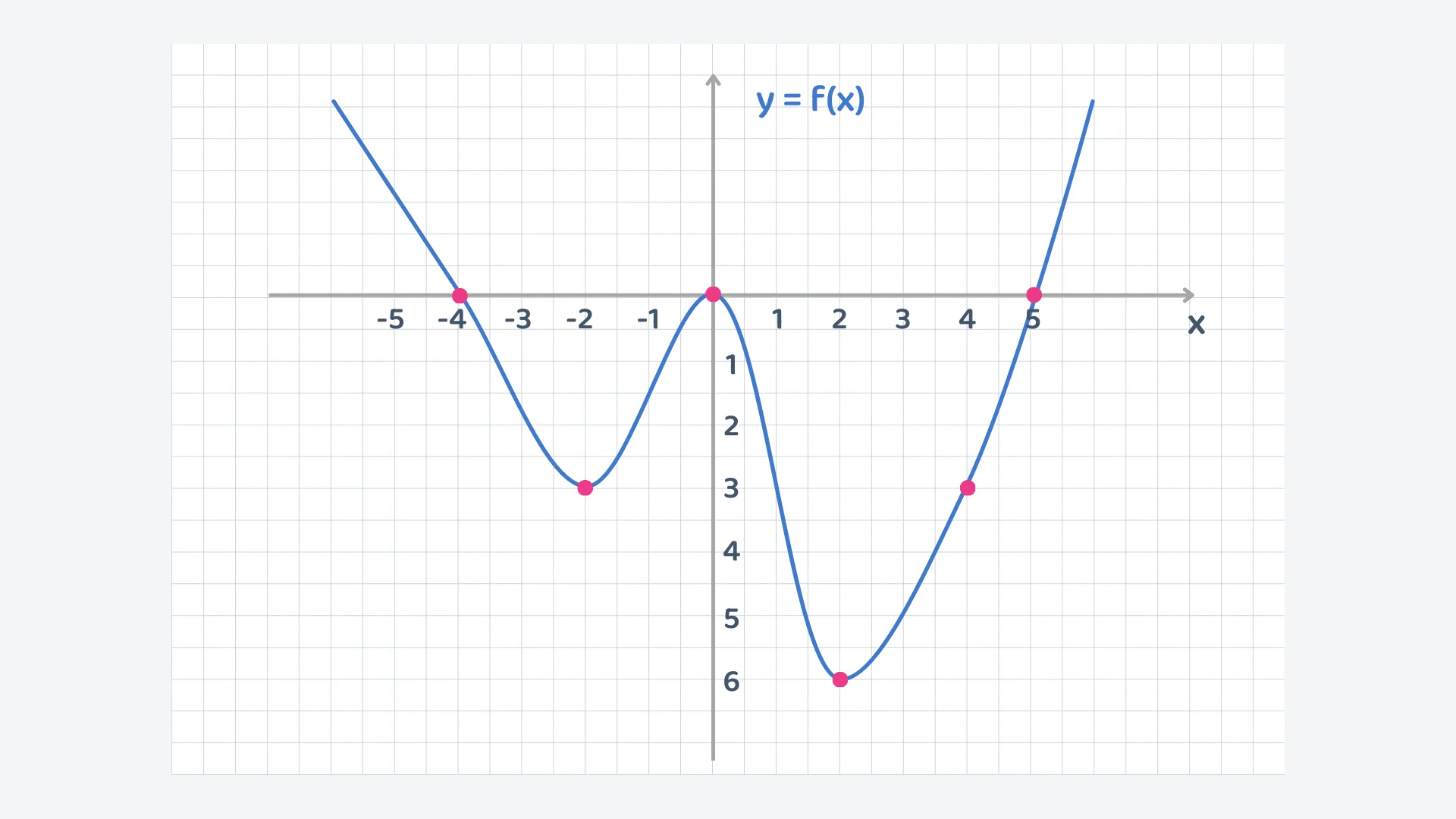
Based on the graph, what are the values of when ?
Correct! 🎉 +30 pointsCorrect! 🎉 Worth 30 XPNot quite right
Draw the horizontal line across the graph and look for every place it meets the curve.
It touches the curve at the turning point where , the curve drops steeply through it at , and the curve rises back through it at .
A touching point counts as a solution just like a crossing, so has three solutions: , and .
Want to see the full working?
Interactive Activity
Introduction to functions and graphs
Loading interactive widget...
Frequently asked questions
The questions students bump into most on this topic
A function is like a machine: you put a number in, it applies a rule, and one number comes out. The rule is that each input gives exactly one output. f(x) = 2x + 1 is a function: an input of 1 gives 3, an input of 2 gives 5. Its graph is the picture of all the input-output pairs.
f stands for the function and x for the input; whatever comes after the equals sign is the output. For f(x) = 2x + 1, f(3) means “the output when the input is 3”: 2 × 3 + 1 = 7, so f(3) = 7. The notation lets you name an input and its output in one short line, which is why exams use it.
Three kinds of question. Evaluate: substitute the input, so for f(x) = 3x + 2, f(5) = 3 × 5 + 2 = 17. Solve: set the rule equal to the output and find x, so f(x) = 3x − 5 = 7 gives 3x = 12 and x = 4. Read a graph: find the x-value, go up to the curve and read off y. Every GCSE functions question is one of these.
Check whether any x-value has more than one y-value. If a single input lines up with two or more points on the graph, it is not a function, because a function gives exactly one output for each input. A quick way to see it: if a vertical line could cross the graph more than once, it is not a function.
y is the output of f(x), so read y off the graph. To find f(−2), find x = −2 on the horizontal axis, go to the curve and read the y-value: in the video it is −3, so f(−2) = −3. To solve f(x) = 0, look where the graph crosses the x-axis, because that is where y is 0: at x = −4, 0 and 5.
Yes, and it is still a function. The rule is one output for each input, not one input for each output. In the video’s graph, f(x) = 0 at three different inputs, x = −4, 0 and 5, and that is perfectly fine. What is not allowed is one input with two outputs.
What's next?
Found this one hard? Go one step back first. Feeling confident? Carry on to the next lesson.