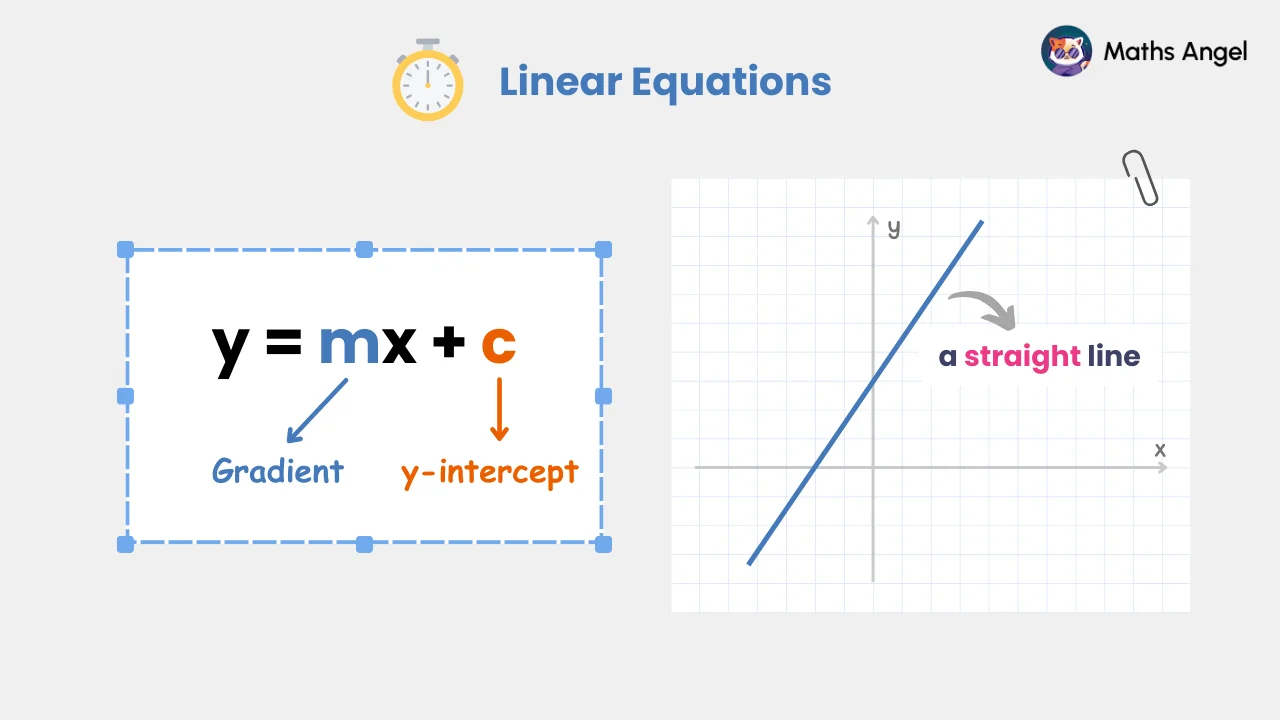
Solving Equations
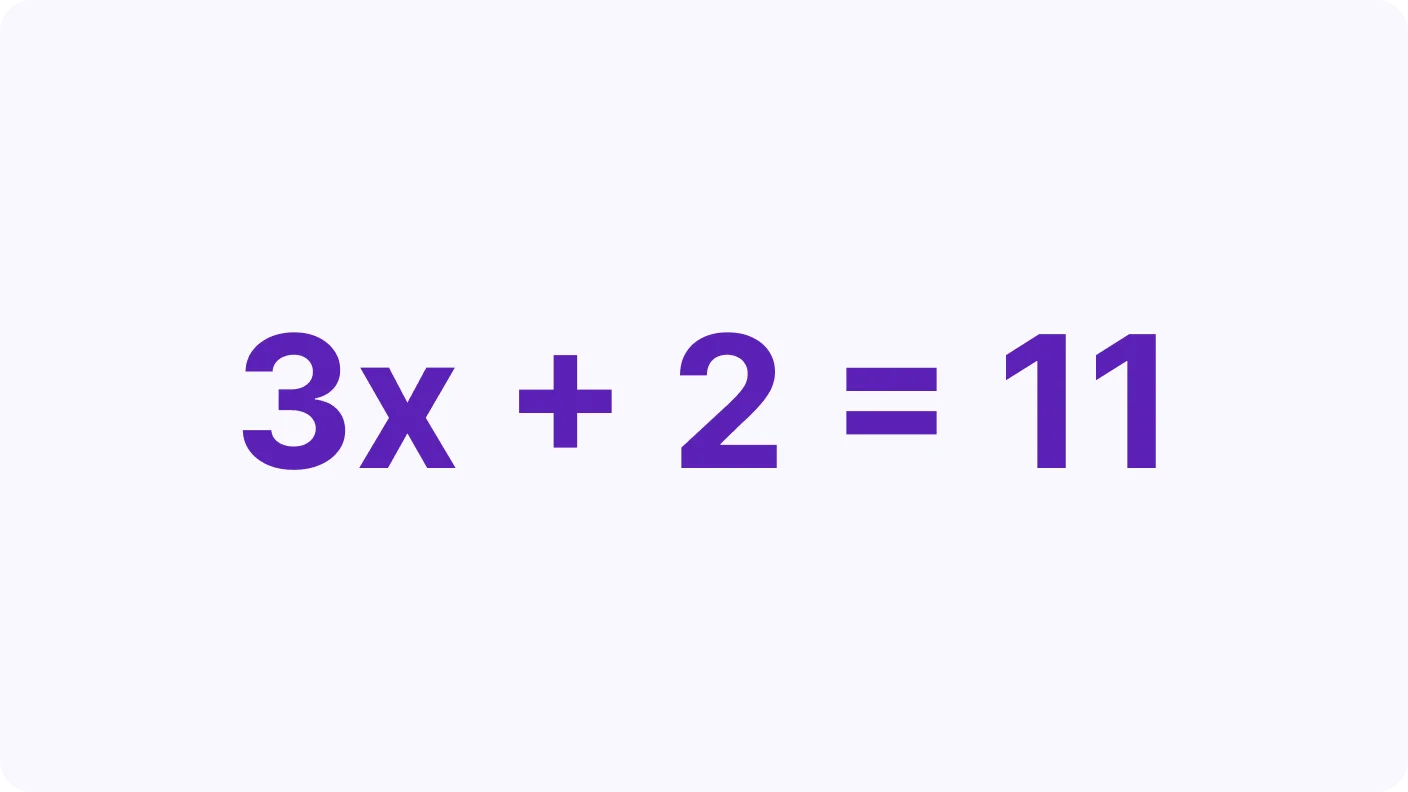
Solving equations means finding the value of x that makes the equation true. To solve 3x + 2 = 11, subtract 2 from both sides to get 3x = 9, then divide both sides by 3, so x = 3.
Video Lesson
Watch and learn the basics
🎬 Did this video explain it clearly?
Flashcards
Review key concepts visually
%20What%20Does%20Solving%20Equations%20Mean.webp)
%20Solving%20Equations%20Techniques.webp)
%20Solving%20Equations%20Example.webp)
Solving an Equation
- Solving an equation means finding the value of x that makes the equation true.
- You can check the solution by substituting the value of x and seeing if both sides are equal.
Simplify Both Sides
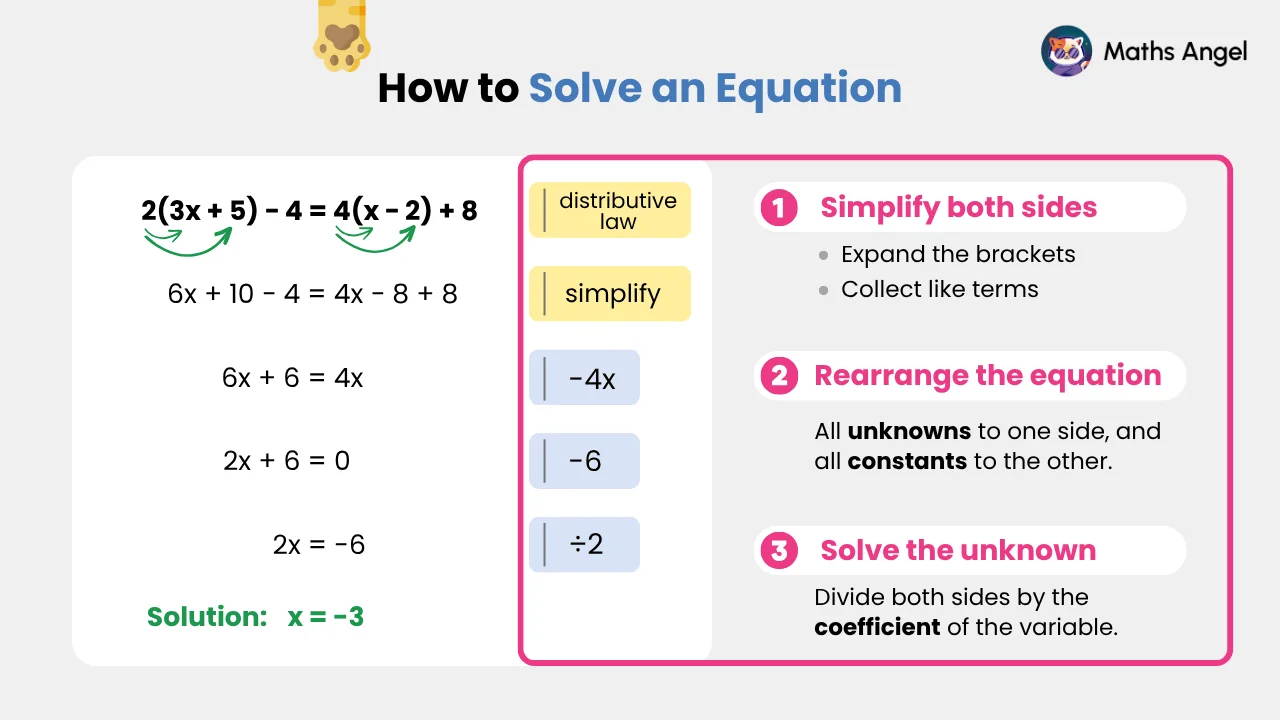
- Use the distributive law to expand brackets.
- Collect like terms to simplify each side of the equation.
Rearrange and Solve
- Move all terms with x to one side and all constants to the other side.
- Divide by the coefficient of x to find the value of x.
Practice Questions
Test your understanding
Solve the equation: .
Correct! 🎉 +10 pointsCorrect! 🎉 Worth 10 XPNot quite right
The has had 4 subtracted from it, so add 4 to both sides: .
The is multiplied by 2, so divide both sides by 2: .
Check: . Correct.
Solve the equation: .
Correct! 🎉 +10 pointsCorrect! 🎉 Worth 10 XPNot quite right
The has had 2 added to it, so subtract 2 from both sides: .
The is multiplied by 3, so divide both sides by 3: .
Check: . Correct.
Solve the equation: .
Correct! 🎉 +20 pointsCorrect! 🎉 Worth 20 XPNot quite right
Expand the bracket, multiplying both terms inside by 2: .
Subtract 8 from both sides: . Divide both sides by 2: .
(You could also divide both sides by 2 first: , which again gives .)
Check: . Correct.
Solve the equation: .
Correct! 🎉 +20 pointsCorrect! 🎉 Worth 20 XPNot quite right
Get the terms on one side by subtracting from both sides: .
Subtract 3 from both sides: . Divide both sides by 2: .
Check: and . Both sides match, so .
Solve the equation: .
Correct! 🎉 +20 pointsCorrect! 🎉 Worth 20 XPNot quite right
Expand the left side, multiplying both terms inside the bracket by 3: .
Subtract from both sides: . Add 6 to both sides: .
Check: and . Both sides match, so .
Simplify the expression: .
Correct! 🎉 +30 pointsCorrect! 🎉 Worth 30 XPNot quite right
Expand each product, multiplying every term inside the bracket by the term outside.
and .
Now collect like terms: , and .
An term and an term are not like terms, so they cannot be combined any further. The simplified expression is .
Want to see the full working?
Interactive Activity
Solve the equation step-by-step
Loading interactive widget...
Frequently asked questions
The questions students bump into most on this topic
Solving an equation means finding the value of the unknown that makes it true. In x + 3 = 8, the unknown is x; when x = 5 the equation reads 5 + 3 = 8, which is correct, so x = 5 is the solution. A linear equation like this has exactly one solution, and you can always test it by putting the value back in.
Three steps. Simplify both sides: expand brackets and collect like terms. Rearrange: get the x terms on one side and the numbers on the other by doing the same thing to both sides. Divide by the number in front of x. For 3x + 2 = 11: subtract 2 from both sides to get 3x = 9, then divide by 3 to get x = 3.
Because an equation is a balance: the two sides are equal, and they only stay equal if you change both in the same way. In 2x − 4 = 6, adding 4 to both sides gives 2x = 10, and dividing both sides by 2 gives x = 5. Change one side only and the sides no longer match, so the answer would be wrong.
Expand the brackets first, then carry on as normal. For 2(3x + 5) − 4 = 4x: expanding gives 6x + 10 − 4, which simplifies to 6x + 6 = 4x. Subtract 4x from both sides: 2x + 6 = 0. Subtract 6: 2x = −6. Divide by 2: x = −3. Expand, collect, rearrange, divide.
Move the smaller x term across by subtracting it from both sides, then move the numbers the other way. For 4x + 3 = 2x + 15: subtract 2x to get 2x + 3 = 15, subtract 3 to get 2x = 12, divide by 2 to get x = 6. American sites say “variables on both sides”; it is the same method.
Put your value back into the original equation and work out each side. If both sides give the same number, the solution is right. For 4x + 3 = 2x + 15 with x = 6: the left side is 4 × 6 + 3 = 27 and the right side is 2 × 6 + 15 = 27, so x = 6 is correct.
What's next?
Found this one hard? Go one step back first. Feeling confident? Carry on to the next lesson.