Solving Rational Equations
Solving rational equations means finding x when it lies in the denominator. Multiply both sides to clear the fraction, then solve. Always check your answer, and never let the denominator be zero.
Video Lesson
Watch and learn the basics
🎬 Did this video explain it clearly?
Flashcards
Review key concepts visually
%20How%20to%20Solve%20Rational%20Equations%20Step%20by%20Step.webp)
%20Solving%20Equations%20with%20X%20in%20Denominator%20(Example).webp)
Rational Equations
- Rational equations have x in the denominator, so extra care is needed.
- Multiply every term on both sides by the denominator containing x.
- This turns the equation into a normal equation without fractions.
Solve and Check
- Rearrange the equation to find the value of x.
- Check the solution by substituting it back into the original equation.
- Make sure the value of x does not make the denominator zero.
Practice Questions
Test your understanding
Solve the equation: .
Correct! 🎉 +10 pointsCorrect! 🎉 Worth 10 XPNot quite right
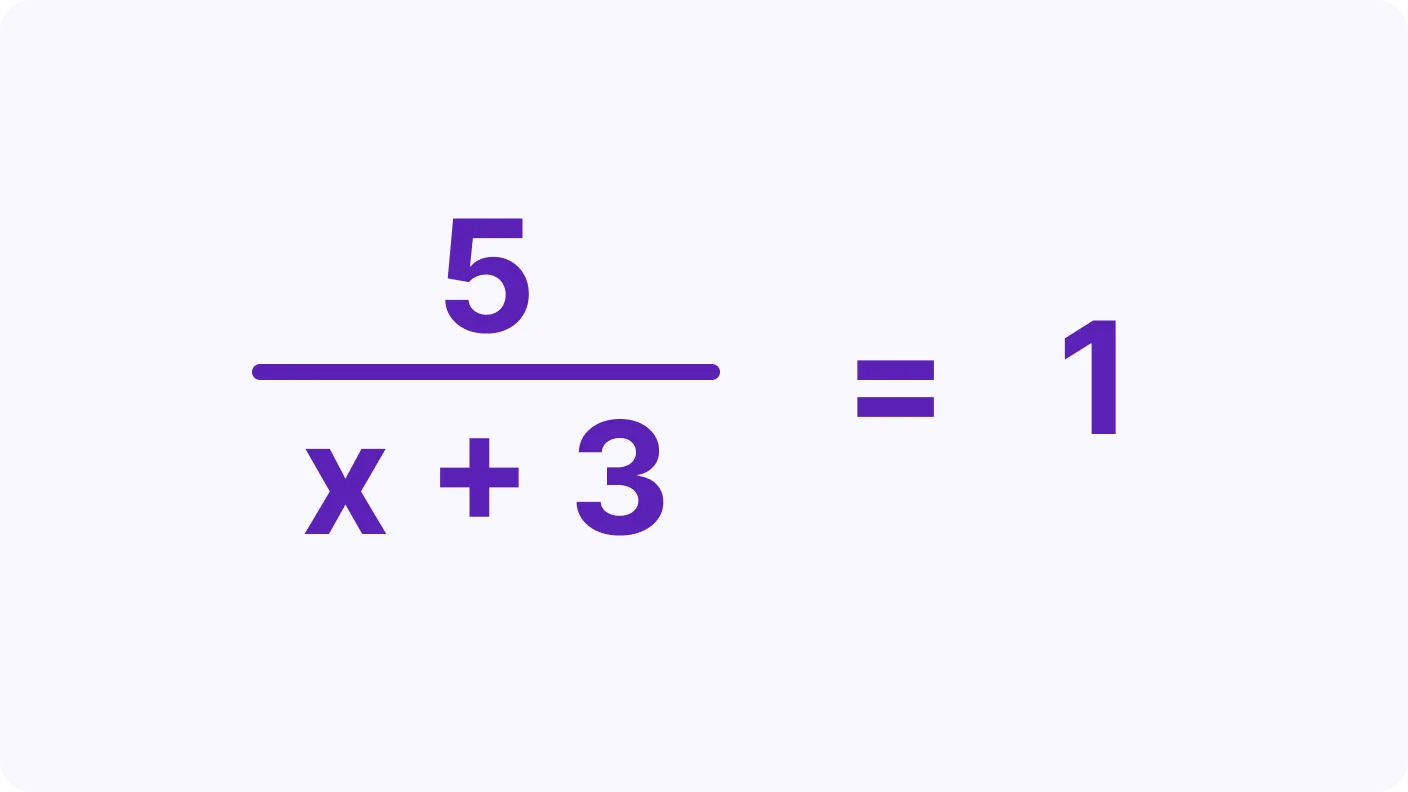
Multiply both sides by x to clear the denominator: , which gives .
Now undo the by dividing both sides by 2: .
Check: ✓
Solve the equation: .
Correct! 🎉 +10 pointsCorrect! 🎉 Worth 10 XPNot quite right
Multiply both sides by to clear the denominator: .
The is undone by subtracting 3 from both sides: , so .
Check: ✓
Solve the equation: .
Correct! 🎉 +20 pointsCorrect! 🎉 Worth 20 XPNot quite right
Multiply both sides by to clear the denominator: .
Expand the bracket, multiplying both terms by 3: .
Add 6 to both sides: . Divide both sides by 3: .
Check: ✓
Solve the equation: .
Correct! 🎉 +20 pointsCorrect! 🎉 Worth 20 XPNot quite right
Multiply every term by x to clear the denominators: , which gives .
Subtract 2 from both sides: . Divide both sides by 3: .
Check: and ✓
Solve the equation: .
Correct! 🎉 +20 pointsCorrect! 🎉 Worth 20 XPNot quite right
Divide both sides by 16: .
Multiply both sides by : .
The is undone by adding 3 to both sides: .
Check: ✓
Solve the equation: .
Correct! 🎉 +30 pointsCorrect! 🎉 Worth 30 XPNot quite right
Divide both sides by 50: .
Multiply both sides by : .
Expand the bracket, multiplying both terms by 5 and keeping the negative: .
Subtract from both sides: . Add 5 to both sides: . Divide by 2: .
Check: ✓
Want to see the full working?
Interactive Activity
Practice solving rational equations step-by-step
Loading interactive widget...
Frequently asked questions
The questions students bump into most on this topic
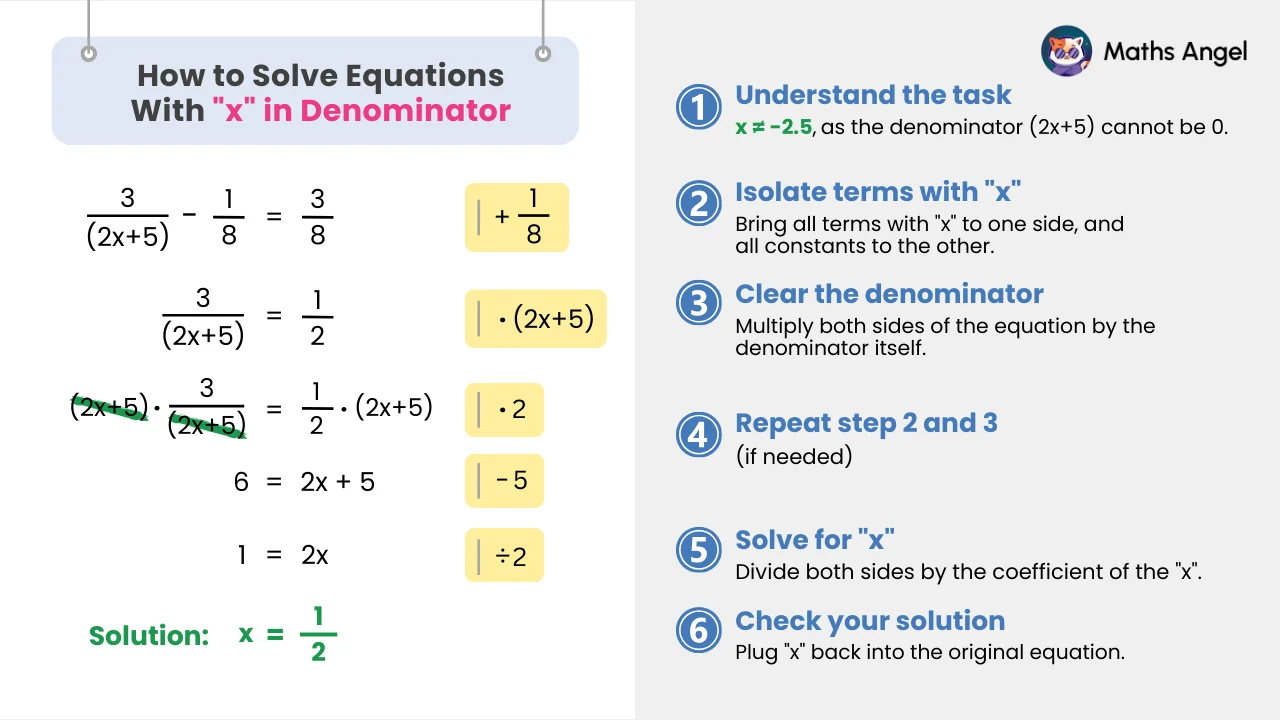
A rational equation is one with x in a denominator, such as 3 ÷ (2x + 5) − 1/8 = 3/8, or 1/x + 1/3 = 1 ÷ (3x) + 1. UK textbooks usually say “an equation with x in the denominator”; rational equation is the American name. You can tell one by looking underneath the fraction lines: if a letter is there, it is rational.
Five steps. Note what x cannot be: in 3 ÷ (2x + 5) − 1/8 = 3/8, x cannot be −2.5. Isolate the x terms: add 1/8 to both sides to get 3 ÷ (2x + 5) = 1/2. Clear the denominator: multiply both sides by (2x + 5), giving 3 = (2x + 5) ÷ 2. Repeat if needed: multiply by 2, so 6 = 2x + 5. Solve: 2x = 1, x = 1/2. Then check.
Multiply both sides of the equation by the denominator, so it cancels on the side with the fraction. If two terms have different denominators, multiply by something that clears both at once: with 1/x and 1 ÷ (3x), multiply everything by 3x. In the video’s second example that turns the equation into 3 − 1 = 2x, so x = 1.
Dividing by zero has no meaning, so any value of x that makes a denominator zero is not allowed. Find those values before you start. For 3 ÷ (2x + 5), the denominator is zero when 2x + 5 = 0, so x cannot be −2.5; for 1/x, x cannot be 0. If your solution turns out to be one of these, it is not a solution.
Because clearing denominators can hide a mistake, and because the answer must not be a forbidden value. Substitute it into the original equation and work out both sides. For x = 1 in 1/x + 1/3 = 1 ÷ (3x) + 1: the left side is 1 + 1/3 = 4/3 and the right side is 1/3 + 1 = 4/3, so x = 1 is correct.
What's next?
Found this one hard? Go one step back first. Feeling confident? Carry on to the next lesson.