
Fibonacci Sequence and Fibonacci-Type Sequences
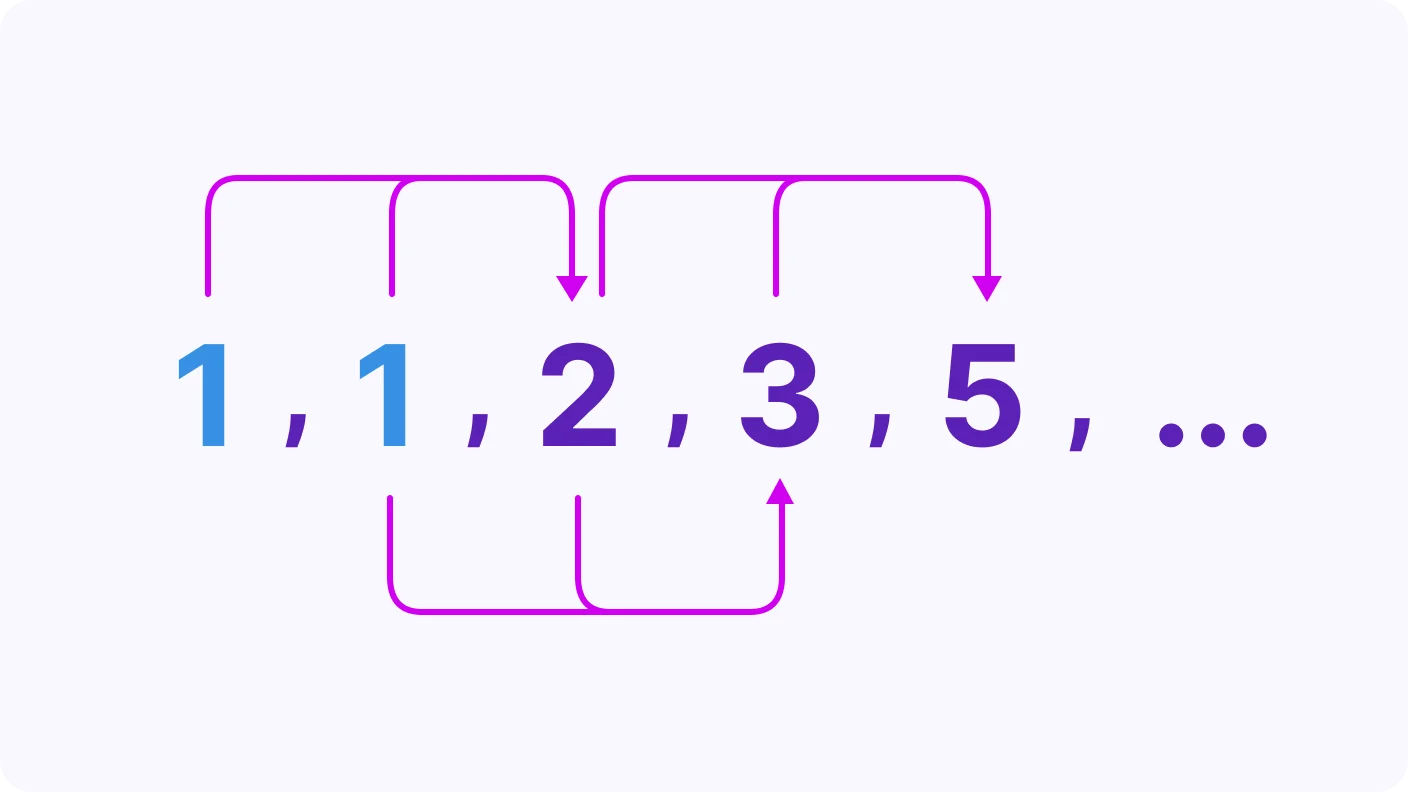
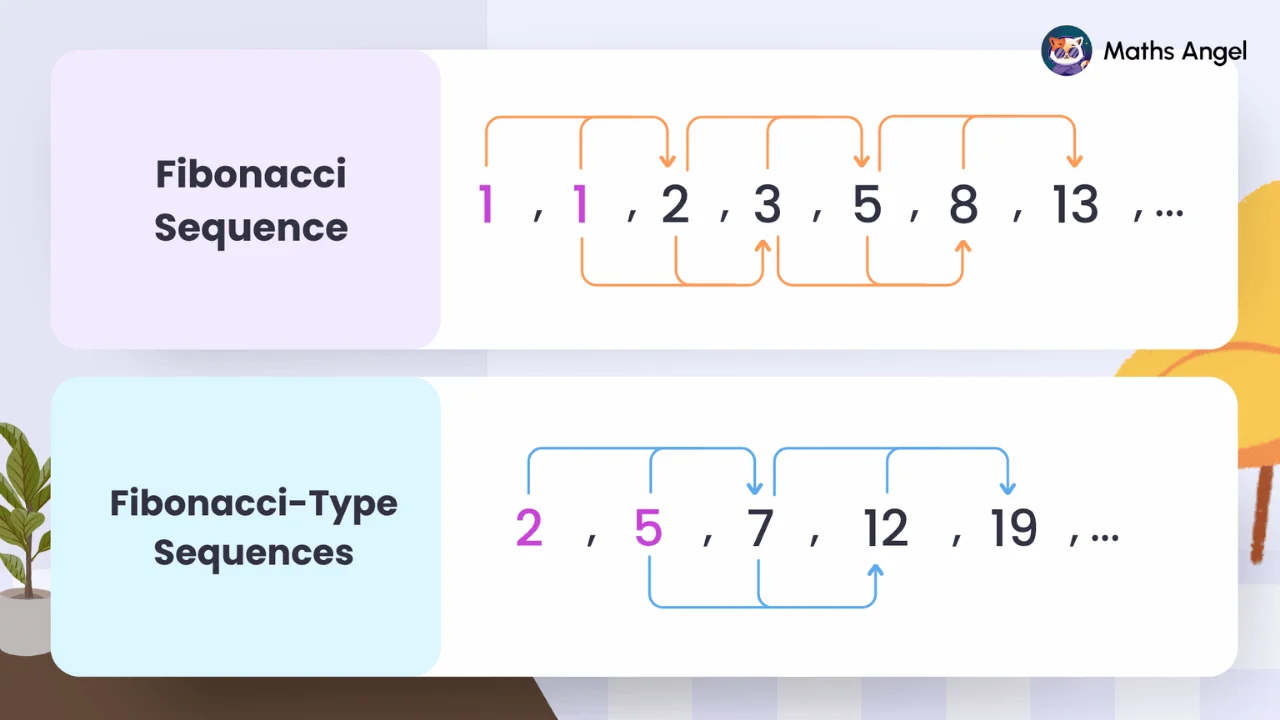
A Fibonacci sequence starts 1, 1 and makes each new term by adding the two terms before it. This gives 1, 1, 2, 3, 5 and so on. A Fibonacci-type sequence follows the same rule but can start with any two numbers.
Video Lesson
Watch and learn the basics
🎬 Did this video explain it clearly?
Flashcards
Review key concepts visually
%20Fibonacci%20Sequence%20and%20Fibonacci-Type%20Sequences.webp)
%20The%20Fibonacci%20Sequence.webp)
%20Fibonacci-Type%20Sequences.webp)
%20Finding%20the%20Next%20Terms.webp)
%20Finding%20Missing%20Terms.webp)
Spot the Fibonacci Family
- Add the last two terms to get the next term.
- The Fibonacci sequence starts with 1 and 1.
- A Fibonacci-type sequence can start with any two numbers.
The Classic Fibonacci Sequence
- The Fibonacci sequence starts with 1 and 1.
- Each new term is the sum of the two terms before it.
- , , and so on.
Fibonacci-Type Sequences
- A Fibonacci-type sequence follows the same adding rule.
- The difference is that it can start with any two numbers.
- The first two numbers determine the whole sequence.
Finding the Next Terms
- Add the first two terms to find the third term.
- Keep adding the last two terms to continue the sequence.
- , , , and so on.
Finding Missing Terms
- Work backwards when later terms are already given.
- Subtract the previous known term to find the missing term before it.
Practice Questions
Test your understanding
Find the next term in the Fibonacci-type sequence 4, 5, 9, 14, 23, ...
Correct! 🎉 +10 pointsCorrect! 🎉 Worth 10 XPNot quite right
In a Fibonacci-type sequence, each term is the sum of the two terms before it.
Check the rule: , and .
So add the last two terms: .
The next term is 37.
In a Fibonacci-type sequence, each term is the sum of the two terms before it. Which of these is a Fibonacci-type sequence?
Correct! 🎉 +10 pointsCorrect! 🎉 Worth 10 XPNot quite right
Check the rule on each option: every term should be the sum of the two before it.
For 3, 7, 10, 17, 27: , and .
The rule holds all the way through, so this is a Fibonacci-type sequence.
The other options grow by adding a fixed amount, by doubling, or only fit the rule for the first pair.
Find the missing term in the Fibonacci-type sequence 6, _, 15, 24, 39, ...
Correct! 🎉 +20 pointsCorrect! 🎉 Worth 20 XPNot quite right
Each term is the sum of the two before it, so the 3rd term equals the 1st term plus the missing 2nd term.
This gives , so the missing term is .
Check it works: , and .
A Fibonacci-type sequence starts 4, 6, where each term is the sum of the two before it. What is the 6th term?
Correct! 🎉 +20 pointsCorrect! 🎉 Worth 20 XPNot quite right
Each term is the sum of the two before it, so keep adding the last two terms and count the positions carefully.
1st: 4, 2nd: 6, 3rd: , 4th: , 5th: , 6th: .
The sequence is , so the 6th term is 42.
A Fibonacci-type sequence has 4th term 25 and 5th term 40. What is the 2nd term?
Correct! 🎉 +20 pointsCorrect! 🎉 Worth 20 XPNot quite right
The sequence so far is and we need to work backwards by subtracting.
The 5th term is the 3rd term plus the 4th term, so the 3rd term is .
The 4th term is the 2nd term plus the 3rd term, so the 2nd term is .
So the 2nd term is 10. (The full sequence is .)
A Fibonacci-type sequence has 5th term 31 and 6th term 51. What is the 1st term?
Correct! 🎉 +30 pointsCorrect! 🎉 Worth 30 XPNot quite right
Each term is the sum of the two before it, so work backwards by subtracting.
4th term: .
3rd term: .
2nd term: .
1st term: .
So the sequence is and the 1st term is 2.
Want to see the full working?
Interactive Activity
Find the missing or next term in these Fibonacci and Fibonacci-type sequences
Loading interactive widget...
Fibonacci Sequence and Fibonacci-Type Sequences frequently asked questions
The questions students bump into most on this topic
The Fibonacci sequence works by adding the two previous terms to get the next one. It starts with 1 and 1. So 1 plus 1 is 2, then 1 plus 2 is 3, and 2 plus 3 is 5. This gives 1, 1, 2, 3, 5, 8, and so on.
Both sequences follow the same rule: each term is the sum of the two terms before it. The difference is the starting numbers. A Fibonacci sequence always starts with 1 and 1. A Fibonacci-type sequence can start with any two numbers you choose.
The Fibonacci sequence starts with 1 and 1. Adding the two previous terms each time gives 1, 1, 2, 3, 5, 8, 13, 21, 34, and so on. Every term after the first two is the sum of the two terms before it.
Add the two previous terms together. In a sequence that starts with 2 and 5, the next term is 2 plus 5, which is 7. Then 5 plus 7 is 12, and 7 plus 12 is 19. This gives 2, 5, 7, 12, 19.
Work backwards using subtraction. Subtract the earlier known term from the later one to find the term before them. Say the 5th term is 35 and the 4th term is 22. Then 35 minus 22 gives 13 as the 3rd term.
Leonardo Fibonacci was an Italian mathematician from the 1200s. The Fibonacci sequence is named after him. It is a famous list of numbers that starts with 1 and 1. Each term is the sum of the two terms before it.