Simple Quadratic Equations
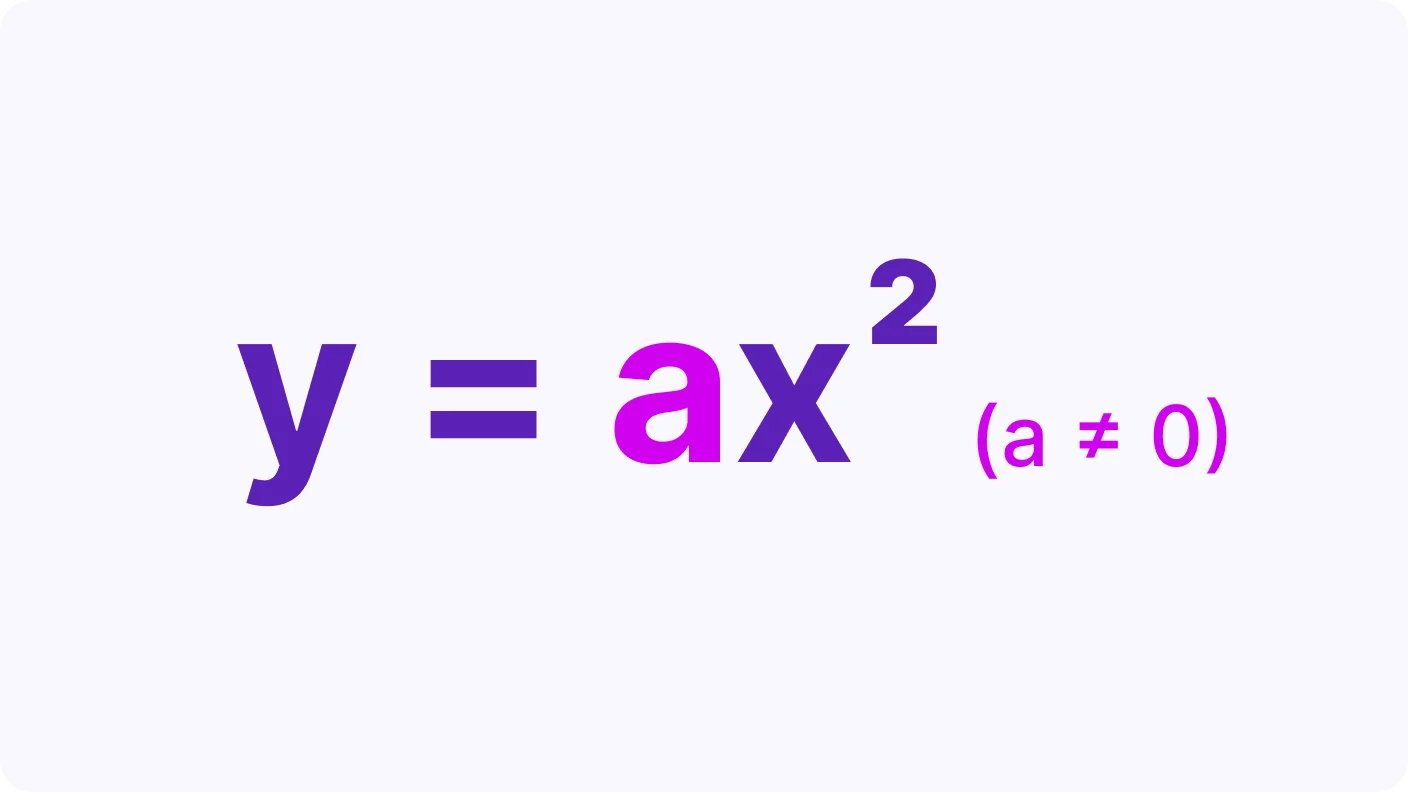
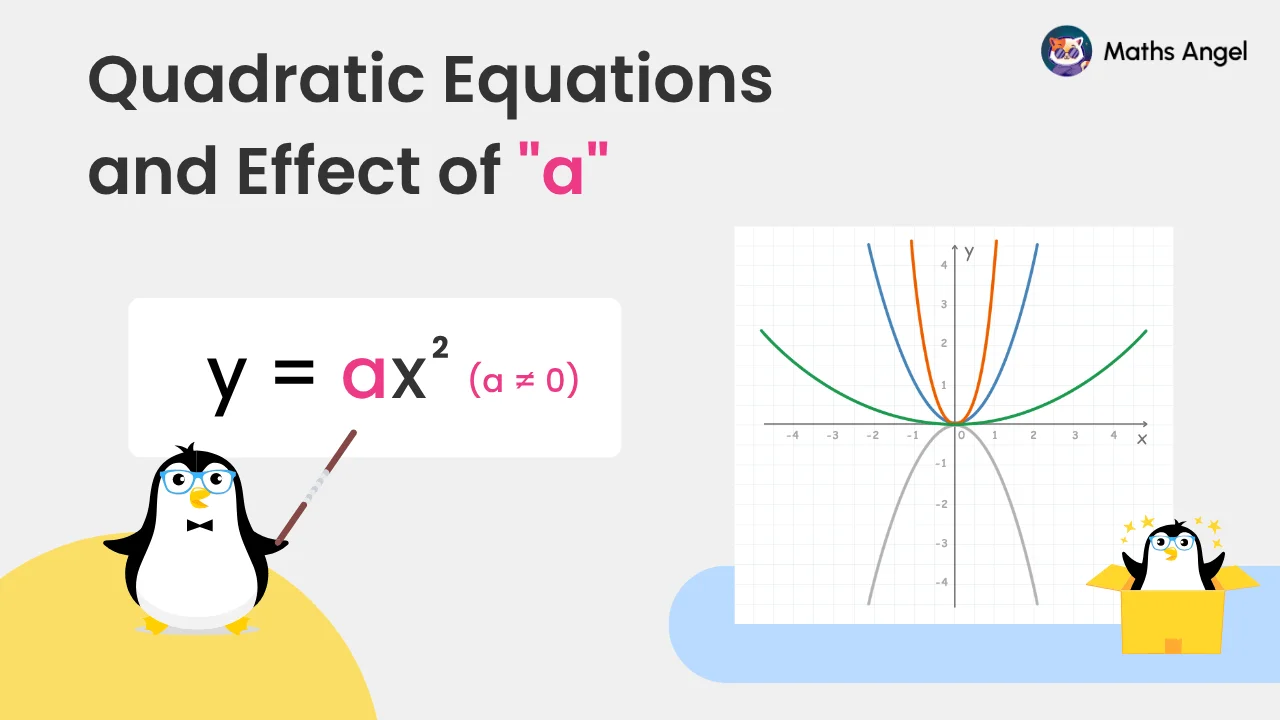
A quadratic equation has an x² term, and its graph is a U-shaped curve called a parabola. In y = ax² (a ≠ 0), the sign of a decides if it opens up or down. The size of a sets the width.
Video Lesson
Watch and learn the basics
🎬 Did this video explain it clearly?
Flashcards
Review key concepts visually
%20Simple%20Quadratic%20Equation.webp)
%20Standard%20Parabola.webp)
%20Effect%20of%20%27a%27%20in%20quadratic%20equation.webp)
What Is a Quadratic Equation?
- A quadratic equation has an x² term.
- Its graph is called a parabola.
Graphing the Standard Parabola y = x²
- You find points by squaring x to get y.
- The graph is symmetrical and has a minimum at the origin.
- Points like (-2,4) and (2,4) show the symmetry.
Effect of a in y = ax²
- The sign of a decides if the parabola opens upwards or downwards.
- The size of |a| controls the width of the parabola.
- A larger |a| makes the parabola narrower.
Practice Questions
Test your understanding
What happens to the graph when a is positive in the quadratic ?
Correct! 🎉 +10 pointsCorrect! 🎉 Worth 10 XPNot quite right
In , the sign of a decides which way the curve opens.
When a is positive, is positive for every non-zero value of x, so for large positive x and for large negative x both arms of the curve rise. The parabola opens upward, making a U shape with a minimum turning point.
The curve is still symmetrical: it has a vertical line of symmetry through its turning point.
The size of a (how far it is from zero) controls how narrow or wide the curve is, not which way it opens.
What can you tell about the parabola if a is negative in the quadratic ?
Correct! 🎉 +10 pointsCorrect! 🎉 Worth 10 XPNot quite right
When a is negative, is negative for every non-zero value of x, so both arms of the curve fall. The parabola opens downward, making an n shape with a maximum turning point.
The curve is still symmetrical about a vertical line through its turning point - a negative a flips the curve, it does not distort it.
How wide or narrow the curve is depends on the size of a (its absolute value), so without knowing the actual value of a you cannot say whether it is wider or narrower than .
In , if , how does the parabola change compared to when ?
Correct! 🎉 +20 pointsCorrect! 🎉 Worth 20 XPNot quite right
is positive, so the parabola still opens upward.
Every y-value is 4 times as large as on : at the curve reaches instead of , and at it reaches instead of .
Rising 4 times as fast makes the curve steeper, so it is narrower than . In general gives a narrower curve and gives a wider one.
The coefficient of stretches the curve vertically; it does not slide the curve up or down. That is the job of the constant term.
In , if , how does the parabola change compared to when ?
Correct! 🎉 +20 pointsCorrect! 🎉 Worth 20 XPNot quite right
is positive, so the parabola still opens upward.
Every y-value is half as large as on : at the curve reaches instead of , and at it reaches instead of .
Rising half as fast makes the curve flatter, so it is wider than . In general gives a wider curve and gives a narrower one.
The coefficient of stretches or squashes the curve vertically; it does not slide it up or down.
In , if , how does the parabola change compared to when ?
Correct! 🎉 +20 pointsCorrect! 🎉 Worth 20 XPNot quite right
is negative, so the parabola is flipped over and opens downward.
The size of a is , so every point is twice as far from the x-axis as on : at the curve reaches instead of , and at it reaches instead of .
Because the curve falls twice as steeply, so it is narrower than .
So the sign of a flips the curve and the size of a stretches it. The coefficient does not move the curve up or down.
In , if , how does the parabola change compared to when ?
Correct! 🎉 +30 pointsCorrect! 🎉 Worth 30 XPNot quite right
is negative, so the parabola is flipped over and opens downward.
The size of a is , which is less than 1, so every point is only half as far from the x-axis as on : at the curve reaches instead of , and at it reaches instead of .
Falling only half as fast makes the curve flatter, so it is wider than .
So the sign of a flips the curve and the size of a decides the width: gives a wider curve, a narrower one.
Want to see the full working?
Interactive Activity
Visualise the quadratic function y = ax², where a cannot be 0
Loading interactive widget...
Frequently asked questions
The questions students bump into most on this topic
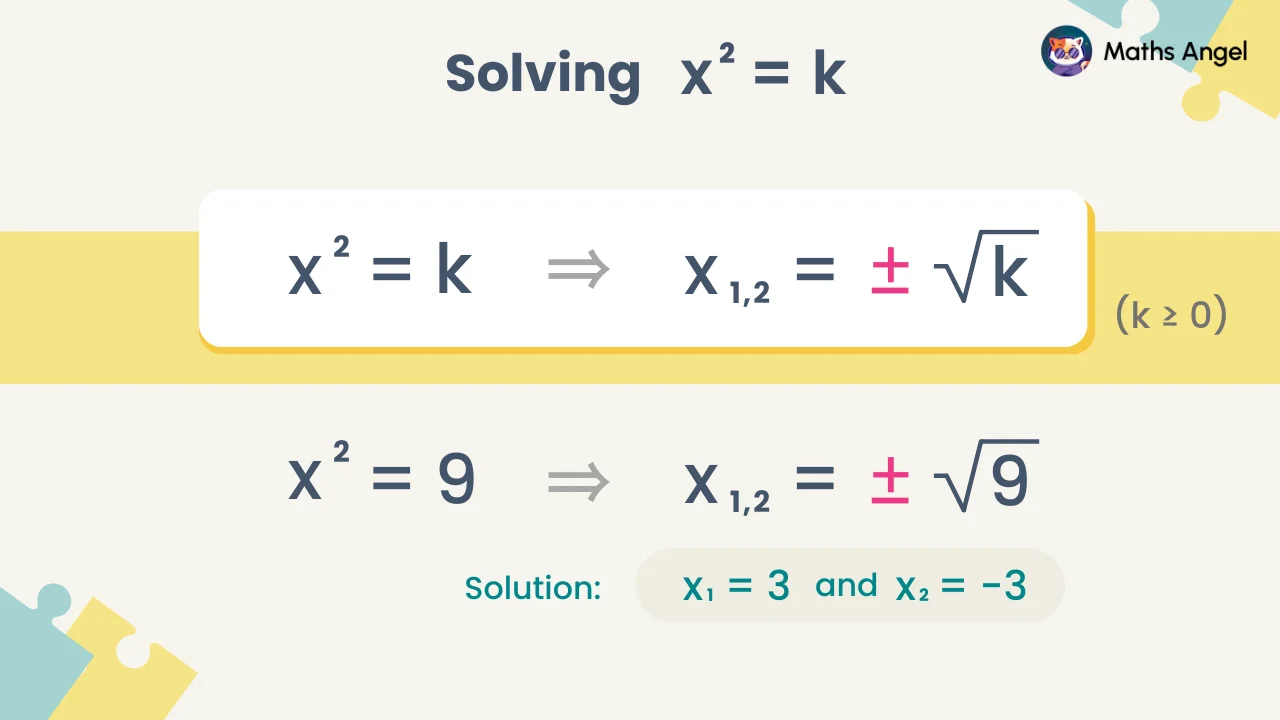
A quadratic equation is one with an x² term, such as y = x², y = 4x² or y = −x². Its graph is a U-shaped curve called a parabola, never a straight line, because squaring x makes y grow quickly on both sides of zero. In GCSE maths you draw them, read their turning points and, later, solve them.
A parabola is the U-shaped curve you get when you draw a quadratic equation. The standard parabola is y = x²: it has its lowest point at the origin and is symmetrical about the y-axis, because (−2)² and 2² both give 4. “Parabolic” just means parabola-shaped. It can open upwards or downwards.
Make a table of values, plot the points and join them with a smooth curve, not straight lines. For y = x²: x = −2 gives 4, x = −1 gives 1, x = 0 gives 0, x = 1 gives 1, x = 2 gives 4. Plot (−2, 4), (−1, 1), (0, 0), (1, 1) and (2, 4), then draw the U through them.
The vertex is the turning point: the lowest point of a parabola that opens upwards, or the highest point of one that opens downwards. For y = x² it is at the origin, (0, 0), because when x is 0, y is 0 too. The parabola is symmetrical either side of its vertex.
In y = ax², the sign of a sets the direction and the size sets the width. Positive a opens upwards, negative a opens downwards. The bigger a is, ignoring the sign, the narrower the curve; the closer to 0, the wider. A quick check: at x = 1, y = a, so a = 4 is a high, narrow curve and a = 0.1 a low, wide one.
Anything thrown or kicked follows a parabola, which is why a football’s path curves the way it does. Satellite dishes and car headlights are parabola-shaped so that signals and light focus at one point. Arched bridges and tunnels are often parabolas too, and the Vertex Form lesson uses a tunnel to decide whether a lorry fits.
What's next?
Found this one hard? Go one step back first. Feeling confident? Carry on to the next lesson.