Vertex Form and Parabola Transformations
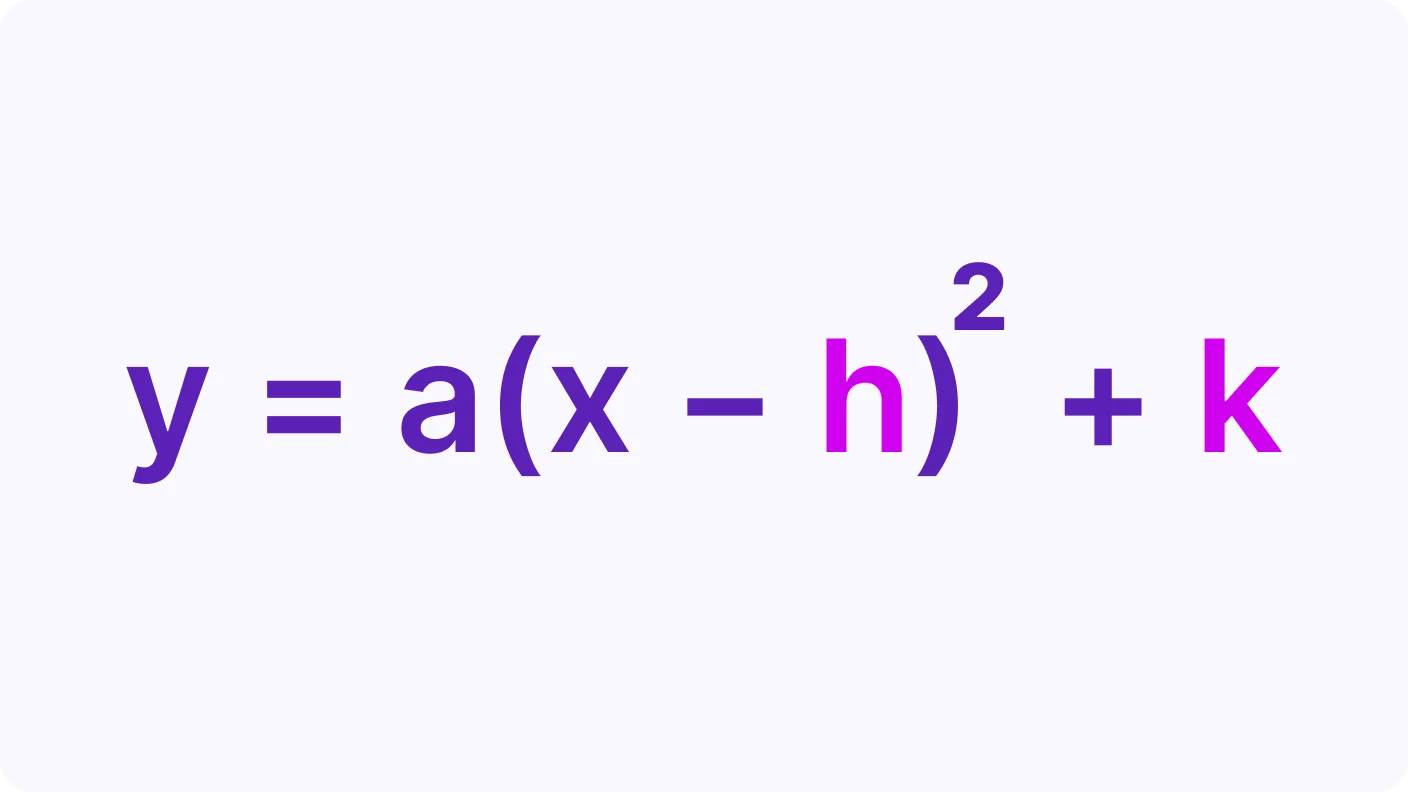
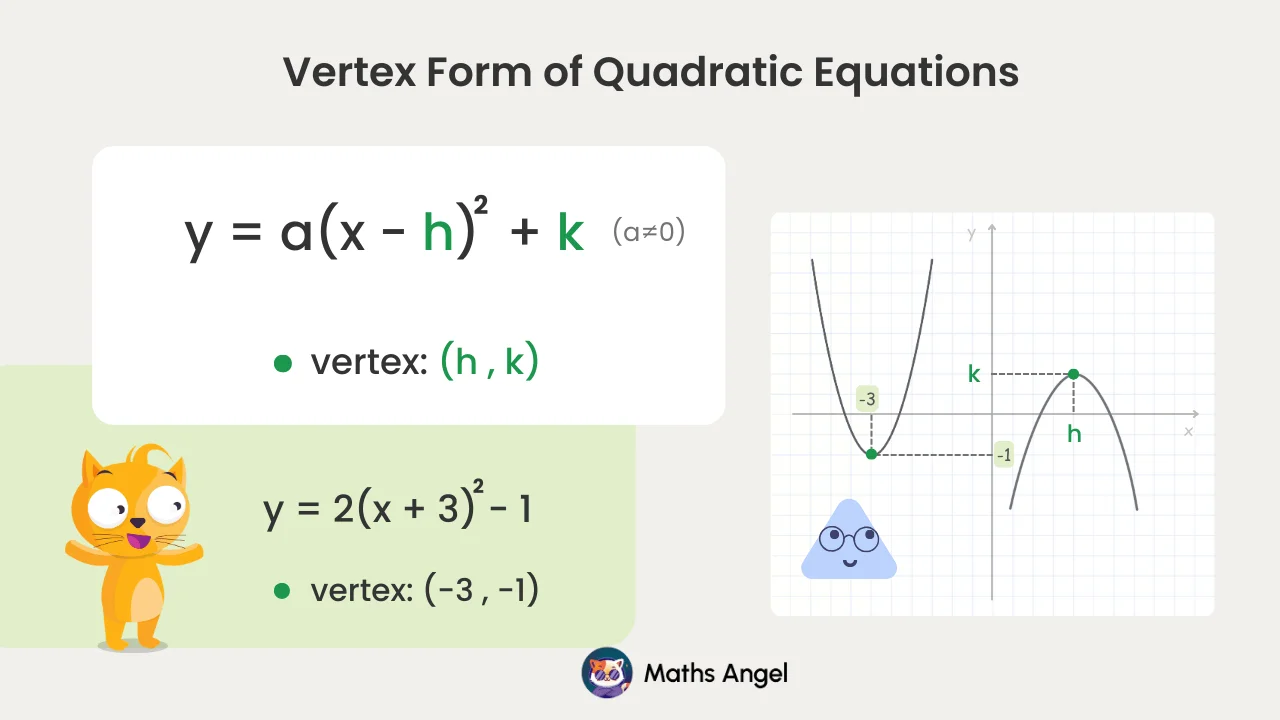
Vertex form writes a quadratic as y = a(x − h)² + k, where (h, k) is the vertex, so y = 2(x − 3)² − 1 has vertex (3, −1). In parabola transformations, h moves the graph left or right and k up or down.
Video Lesson
Watch and learn the basics
🎬 Did this video explain it clearly?
Flashcards
Review key concepts visually
%20Vertex%20Form%20of%20Quadratic%20Equations.webp)
%20How%20to%20Find%20the%20Vertex%20of%20a%20Quadratic%20Function.webp)
%20Transformations%20of%20Quadratic%20Functions%20Using%20the%20Vertex.webp)
Vertex Form of a Quadratic
- The vertex form is , and the vertex is (h, k).
- For example, in , the vertex is (−3, −1).
What Do h and k Mean?
- h moves the graph left or right.
- k moves the graph up or down.
Shifting a Parabola Using Vertex Form
- Start with , which has its vertex at (0,0).
- Moving the vertex 3 left and 1 down gives the new graph .
Practice Questions
Test your understanding
In the vertex form of a quadratic equation, , what does h represent?
Correct! 🎉 +10 pointsCorrect! 🎉 Worth 10 XPNot quite right
h is the x-coordinate of the vertex (the turning point). The bracket equals zero when , and that is exactly where the parabola turns, so h fixes its horizontal position.
Watch the minus sign built into the form: is really , so , not 3. The letter a controls the shape and which way the parabola opens, and k gives the y-coordinate of the vertex.
In the vertex form of a quadratic equation, , what does k represent?
Correct! 🎉 +10 pointsCorrect! 🎉 Worth 10 XPNot quite right
k is the y-coordinate of the vertex. When the squared bracket equals 0, so , the lowest (or highest) value the curve reaches. Adding k shifts the whole parabola vertically.
k is not the constant term of the expanded quadratic: expanding gives , so the constant is . The x-coordinate of the vertex is h, and a controls the shape.
In the quadratic equation , what are the coordinates of the vertex?
Correct! 🎉 +20 pointsCorrect! 🎉 Worth 20 XPNot quite right
Compare with the vertex form .
The bracket is zero when , so . The number added outside the bracket is . The vertex is therefore .
The is the value of a: it makes the parabola narrower and turns it upside down, but its minus sign belongs to a alone and changes neither coordinate of the vertex.
In the quadratic equation , what are the coordinates of the vertex?
Correct! 🎉 +20 pointsCorrect! 🎉 Worth 20 XPNot quite right
Compare with the vertex form .
Rewrite as , so : the bracket is zero when . The number outside the bracket is .
The vertex is therefore . Both coordinates are negative here, so keep the signs.
In the quadratic equation , what are the coordinates of the vertex?
Correct! 🎉 +20 pointsCorrect! 🎉 Worth 20 XPNot quite right
Compare with the vertex form .
The bracket is zero when , so , and the number outside the bracket is . The vertex is therefore .
The is the value of a: it turns the parabola upside down, but that minus sign belongs to a and does not make negative.
In the quadratic equation , find the coordinates of the highest point of the parabola.
Correct! 🎉 +30 pointsCorrect! 🎉 Worth 30 XPNot quite right
Because is negative, the parabola opens downwards, so its vertex is the highest point.
Compare with the vertex form . Rewrite as , so , and the number outside the bracket is .
The highest point is therefore .
Want to see the full working?
Interactive Activity
Vertex form and parabola transformations
Loading interactive widget...
Frequently asked questions
The questions students bump into most on this topic
Vertex form writes a quadratic as y = a(x − h)² + k, where a is not zero. It is named after the point (h, k), which is the parabola’s vertex, or turning point: h moves the graph left or right and k moves it up or down. In GCSE maths the same form is called completed square form.
The vertex is the turning point of a parabola, where the curve changes direction. When a is positive the parabola opens upwards and the vertex is its lowest point; when a is negative it opens downwards and the vertex is its highest point. In vertex form, y = a(x − h)² + k, the vertex is the point (h, k).
Read it straight from the equation: in y = a(x − h)² + k the vertex is (h, k). Take h from inside the bracket and k from outside, watching the signs. The bracket must be zero at the vertex, so y = 2(x + 3)² − 1 means x + 3 = 0, giving h = −3, not 3, and k = −1. The vertex is (−3, −1).
The value of a tells you which way the parabola opens. When a is positive, the parabola opens upwards and the vertex is its lowest point. When a is negative, it opens downwards and the vertex is its highest point. Moving the graph left, right, up or down never changes a, because the shape stays the same.
Find the vertex first, then move a known graph to it. For y = 0.5(x − 2)² − 3, the vertex is (2, −3), so take the graph of y = 0.5x², whose vertex is at the origin, and slide it so the vertex sits at (2, −3). The shape does not change, because a is the same; only the position moves.
Because the vertex can be read straight from it, and because moving a parabola becomes easy. Moving y = 2x² two units left and three units up puts the vertex at (−2, 3), so the new equation is y = 2(x + 2)² + 3: a is unchanged, h is −2 and k is 3. Focusing on the vertex stops you moving the graph the wrong way.
What's next?
Found this one hard? Go one step back first. Feeling confident? Carry on to the next lesson.