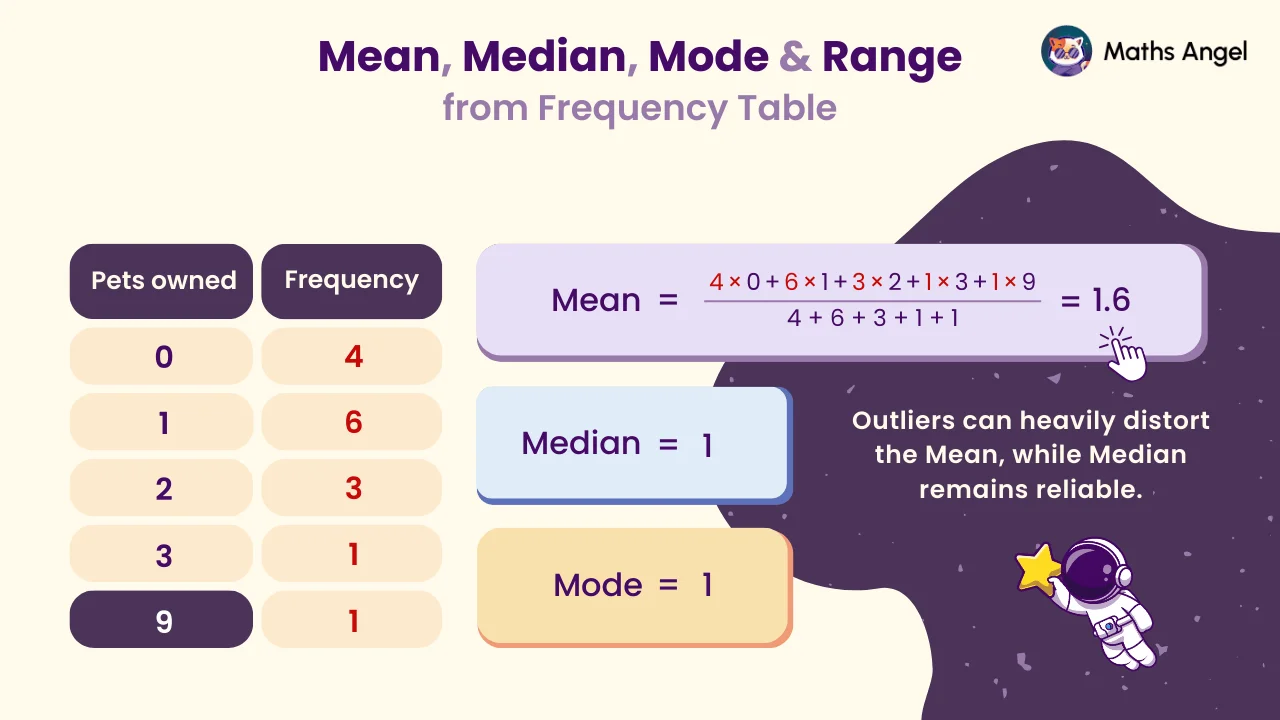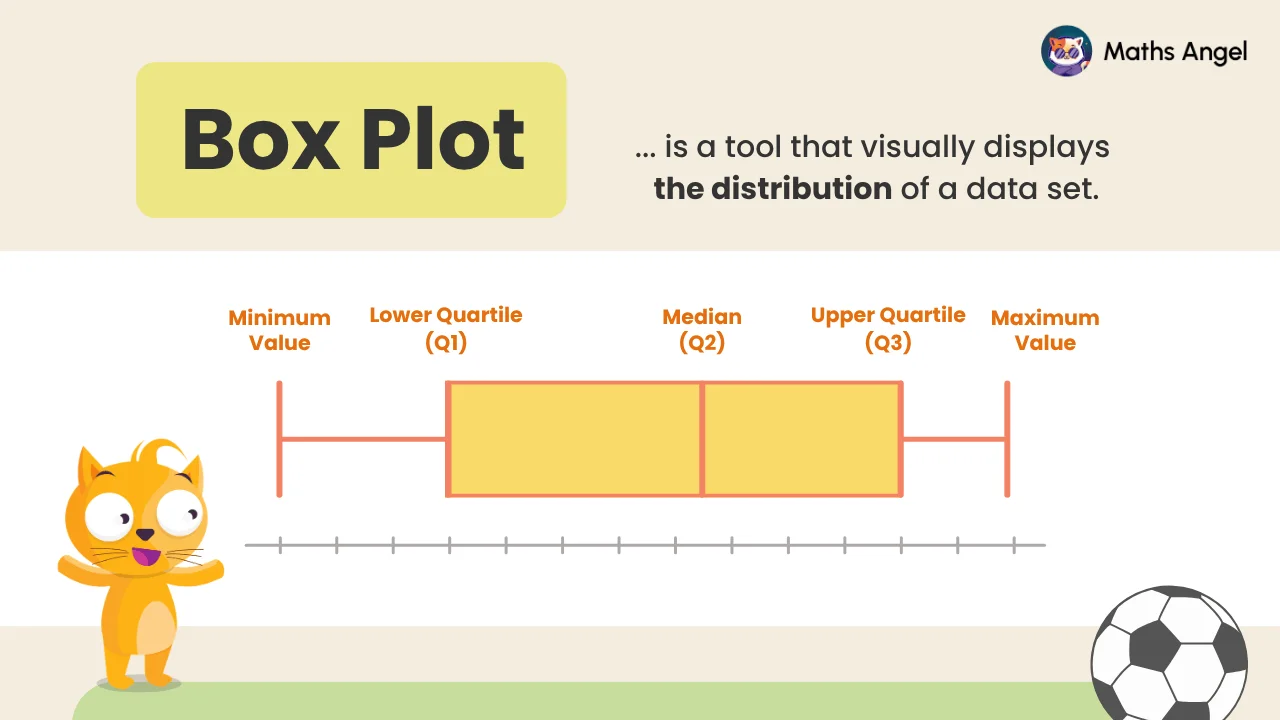
Averages from a Grouped Frequency Table
A grouped frequency table sorts data into class intervals and lists their frequencies. A frequency of 8 for 20-30 means 8 values fall in that range. From it you find the modal class, median class, and estimate the mean.
Video Lesson
Watch and learn the basics
🎬 Did this video explain it clearly?
Flashcards
Review key concepts visually
%20Grouped%20Frequency%20Table.webp)
%20Modal%20Class.webp)
%20Median%20from%20a%20Grouped%20Frequency%20Table.webp)
%20Mean%20from%20a%20Grouped%20Frequency%20Table.webp)
What Is a Grouped Frequency Table?
- A grouped frequency table organises data into class intervals.
- Each class shows how many values fall within that interval.
How to Find the Modal Class?
- The modal class is the class with the highest frequency.
- It shows where the data occurs most often.
How to Find the Median Class?
- Add the frequencies to find the total number of values (n).
- Use (n + 1) ÷ 2 to find the median position.
- If , , so the class containing the 13th value is the median class.
How to Estimate the Mean?
- Find the midpoint of each class by adding the lower and upper values and dividing by 2.
- Multiply each midpoint by its frequency and add the results.
- Divide this sum by the total frequency to estimate the mean.
Practice Questions
Test your understanding
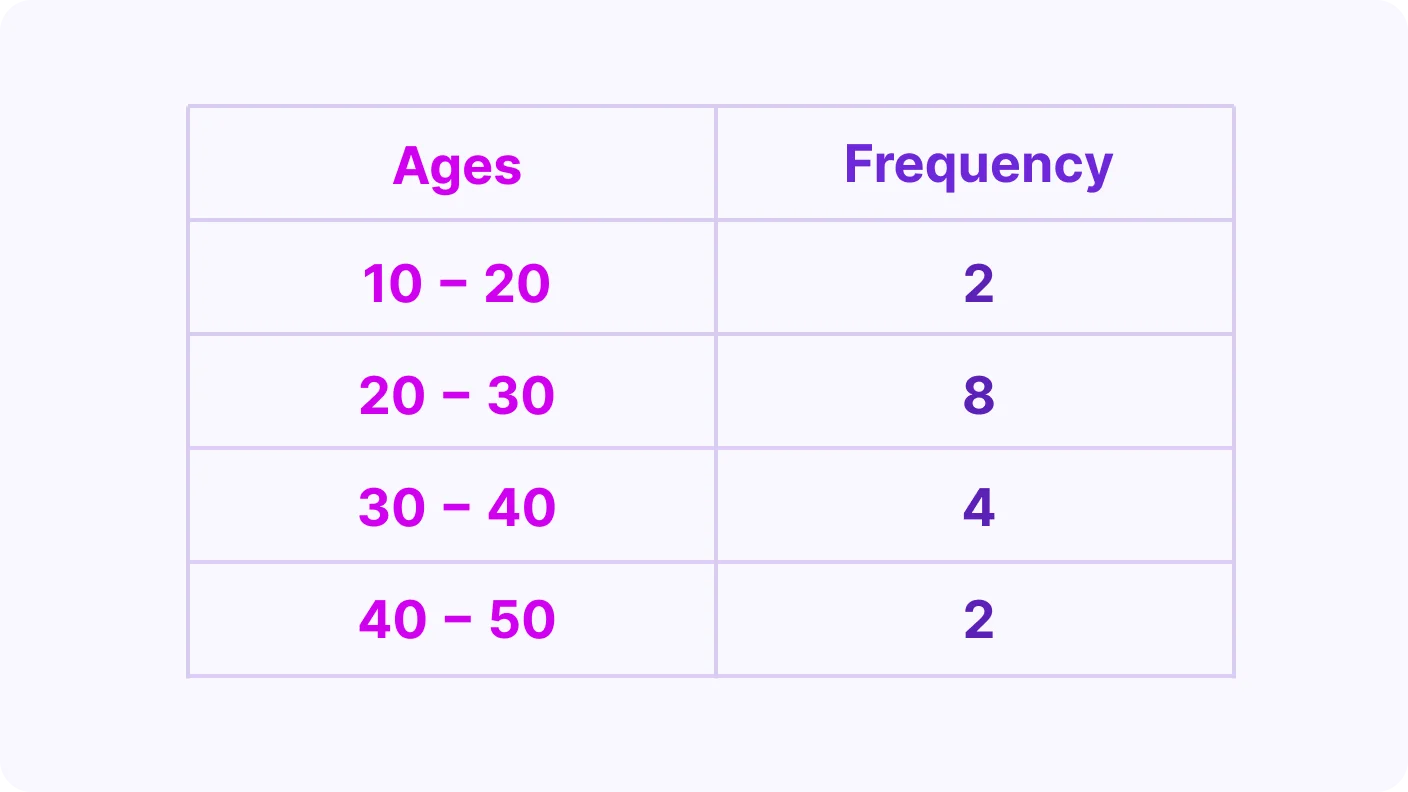
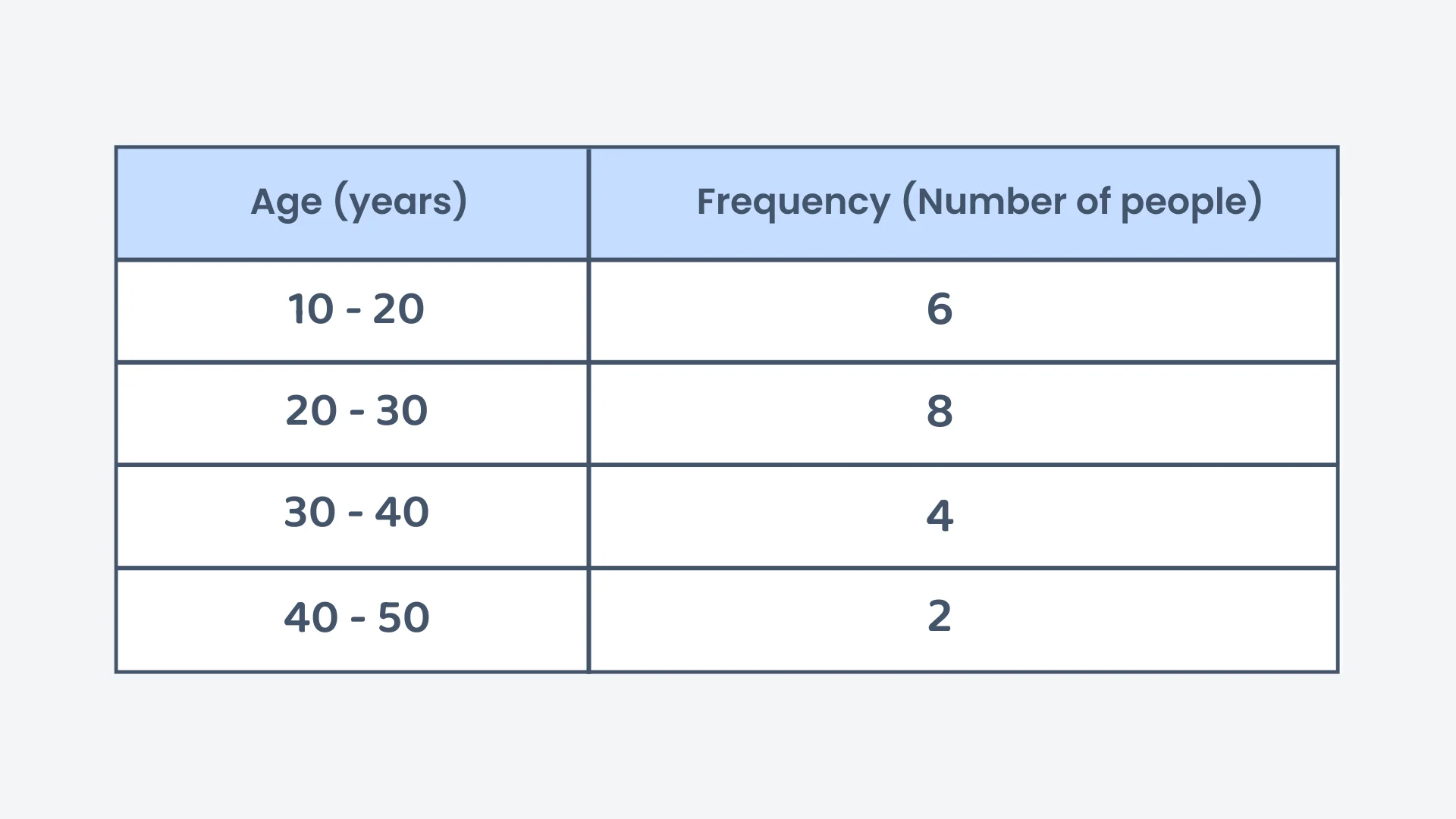
The table shows the ages of people attending a concert. How many people are represented in total?
Correct! 🎉 +10 pointsCorrect! 🎉 Worth 10 XPNot quite right
The total number of people is the sum of the frequencies, not of the age labels.
people attended the concert.
The table shows the ages of people attending a concert. What is the modal class for the data?
Correct! 🎉 +10 pointsCorrect! 🎉 Worth 10 XPNot quite right
The modal class is the group with the highest frequency.
The frequencies are 6, 8, 4 and 2, and the highest is 8, which belongs to the 20-30 years group. So the modal class is 20-30 years.
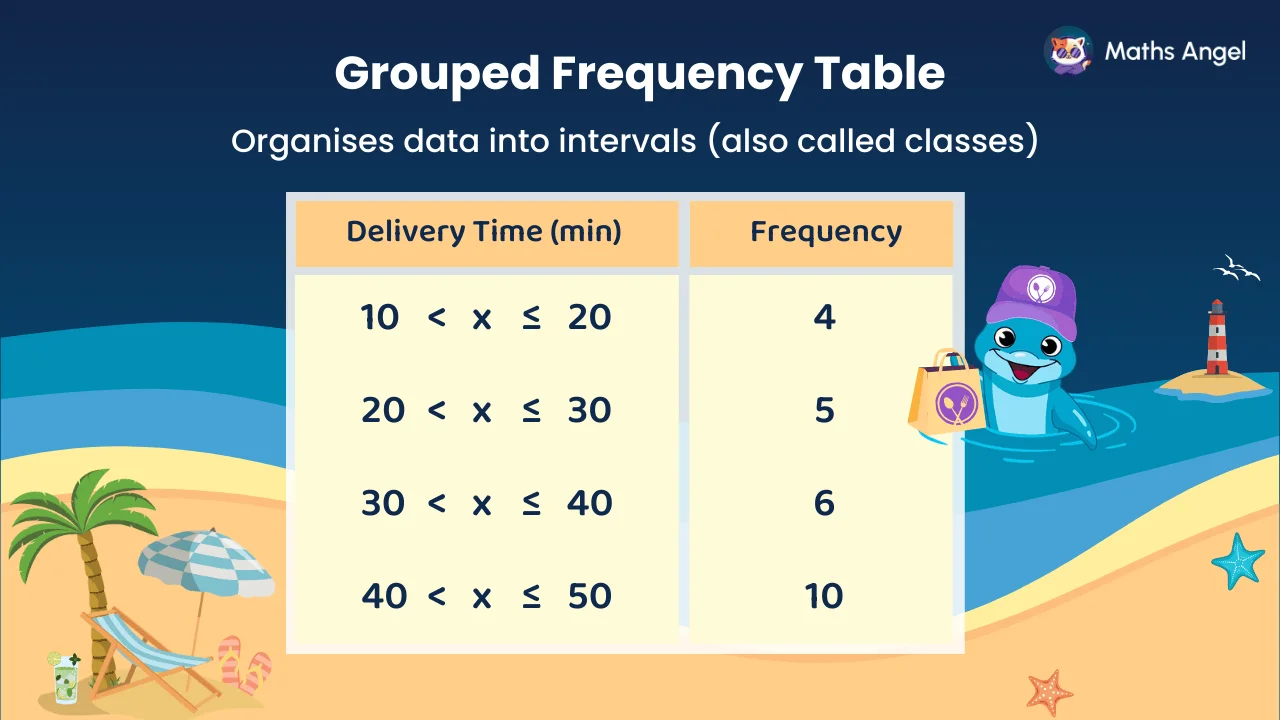
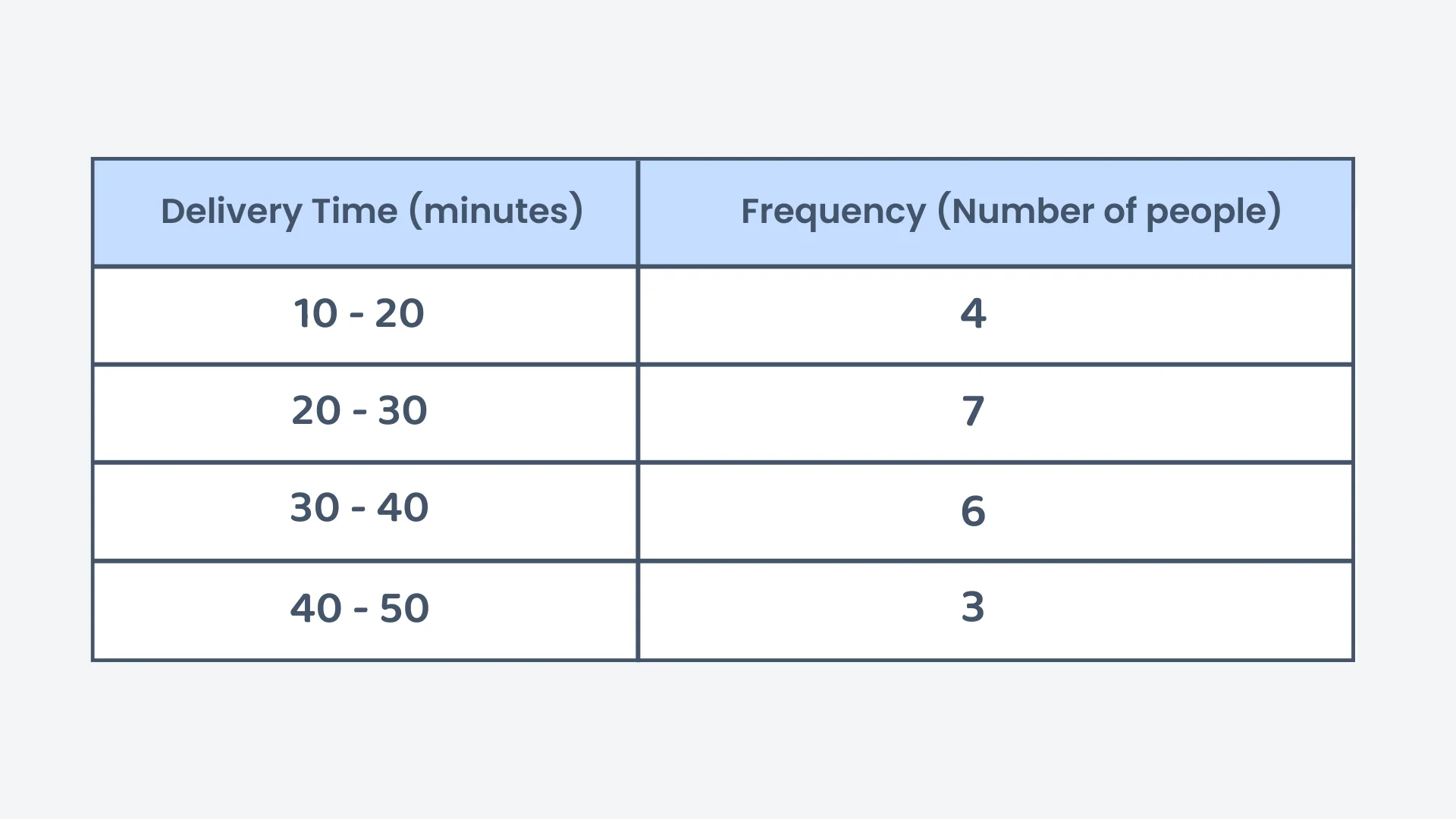
The table below shows the delivery times for a courier service. Which class contains the median delivery time?
Correct! 🎉 +20 pointsCorrect! 🎉 Worth 20 XPNot quite right
Total frequency: .
With 20 values, the median lies halfway between the 10th and 11th values. The running totals are 4, then , then 17, then 20.
The 10th and 11th values are both in the second class, so the median lies in 20-30 minutes.
The table below shows the delivery times for a courier service. What is the midpoint of the 20-30 minute class?
Correct! 🎉 +20 pointsCorrect! 🎉 Worth 20 XPNot quite right
The midpoint of a class is halfway between its two endpoints.
minutes.
The table below shows the delivery times for a courier service. If 2 more orders are added to the 30-40 minute class, how does this affect the modal class?
Correct! 🎉 +20 pointsCorrect! 🎉 Worth 20 XPNot quite right
The 30-40 class had a frequency of 6. Adding 2 more orders makes it .
The frequencies are now 4, 7, 8 and 3. The highest is 8, so the modal class changes from 20-30 minutes to 30-40 minutes.
The table below shows the delivery times for a courier service. Estimate the mean delivery time.
Correct! 🎉 +30 pointsCorrect! 🎉 Worth 30 XPNot quite right
Use the class midpoints: 15, 25, 35 and 45 minutes.
Multiply each midpoint by its frequency: .
Divide by the total frequency: minutes.
Want to see the full working?
Interactive Activity
Averages from grouped frequency table
Loading interactive widget...
Frequently asked questions
The questions students bump into most on this topic
A grouped frequency table sorts data into class intervals and shows how many values fall in each one, which makes a large data set easier to handle. In the pizza shop’s table, a frequency of 4 for 10 to 20 minutes means 4 deliveries took that long. An ungrouped table lists each separate value instead; you group when there are too many different values to list.
The modal class is the class interval with the highest frequency. To find it, look down the frequency column for the largest number and read off its interval. In the pizza table the largest frequency is 10, for 40 to 50 minutes, so that is the modal class. It is a class rather than a single value, because the exact values are unknown.
Add the frequencies to get n, then use (n + 1) ÷ 2 to find the median position. For the pizza table n = 25, so the median is the 13th value. Count up through the classes: 4, then 9, then 15, so the 13th value is in the 30 to 40 minutes class. That is the median class; here it differs from the modal class.
The midpoint is the value halfway along a class interval: add the two ends and divide by 2, so for 10 to 20 minutes it is (10 + 20) ÷ 2 = 15. Midpoints stand in for the unknown exact values when you estimate the mean, which is why the mean from a grouped table is only an estimate.
Three steps. Find the midpoint of each class. Multiply each midpoint by its frequency and add the results. Divide that total by the total frequency. For the pizza deliveries the products add to 845 and there are 25 deliveries, so the estimated mean is 845 ÷ 25 = 33.8 minutes. It is an estimate because the midpoints stand in for the real values.
What's next?
Found this one hard? Go one step back first. Feeling confident? Carry on to the next lesson.